


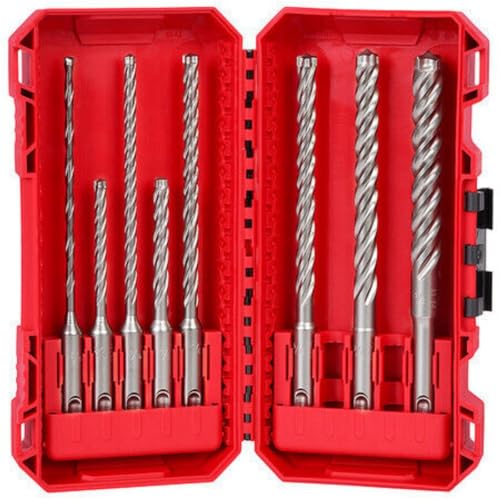
Hitting rebar while sinking anchor holes into cured foundation walls turns a simple masonry job into a frustrating stall. Standard two-cutter masonry bits often grab steel reinforcement and snap their heads off, leaving operators with wasted time and ruined concrete anchors. Investing in genuine milwaukee mx4 rotary hammer drill bits gives tradespeople the reinforced 4-cutter carbide tips needed to smash through aggregate and resist violent bit seizure. These solid carbide geometries channel destructive impact energy directly into tough masonry without deflecting sideways inside narrow anchor holes. Pairing high-grade SDS-plus bits with a quality drill bit depth stop ensures every expansion anchor seats flush against structural surfaces without blowouts.
Careful evaluation of tool specifications and jobsite feedback reveals that flute geometry plays as big a role in speed as the carbide cutting head itself. Debris clearing flutes whisk powdered aggregate out of deep pilot channels quickly, which keeps the tool running cooler during repetitive overhead drilling. That rapid dust extraction lowers motor drag on cordless rotary hammers and preserves battery runtime over long shifts. Whether you are running conduit clips or anchoring sill plates, selecting dependable SDS-plus rotary hammers and properly engineered bits keeps your workflow moving forward without constant bit swaps.


Frequently Asked Questions
What makes a 4-cutter head superior to a standard 2-cutter bit in masonry?
Four carbide cutting edges shatter concrete aggregate evenly and prevent catastrophic bit seizing when hitting steel rebar. While standard 2-cutter bits wedge and snap against embedded rebar, the symmetrical head geometry in Milwaukee Mx4 Rotary Hammer Drill Bits deflects the bit safely or chews through the obstruction. This symmetrical cutting action also produces rounder, cleaner anchor holes for drop-in fasteners and sleeve anchors.
Can you use Milwaukee Mx4 Rotary Hammer Drill Bits in a standard 3-jaw drill chuck?
No, these bits require an SDS-plus chuck mechanism to lock in place properly. The slotted SDS shank allows axial movement for heavy percussion impacts that standard ratcheting chucks cannot accommodate. Trying to clamp an SDS-plus shank into a standard chuck causes slippage, severe chuck jaw wear, and dangerous bit wobble. If you regularly switch between light drilling and heavy fastening, using a versatile drill driver impact combo alongside your rotary hammer keeps each tool doing what it does best.
How does flute design impact drilling speed and bit lifespan?
Wide variable flutes remove pulverized concrete dust from the hole channel much faster, preventing thermal buildup that degrades carbide joints. Trapped concrete dust creates friction, which overheats the bit brazing and forces the rotary hammer motor to pull excessive amperage. Efficient dust ejection keeps drilling temperatures manageable and extends overall accessory life during demanding 2026 commercial installations.
Are Milwaukee Mx4 Rotary Hammer Drill Bits compatible with other SDS-plus rotary hammer brands?
Yes, any tool featuring a standard SDS-plus chuck accepts these bits regardless of brand. The SDS-plus shank design is an open mechanical standard across major tool platforms. You can run these bits in DeWalt, Bosch, or Makita rotary hammers without experiencing fitment issues or loss of striking energy.
Why do Milwaukee Mx4 Rotary Hammer Drill Bits wear out prematurely on certain jobsites?
Excessive downforce and running the rotary hammer dry in abrasive materials are the most common causes of premature carbide failure. Forcing the tool does not speed up drilling because the internal hammer mechanism does the work through rapid impact energy. Applying moderate pressure and occasionally clearing dust from the hole keeps the 4-cutter head intact across hundreds of anchor installations.
What is the practical difference between a regular hammer drill and an SDS-plus rotary hammer?
Dedicated SDS-plus rotary hammers utilize an electro-pneumatic piston mechanism that delivers significantly higher impact energy per blow than mechanical cam-action hammer drills. Standard hammer drills rely on two spinning toothed plates that vibrate rapidly, which works fine for small brick holes but struggles in cured foundation concrete. SDS-plus bits like the Milwaukee Mx4 Rotary Hammer Drill Bits lineup are purpose-built to withstand the punishing blows generated by pneumatic piston systems.




Write Your Review
No reviews yet. Be the first to share your experience!