


Overgrown tree canopies often present a tricky maintenance challenge when thick limbs loom out of arm’s reach. Homeowners frequently wonder exactly how thick branch pole saw cut tools can slice through without binding, bending, or creating unsafe conditions overhead. Whether you work with a manual pole pruner or a motorized chain model, limb diameter directly dictates the cutting technique, required physical effort, and overall balance needed to finish tree trimming cleanly. While ground-level saws such as reciprocating saw blades handle demolition and fallen yard logs easily, managing tall overhead wood requires tools built specifically for reach and controlled leverage.
Cutting capacity varies significantly between manual curved saw blades, compound bypass shears, and powered chainsaw bars. A manual bypass pruner head typically snips green growth up to an inch thick, while curved manual saw blades tackle medium-sized limbs through smooth draw strokes. Motorized pole saws feature dedicated guide bars capable of chewing through much heavier wood when supported properly. Choosing the right tool configuration for your yard prevents dangerous saw binding, reduces upper-body fatigue, and protects the health of your trees by making clean, tear-free cuts.

Pros
- Impressive 27-foot reach for accessing high tree branches without a ladder.
- High-quality carbon steel blade stays sharp and resists rust with Teflon coating.
- Dual hook knives improve efficiency by clearing twigs and stuck branches.
- Pulley system and scissors add versatility for different trimming tasks.
Cons
- At 14.8 pounds, the pole saw may feel heavy for some users during extended overhead use.
- Assembly of the 8 pole sections can be time-consuming initially.
- Limited user reviews at launch, so long-term durability is not yet verified.
The VEVOR Manual Pole Saw is a versatile tree trimming tool designed for DIY homeowners, gardeners, landscapers, and even contractors who need to maintain tall trees or dense shrubs. With an adjustable length from 7.3 to 27 feet (2.24 m to 8.24 m), this extendable pruner allows you to cut high branches safely from the ground, eliminating the need for ladders or risky climbing.
In terms of performance, the pole saw features a 1.2 mm thick carbon steel blade with a Teflon coating that resists rust and stays sharp through repeated use. The blade includes a hook knife on top for pulling down twigs and another hook on the bottom to dislodge stuck branches during cutting, making the trimming process more efficient. Additionally, the included Mn steel scissors are perfect for snipping smaller twigs and leaves, while the pulley system and 11.5-foot nylon rope reduce the effort required for each cut.
Build quality is a key consideration. The pole is constructed from eight lightweight fiberglass handles that connect via double-lock joints. These joints lock firmly and are designed to prevent bending or breaking under normal use. The entire assembly weighs about 14.8 pounds, which is manageable for most users, though it might feel a bit heavy during prolonged overhead work. The included saw sleeve and storage bag help keep the tool and accessories organized and safe when not in use.
Storage and maintenance are straightforward. The blade can be wiped clean after use, and the storage bag keeps everything together. The pole sections collapse to a compact size, making it easy to store in a garage, shed, or workshop. One realistic limitation is the initial assembly time; putting together the eight pole sections can take a few minutes, but the instructions are clear.
Overall, the VEVOR Manual Pole Saw offers excellent value for homeowners and gardeners who need a reliable, extendable tree pruner. It combines reach, sharp cutting capability, and labor-saving features like the pulley system and scissors. While heavier than some models, its build quality and versatility make it a practical choice for anyone tackling branch trimming projects around the property.

Pros
- Four-pulley rope system provides strong mechanical advantage on dense branches
- Versatile two-in-one head handles both quick clipping and heavy sawing
- Sectional pole breaks down easily to fit inside compact garage spaces or car trunks
- Helps eliminate the need for dangerous ladder work during routine yard maintenance
Cons
- Manual overhead sawing can cause shoulder and arm fatigue during long sessions
- Multi-section poles naturally experience slight flex when working at maximum 10-foot reach
- Pruning shear jaw capacity is limited to smaller twigs and saplings under an inch
The Walensee 10FT Manual Pole Saw is an outdoor cutting tool engineered to simplify routine tree care and property maintenance. Combining a curved pull-stroke saw blade with a rope-operated bypass pruning lopper, this unit targets the common problem of reaching high limbs safely. It is particularly well suited for DIY homeowners, rural property managers, groundskeepers, and gardening enthusiasts who prefer maintaining their trees from ground level rather than balancing precariously on stepladders.
In practical yard work, the standout feature of this tool is its cutting efficiency across two distinct branch sizes. For small green twigs, water sprouts, and thin suckers up to moderate diameters, the bypass shear mechanism engages quickly via an overhead pull cord. The integrated quadruple pulley system provides substantial mechanical leverage, multiplying user pull force so cuts snap through with minimal jerkiness. For thicker limbs where shears cannot bite, the hooked saw blade takes over, using alternating teeth designed to clear wood chips efficiently on the pull stroke without binding in green wood.
Build quality centers on functional simplicity and field reliability. The pole is manufactured from modular tubular sections connected by reinforced joints, minimizing rotational play while you saw through dense branches. The steel cutting head features corrosion-resistant surface coatings to resist sap buildup and moisture damage during seasonal outdoor use. Because overhead tools must balance rigidity with manageable weight, the structural layout focuses on keeping the top end light enough for steady positioning.
Storage and maintenance are straightforward, making the tool well suited for cramped workshop corners or crowded garden sheds. The segmented pole design allows users to detach the poles within minutes, reducing a 10-foot reach down to compact lengths that easily fit into utility closets, vehicle trunks, or garage pegboard racks. Routine upkeep requires little more than brushing away pitch and sap, drying the metal surfaces, and applying a light coat of machine oil across the pivot points and saw teeth to preserve cutting edges between seasons.
Users should keep in mind realistic manual cutting limitations before tackling heavy clearing jobs. Extended overhead sawing naturally tires out shoulders and arms, especially when cutting dense, cured hardwoods. Additionally, while the joint connections are sturdy, any sectional pole extended to ten feet will experience a minor degree of flex when aggressive downward pressure is applied. For massive limbs beyond three to four inches, a dedicated gas or battery pole saw remains the faster choice.
For routine yard clearing, fruit tree thinning, and removing storm-damaged limbs around fence lines, the Walensee 10FT Manual Pole Saw is a dependable and cost-effective yard asset. It provides the reach, mechanical advantage, and dual-action versatility needed to keep trees healthy while keeping both feet safely planted on the ground.
The mechanical leverage provided by the quadruple pulley assembly is central to the operational efficiency of this pruner. By routing the pull cord through four distinct rollers, the force required to close the shear jaw is significantly reduced compared to traditional single-pulley or direct-pull models. This allows users to cleanly sever stubborn branches without violently jerking the pole out of alignment.
When tackling larger limbs, the curved saw blade utilizes an aggressive tooth geometry that cuts primarily on the pull stroke. This design ensures that user energy pulls the blade firmly against the limb rather than pushing away, preventing buckling along the pole shaft and promoting smooth, straight cuts through green and seasoned wood alike.

Pros
- Sharp, rust-resistant Mn steel blade that cuts smoothly and doesn't clog easily
- Lightweight and well-balanced, reducing arm fatigue during extended pruning sessions
- Modular pole system makes length adjustment quick and tool-free
- Safe, ladder-free operation for trimming branches up to 14.5 feet high
- Comfortable anti-slip grip with a replaceable soft-wrapped handle
Cons
- Manual operation requires more physical effort than gas or electric pole saws for thicker branches
- At 5.2 lbs, the fully extended 14.5ft pole may feel slightly heavy for some users during prolonged overhead work
- Limited to cutting branches within the blade's capacity; very thick limbs may need a powered saw
The BlumeTrec 14.5FT pole saw is a manual pruning tool designed for homeowners, gardeners, and light forestry work. It combines a sharp manganese steel blade with a modular, adjustable-length pole to help you trim high branches safely from the ground. This saw is a solid choice for DIY users who want a reliable, low-maintenance alternative to gas or electric pruners.
This pole saw is best suited for DIY homeowners, gardeners, and anyone who regularly maintains trees, shrubs, or hedges around the yard. It's also practical for older adults or those who prefer not to climb ladders for routine pruning. While it's not a heavy-duty professional tool, it handles most residential trimming tasks with ease.
In real-world use, the Mn steel blade delivers clean cuts on branches up to several inches thick. The three-sided edge and double-sided barb design grip the branch securely, reducing slipping and allowing you to cut from multiple angles. The precision-ground teeth help discharge sawdust, so the blade doesn't clog during use. The modular pole system lets you quickly adjust the length from 8.5ft to 14.5ft, and the extra locking screw keeps the saw head firmly attached. The anti-slip grip and soft-wrapped handle provide comfortable control, even during longer sessions.
Build quality is decent for the price point. The stainless steel poles have a matte, powder-coated finish that resists rust, and the Mn steel blade is durable and corrosion-resistant. Assembly is straightforward: you simply screw the sections together. Storage is easy since the pole breaks down into compact sections, and the saw head can be detached. No special maintenance is required beyond occasional cleaning and blade sharpening.
One realistic limitation is that this is a manual saw, so cutting thicker branches requires more physical effort than a powered pruner. Also, at full extension, the 14.5ft pole can feel a bit heavy for some users during prolonged overhead work. The blade is best suited for branches up to about 3-4 inches in diameter; anything larger may be tough to cut by hand.
Overall, the BlumeTrec 14.5FT pole saw is a practical, budget-friendly option for DIY homeowners and gardeners who need a safe way to trim high branches without a ladder. It's lightweight, easy to assemble, and offers good cutting performance for routine yard maintenance. If you're looking for an affordable manual pruner that gets the job done without fuss, this saw is worth considering.

Pros
- Quad-pulley system noticeably reduces the manual pulling effort required to slice through green branches
- Two-in-one head design eliminates the need to swap between separate pole saws and pole loppers
- Threaded pole sections provide dependable stability compared to cheap twist-lock extension mechanisms
- Breaks down into modular sections for easy garage storage and transport in car trunks
Cons
- Working at full 14-foot extension requires significant upper-body stamina and control against pole leverage
- Long pull rope can snag on lower dense brush if not managed carefully during overhead cutting
The Walensee 14FT Pole Saw and Tree Pruner is a multi-function manual cutting tool engineered for overhead tree maintenance and yard cleanup. Designed primarily for DIY homeowners, groundskeepers, and property managers, this tool eliminates the hazards of balancing on ladders while attempting to trim unruly branches. Its dual-function head features both a pruning bypass shear for tender growth and a curved saw blade intended for thicker tree limbs.
Cutting efficiency overhead relies heavily on mechanical advantage, and the integrated quadruple pulley system is built to minimize arm fatigue. By compounding the pulling force through four distinct pivot points, the system delivers significant leverage directly to the pruning shear with smooth pulling action. For branches exceeding shear capacity, the aggressive tooth profile on the curved saw blade bites into green wood efficiently, allowing users to saw back and forth using steady, grounded pole motions.
Practicality and stability are critical when working with extended pole tools. This model utilizes reinforced, threaded pole sections that join tightly to resist unwanted twisting or separation while pushing and pulling against tough wood. The durable construction resists bending under moderate loads, while corrosion-resistant coatings help shield the metal saw blade and shear head from sap, moisture, and outdoor debris commonly encountered during routine yard maintenance.
Assembly and transport remain straightforward thanks to the modular, detachable design. Rather than dealing with a cumbersome single-piece pole that clutters garage or workshop rafters, users can break the tool down into compact segments that store neatly in a corner, shed, or vehicle trunk. Routine maintenance mainly requires wiping down the blade after resinous cuts, oiling the pivot joints, and keeping the pull cord clean and untangled.
As with most manual pole pruners, reaching full extension naturally introduces some pole flex and requires arm stamina during extended cutting sessions. It will not replace heavy gas or battery chainsaws for massive fallen trunks, but for seasonal maintenance, palm trimming, fruit tree thinning, and overhead clearance, it offers an economical and safe solution. For property owners and DIYers who want to maintain trees without risking ladder falls, this extendable pruner serves as a dependable addition to any home outdoor tool lineup.
Overhead branch cutting is notoriously strenuous on shoulders and forearms, making mechanical leverage a critical factor in tool selection. The four-pulley compound mechanism significantly decreases the physical effort needed to snip through green branches compared to standard single-pulley loppers.
The pull cord handle allows the operator to maintain a balanced, grounded stance with both feet planted firmly on the turf. By operating the shears from the ground, users avoid awkward body positioning, reducing the risk of muscle strain and fatigue during long seasonal pruning sessions.
Pros
- Sharp, rust-resistant Mn steel blade delivers efficient cutting performance
- Adjustable length allows safe pruning from the ground without ladders
- Lightweight and comfortable grip reduces fatigue during long sessions
- Quick assembly and modular design for easy storage and transport
Cons
- Manual operation may require more effort compared to powered pole saws for thicker branches
- Maximum reach of 14.5 feet may not be sufficient for very tall trees
- Some users may find the pole sections slightly wobbly when fully extended
The BlumeTrec 11FT pole saw is a manual pruning tool designed for homeowners, gardeners, and DIY enthusiasts who need to trim branches safely from the ground. It features a sharp Mn steel blade with a three-sided edge and double-sided barb design that grips branches securely and cuts smoothly from multiple angles. The blade is durable, rust-resistant, and lightweight, with precision-ground teeth that discharge sawdust to prevent clogging during use.
This pole saw is best suited for DIY homeowners, gardeners, and light landscaping tasks. It allows users to prune branches up to 14.5 feet high without climbing ladders, reducing fall risks and increasing safety. The adjustable length comes in three options: 8.5 feet, 11 feet, and 14.5 feet, with modular stainless steel sections that connect quickly for easy length changes. The powder-coated finish and anti-slip grip provide stable control, while an extra screw secures the saw head firmly to the pole to prevent loosening.
In real-world use, the Mn steel blade delivers fast, clean cuts on branches up to several inches thick. The double-sided barb design helps grip branches and cut from multiple angles, making it effective for both handheld and extended pruning. The lightweight construction reduces user fatigue, making it comfortable for women and seniors to handle. The soft-wrapped handle adds comfort during long sessions and can be replaced when needed.
Build quality is solid for the price point. The stainless steel poles are rust-resistant with a matte finish, and the blade is made from Mn steel for durability. The modular design allows for easy assembly and disassembly, making storage and transport convenient. The pole saw comes with a simple setup process that takes just a few steps, and the sections can be stored compactly when not in use.
One realistic limitation is that manual operation requires more physical effort compared to powered pole saws, especially for thicker or tougher branches. The maximum reach of 14.5 feet may not be sufficient for very tall trees, and some users may find the pole sections slightly wobbly when fully extended. However, for typical yard maintenance and pruning tasks, this tool performs reliably.
Overall, the BlumeTrec 11FT pole saw is a practical and affordable option for DIY homeowners and gardeners who want a safe, ladder-free way to trim branches. Its sharp blade, adjustable length, and lightweight design make it a good choice for regular yard work. While it may not replace a powered saw for heavy-duty jobs, it offers solid value for light to medium pruning tasks.

Pros
- Dual flip and screw locking collar setup holds pole sections firmly under load
- Integrated two-in-one head handles both thick limbs and fine branch pruning
- Eliminates the need for precarious ladder climbing during seasonal yard cleanups
- Smooth pulley action cuts green branches with minimal pulling effort
Cons
- Full 20-foot extension naturally introduces moderate pole flex that requires practice to control
- Pruner pull rope requires careful management around dense thickets to prevent snagging
The TONYINGO Manual Pole Saw and Tree Pruner is an extendable overhead cutting system designed to tackle high tree branches directly from the safety of the ground. By pairing a curved pruning saw blade with a bypass lopper operated by a double-pulley cord system, this tool gives property owners two distinct methods of attack. You can slice through larger limbs with a traditional pull-saw action or snap through green growth up to an inch thick using the spring-assisted bypass pruner.
This tool is best suited for DIY homeowners, groundskeepers, rural property managers, and landscapers who want to maintain trees without constantly setting up ladders on uneven terrain. Ladder falls remain one of the most common hazards in home maintenance, so having a grounded tool capable of reaching up to 26 feet overhead provides a tangible safety improvement for weekend pruning, storm clean-up, and seasonal fruit tree shaping.
In practical cutting performance, the combination head provides solid flexibility. The curved saw blade features aggressive pull-cut teeth that bite deeply into pine, oak, and maple limbs on the downward stroke, using gravity to assist your cutting motion. For smaller stems and encroaching shoots, the compound two-pulley setup significantly increases mechanical advantage, cutting down on the hand strain typically associated with long-reach pruning ropes.
Build quality centers around a multi-section aluminum pole that balances rigidity against overall weight. Telescoping poles often fail at the connection collars, but TONYINGO addresses this by using a dual-locking mechanism: an external flip latch for fast length changes, backed by a threaded twist lock that wedges the sections securely together. An EVA foam grip at the base gives a comfortable handhold, allowing for positive orientation of the cutting head even while wearing work gloves.
Handling any manual tool extended beyond 15 feet involves some pole deflection, so controlling your cutting tempo is essential for best results. When working at full extension, resting the curved blade hook against the branch before applying force helps stabilize the cut. Storage is straightforward, as the pole collapses down into a compact length that easily hangs on standard garage wall hooks or stows along the side rail of a pickup bed.
For homeowners and maintenance workers seeking an affordable, dependable way to trim back overgrown oak branches, deadwood, and encroaching canopy lines, this manual pole saw is a sensible addition to the outdoor tool collection. It delivers consistent cutting power without the fuel, noise, or weight associated with gas and battery-powered pole chainsaws.
The core structural advantage of this pole saw lies in its dual-lock telescoping design. Standard single-lock telescoping poles often loosen when subjected to the repeated pushing and pulling forces of manual sawing. Combining quick-release flip clamps with secondary screw collars locks each aluminum segment tightly, reducing rotational wobble and eliminating accidental retraction during tough cuts.
The cutting head is made with durable metal components to resist bending under side loads. The steel pruner spring quickly resets the lopper blade after each pull, while the nylon operating cord is routed through dual pulleys to double your mechanical advantage. Routine maintenance requires little more than brushing sap off the blade teeth, wiping down the aluminum tubes, and occasionally applying a light coat of machine oil to the pivot bolt and spring mechanism.
Pros
- Impressive reach range from 7.3 to 27 feet, suitable for most residential trees
- Lightweight construction minimizes arm fatigue during extended use
- Includes both saw and pruner heads plus a spare saw blade for versatility
- Pulley mechanism makes pruning thicker branches easier than manual snips
- Carry bag keeps all parts organized and protected when not in use
Cons
- Fully extended 27-foot setup can feel heavy and difficult to control for smaller users
- Epoxy resin poles may feel less rigid than all-aluminum or fiberglass alternatives
- No customer reviews yet, so long-term durability is unproven
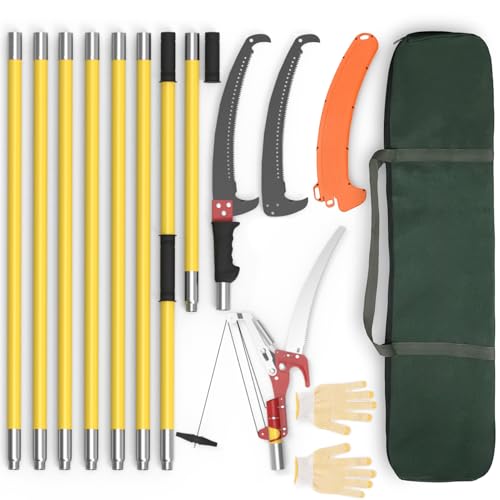
The LETYANGER 7.3-27 ft Extendable Pole Saw and Pruner Set is designed for homeowners and light-duty landscaping tasks where reaching high branches without a ladder is essential. This tool combines a manual saw blade with a pruner head, giving you two ways to trim overhead growth. The set includes seven poles that connect via aluminum alloy joints, allowing you to adjust the length from about 7.3 feet to a full 27 feet.
For DIY homeowners, contractors, and gardeners who regularly deal with overhanging limbs, this pole saw offers a practical solution. The saw blade is made from 65Mn alloy steel, which is harder than standard carbon steel and should hold its edge reasonably well. The pruner head uses a pulley system to multiply your pulling force, making it easier to slice through branches up to about an inch thick. An extra saw blade comes with a sheath, providing a backup if the main blade gets stuck or dulls.
Performance-wise, the tool is best suited for moderate trimming. The lightweight epoxy resin poles keep the overall weight manageable, though at the maximum 27-foot extension the setup weighs around 9.5 lbs. That may feel front-heavy and require some upper body strength to control accurately. Many users may find the 20-foot configuration (using six poles) a more comfortable balance between reach and stability. The hook knife at the saw tip helps clear small twigs, and the bright yellow color is a thoughtful safety feature to alert others nearby.
Build quality appears decent for the price point. The aluminum joints click together securely, and the saw attachment locks firmly. The pruner head has a plastic component around the pulley, but the cutting blade is steel. The included carry bag is basic but functional, keeping all parts together and protecting them during storage. After use, you can disassemble the poles and pack everything into the bag, which takes up minimal space in a garage or workshop.
Potential limitations include the lack of a telescoping mechanism - you have to attach or remove individual poles to change length, which takes a minute. The poles are made from epoxy resin, which is lighter than metal but may flex slightly under heavy loads. Also, with no customer reviews available yet, it's hard to gauge long-term durability. For occasional backyard use, it should hold up well, but heavy daily use might wear out the joints or blade faster.
Overall, the LETYANGER pole saw set is a reasonable choice for DIY homeowners and gardeners who need an extendable reach for branch trimming. It's not a professional-grade tool, but for the price and included accessories (saw, pruner, spare blade, bag), it offers good value for light to moderate trimming tasks. If you're planning to tackle large trees regularly, you might prefer a powered pole saw, but for manual trimming, this setup works well within its intended range.
Pros
- Fast chain speed helps cut through branches quickly
- Lightweight and well-balanced for comfortable extended use
- 2-in-1 design offers versatility for different cutting tasks
- Easy chain tensioning and auto lubrication simplify maintenance
Cons
- 8-amp motor may struggle with very thick or dense hardwood branches
- Electric cord limits mobility compared to battery-powered models
- Some users may find the pole length adjustment mechanism a bit stiff initially
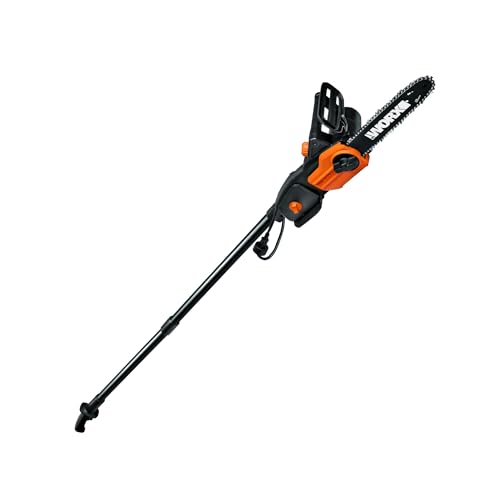
The WORX 8 Amp 10-Inch Electric Pole Saw is a practical tool for homeowners and gardeners who need to tackle high branches without climbing a ladder. With a chain speed of 28 feet per second, it delivers fast cuts through limbs up to about 6 inches thick, making it suitable for routine pruning and light tree trimming around the yard.
This pole saw is designed with versatility in mind. It extends to a full 10 feet, allowing you to reach branches that would otherwise require risky ladder work. The 2-in-1 feature lets you detach the saw head and use it as a standard electric chainsaw for ground-level cutting, which adds convenience for tasks like cutting firewood or clearing fallen branches.
Build quality is solid for a consumer-grade tool. The telescoping pole locks securely, and the 180-degree rotating rear handle helps you position the saw at comfortable angles. The one-button chain tensioning system is a standout feature, making adjustments quick and tool-free, so you can keep cutting without fussing with tools. The auto lubrication system also helps maintain chain performance and extends the life of the bar and chain.
At about 10 pounds, this pole saw is lightweight and well-balanced. It won't wear you out during a session of trimming a few trees, though extended use on larger properties could still be tiring. The electric cord means you'll need an extension cord and access to an outlet, which can be a minor inconvenience compared to a cordless model, but it also means you never have to worry about battery life or charging.
One realistic limitation is that the 8-amp motor is not meant for heavy-duty commercial use. It works well on typical residential trees like maples, oaks, and pines, but it may struggle with especially dense hardwoods or very thick branches. For most homeowners and DIY users, however, this saw offers a good balance of reach, power, and ease of use.
Overall, the WORX electric pole saw is a reliable choice for anyone looking to maintain their yard without professional equipment. It's especially well-suited for homeowners with mature trees, gardeners who need precision trimming, and DIY enthusiasts who want a tool that handles both high and low cutting tasks. Set up is straightforward, maintenance is minimal, and the storage footprint is manageable for a garage or shed.
Understanding Branch Thickness Limits and Cutting Capacities for Pole Saws
A standard pole saw can reliably cut branches between one-half inch and eight inches in diameter, depending entirely on whether the tool uses a bypass lopper, a curved manual pull blade, or an electric chainsaw bar. Most manual pole pruners combine a steel bypass blade for twigs up to one inch and an aggressive curved saw blade designed for limbs between two and six inches thick. Powered models, such as electric pole chainsaws with ten-inch bars, can safely slice through dense wood up to seven or eight inches across in a single pass. Pushing any pole saw beyond its realistic cutting threshold increases the risk of blade pinching, pole deflection, and unpredictable limb drop.
Understanding these practical cut limits protects both the operator and the tool from preventable stress. Overhead pruning magnifies gravity, meaning that a binding saw head thirty feet in the air creates immediate physical strain. Matching the limb diameter to the correct cutting mechanism ensures smooth, predictable yard maintenance from the safety of firm ground.
Manual Bypass Pruners: Snipping Twigs and Small Branches
Integrated shears mounted on manual pole saw heads are engineered specifically for small green growth and smaller suckers. These lopping jaws generally feature a scissor-style steel hook operated by a heavy-duty pull cord and spring-return mechanism. Manufacturer specifications show that these shears comfortably manage water sprouts, flexible shoots, and green branches measuring between one-half inch and one inch in diameter. Attempting to force the steel jaws over branches thicker than one inch frequently jams the mechanism, strains the pulley line, and produces ragged bark tears rather than clean plant cuts.
Pulley leverage plays an essential role in shear efficiency when reaching into dense foliage. Many multi-section pruners incorporate double or quadruple pulley assemblies that multiply pulling force while cutting overhead twigs. Systems like the compound setups found on extendable trimmers help reduce hand strain when trimming soft green stems across extended sessions. When a branch exceeds the jaw opening of the shears, switching immediately to the mounted saw blade preserves the mechanical longevity of the cutting head.
Curved Manual Saw Blades: Managing Medium Limbs from Two to Six Inches
Manual pole saw blades are dedicated to medium-diameter limbs that bypass shears cannot accommodate. Most manual blades measure between thirteen and eighteen inches long, crafted from carbon steel or alloy materials like Mn steel. These blades feature sharp, multi-faceted teeth arranged to cut on the pull stroke, allowing gravity and downward pulling force to drive the cut. A quality curved blade handles branches ranging from two to six inches thick with steady, deliberate strokes.
Blade profile and tooth geometry directly govern how efficiently the manual saw removes sawdust and chips. Modern pruning blades utilize ground, induction-hardened teeth with wide gullets designed to eject wood particles rapidly, preventing binding in moist sapwood. Teflon or rust-resistant coatings further reduce friction inside deep kerfs on four-inch and five-inch branches. Upper and lower hooked tips, commonly integrated into long manual blades, help keep the teeth locked inside the cutting groove so the saw does not slip off the branch overhead.
Limbs thicker than six inches present significant physical challenges for manual pole sawing. As the wood grain pinches down under its own weight, manual friction increases dramatically, quickly tiring the operator. While a patient user can technically cut a seven-inch limb with a manual blade, doing so overhead often results in fatigue, rough cuts, and slow progress. Keeping manual blade work limited to branches under six inches preserves control and maintains proper cutting cadence.
Powered Electric and Cordless Pole Saws: Heavy Cuts up to Eight Inches
Motorized pole saws bridge the gap between manual yard pruners and full-sized chainsaws, offering automated cutting teeth driven by an electric motor. An electric unit equipped with an eight-inch or ten-inch bar easily manages thick hardwood limbs between four and eight inches across. Corded or battery-powered motors maintain high chain speeds, allowing the weight of the cutting head to drop smoothly through dense oak, maple, or pine without requiring aggressive downward pulling.
Effective bar length dictates the true maximum branch thickness a powered pole saw can cut cleanly. Standard ten-inch guide bars have a usable cutting envelope of approximately eight to nine inches, leaving sufficient clearance for the nose sprocket. Features such as automatic chain lubrication, tool-free chain tensioning, and rotating rear handles ensure consistent cutting power during horizontal or angled branch removals. When making structural cuts on property, homeowners who also utilize utility cutting saws around structural timber will appreciate how a steady motor speed prevents the saw chain from jerking against dense tree grain.
Operating a powered cutting head on an extended shaft requires steady footing and firm hand placement. The added weight of an electric motor and guide bar at the top of an extension pole alters the center of gravity considerably. Cutting limbs approaching eight inches must be approached cautiously, as heavy falling logs carry substantial momentum capable of damaging property or jerking the pole unexpectedly.
Pole Reach, Material Deflection, and Practical Overhead Stability
A tool’s maximum cutting capacity is inseparable from the length and rigidity of its extension pole. While a manual blade can easily cut a four-inch limb at eight feet of reach, attempting the same cut at twenty-seven feet becomes much more demanding. As pole sections are joined together, minor flex along the shaft absorbs cutting energy, making it harder to exert firm downward pressure on the branch.
Pole construction materials directly impact how much stiffness you retain at full extension. Lightweight aluminum poles offer reasonable rigidity for moderate elevations up to twenty feet, often using flip locks and screw collars to secure telescoping joints. Heavy-duty fiberglass or reinforced epoxy resin rods provide robust strength and electrical non-conductivity, making them popular for high-reach assemblies reaching up to twenty-seven feet. Even with rigid materials, working at heights above twenty feet requires patience, lighter stroke force, and deliberate alignment to keep the blade tracking straight.
Weight distribution also limits your practical capacity over long work sessions. A manual multi-rod assembly weighing under ten pounds remains manageable for periodic overhead pruning, while heavier setups cause shoulder and lower back strain. To maximize stability when cutting limbs near the tool’s maximum diameter, operators should shorten the pole to the minimum height necessary rather than running fully extended whenever possible.
The Three-Cut Pruning Method for Heavy, Thick Branches
Attempting to cut through a thick branch with a single downward stroke is a common mistake that damages both tree bark and saw blades. When cutting branches thicker than two inches, the sheer weight of the limb causes it to split and snap downward before the cut is finished. This premature tear strips bark down the trunk, creating extensive wounds that invite pests, fungal infection, and rot. The three-cut pruning technique solves this problem completely by releasing limb weight in controlled stages.
The first step requires an undercut made on the underside of the limb, approximately twelve inches outward from the branch collar. Saw upward about one-third of the way through the branch thickness to create an anti-peel relief barrier. Because gravity works against an upward manual cut, use the bottom hook or upper push teeth on your pole saw blade to establish a clean groove without catching the chain or blade.
The second cut is a top cut placed two to three inches further out along the branch, away from the tree trunk. Saw straight downward from the top until the weight of the limb snaps the wood downward. Because you established the initial undercut, the falling limb breaks cleanly at the notch rather than peeling bark down the main stem. Once the heavy bulk of the branch drops safely to the lawn, a third cut removes the remaining stub neatly outside the branch bark ridge without binding.
Green Wood Versus Dry Hardwood: How Wood Density Alters Capacity
Limb diameter alone does not tell the full story; wood density and moisture content dramatically influence saw behavior. Green branches containing live sap are softer and cut faster, but their fibrous grain can compress tightly against the sides of a saw blade. Resinous conifers such as pine, spruce, and fir quickly coat saw teeth and chain links in tacky pitch, creating dragging resistance on limbs thicker than three inches.
Dead branches and seasoned hardwood present the opposite operational challenge. Dry oak, hickory, and dead maple limbs are exceptionally dense, creating high cutting resistance that dulls saw teeth quickly. When pruning deadwood, practical manual cutting capacity shrinks from six inches down to roughly three or four inches due to the physical effort required. When addressing dense dry materials around workshop setups, builders who compare specialized teeth on clean cutting blades recognize how matched tooth geometry prevents premature binding.
Maintaining sharp cutting edges is essential when switching between green growth and petrified deadwood. A dull blade slips across dry bark without biting, forcing the operator to push upward awkwardly against the pole. Inspecting blade teeth for resin buildup and keeping cutting edges sharp restores maximum cutting diameter and preserves energy during demanding yard cleanups.
Critical Overhead Safety and When Limbs Exceed Safe Limits
Trimming high branches from the ground is far safer than balancing on a stepladder, but working under falling timber demands strict safety habits. Homeowners should always stand well outside the direct drop path of the targeted limb, maintaining a forty-five-degree operational angle relative to the tree. Personal protective equipment, including a sturdy hard hat, impact-resistant safety glasses, heavy work gloves, and steel-toe boots, protects against falling bark, sawdust, and bouncing wood fragments.
Recognizing the absolute limits of pole saw equipment is critical for avoiding structural property damage or severe injury. Branches thicker than eight inches carry immense weight, often weighing hundreds of pounds depending on length and foliage. When a limb exceeds eight inches in diameter, hangs over power lines, or threatens roofs and vehicles, it surpasses the safe envelope for standard manual and consumer electric pole saws. In these situations, hiring an insured, certified arborist equipped with rigging ropes and bucket lifts is the safest and most responsible course of action.
By pairing the correct tool mechanism to the specific limb thickness, trimming your trees remains safe, efficient, and productive. Keep small twigs under one inch within your pruner shears, reserve medium limbs up to six inches for curved manual pull blades, and deploy powered chainsaw heads for stubborn wood up to eight inches across. Respecting these operational limits keeps your equipment in peak condition and ensures healthy, beautiful trees throughout the season.




Write Your Review
No reviews yet. Be the first to share your experience!