


Trimming high overhead tree limbs often presents difficult safety challenges for property owners looking to keep trees healthy and tidy. Learning how use extendable pole saw equipment correctly allows homeowners to manage dangerous branches directly from stable ground without needing ladders. Many telescoping models, ranging from manual pull saws to powered mini chainsaws, offer reach spans from several feet up to nearly thirty feet. Choosing the right cutting approach and knowing how each tool locks into place helps you avoid limb binding and hand fatigue during long yard maintenance sessions.
Whether you work with manual pruning blades featuring compound pulley systems or motorized pole cutters, understanding proper leverage and body positioning makes all the difference. Much like matching the right blade when exploring a reciprocating saw blade selection for tough yard demolition, setting up an extendable pole saw requires balancing extension length, pole flex, and limb weight. Taking the time to survey overhead obstacles and clearing a distinct retreat path ensures smooth, predictable results every time you prune.

Pros
- Generous 5 to 20-foot reach keeps your feet firmly planted on the ground
- High-carbon steel blade cuts cleanly on pull strokes to reduce binding
- Dual-function design includes both a pruning saw and shear mechanism
- Quickly converts into a handheld saw for low-level branch cleanup
Cons
- Extended pole exhibits natural flex at full length, requiring careful sawing technique
- Manual overhead sawing demands reasonable upper-body stamina for large jobs
- Collapsed length of roughly 58 inches requires dedicated shed or garage wall space
The SISUPASSIE 26FT Reach Pole Saw is an extendable manual pruning tool built for groundskeeping, landscape maintenance, and residential property upkeep. Designed primarily for DIY homeowners, acreage owners, and yard care enthusiasts, this manual pole saw helps you manage overgrown branches and storm-damaged limbs without the inherent danger of balancing atop an unstable ladder.
At the core of the system is an adjustable multi-section telescoping pole that shifts smoothly between 5 and 20 feet, offering an estimated working reach of roughly 26 feet when factoring in user height. The upper saw blade is stamped from high-carbon steel with precision-sharpened teeth configured to clear wood chips efficiently on the pull stroke. For smaller suckers and thin twigs, the lower bypass scissor mechanism snips cleanly, eliminating the need to continuously reposition a large saw blade for minor growth.
Durability and user control are central to the overall assembly. Fitted with non-slip foam handles, the base gives users a solid, tactile hold even when wearing work gloves or dealing with damp outdoor conditions. The locking collars keep pole sections firmly seated under working tension, while the blade attaches with heavy-duty hardware to prevent twisting while sawing overhead. In addition, the cutting head can be unbolted from the pole, converting it into a versatile handheld saw for bucking small logs or pruning low garden shrubs.
Getting the tool ready for yard work is straightforward: simply extend the telescoping sections to your desired height, tighten the locking mechanisms, and secure the saw bracket. When collapsed, the tool measures roughly 58 inches in length, making it compact enough to hang along a garage wall organizer or stow in a garden shed corner. Routine maintenance involves wiping sap off the carbon steel blade after use and applying a light coat of multi-purpose oil to prevent surface rust during the off-season.
Because the pole extends to 20 feet, users should expect a natural degree of flex at maximum extension, which requires steady pacing and proper pull-stroke technique to avoid blade pinch. Manual sawing also demands physical effort, meaning it may not fully replace a gas or cordless pole saw for commercial forestry clearing. However, for suburban homeowners and property managers who need a dependable, ladder-free pruning solution for palms, oaks, and fruit trees, this manual telescoping pole saw offers practical performance and reliable value.
Overhead pruning requires balanced leverage and a sharp cutting edge to minimize fatigue. The curved carbon steel blade on this tool bites into wood fibers cleanly, allowing gravity and pull strokes to do the bulk of the work rather than excessive downward muscle force.
For mixed foliage, the secondary shear mechanism at the base of the saw head handles flexible green stems up to half an inch thick that might otherwise deflect a reciprocating saw blade. This dual setup saves time by letting you prune diverse canopy layers in a single pass without switching tools.

Pros
- Impressive 27-foot reach for accessing high tree branches without a ladder.
- High-quality carbon steel blade stays sharp and resists rust with Teflon coating.
- Dual hook knives improve efficiency by clearing twigs and stuck branches.
- Pulley system and scissors add versatility for different trimming tasks.
Cons
- At 14.8 pounds, the pole saw may feel heavy for some users during extended overhead use.
- Assembly of the 8 pole sections can be time-consuming initially.
- Limited user reviews at launch, so long-term durability is not yet verified.
The VEVOR Manual Pole Saw is a versatile tree trimming tool designed for DIY homeowners, gardeners, landscapers, and even contractors who need to maintain tall trees or dense shrubs. With an adjustable length from 7.3 to 27 feet (2.24 m to 8.24 m), this extendable pruner allows you to cut high branches safely from the ground, eliminating the need for ladders or risky climbing.
In terms of performance, the pole saw features a 1.2 mm thick carbon steel blade with a Teflon coating that resists rust and stays sharp through repeated use. The blade includes a hook knife on top for pulling down twigs and another hook on the bottom to dislodge stuck branches during cutting, making the trimming process more efficient. Additionally, the included Mn steel scissors are perfect for snipping smaller twigs and leaves, while the pulley system and 11.5-foot nylon rope reduce the effort required for each cut.
Build quality is a key consideration. The pole is constructed from eight lightweight fiberglass handles that connect via double-lock joints. These joints lock firmly and are designed to prevent bending or breaking under normal use. The entire assembly weighs about 14.8 pounds, which is manageable for most users, though it might feel a bit heavy during prolonged overhead work. The included saw sleeve and storage bag help keep the tool and accessories organized and safe when not in use.
Storage and maintenance are straightforward. The blade can be wiped clean after use, and the storage bag keeps everything together. The pole sections collapse to a compact size, making it easy to store in a garage, shed, or workshop. One realistic limitation is the initial assembly time; putting together the eight pole sections can take a few minutes, but the instructions are clear.
Overall, the VEVOR Manual Pole Saw offers excellent value for homeowners and gardeners who need a reliable, extendable tree pruner. It combines reach, sharp cutting capability, and labor-saving features like the pulley system and scissors. While heavier than some models, its build quality and versatility make it a practical choice for anyone tackling branch trimming projects around the property.

Pros
- Sharp, rust-resistant Mn steel blade that cuts smoothly and doesn't clog easily
- Lightweight and well-balanced, reducing arm fatigue during extended pruning sessions
- Modular pole system makes length adjustment quick and tool-free
- Safe, ladder-free operation for trimming branches up to 14.5 feet high
- Comfortable anti-slip grip with a replaceable soft-wrapped handle
Cons
- Manual operation requires more physical effort than gas or electric pole saws for thicker branches
- At 5.2 lbs, the fully extended 14.5ft pole may feel slightly heavy for some users during prolonged overhead work
- Limited to cutting branches within the blade's capacity; very thick limbs may need a powered saw
The BlumeTrec 14.5FT pole saw is a manual pruning tool designed for homeowners, gardeners, and light forestry work. It combines a sharp manganese steel blade with a modular, adjustable-length pole to help you trim high branches safely from the ground. This saw is a solid choice for DIY users who want a reliable, low-maintenance alternative to gas or electric pruners.
This pole saw is best suited for DIY homeowners, gardeners, and anyone who regularly maintains trees, shrubs, or hedges around the yard. It's also practical for older adults or those who prefer not to climb ladders for routine pruning. While it's not a heavy-duty professional tool, it handles most residential trimming tasks with ease.
In real-world use, the Mn steel blade delivers clean cuts on branches up to several inches thick. The three-sided edge and double-sided barb design grip the branch securely, reducing slipping and allowing you to cut from multiple angles. The precision-ground teeth help discharge sawdust, so the blade doesn't clog during use. The modular pole system lets you quickly adjust the length from 8.5ft to 14.5ft, and the extra locking screw keeps the saw head firmly attached. The anti-slip grip and soft-wrapped handle provide comfortable control, even during longer sessions.
Build quality is decent for the price point. The stainless steel poles have a matte, powder-coated finish that resists rust, and the Mn steel blade is durable and corrosion-resistant. Assembly is straightforward: you simply screw the sections together. Storage is easy since the pole breaks down into compact sections, and the saw head can be detached. No special maintenance is required beyond occasional cleaning and blade sharpening.
One realistic limitation is that this is a manual saw, so cutting thicker branches requires more physical effort than a powered pruner. Also, at full extension, the 14.5ft pole can feel a bit heavy for some users during prolonged overhead work. The blade is best suited for branches up to about 3-4 inches in diameter; anything larger may be tough to cut by hand.
Overall, the BlumeTrec 14.5FT pole saw is a practical, budget-friendly option for DIY homeowners and gardeners who need a safe way to trim high branches without a ladder. It's lightweight, easy to assemble, and offers good cutting performance for routine yard maintenance. If you're looking for an affordable manual pruner that gets the job done without fuss, this saw is worth considering.

Pros
- Extensive reach eliminates the safety hazards associated with trimming branches from a ladder
- Dual-function pruner and saw head easily tackles both thin shoots and thicker tree limbs
- Modular section design allows quick height adjustments depending on the canopy level
- Comes complete with an extra replacement saw blade and a protective sheath
Cons
- Operating at the full 30-foot length creates noticeable pole flex that requires careful handling
- Extended overhead cutting can cause shoulder and lower back fatigue during prolonged jobs
The MEFBANT 30.1 FT Extendable Tree Pruner is a manual cutting system built for homeowners, landscapers, groundskeepers, and DIY property caretakers. Overhead tree maintenance often demands climbing shaky ladders or renting expensive powered boom lifts. This modular pole kit provides a ground-based alternative, allowing users to tackle thick hanging boughs, storm damage, and overgrown branches safely from the yard.
Cutting performance centers on a dual-purpose head that handles multiple branch diameters. For lighter growth, the bypass pruner utilizes a smooth pulley-assisted pull rope, multiplying hand leverage so users can snip smaller offshoots with minimal pulling force. When addressing larger limbs, the hardened steel saw blade takes over. Its curved profile and hooked tip help keep the teeth locked into the cut, preventing the blade from slipping out of the kerf while working at steep overhead angles.
Build quality focuses on structural integrity across high elevations. The tool features eight interlocking extension sections crafted from reinforced epoxy resin coupled with aluminum connecting joints. This pairing delivers strong resistance against bending stresses while guarding against moisture, rust, and outdoor corrosion. The kit also includes a spare saw blade, sheath, and a dedicated storage bag to protect the teeth and keep the poles organized in your garage or work shed.
As with any ultra-long manual pole tool, physical leverage creates natural limitations. While the system can assemble out to 30 feet, the pole inevitably flexes under its own weight at maximum extension, making precision control more demanding. Many users find that configuring the pole between 15 and 20 feet offers an ideal balance of stiffness and maneuverability. Wearing back support or taking periodic breaks helps mitigate upper body fatigue during extended pruning sessions.
For homeowners and rural property managers wanting to clear driveways, rooflines, and fence rows without relying on gas saws or climbing equipment, this pruner is a practical addition to any outdoor tool collection. It offers dependable cutting versatility, straightforward modular assembly, and the essential safety benefit of keeping both feet planted firmly on the ground.
The modular setup allows users to assemble only the number of sections required for the specific tree canopy height. Connecting the lightweight epoxy resin poles takes just minutes, and the aluminum joints secure each section to minimize wobble during back-and-forth sawing strokes.
Storage convenience is another key asset. Rather than dealing with a fixed, cumbersome 10-foot pole in the bed of a truck, this entire 30-foot kit breaks down into compact pole segments that slide cleanly into the included canvas carrying bag. This makes transport between jobsites or storage on a garage wall hook simple and organized.
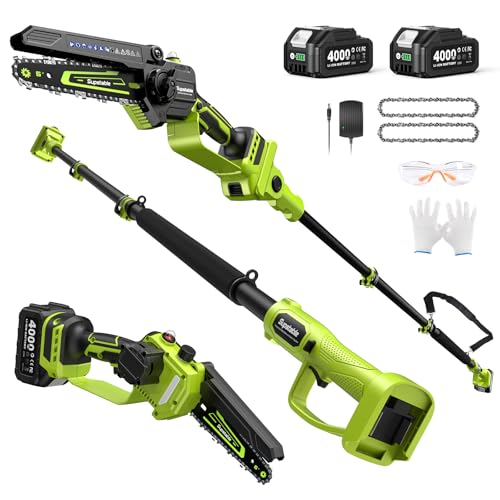
Pros
- Versatile 2-in-1 functionality for both handheld and pole saw use
- Long reach up to 16 feet allows safe pruning from the ground
- Generous runtime with two 4.0Ah batteries for extended work
- Tool-free chain tensioning simplifies adjustments and maintenance
- Lightweight and well-balanced design reduces user fatigue
Cons
- Manual oil bulb lubrication requires occasional attention during use
- 6-inch bar limits cutting capacity to branches up to 6 inches thick
- Pole extension may feel slightly flexible when fully extended
The Supstable 6-inch cordless pole saw is a practical 2-in-1 tool designed for tree trimming, branch cutting, and general yard maintenance. It combines a handheld mini chainsaw with an extendable pole saw, allowing users to reach up to 16 feet without climbing a ladder. This makes it a safer option for pruning high branches, especially for DIY homeowners, gardeners, and even professionals like arborists or landscapers.
Performance-wise, the brush motor delivers reliable cutting power for branches up to 6 inches thick. The two included 4.0Ah batteries provide up to 100 minutes of runtime, which is ample for most residential pruning tasks. The tool-free chain tensioning system is a standout feature, letting you adjust the chain in seconds without any tools. This reduces downtime and makes the saw beginner-friendly.
Build quality appears solid for its price point. The saw weighs only 3.4 lbs, making it easy to handle with one hand, even when attached to the pole. The ergonomic design helps reduce fatigue during extended use. The manual oil bulb lubrication system is simple and gives you control over chain lubrication, though it does require periodic pressing to keep the chain running smoothly.
Storage and maintenance are straightforward. The kit comes with a charger, extra chains, an oil bottle, gloves, and safety goggles, so it's ready to use out of the box. The telescopic pole collapses for compact storage in a garage or shed. However, the 6-inch bar means it's best suited for smaller branches, not heavy-duty felling.
One limitation is that the pole can feel slightly flexible when fully extended, especially during aggressive cuts. Also, the manual oiling system requires you to remember to lubricate the chain, unlike automatic oilers found on some larger saws. But for light to medium pruning tasks, this is a minor inconvenience.
Overall, the Supstable pole saw offers good value for homeowners, gardeners, and DIYers who need a safe, easy-to-use tool for trimming branches and maintaining their yard. It's also a practical addition for contractors or property maintenance professionals who want a lightweight, versatile saw for quick pruning jobs. The included 2-year warranty adds peace of mind.
The Supstable pole saw features a durable plastic housing with a metal guide bar and chain. The telescopic pole is made of aluminum, providing a good balance of strength and weight. The battery contacts are well-sealed, and the overall construction feels robust enough for regular yard work. The included extra chains and bar indicate the manufacturer expects normal wear and tear, and replacement parts are readily available.
The manual oil bulb system uses a 30ml leak-proof tank that helps keep the chain lubricated without messy oil spills. While not as convenient as automatic oilers, it gives you direct control over lubrication, which can extend chain life. The tool-free tensioning knob is made of metal and should hold up well over time.
For users who prioritize durability, this saw should handle seasonal pruning and storm cleanup without issues. However, it's not designed for heavy commercial use, so professionals might want a more heavy-duty model for daily jobs.
Setting up the Supstable pole saw is straightforward. The saw head attaches to the pole with a simple locking mechanism, and the pole extends in sections with twist locks. The chain tensioning is tool-free, so you can adjust it in seconds. The battery slides in and clicks securely, and the trigger has a safety lock to prevent accidental starts.
Using the saw as a handheld mini chainsaw is easy for small pruning jobs, while attaching the pole allows you to reach high branches safely. The lightweight design (3.4 lbs) makes one-handed operation possible, reducing fatigue. The included manual provides clear instructions, and the kit includes everything needed to start cutting right away.
Maintenance is minimal: keep the chain sharp, lubricate it regularly, and clean the bar and housing after use. The batteries charge quickly, and the charger has an LED indicator. Overall, this is a user-friendly tool suitable for beginners and experienced users alike.

Pros
- Dual flip and screw locking collar setup holds pole sections firmly under load
- Integrated two-in-one head handles both thick limbs and fine branch pruning
- Eliminates the need for precarious ladder climbing during seasonal yard cleanups
- Smooth pulley action cuts green branches with minimal pulling effort
Cons
- Full 20-foot extension naturally introduces moderate pole flex that requires practice to control
- Pruner pull rope requires careful management around dense thickets to prevent snagging
The TONYINGO Manual Pole Saw and Tree Pruner is an extendable overhead cutting system designed to tackle high tree branches directly from the safety of the ground. By pairing a curved pruning saw blade with a bypass lopper operated by a double-pulley cord system, this tool gives property owners two distinct methods of attack. You can slice through larger limbs with a traditional pull-saw action or snap through green growth up to an inch thick using the spring-assisted bypass pruner.
This tool is best suited for DIY homeowners, groundskeepers, rural property managers, and landscapers who want to maintain trees without constantly setting up ladders on uneven terrain. Ladder falls remain one of the most common hazards in home maintenance, so having a grounded tool capable of reaching up to 26 feet overhead provides a tangible safety improvement for weekend pruning, storm clean-up, and seasonal fruit tree shaping.
In practical cutting performance, the combination head provides solid flexibility. The curved saw blade features aggressive pull-cut teeth that bite deeply into pine, oak, and maple limbs on the downward stroke, using gravity to assist your cutting motion. For smaller stems and encroaching shoots, the compound two-pulley setup significantly increases mechanical advantage, cutting down on the hand strain typically associated with long-reach pruning ropes.
Build quality centers around a multi-section aluminum pole that balances rigidity against overall weight. Telescoping poles often fail at the connection collars, but TONYINGO addresses this by using a dual-locking mechanism: an external flip latch for fast length changes, backed by a threaded twist lock that wedges the sections securely together. An EVA foam grip at the base gives a comfortable handhold, allowing for positive orientation of the cutting head even while wearing work gloves.
Handling any manual tool extended beyond 15 feet involves some pole deflection, so controlling your cutting tempo is essential for best results. When working at full extension, resting the curved blade hook against the branch before applying force helps stabilize the cut. Storage is straightforward, as the pole collapses down into a compact length that easily hangs on standard garage wall hooks or stows along the side rail of a pickup bed.
For homeowners and maintenance workers seeking an affordable, dependable way to trim back overgrown oak branches, deadwood, and encroaching canopy lines, this manual pole saw is a sensible addition to the outdoor tool collection. It delivers consistent cutting power without the fuel, noise, or weight associated with gas and battery-powered pole chainsaws.
The core structural advantage of this pole saw lies in its dual-lock telescoping design. Standard single-lock telescoping poles often loosen when subjected to the repeated pushing and pulling forces of manual sawing. Combining quick-release flip clamps with secondary screw collars locks each aluminum segment tightly, reducing rotational wobble and eliminating accidental retraction during tough cuts.
The cutting head is made with durable metal components to resist bending under side loads. The steel pruner spring quickly resets the lopper blade after each pull, while the nylon operating cord is routed through dual pulleys to double your mechanical advantage. Routine maintenance requires little more than brushing sap off the blade teeth, wiping down the aluminum tubes, and occasionally applying a light coat of machine oil to the pivot bolt and spring mechanism.
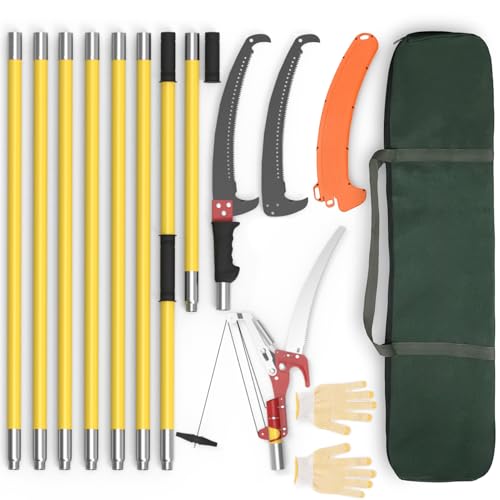
Pros
- Impressive reach range from 7.3 to 27 feet, suitable for most residential trees
- Lightweight construction minimizes arm fatigue during extended use
- Includes both saw and pruner heads plus a spare saw blade for versatility
- Pulley mechanism makes pruning thicker branches easier than manual snips
- Carry bag keeps all parts organized and protected when not in use
Cons
- Fully extended 27-foot setup can feel heavy and difficult to control for smaller users
- Epoxy resin poles may feel less rigid than all-aluminum or fiberglass alternatives
- No customer reviews yet, so long-term durability is unproven
The LETYANGER 7.3-27 ft Extendable Pole Saw and Pruner Set is designed for homeowners and light-duty landscaping tasks where reaching high branches without a ladder is essential. This tool combines a manual saw blade with a pruner head, giving you two ways to trim overhead growth. The set includes seven poles that connect via aluminum alloy joints, allowing you to adjust the length from about 7.3 feet to a full 27 feet.
For DIY homeowners, contractors, and gardeners who regularly deal with overhanging limbs, this pole saw offers a practical solution. The saw blade is made from 65Mn alloy steel, which is harder than standard carbon steel and should hold its edge reasonably well. The pruner head uses a pulley system to multiply your pulling force, making it easier to slice through branches up to about an inch thick. An extra saw blade comes with a sheath, providing a backup if the main blade gets stuck or dulls.
Performance-wise, the tool is best suited for moderate trimming. The lightweight epoxy resin poles keep the overall weight manageable, though at the maximum 27-foot extension the setup weighs around 9.5 lbs. That may feel front-heavy and require some upper body strength to control accurately. Many users may find the 20-foot configuration (using six poles) a more comfortable balance between reach and stability. The hook knife at the saw tip helps clear small twigs, and the bright yellow color is a thoughtful safety feature to alert others nearby.
Build quality appears decent for the price point. The aluminum joints click together securely, and the saw attachment locks firmly. The pruner head has a plastic component around the pulley, but the cutting blade is steel. The included carry bag is basic but functional, keeping all parts together and protecting them during storage. After use, you can disassemble the poles and pack everything into the bag, which takes up minimal space in a garage or workshop.
Potential limitations include the lack of a telescoping mechanism - you have to attach or remove individual poles to change length, which takes a minute. The poles are made from epoxy resin, which is lighter than metal but may flex slightly under heavy loads. Also, with no customer reviews available yet, it's hard to gauge long-term durability. For occasional backyard use, it should hold up well, but heavy daily use might wear out the joints or blade faster.
Overall, the LETYANGER pole saw set is a reasonable choice for DIY homeowners and gardeners who need an extendable reach for branch trimming. It's not a professional-grade tool, but for the price and included accessories (saw, pruner, spare blade, bag), it offers good value for light to moderate trimming tasks. If you're planning to tackle large trees regularly, you might prefer a powered pole saw, but for manual trimming, this setup works well within its intended range.
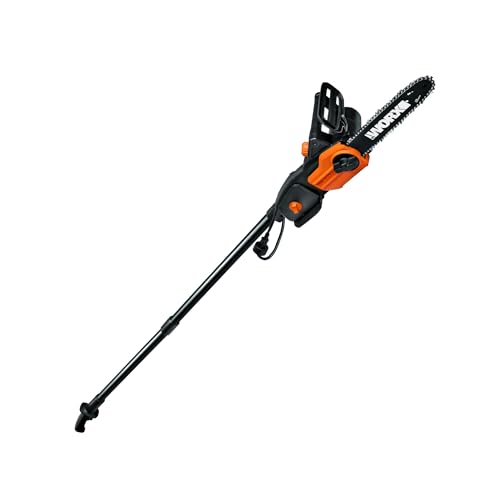
Pros
- Fast chain speed helps cut through branches quickly
- Lightweight and well-balanced for comfortable extended use
- 2-in-1 design offers versatility for different cutting tasks
- Easy chain tensioning and auto lubrication simplify maintenance
Cons
- 8-amp motor may struggle with very thick or dense hardwood branches
- Electric cord limits mobility compared to battery-powered models
- Some users may find the pole length adjustment mechanism a bit stiff initially
The WORX 8 Amp 10-Inch Electric Pole Saw is a practical tool for homeowners and gardeners who need to tackle high branches without climbing a ladder. With a chain speed of 28 feet per second, it delivers fast cuts through limbs up to about 6 inches thick, making it suitable for routine pruning and light tree trimming around the yard.
This pole saw is designed with versatility in mind. It extends to a full 10 feet, allowing you to reach branches that would otherwise require risky ladder work. The 2-in-1 feature lets you detach the saw head and use it as a standard electric chainsaw for ground-level cutting, which adds convenience for tasks like cutting firewood or clearing fallen branches.
Build quality is solid for a consumer-grade tool. The telescoping pole locks securely, and the 180-degree rotating rear handle helps you position the saw at comfortable angles. The one-button chain tensioning system is a standout feature, making adjustments quick and tool-free, so you can keep cutting without fussing with tools. The auto lubrication system also helps maintain chain performance and extends the life of the bar and chain.
At about 10 pounds, this pole saw is lightweight and well-balanced. It won't wear you out during a session of trimming a few trees, though extended use on larger properties could still be tiring. The electric cord means you'll need an extension cord and access to an outlet, which can be a minor inconvenience compared to a cordless model, but it also means you never have to worry about battery life or charging.
One realistic limitation is that the 8-amp motor is not meant for heavy-duty commercial use. It works well on typical residential trees like maples, oaks, and pines, but it may struggle with especially dense hardwoods or very thick branches. For most homeowners and DIY users, however, this saw offers a good balance of reach, power, and ease of use.
Overall, the WORX electric pole saw is a reliable choice for anyone looking to maintain their yard without professional equipment. It's especially well-suited for homeowners with mature trees, gardeners who need precision trimming, and DIY enthusiasts who want a tool that handles both high and low cutting tasks. Set up is straightforward, maintenance is minimal, and the storage footprint is manageable for a garage or shed.
Complete Operational Guide: How to Use an Extendable Pole Saw Safely and Effectively
Operating an extendable pole saw successfully comes down to managing mechanical leverage, maintaining firm control, and understanding how wood reacts under tension. A pole extended twenty feet into the air behaves very differently from a short handheld pruning tool because small movements at your hands become magnified oscillations at the blade tip. Learning how use extendable pole saw attachments starts on the ground before the teeth ever touch bark. By mastering ground setup, limb assessment, multi-cut pruning techniques, and tool maintenance, you can prune overhead canopies safely and cleanly.
Pre-Cut Site Assessment and Personal Safety Preparation
Before loosening any pole collar or extending pole sections, inspect the immediate cutting zone thoroughly for overhead hazards. Utility lines pose severe risks, and you should never operate any pole saw, whether made of aluminum, steel, or fiberglass, near electrical wires. Clear the ground beneath the tree canopy of tripping hazards such as fallen sticks, garden hoses, uneven stones, and lawn furniture. Establishing solid, level footing prevents sudden slips while your eyes and balance are focused upward.
Equipping proper personal protective gear is non-negotiable for overhead saw work. Falling wood debris, dislodged twigs, and fine sawdust will drop directly downward, making a hard hat and impact-resistant safety glasses essential. Heavy-duty work gloves provide grip security along extended handles, while sturdy work boots protect against falling limbs. Ear protection is also wise if you run an electric or battery-powered pole chainsaw model.
Establish a designated drop zone and identify a clear retreat route before making your first cut. The drop zone should extend well beyond the reach of the limb you plan to remove, as falling branches frequently kick backward or bounce unpredictably upon ground impact. Never stand directly beneath the branch you are sawing. Position yourself at an angle of roughly forty-five degrees to the branch, allowing gravity to carry the severed wood away from your stance.
Assembling and Securing Telescoping Pole Sections
Modern extendable pole saws rely on either nested telescoping tubes or modular screw-together extension sections. Nested models, like those using flip levers and internal threaded friction locks, require you to extend the thickest base sections first. Keeping the thicker tubes lower down increases structural rigidity and reduces severe pole bending. Always confirm that every flip lock snaps firmly shut and that threaded collars are tightened completely to prevent unwanted collapsing mid-stroke.
Modular pole systems made with resin or fiberglass rods rely on reinforced connection joints, often using spring-loaded pins or threaded metal collars. When assembling multiple sections, inspect each connection joint to confirm that the locking mechanism engages fully. A loose connection high in the pole assembly can cause the saw head to rotate off-axis or bind, compromising both cutting accuracy and operator safety. Some models include secondary set screws near the head attachment that must be tightened before lifting the unit overhead.
Extend the pole only to the length necessary to reach the target branch comfortably. Operating a pole saw at maximum extension when trimming lower branches adds unnecessary flex, makes the tool feel substantially heavier, and accelerates muscle fatigue. As general guidance, keeping the pole around twenty feet or shorter yields the best balance between reach and tip control, even on units capable of extending toward thirty feet.
Evaluating Branch Anatomy and Planning Your Cuts
Proper pruning protects the tree from disease while keeping the cutting process smooth and predictable. Inspect the target limb to identify its natural growth direction, thickness, and distribution of foliage weight. Branches that carry heavy side growth or thick foliage clusters can twist suddenly as the wood fibers separate, potentially binding your blade or tearing bark strips down the main trunk.
Locate the branch collar, which is the swollen area of bark where the branch joins the main trunk or larger scaffold branch. To help the tree form healthy protective tissue after cutting, you must preserve this collar rather than making a flush cut directly against the trunk. Leaving a stub that is too long invites rot, while cutting into the collar damages tree defenses. A clean, properly positioned cut just outside the branch bark ridge allows the natural healing zone to close over time.
When dealing with long or heavy limbs, plan to remove the branch in smaller, manageable sections rather than attempting one single cut near the trunk. Cutting off outer branch tips first reduces the overall weight and mechanical leverage acting against the saw blade. This step-by-step weight reduction keeps the final cut controlled and prevents the remaining limb segment from snapping violently before the cut is finished.
Executing the Three-Cut Pruning Method
The standard three-cut method is the safest, most reliable technique for removing branches thicker than one to two inches. Attempting to sever a thick branch with a single downward cut almost always results in the branch snapping under its own weight before the saw reaches the bottom. When this occurs, the falling wood peels a long strip of bark down the trunk, creating an open wound vulnerable to pests and decay.
Begin the three-cut sequence by placing an undercut on the bottom side of the limb, roughly six to twelve inches outward from the branch collar. Saw upward through the bark until you have cut approximately one-quarter to one-third of the way through the branch thickness. If using a manual pole saw, this cut is performed using steady upward pulling strokes against the branch. This notch stops any bark stripping that might happen during subsequent cuts.
The second cut, known as the relief cut, is made from the top of the limb, placed two to three inches farther outward along the branch away from the undercut. Saw downward through the branch until the wood snaps cleanly between the two cuts. Because the bottom fibers have already been severed by your initial undercut, the falling limb breaks free without tearing the bark back toward the trunk.
The third and final cut removes the remaining stub cleanly. Position your pole saw just outside the branch collar at a slight downward angle that mimics the natural angle of the branch bark ridge. Make a smooth, deliberate cut straight through the remaining wood. Because the heavy weight of the limb has already been removed, this finishing cut requires minimal effort and leaves a clean, flat surface that seals quickly.
Manual Pole Saw Technique: Strokes, Hooks, and Pulley Pruners
Manual extendable pole saws rely on curved blades with razor-sharp teeth engineered to cut specifically on the pull stroke. Pushing forcefully against the wood when using a long pole only causes the shaft to buckle, risking blade deflection or bending. Rest the curved blade over the branch and establish a shallow starting groove with light, careful strokes. Once the teeth seat in the groove, apply smooth, downward pulling force, allowing the blade geometry to do the cutting work.
Many manual cutting heads feature integrated upper and lower hook knives. The top hook rests over the branch to keep the blade from slipping off the wood during vigorous pulling motions. When a cut is finished, the hook can also be used to dislodge stuck or hanging twigs that remain tangled in the canopy. The lower hook allows you to clear small shoots or score bark quickly without readjusting your stance.
Manual combination tools also feature spring-loaded pruning shears operated by an extended compound pulley cord. These shears are designed for smaller branches, typically under one to one-and-a-half inches in diameter. Position the bypass shear jaw firmly over the twig, steady the pole with one hand, and pull smoothly downward on the cord handle. The mechanical advantage provided by dual or triple pulleys multiplies your hand force, snipping through green wood with minimal strain.
Operating Motorized and Cordless Pole Saws
Motorized pole saws, whether powered by lithium-ion battery packs or electric cords, replace manual pulling motion with a miniature chainsaw bar and chain. Running an electric pole saw requires a disciplined, steady approach because the rotating chain produces rotational reaction forces. Always ensure the guide bar oil reservoir or manual oil bulb has adequate chain lubricant before lifting the saw into the tree. Running a dry chain causes rapid friction heating, blade binding, and premature chain dulling.
When cutting with an electric pole saw, bring the motor up to full operating speed before allowing the teeth to contact the branch. Gently lower the guide bar onto the wood, letting the cutting teeth bite without applying excessive downward muscle force. For clean cuts on construction materials, as discussed in our guide on cutting subfloor panels cleanly, tool balance and continuous blade speed are crucial to prevent motor stalling and erratic kickback. The same principle applies overhead: let the weight of the motor head supply the necessary cutting pressure.
Be prepared for the saw to drop slightly as it breaks through the bottom of the limb. Maintain a firm grip on the lower handle and throttle trigger with both hands spaced widely along the shaft for maximum leverage. Release the throttle trigger immediately once the branch separates so the chain stops spinning while you reposition the pole for the next cut.
Preventing Common Cutting Mistakes and Pole Flex Issues
One of the most frequent mistakes made when learning how use extendable pole saw equipment is trying to push the blade too aggressively into the wood. Excessive downward pressure increases friction, causes the blade to bind inside the kerf, and causes the pole shaft to bend excessively. Pole flex makes precise tool control nearly impossible and drains your upper body strength rapidly. Maintaining steady, rhythmic strokes allows the teeth to clear sawdust efficiently without jamming.
Another common error is trimming branches directly overhead while standing parallel to the pole shaft. In this awkward position, the tool feels unwieldy, your neck suffers extreme strain, and any falling wood threatens your immediate space. Always keep an angled offset between your stance and the target branch. A forty-five to sixty-degree angle provides natural leverage, clearer visibility, and improved reaction time if a branch falls off-course.
Blade pinching is another frustrating obstacle when pruning green wood. When a limb sags under its own weight, the upper kerf closes, trapping the saw blade tightly. If the blade becomes stuck, do not violently yank on the pole, as this can snap the blade or bend the telescoping tubing. Instead, support the pole gently, use a secondary handheld pole or hook to lift the sagging branch slightly, and release the tension before easing the blade out.
Care, Cleaning, and Storage for Long Tool Life
Routine post-use care ensures your pole saw remains sharp, safe, and ready for future trimming sessions. Tree sap, resin, and green wood moisture quickly accumulate along the blade teeth and pulley pivots. Wipe the blade down with a solvent, rubbing alcohol, or warm soapy water after every trimming session to prevent pitch buildup from hardening. Apply a light coat of multi-purpose oil or silicone lubricant to carbon steel blades and chain links to prevent rust during storage.
Check all locking mechanisms, extension clamps, and hardware fasteners periodically. Telescoping pole joints can collect fine wood dust and grit over time, which may cause sliding tubes to stick or scratch. Disassemble modular sections occasionally, wipe down the inner and outer tubing surfaces, and confirm that all set screws and thumb levers hold firmly without slipping. If using a model with a pulley rope, check the cord for fraying and ensure the return spring operates smoothly.
Always place protective sheath covers over saw blades when transporting or storing your equipment. Sharp curved blades and exposed chains can easily cut fingers or snag nearby items during storage. Store the collapsed pole saw horizontally in a dry shed or hang it vertically along garage wall mounts away from damp ground. Storing the tool in a clean, dry space ensures the locking collars and blades remain corrosion-free for seasons to come.
Mastering how use extendable pole saw systems turns demanding canopy maintenance into a safe, controlled DIY task. By prioritizing personal safety, maintaining proper body angles, employing the three-cut method, and allowing the cutting teeth to work without forced pressure, you protect both your yard trees and your physical well-being. Regular inspection and simple cleaning routines keep your telescoping equipment in peak condition, delivering clean, reliable pruning cuts whenever overhead branches require attention.


Write Your Review
No reviews yet. Be the first to share your experience!