


Trimming high tree canopy growth often presents homeowners with tricky overhead hazards and awkward working angles. Learning how cut branches with pole saw equipment lets you manage unruly limbs directly from the solid ground without balancing precariously on ladders. Selecting the proper equipment, whether that involves a manual pruning saw with a pulley system or a powered cordless mini chainsaw on an extension shaft, ensures your yard work remains safe, controlled, and efficient. If you tackle broader structural cutting around the home, reviewing a subfloor cutting saw guide provides helpful perspectives on maintaining proper blade control during demanding cutting tasks.
Proper cutting execution protects the tree from peeling bark and prevents heavy limbs from binding the saw blade overhead. Understanding how weight, branch tension, and branch collar angles interact allows you to make clean pruning cuts that promote rapid plant healing. The following guide highlights reliable cutting methods, structural preparation, and reputable tools designed to keep overhead branch removal straightforward and dependable.

Pros
- Quad-pulley system noticeably reduces the manual pulling effort required to slice through green branches
- Two-in-one head design eliminates the need to swap between separate pole saws and pole loppers
- Threaded pole sections provide dependable stability compared to cheap twist-lock extension mechanisms
- Breaks down into modular sections for easy garage storage and transport in car trunks
Cons
- Working at full 14-foot extension requires significant upper-body stamina and control against pole leverage
- Long pull rope can snag on lower dense brush if not managed carefully during overhead cutting
The Walensee 14FT Pole Saw and Tree Pruner is a multi-function manual cutting tool engineered for overhead tree maintenance and yard cleanup. Designed primarily for DIY homeowners, groundskeepers, and property managers, this tool eliminates the hazards of balancing on ladders while attempting to trim unruly branches. Its dual-function head features both a pruning bypass shear for tender growth and a curved saw blade intended for thicker tree limbs.
Cutting efficiency overhead relies heavily on mechanical advantage, and the integrated quadruple pulley system is built to minimize arm fatigue. By compounding the pulling force through four distinct pivot points, the system delivers significant leverage directly to the pruning shear with smooth pulling action. For branches exceeding shear capacity, the aggressive tooth profile on the curved saw blade bites into green wood efficiently, allowing users to saw back and forth using steady, grounded pole motions.
Practicality and stability are critical when working with extended pole tools. This model utilizes reinforced, threaded pole sections that join tightly to resist unwanted twisting or separation while pushing and pulling against tough wood. The durable construction resists bending under moderate loads, while corrosion-resistant coatings help shield the metal saw blade and shear head from sap, moisture, and outdoor debris commonly encountered during routine yard maintenance.
Assembly and transport remain straightforward thanks to the modular, detachable design. Rather than dealing with a cumbersome single-piece pole that clutters garage or workshop rafters, users can break the tool down into compact segments that store neatly in a corner, shed, or vehicle trunk. Routine maintenance mainly requires wiping down the blade after resinous cuts, oiling the pivot joints, and keeping the pull cord clean and untangled.
As with most manual pole pruners, reaching full extension naturally introduces some pole flex and requires arm stamina during extended cutting sessions. It will not replace heavy gas or battery chainsaws for massive fallen trunks, but for seasonal maintenance, palm trimming, fruit tree thinning, and overhead clearance, it offers an economical and safe solution. For property owners and DIYers who want to maintain trees without risking ladder falls, this extendable pruner serves as a dependable addition to any home outdoor tool lineup.
Overhead branch cutting is notoriously strenuous on shoulders and forearms, making mechanical leverage a critical factor in tool selection. The four-pulley compound mechanism significantly decreases the physical effort needed to snip through green branches compared to standard single-pulley loppers.
The pull cord handle allows the operator to maintain a balanced, grounded stance with both feet planted firmly on the turf. By operating the shears from the ground, users avoid awkward body positioning, reducing the risk of muscle strain and fatigue during long seasonal pruning sessions.

Pros
- Converts quickly between an extended pole saw and a handheld mini chainsaw
- Includes a high-capacity 4.0Ah battery and an automatic chain-oiling system
- Up to 13-foot maximum reach eliminates the need for climbing unstable ladders
- Lightweight, approachable handling suitable for beginners and residential yard care
Cons
- Uses a brushed motor rather than a brushless design
- Chain tensioning requires an external screwdriver rather than tool-free adjustment
- Compact 6-inch bar length limits use to smaller limbs and moderate branch pruning
The Velotrex 6-inch cordless pole saw is an outdoor cutting tool designed for suburban homeowners, rural property managers, and yard maintenance DIYers who need to manage overgrown branches and storm debris. Combining an extended reach mechanism with a compact cutting head, this tool appeals to users who want to avoid the risks of climbing up ladders with heavy gas saws.
At the core of the tool is a 6-inch guide bar driven by a 650W brush motor, capable of reaching a chain speed of up to 32 feet per second. The system is engineered to handle branch trimming, storm cleanup, and shrub maintenance across backyards, orchards, or small farms. With an assembled reach reaching up to 13 feet, users can make clean cuts on elevated limbs while maintaining a stable footing on solid ground.
Beyond overhead trimming, the tool features a 2-in-1 detachable architecture that unlocks substantial practical versatility. By removing the saw head from the pole assembly, the tool functions as an agile handheld mini chainsaw for bucking fallen limbs, pruning garden bushes, and preparing small firewood at ground level. The cutting head also incorporates an automatic oiling reservoir that keeps the chain constantly lubricated without manual pumping, helping maintain cutting smoothness and preserving bar life.
The saw is built with a lightweight frame, making it accessible for homeowners who find full-sized gas pole saws too cumbersome to maneuver. Chain adjustments are handled via a screwdriver tensioning mechanism that locks the cutting chain firmly into the bar track. For storage and transport, the segmented pole structure collapses down to fit standard garden sheds, tool racks, or vehicle trunks without taking up excess workshop floor space.
Prospective buyers should consider that the 6-inch bar length is intended primarily for branch trimming and light bucking rather than felling substantial timber. Additionally, the tool uses a traditional brushed motor and requires a tool-based screwdriver adjustment for chain tensioning rather than a quick-turn dial. Runtime and cutting stamina will also depend on branch thickness, wood hardness, and continuous battery charge levels.
For residential homeowners and hobby gardeners seeking an affordable, multi-use pruning setup, the Velotrex 6-inch pole saw offers practical value. It balances high-reach safety with ground-level pruning convenience, delivering a functional all-in-one yard maintenance solution for routine seasonal cleanup.
This tool is engineered to tackle overhead limbs and ground-level shrubbery with equal convenience. The extended pole configuration provides a safe working envelope of up to 13 feet, allowing users to prune encroaching tree limbs, dead wood, and seasonal growth without positioning a ladder on uneven turf.
When transitioning from high branch work to trail clearance or garden beds, detaching the pole allows the saw head to operate as a self-contained 6-inch mini chainsaw. This handheld mode makes quick work of cutting down fallen branches, trimming thick hedges, and sizing small logs for campfire wood directly on the ground.
The cutting assembly is powered by a 650W electric brush motor matched with an included 4.0Ah high-capacity rechargeable battery. This setup drives the chain at speeds up to 32 feet per second, providing adequate velocity for clean wood fiber severing on common yard branches.
To support sustained operation, the integrated automatic oiler continuously distributes bar and chain oil across the cutting track. This automated lubrication reduces friction and thermal buildup, helping protect both the chain links and the guide bar during extended pruning sessions.

Pros
- Lightweight and easy to maneuver for extended pruning sessions
- Adjustable length from hand saw to 14 feet for versatile reach
- Sharp blade provides clean cuts with minimal effort
- Rust-resistant materials suitable for outdoor storage
- Simple assembly with no tools required
Cons
- Manual operation may require more effort than powered pruners for thick branches
- Pole sections may loosen over time and need periodic tightening
- Not ideal for heavy-duty or professional forestry work due to lightweight construction
The Walensee 14 FT manual pole saw is a practical pruning tool designed for homeowners and gardeners who need to trim high branches safely from the ground. This pole saw combines a sharp manganese steel blade with a lightweight, adjustable extension pole to help you reach branches up to 14 feet without climbing a ladder. It's best suited for occasional yard maintenance, light tree trimming, and clearing overgrown branches around the garden, patio, or yard.
For DIY homeowners and hobbyist gardeners, this pole saw offers a solid balance of reach and control. The blade features a three-sided ground edge with double-sided barbs that cut through green wood smoothly and efficiently. Many users will appreciate how the sharp teeth slice through branches up to a couple of inches thick without binding or tearing bark. The cutting performance is adequate for most residential pruning tasks, though it may struggle with very thick or dead hardwood limbs.
Build quality is decent for the price point. The pole is made from stainless steel with a powder-coated finish that resists rust, and the blade uses manganese steel for durability and edge retention. The anti-slip handle provides a comfortable grip, and the extra reinforcement screw helps keep the saw head securely attached to the pole. Assembly is straightforward - you simply screw the sections together to your desired length. The saw can also be used as a hand saw by removing the extension sections, adding versatility for lower branches.
One realistic limitation is that manual pole saws require more physical effort than gas or electric pruners, especially for thicker branches or prolonged use. The pole sections may loosen slightly during use, so periodic tightening is recommended. Additionally, this saw is not built for heavy-duty professional forestry work; its lightweight design is better suited for light to moderate residential trimming. Storage is easy since the sections come apart and can be stored in a garage or shed without taking up much space.
Overall, the Walensee 14 FT manual pole saw is a good value for homeowners who want a safe, affordable way to trim high branches without the expense or maintenance of powered pruners. It's a practical addition to any garden tool collection, especially for those who prioritize safety and simplicity over raw cutting power. If you need a reliable tool for occasional yard work and light pruning, this pole saw is worth considering.

Pros
- Extended ground reach eliminates the need for unstable ladder setups
- Sharp triple-ground teeth cut efficiently on the pull stroke with minimal binding
- Multi-use universal threaded head works with everyday utility attachments
- Detachable saw head doubles as a standalone hand saw for ground work
Cons
- Telescoping pole naturally exhibits some flex when fully extended to twenty feet
- Manual overhead sawing requires notable upper-body stamina during dense wood cuts
- Lacks an integrated rope-operated bypass pruner for thin, leafy twigs
The Karveden telescoping pole saw is a manual tree-trimming tool designed to handle tall, overgrown branches without forcing you onto a shaky ladder. Operating from ground level is one of the most effective ways to avoid yard maintenance injuries, and this tool pairs a multi-stage extendable aluminum pole with a dedicated high-reach saw blade. It is best suited for DIY homeowners, property caretakers, hobby farmers, and grounds maintenance workers who need an affordable, dependable way to clear deadwood, shape shade trees, and trim back encroaching limbs around fences or rooflines.
At the business end, the tool features a 19-inch curved blade made from high-carbon steel. The teeth are sharpened with a three-sided bevel profile designed to bite aggressively into green or seasoned wood, cutting smoothly on the pull stroke. A rust-resistant non-stick coating reduces sap buildup and friction, helping keep the blade from binding inside thick branches. When high trimming is finished, the blade assembly unbolts easily to serve as a standalone hand saw, making quick work of fallen limbs, low shrubs, and small logs on the ground.
Handling a pole saw at maximum length requires a balance of rigidity and weight management. Weighing just under five pounds, the four-stage aluminum pole adjusts smoothly from five feet up to twenty feet using flip-tab tension clamps. Dual high-density foam sleeves on the lower sections give your hands traction and cushion against vibration, while the reinforced screw-mount connection keeps the saw head stable during rigorous back-and-forth strokes. The standard 3/4-inch universal thread at the top also allows the pole to double as an extension handle for paint rollers, fruit pickers, or gutter cleaning attachments.
As with any manual pole saw extended past fifteen feet, working at maximum reach requires patient technique. There is noticeable flex when fully telescoped, meaning you will need to let the weight of the blade guide the cut rather than pressing upward with excessive force. Extended overhead work will also test your shoulder stamina compared to powered pole saws, and the tool does not include a spring-loaded bypass shear for thin, flexible greenery that tends to deflect a saw blade.
For routine yard clearing, seasonal storm cleanup, and safe pruning around the homestead, the Karveden manual pole saw offers strong value and straightforward utility. It collapses down to a compact 42 inches for easy storage along workshop rafters or garage wall racks, avoiding the fuel mixing, battery charging, and mechanical upkeep associated with power tools.
Constructed around lightweight aluminum tubing and hardened carbon steel, the assembly is built to withstand repeated outdoor chores while resisting moisture and rust. The clamp mechanisms can be adjusted for tension, ensuring tight lockups between the pole segments even after prolonged vibration during aggressive cutting strokes.
The universal 3/4-inch threaded tip adds substantial utility outside of tree pruning season. Homeowners and workshop users can unthread the saw bracket and mount utility dusters, light bulb changers, squeegees, or paint rollers, transforming a dedicated yard tool into a versatile high-reach home maintenance asset.

Pros
- Dual flip and screw locking collar setup holds pole sections firmly under load
- Integrated two-in-one head handles both thick limbs and fine branch pruning
- Eliminates the need for precarious ladder climbing during seasonal yard cleanups
- Smooth pulley action cuts green branches with minimal pulling effort
Cons
- Full 20-foot extension naturally introduces moderate pole flex that requires practice to control
- Pruner pull rope requires careful management around dense thickets to prevent snagging
The TONYINGO Manual Pole Saw and Tree Pruner is an extendable overhead cutting system designed to tackle high tree branches directly from the safety of the ground. By pairing a curved pruning saw blade with a bypass lopper operated by a double-pulley cord system, this tool gives property owners two distinct methods of attack. You can slice through larger limbs with a traditional pull-saw action or snap through green growth up to an inch thick using the spring-assisted bypass pruner.
This tool is best suited for DIY homeowners, groundskeepers, rural property managers, and landscapers who want to maintain trees without constantly setting up ladders on uneven terrain. Ladder falls remain one of the most common hazards in home maintenance, so having a grounded tool capable of reaching up to 26 feet overhead provides a tangible safety improvement for weekend pruning, storm clean-up, and seasonal fruit tree shaping.
In practical cutting performance, the combination head provides solid flexibility. The curved saw blade features aggressive pull-cut teeth that bite deeply into pine, oak, and maple limbs on the downward stroke, using gravity to assist your cutting motion. For smaller stems and encroaching shoots, the compound two-pulley setup significantly increases mechanical advantage, cutting down on the hand strain typically associated with long-reach pruning ropes.
Build quality centers around a multi-section aluminum pole that balances rigidity against overall weight. Telescoping poles often fail at the connection collars, but TONYINGO addresses this by using a dual-locking mechanism: an external flip latch for fast length changes, backed by a threaded twist lock that wedges the sections securely together. An EVA foam grip at the base gives a comfortable handhold, allowing for positive orientation of the cutting head even while wearing work gloves.
Handling any manual tool extended beyond 15 feet involves some pole deflection, so controlling your cutting tempo is essential for best results. When working at full extension, resting the curved blade hook against the branch before applying force helps stabilize the cut. Storage is straightforward, as the pole collapses down into a compact length that easily hangs on standard garage wall hooks or stows along the side rail of a pickup bed.
For homeowners and maintenance workers seeking an affordable, dependable way to trim back overgrown oak branches, deadwood, and encroaching canopy lines, this manual pole saw is a sensible addition to the outdoor tool collection. It delivers consistent cutting power without the fuel, noise, or weight associated with gas and battery-powered pole chainsaws.
The core structural advantage of this pole saw lies in its dual-lock telescoping design. Standard single-lock telescoping poles often loosen when subjected to the repeated pushing and pulling forces of manual sawing. Combining quick-release flip clamps with secondary screw collars locks each aluminum segment tightly, reducing rotational wobble and eliminating accidental retraction during tough cuts.
The cutting head is made with durable metal components to resist bending under side loads. The steel pruner spring quickly resets the lopper blade after each pull, while the nylon operating cord is routed through dual pulleys to double your mechanical advantage. Routine maintenance requires little more than brushing sap off the blade teeth, wiping down the aluminum tubes, and occasionally applying a light coat of machine oil to the pivot bolt and spring mechanism.
Pros
- Impressive reach range from 7.3 to 27 feet, suitable for most residential trees
- Lightweight construction minimizes arm fatigue during extended use
- Includes both saw and pruner heads plus a spare saw blade for versatility
- Pulley mechanism makes pruning thicker branches easier than manual snips
- Carry bag keeps all parts organized and protected when not in use
Cons
- Fully extended 27-foot setup can feel heavy and difficult to control for smaller users
- Epoxy resin poles may feel less rigid than all-aluminum or fiberglass alternatives
- No customer reviews yet, so long-term durability is unproven
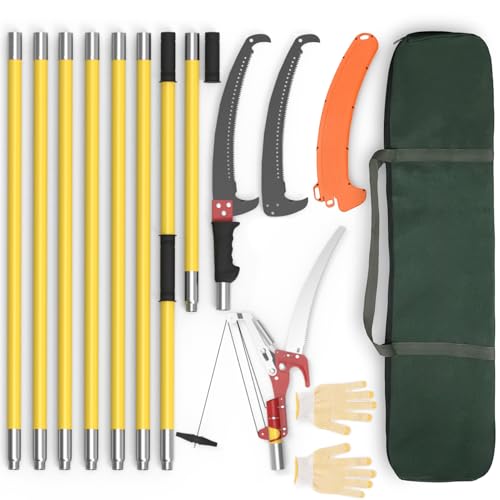
The LETYANGER 7.3-27 ft Extendable Pole Saw and Pruner Set is designed for homeowners and light-duty landscaping tasks where reaching high branches without a ladder is essential. This tool combines a manual saw blade with a pruner head, giving you two ways to trim overhead growth. The set includes seven poles that connect via aluminum alloy joints, allowing you to adjust the length from about 7.3 feet to a full 27 feet.
For DIY homeowners, contractors, and gardeners who regularly deal with overhanging limbs, this pole saw offers a practical solution. The saw blade is made from 65Mn alloy steel, which is harder than standard carbon steel and should hold its edge reasonably well. The pruner head uses a pulley system to multiply your pulling force, making it easier to slice through branches up to about an inch thick. An extra saw blade comes with a sheath, providing a backup if the main blade gets stuck or dulls.
Performance-wise, the tool is best suited for moderate trimming. The lightweight epoxy resin poles keep the overall weight manageable, though at the maximum 27-foot extension the setup weighs around 9.5 lbs. That may feel front-heavy and require some upper body strength to control accurately. Many users may find the 20-foot configuration (using six poles) a more comfortable balance between reach and stability. The hook knife at the saw tip helps clear small twigs, and the bright yellow color is a thoughtful safety feature to alert others nearby.
Build quality appears decent for the price point. The aluminum joints click together securely, and the saw attachment locks firmly. The pruner head has a plastic component around the pulley, but the cutting blade is steel. The included carry bag is basic but functional, keeping all parts together and protecting them during storage. After use, you can disassemble the poles and pack everything into the bag, which takes up minimal space in a garage or workshop.
Potential limitations include the lack of a telescoping mechanism - you have to attach or remove individual poles to change length, which takes a minute. The poles are made from epoxy resin, which is lighter than metal but may flex slightly under heavy loads. Also, with no customer reviews available yet, it's hard to gauge long-term durability. For occasional backyard use, it should hold up well, but heavy daily use might wear out the joints or blade faster.
Overall, the LETYANGER pole saw set is a reasonable choice for DIY homeowners and gardeners who need an extendable reach for branch trimming. It's not a professional-grade tool, but for the price and included accessories (saw, pruner, spare blade, bag), it offers good value for light to moderate trimming tasks. If you're planning to tackle large trees regularly, you might prefer a powered pole saw, but for manual trimming, this setup works well within its intended range.
Pros
- Versatile 2-in-1 design saves money and storage space compared to buying separate tools
- Powerful brush motor delivers reliable cutting performance on branches up to 6 inches thick
- Automatic oiling reduces maintenance and keeps the chain running smoothly
- Lightweight and well-balanced for comfortable use over long periods
- Comes with two batteries and a complete accessory kit for immediate use
Cons
- Battery life may be limited for very large yards or heavy-duty professional use, requiring careful job planning
- Extension pole may feel slightly flexible under heavy load, though adequate for typical pruning tasks
- Chain tension adjustment may require occasional attention to maintain optimal cutting performance
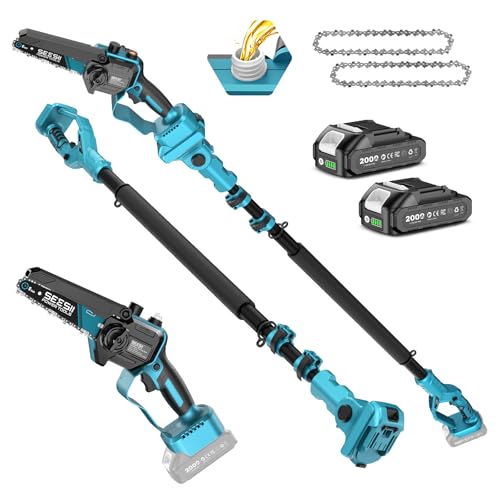
The SEESII 2-in-1 Electric Pole Saw is a versatile tool that combines a handheld mini chainsaw with an extension pole, allowing you to trim branches from ground level up to 10 feet high. This battery-powered pruner is designed for DIY homeowners, gardeners, and professionals who need a lightweight, cordless solution for tree trimming and yard maintenance. With a 6-inch bar and a brush motor that cuts branches up to 6 inches in diameter, it handles most residential pruning tasks with ease.
Performance-wise, the brush motor delivers consistent power for clean cuts through green wood, and the automatic oiling system keeps the chain lubricated for smoother operation and longer chain life. The dual 21V 2000mAh batteries provide enough runtime for typical yard work, and swapping them is quick so you can keep going without long breaks. The adjustable cutting head lets you angle the saw for awkward branches, reducing strain on your arms and back compared to fixed-angle saws.
Build quality is solid for the price point, with a durable plastic housing and a metal bar that holds up well to regular use. The tool weighs only 3.4 pounds in handheld mode, making it easy to maneuver with one hand, and the extension pole adds minimal weight while providing good reach. The included accessories, such as a shoulder strap, goggles, gloves, and a carrying case, add value and make it a ready-to-go kit for most users.
Setup is straightforward: attach the pole, install the battery, fill the oil reservoir, and you are ready to cut. Maintenance is minimal thanks to the automatic oiler, though you will need to check chain tension periodically and sharpen or replace the chain as needed. The tool stores compactly in the included case, which keeps everything organized and protected.
One realistic limitation is that the battery life may not be sufficient for very large properties or heavy-duty professional use without extra batteries. The extension pole, while functional, can feel slightly flexible when cutting thick branches at full extension, so taking steady cuts is recommended. Also, the chain tension adjustment requires a small tool, which is included but could be more convenient if it were tool-less.
Overall, the SEESII 2-in-1 cordless pole saw is a practical choice for homeowners and light commercial users who want a safe, ladder-free way to trim high branches and handle general yard pruning. It offers good value with its dual batteries, automatic oiling, and complete accessory package. For those with larger properties or more demanding needs, investing in additional batteries or a gas-powered saw might be worth considering, but for most DIY and professional trimming tasks, this tool delivers reliable performance and convenience.
The SEESII 2-in-1 pole saw features a durable plastic housing that feels sturdy enough for regular yard work. The metal bar and chain are well-made, and the brush motor is sealed to resist dust and debris. The extension pole is made of aluminum with a secure locking mechanism, though it may flex slightly under heavy loads. Overall, the build quality is appropriate for the price and intended use, offering a good balance of weight and durability.
The package includes the 6-inch mini chainsaw, extension pole, two 21V 2000mAh batteries, a charger, two chains, an adjustable shoulder strap, an empty oil bottle, a chain sleeve, safety goggles, and gloves. This comprehensive kit allows you to start trimming right away without needing to purchase additional items. The carrying case keeps everything organized and portable.
Pros
- Fast chain speed helps cut through branches quickly
- Lightweight and well-balanced for comfortable extended use
- 2-in-1 design offers versatility for different cutting tasks
- Easy chain tensioning and auto lubrication simplify maintenance
Cons
- 8-amp motor may struggle with very thick or dense hardwood branches
- Electric cord limits mobility compared to battery-powered models
- Some users may find the pole length adjustment mechanism a bit stiff initially
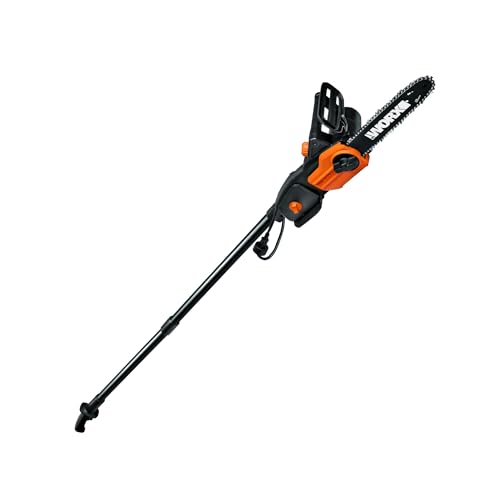
The WORX 8 Amp 10-Inch Electric Pole Saw is a practical tool for homeowners and gardeners who need to tackle high branches without climbing a ladder. With a chain speed of 28 feet per second, it delivers fast cuts through limbs up to about 6 inches thick, making it suitable for routine pruning and light tree trimming around the yard.
This pole saw is designed with versatility in mind. It extends to a full 10 feet, allowing you to reach branches that would otherwise require risky ladder work. The 2-in-1 feature lets you detach the saw head and use it as a standard electric chainsaw for ground-level cutting, which adds convenience for tasks like cutting firewood or clearing fallen branches.
Build quality is solid for a consumer-grade tool. The telescoping pole locks securely, and the 180-degree rotating rear handle helps you position the saw at comfortable angles. The one-button chain tensioning system is a standout feature, making adjustments quick and tool-free, so you can keep cutting without fussing with tools. The auto lubrication system also helps maintain chain performance and extends the life of the bar and chain.
At about 10 pounds, this pole saw is lightweight and well-balanced. It won't wear you out during a session of trimming a few trees, though extended use on larger properties could still be tiring. The electric cord means you'll need an extension cord and access to an outlet, which can be a minor inconvenience compared to a cordless model, but it also means you never have to worry about battery life or charging.
One realistic limitation is that the 8-amp motor is not meant for heavy-duty commercial use. It works well on typical residential trees like maples, oaks, and pines, but it may struggle with especially dense hardwoods or very thick branches. For most homeowners and DIY users, however, this saw offers a good balance of reach, power, and ease of use.
Overall, the WORX electric pole saw is a reliable choice for anyone looking to maintain their yard without professional equipment. It's especially well-suited for homeowners with mature trees, gardeners who need precision trimming, and DIY enthusiasts who want a tool that handles both high and low cutting tasks. Set up is straightforward, maintenance is minimal, and the storage footprint is manageable for a garage or shed.
Essential Steps and Techniques for Cutting Overhead Limbs Safely
Executing an overhead pruning cut requires deliberate planning, correct posture, and a firm understanding of limb dynamics. Working under tree canopies introduces falling debris hazards, blade-pinch risks, and unpredictable branch swing. When you understand the physics of branch tension and the mechanical operation of your pole saw, you can remove hazardous or overgrown limbs without damaging the tree trunk or endangering yourself on the ground.
Evaluating the Work Zone and Establishing Safe Clearance
Before extending any pole saw, clear the ground beneath the target tree of trip hazards, lawn furniture, toys, and loose stones. Look up into the canopy to trace the full length of the limb you plan to prune. Check for entangled neighboring branches, hidden deadwood, and especially overhead utility wires. Never use any pole saw near energized electrical lines, because even fiberglass or epoxy resin poles can conduct high-voltage electricity if moisture, sap, or surface contamination is present.
Determine an unobstructed retreat route before initiating your cut. Overhead branches rarely fall straight down in a tidy path; they frequently roll, deflect off lower foliage, or spring backward upon striking the turf. Position your body outside the projected drop zone, angling the pole so you stand well to the side rather than directly underneath the limb. Keeping your footing stable on dry, level turf allows you to step back quickly if a falling branch glances off an adjacent limb.
Selecting Between Manual Extension Saws and Powered Pole Chainsaws
Choosing the right tool style depends directly on the limb diameter, overhead height, and personal endurance. Manual pole saws, such as the Walensee 14FT Pole Saw for Tree Trimming or Karveden 26FT Reach Pole Saws for Tree Trimming, utilize high-carbon or manganese steel curved blades with aggressive three-sided ground teeth. These saws cut on the pull stroke, relying on your arm motion and downward leverage to slice through fibrous green wood. Many manual designs, including models from TONYINGO and LETYANGER, incorporate a secondary bypass pruner head with a dual-pulley or quadruple-pulley rope system to snip thin branches up to an inch thick.
Powered options introduce motorized efficiency for thicker limbs that would otherwise demand exhausting manual sawing. Cordless units like the Velotrex 6 Inch Pole Saw Battery Powered for Trimming Tree or the SEESII 2-in-1 Electric Pole Saws for Tree feature a 6-inch guide bar driven by a rechargeable battery pack, delivering chain speeds up to 32 feet per second. Meanwhile, corded electric saws such as the WORX Pole Saw, 8 Amp 10″ Electric Pole Saw supply continuous 8-amp cutting power with an extended 10-inch bar. While powered saws chew through heavy wood rapidly, they add top-heavy motor weight that requires solid upper-body stabilization.
Mastering the Three-Cut Pruning Method to Prevent Bark Stripping
The single most destructive mistake in tree maintenance is making a single downward cut from the top of a heavy branch. As the saw cuts past the midway point, the unsupported weight causes the branch to snap downward before the cut is finished. This creates a severe tear in the bark that strips down the trunk, exposing deep wood tissue to fungal rot, insect infestation, and permanent structural weakness. The classic three-cut pruning technique eliminates this danger completely.
Begin with an undercut placed roughly twelve to eighteen inches out from the tree trunk or parent branch. Position the saw blade against the underside of the limb and cut upward through approximately one-quarter to one-third of the branch thickness. If using a manual saw with a curved tip hook, use steady upward pull strokes to establish a clean groove without binding. On a powered pole saw, bring the motor up to speed before gently contacting the bottom bark to avoid jarring chain kick.
Make your second cut, known as the relief or top cut, two to three inches farther out along the branch past your initial undercut. Saw down firmly from the top surface of the limb. As the blade bites deep and the branch bends under gravity, the wood will fracture cleanly along the grain and break off at the undercut location. The undercut acts as a clean breaking threshold, stopping the tear instantly and preventing bark from peeling back toward the tree trunk.
Finish by removing the remaining stub with a precise third cut just outside the branch bark ridge and branch collar. The branch collar is the swollen ring of specialized tissue where the limb joins the main trunk. Saw downward at a slight angle away from the trunk, being careful not to cut flush against the trunk surface. Preserving the branch collar allows the tree to form protective callous tissue naturally over the wound, sealing off pathogens without requiring wound sealants or chemical paints.
Adjusting Pole Reach and Managing Overhead Leverage
Extending a pole pruner alters its balance point dramatically. Long telescoping designs, like the Karveden 26FT or TONYINGO 26FT models, utilize multi-stage aluminum sections with flip-tab and screw-collar locks. Segmented models, such as the Walensee Pole Saws for Tree Trimming 14 FT or LETYANGER epoxy resin systems, use threaded or clip-together poles. Regardless of lock style, every foot of extension increases the lever arm, making the tool feel significantly heavier at your hands than its static scale weight suggests.
Adjust the pole length so you can work comfortably with your hands positioned around chest and waist height, maintaining roughly a sixty-degree operating angle to the ground. Holding a pole vertically directly above your head increases the danger of falling debris striking you and limits your mechanical leverage. If you extend a segmented system toward twenty or more feet, expect noticeable pole flex. Counteract pole wobble by planting your feet shoulder-width apart, resting the saw blade lightly on the limb before starting the stroke, and letting the weight of the cutting head apply natural downward pressure.
Operating Manual Pulley Pruners on Dense Twig Clusters
When clearing fine secondary growth, water sprouts, or crossing branches under one inch thick, the manual pruning shear attachment is far faster and cleaner than a reciprocating saw blade. Models like the Walensee 14FT and LETYANGER setups incorporate a spring-loaded bypass blade connected to a durable operating cord. The pulley assemblies on these pruner heads multiply your physical pulling force, giving the hardened steel shear the leverage needed to snap through fibrous green limbs with minimal arm strain.
Hook the pruner jaw firmly over the target branch with the cutting blade positioned toward the parent stem. Ensure the pull rope hangs straight down without twisting around the extension pole sections, as rope wrap creates parasitic friction that drains your pulling power. Pull the rope downward smoothly with a steady, continuous tug rather than a violent jerk. A controlled pull slices through the branch cleanly without leaving jagged bark tags or jamming the jaw open mid-cut.
Controlling Powered Pole Saws to Avoid Binding and Kickback
Powered pole saws demand focused throttle management and careful blade tracking. When using a cordless mini chainsaw system like the SEESII 2-in-1 PS600 or Velotrex 6-inch unit, let the electric motor attain full operating velocity before touching the chain to the bark. Never force the bar down into the cut. The high chain speed combined with sharp micro-chisel cutters will draw the bar through the wood naturally. For operators who also use reciprocating tools for ground-level demolition or metal cutting, exploring a reciprocating saw blade guide illustrates how proper tooth configuration prevents binding across different wood densities.
Pinching occurs when a sagging branch closes the kerf around the guide bar, locking the chain solid. If you feel the saw slow down or notice the branch shifting downward onto the bar, immediately release the throttle trigger. Do not yank the pole violently, which can bend the guide bar or snap pole connection ferrules. Instead, support the pole weight, engage a manual pruner or secondary hand saw to relieve branch tension from another angle, and gently slip the guide bar free once the pressure eases.
Handling Multi-Angle Cutting Heads for Awkward Overhead Growth
Trees rarely grow in uniform vertical or horizontal lines, frequently producing crossed branches that lean across fence lines, outbuildings, or garden sheds. Systems equipped with pivoting cutter heads, such as the SEESII cordless pruner or the WORX electric saw with its 180-degree rotating rear handle, permit precise angle adaptation without forcing you into an unbalanced stance. Tilting the cutting head allows the guide bar to lay flat across the top of an angled branch while you stand firmly in a safe clearing.
Before adjusting the angle on any powered head, disconnect the battery pack or unplug the extension cord. Loosen the adjustment knob or push-pin mechanism, set the head firmly into the required detent notch, and tighten the collar completely. Never attempt to cut with an angle adjustment collar partially engaged, as cutting vibration can cause the head to flop loosely mid-stroke, pinching the chain and throwing the entire tool off balance overhead.
Essential Tool Maintenance: Chain Tension, Oiling, and Blade Care
Consistent tool maintenance preserves cutting speed, reduces physical fatigue, and protects mechanical components from premature wear. On powered pole chainsaws, proper lubrication is vital. Units with automatic oiling systems, such as the Velotrex, SEESII, and WORX models, keep the bar channel and drive links coated with bar and chain oil during operation. Always check the fluid reservoir before lifting the tool overhead, and verify that oil is flowing freely along the guide bar rails to prevent thermal expansion and chain binding.
Chain tension must be monitored regularly, especially during the first few hours of working with a new cutting chain. A properly tensioned chain fits snugly against the underside of the guide bar while still pulling smoothly around the nose sprocket by gloved hand. If the drive links sag visibly below the bar groove, use the onboard screwdriver tensioner or tool-free tension dial to take up the slack. On manual pole saws, wipe sticky sap and moisture off the carbon steel blades with a light solvent after each session, followed by a thin film of machine oil to prevent surface rust during storage.
Practical Decision Summary for Overhead Branch Removal
Mastering overhead tree trimming comes down to methodical branch assessment, disciplined cut sequencing, and using the right tool configuration for the job. By employing the three-cut method on every branch thicker than two inches, you protect the health of your trees while preventing unpredictable wood splits that could trap your saw. Maintain a stable sixty-degree stance outside the drop zone, verify chain lubrication and blade tightness before extending your reach, and let the tool do the cutting work smoothly without excessive downward force.




Write Your Review
No reviews yet. Be the first to share your experience!