


Wobbly hand drills often ruin critical joinery when a bit skews slightly off vertical, chewing up valuable stock and throwing off bolt alignment. Mounting your workpiece under a rigid quill delivers the spindle accuracy, mechanical leverage, and repeatable plunge depth that handheld tools simply cannot match. Investing in the best drill press underr lineup ensures clean holes through dense hardwoods, thick aluminum plate, and structural tubing without exhausting your forearms. Cast iron bases absorb persistent motor vibration, while adjustable pulley belts and mechanical speed dials deliver the sustained torque delivery needed for heavy Forstner bits and metal twist drills.
Careful analysis of motor horsepower, swing capacity, table bevel mechanisms, and user feedback helps separate reliable bench units from sloppy machinery. Whether you need a compact benchtop frame to anchor alongside your workshop benchtop sanding machines or a heavy-duty production drill with extended spindle travel, selecting the right machine protects both your budget and your workpiece accuracy. The right tabletop drilling setup locks your bits true, keeping hole centers dead on target across repetitive production runs.



Frequently Asked Questions
What does swing size mean on a benchtop drill press?
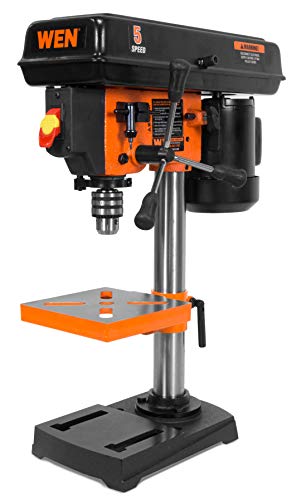
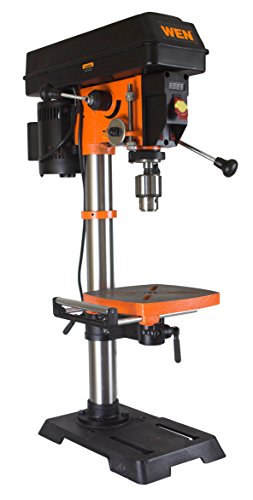
Drill press swing represents double the distance between the center of the spindle and the front of the vertical support column. A 10-inch swing allows you to bore a hole directly through the center of a 10-inch wide circular workpiece. For the best drill press underr options in 2026, swing measurements typically range from 8 inches on compact hobby benches to 12 inches on heavy-duty cast iron models.
How do pulley belts and variable speed dials affect drilling in tough materials?
Speed regulation matches motor RPM to material density and bit diameter to prevent burning bits or stalling out. Slower spindle speeds near 500 to 750 RPM provide maximum torque for boring thick carbon steel and large hole saws without overheating cutting edges. Higher velocity settings approaching 3100 RPM produce clean, splinter-free cuts in softwoods and plastics, allowing clean prep work before moving parts to your detail sanding tools for final surface cleanup.
Can an 8-inch or 10-inch benchtop drill press handle large Forstner bits?
Yes, standard benchtop drill presses can spin large Forstner bits provided the induction motor offers sufficient amperage and low belt speeds. A 2.5-amp to 6.2-amp induction motor running on its lowest pulley tier generates ample mechanical advantage to feed a 2-inch Forstner bit into dense maple or oak without belt slipping. Setting your mechanical depth stop ensures flat-bottomed hinge mortises without blowing through the back of cabinet door panels.
Why is spindle travel important on compact workshop drill presses?
Spindle travel determines the maximum drilling depth achievable in a single plunge without adjusting the worktable elevation. Compact benchtop units provide between 2 inches and 3-1/8 inches of quill stroke, which dictates how deep you can bore through solid timber or thick stock. Shorter travel requires repetitive table adjustments or stepped plunge depths, making generous spindle travel a major asset for mortising and deep boring operations.
What causes chuck runout and how can it be minimized?
Radial runout occurs when the drill chuck or internal spindle taper seats improperly, causing the bit tip to orbit off-center. Inspecting the Morse taper socket, seating the chuck firmly with a wood block, and tightening all three chuck key positions evenly reduces bit wobble dramatically. Sturdy cast iron frames also suppress motor vibration to maintain tight tolerances across delicate pilot holes and metal fabrication tasks.
What is the benefit of an induction motor over a small DC motor?
Induction motors provide brushless operation, sustained operating torque, and quiet performance under continuous workshop loads. Unlike miniature high-RPM DC motors that suit precision craft modeling, induction motors utilize stepped pulleys to maximize low-speed mechanical force without thermal bogging. This reliable power delivery helps workshop enthusiasts maintain steady feed pressure through tough metals without bogging down the drivetrain.



Write Your Review
No reviews yet. Be the first to share your experience!