


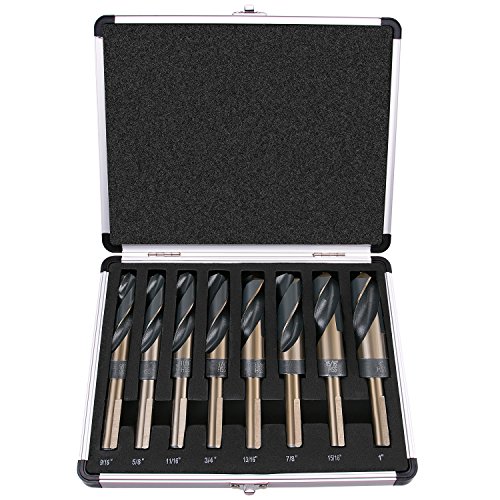
Spinning a heavy-diameter cutter inside a handheld drill press or standard portable driver often leads to violent chuck slippage and stalled motors. Standard drill chucks cannot grip oversized cutting flutes without a stepped profile to step down the diameter. Securing the best drill bit to reduce shank dimensions down to a standard 1/2-inch collar allows tradespeople to bore clean 1-inch holes without buying specialized industrial machinery. When prepping rough timber alongside metal framing, craftsmen frequently deburr edges or smooth joints using an oscillator sander for woodworking before boring their final structural bolt passages.
A quality Silver and Deming pattern bit features M2 high-speed steel construction and a secure 3-flat shank design that locks tightly into a 1/2-inch keyless chuck. Premium flutes with dual titanium and nitride coatings shed metal shavings smoothly, while a self-centering 135-degree split point stops bit wander across steel plate or dense timber. Evaluating core flute geometry, shank tolerances, and metal hardening profiles ensures your drill motor transfers sustained drilling torque cleanly without throwing the bit off center.


Frequently Asked Questions
What is the primary purpose of using a reduced shank drill bit?
A reduced shank drill bit allows standard 1/2-inch or 3/8-inch chucks to run large-diameter cutting flutes exceeding the chuck’s physical jaw capacity. These designs, often called Silver and Deming bits, turn large shanks down to a uniform 1/2-inch size. This configuration lets you drill holes from 9/16-inch up to 1-inch in steel, wood, and aluminum using everyday handheld power tools or benchtop drill presses.
Why do reduced shank bits feature three flats on the shank?
Three machined flats provide flat purchase points for chuck jaws to eliminate rotational slipping under heavy torque. When boring through thick mild steel or hardwood, round shanks can spin out and mar the chuck jaws. A tri-flat profile locks firmly into standard three-jaw keyless or keyed chucks, ensuring direct power transfer without stalling.
How does a 135-degree split point improve drilling performance in 2026?
A 135-degree split point prevents bit walking and allows quick penetration into tough metals without requiring a center punch or pilot hole. The split geometry begins cutting immediately at the center rather than scraping the workpiece. This design also shears smaller chips, which helps flutes evacuate metal and wood debris efficiently to keep cutting temperatures lower.
Can you use the Best Drill Bit To Reduce in a standard handheld cordless drill?
Yes, provided the handheld drill has a 1/2-inch chuck and sufficient sustained torque output. Large-diameter cutting puts heavy rotational strain on power tools, so low-speed gear settings should always be engaged. For delicate project cleanup or smoothing surrounding trim after boring large holes, using a detailing sander for tight spaces can provide a clean finished edge.
What cutting fluid should you use when drilling thick steel with these bits?
Soluble cutting oil or heavy-duty tapping fluid should be used to dissipate heat and preserve the sharp cutting edges of M2 high-speed steel. Lubrication prevents the dual gold titanium and black nitride coatings from burning off prematurely. Applying moderate downward pressure at low RPM alongside cutting oil extends tool life significantly.
How do M2 high-speed steel bits differ from standard carbon steel bits?
Industrial M2 high-speed steel retains its temper and hardness at substantially higher operating temperatures than carbon steel. This alloy withstands the aggressive friction generated when cutting cast iron, stainless steel, and structural lumber. Combined with wear-resistant surface treatments, M2 steel keeps cutting edges sharper over dozens of demanding cycles.



Write Your Review
No reviews yet. Be the first to share your experience!