


Tight workspaces make clean cuts on unistrut, conduit, and threaded rod a real headache when using bulky stationary saws or vibrating reciprocating tools. Sparks fly, cuts wander, and awkward one-handed operation creates serious safety hazards on crowded jobsites. Compact cordless band saws solve these headaches by delivering spark-free, square cuts in tight spots while keeping tool weight manageable. That is why checking out an honest milwaukee compact dual trigger bandsaw review matters before adding one of these portable tools to your jobsite kit. Looking closely at motor stamina, dual-trigger safety switches, and blade tracking reveals how these lightweight units perform when slicing through structural steel or EMT day in and day out.
Balancing a saw high on a ladder or inside a narrow mechanical chase demands solid balance, rock-solid grip security, and instant stop capabilities. Modern brushless motors combined with constant power electronics prevent the blade from stalling out mid-cut when you bear down on dense metal. If you regularly prep steel on site, pairing your cutting rig with the best drill bit for steel beam ensures clean fastener holes right after your cuts. Careful analysis of manufacturer motor specifications, cutting capacities up to 2.5 inches, reinforced nylon housing builds, and real user feedback shows that compact portable bandsaws deliver professional control without dragging heavy power cords around the shop floor.
Pros
- Significantly lighter than previous models, reducing arm fatigue during extended use
- Blazing fast cutting speed – one of the quickest cordless band saws available
- Brushless motor extends runtime and increases tool life
- Compact form factor simplifies storage and transport
- Ergonomic grip and well-balanced design improve control in tight spaces
Cons
- Battery and charger sold separately, adding to initial investment if you don’t already own M18 batteries
- Premium price point may be a barrier for occasional DIY users
- Made in China – some users may prefer domestic manufacturing
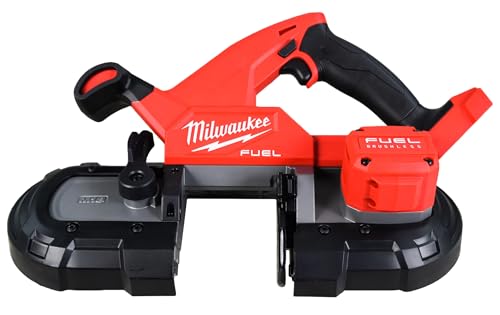
The Milwaukee M18 Compact Band Saw is a cordless cutting tool designed for tradespeople and serious DIYers who need reliable, portable metal cutting. It replaces the original M18 model with a 20% lighter chassis and an upgraded brushless motor, making it easier to handle overhead and in tight spaces.
This band saw excels for electricians cutting conduit, plumbers working with pipe, mechanics modifying brackets, and woodworkers handling metal hardware. The POWERSTATE Brushless Motor works with Constant Power Technology to maintain fast blade speed even under load, delivering what Milwaukee claims is the fastest cutting performance in its class.
Build quality is typical Milwaukee – rugged red housing, a sturdy blade guard, and an ergonomic handle that reduces fatigue. At 7.67 pounds, it’s light enough for one-handed operation for short periods. The compact dimensions allow it to slide into a tool bag or sit neatly on a workshop shelf.
Storage is straightforward – no bulky case is included, but the saw’s small footprint means it won’t dominate your workspace. Maintenance involves occasional blade changes, which are tool-free on this model. Users should note that the saw does not include a battery or charger, so you’ll need existing M18 batteries or plan to purchase a starter kit.
One limitation is the price: at around $274 (tool only), it’s a significant investment for casual users. However, for professionals who cut metal daily, the speed and reduced weight pay off quickly. The saw runs on Milwaukee’s M18 platform, giving access to a huge range of batteries and chargers.
Overall, if you need a cordless band saw that won’t slow you down and is easier to use than previous models, this Milwaukee is a top choice for contractors and dedicated DIYers. It’s best paired with high-capacity M18 batteries for full-day job site use.
In a workshop setting, the Milwaukee M18 Compact Band Saw shines for repetitive metal cutting tasks. Its brushless motor delivers consistent blade speed, reducing the risk of blade stall when cutting thicker materials like rebar or angle iron. The 20% lighter weight compared to the original model makes it easier to guide the saw along a cut line with precision.
The compact size also means it takes up minimal bench space when not in use, and the tool-free blade release speeds up swaps between different tooth configurations. While not a full-size stationary saw, this portable performer is ideal for quick cuts without firing up a larger bandsaw.

Pros
- Compact and well-balanced for overhead cutting or tight mechanical spaces
- Clean cuts on conduit, black pipe, and strut with minimal burrs and no open sparks
- Generous 2.5-inch cutting capacity handles standard electrical and plumbing stock
- Durable reinforced nylon housing built for tough jobsite conditions
Cons
- Sold as a bare tool without M12 battery or charger included
- Lacks a multi-setting variable speed dial for specialty metal applications
The Milwaukee M12 FUEL Compact Band Saw is a cordless, portable cutting solution designed specifically for trade professionals and workshop fabricators who need clean cuts in tight spaces. Operating on Milwaukee's 12-volt lithium-ion platform, this compact band saw offers a convenient alternative to bulky two-handed models or spark-throwing cutoff grinders. It fits naturally into the tool kits of commercial electricians, plumbers, HVAC technicians, mechanical contractors, and home shop fabricators tackling metal fabrication and repair.
In terms of jobsite productivity, this tool is engineered to rip through common materials like EMT conduit, rigid pipe, unistrut, and threaded rod with minimal effort. Running at up to 570 surface feet per minute with a 2.5-inch throat capacity, it delivers swift, clean cuts that require very little deburring. Because a portable band saw utilizes continuous blade movement rather than high-speed grinding, it produces virtually cold cuts with zero hot sparks, making it far safer around sensitive commercial interiors or finished residential basements.
Build quality centers around a durable, reinforced nylon housing that absorbs everyday jobsite impacts without adding unnecessary bulk. Tipping the scales right around six pounds, the balance of the straight handle and motor housing allows for controlled operation when holding conduit overhead or trimming pipe between wall studs. An integrated work light provides direct illumination over the blade contact point, which simplifies following scribe lines in dimly lit mechanical rooms or cramped crawl spaces.
Ease of use is a strong suit here, as standard 30-9/16 inch blades swap out quickly via straightforward blade tensioning mechanisms. As a bare tool, it requires an existing M12 battery and charger, which is fine for current platform owners but represents an added expense for newcomers. While the fixed electronic speed control keeps operation simple, users working with varied alloy compositions might occasionally miss having a multi-position variable speed dial to fine-tune blade speeds for specific hard metals.
For electricians running conduit, plumbers fitting drainage brackets, or garage mechanics seeking spark-free metal cutting, this compact band saw provides an exceptional balance of portability and power. Its modest footprint tucks neatly into a tool tote or job box without eating up prime storage space, while the five-year manufacturer warranty offers strong long-term peace of mind for daily commercial demands.
On active construction sites and retrofit jobs, dragging extension cords or setting up hot-work permits for abrasive chop saws can slow productivity down. The cordless portability of this 12-volt band saw allows tradespeople to trim materials directly at the installation point, whether standing atop a ladder or kneeling inside a mechanical closet.
Its clean cut quality also saves labor down the line. Unlike reciprocating saws that can shake pipe violently or abrasive wheels that throw burning debris, the band saw leaves square, smooth edges on threaded rod and strut that take nuts and fittings right away without intensive filing.
Frequently Asked Questions
What is the cutting capacity of a compact cordless band saw?
A maximum cutting capacity of 2.5 inches by 2.5 inches handles most daily trade tasks. This throat depth easily accommodates EMT conduit, strut channel, angle iron, and threaded rod in a single pass. For larger structural stock, standard deep-cut bandsaw models offer wider clearance, but compact units excel in narrow framing cavities.
Why is a dual trigger setup beneficial on a portable band saw?
Yes, a dual trigger system significantly enhances operator safety during repetitive overhead cuts. Requiring two separate switch actuations ensures both hands remain on the auxiliary and main handles during operation. This layout minimizes accidental blade engagement and keeps fingers clear of the exposed cutting zone.
Can a compact band saw cut hardened steel and galvanized materials?
Yes, these tools cut through galvanized pipe and mild steel when paired with appropriate bimetal blades. Using blades with 14 to 18 teeth per inch ensures clean chip removal without tooth stripping or overheating. When prepping galvanized framing, combining smooth band saw cuts with the best drill bit for galvanized steel streamlines fabrication without tearing up thin metal edges.
What blade speed in feet per minute is best for compact metal cutting?
A blade speed around 570 feet per minute provides the optimal balance of cutting speed and blade longevity for thin-to-medium wall metals. Slower speeds prevent excessive heat buildup that dulls teeth prematurely on dense alloys. Constant power technology helps maintain this FPM rating even when moderate feed pressure is applied during the cut.
Does a brushless motor make a difference in compact band saws?
Yes, brushless motors deliver higher torque under load and noticeably extend battery runtime per charge. Electronic speed control and constant power circuitry keep blade velocity steady so the blade will not bind or chatter in dense workpieces. The absence of carbon brushes also eliminates regular maintenance and reduces internal motor heat buildup.
How often do compact band saw blades need tension and tracking adjustments?
Minimal manual adjustment is required on modern compact band saws equipped with self-adjusting blade guide bearings. Quick-release blade tension levers allow swift blade changes in under a minute without using hex wrenches. Checking the rubber tire condition and clearing stray metal filings regularly ensures the blade remains centered across both drive wheels.



Write Your Review
No reviews yet. Be the first to share your experience!