


Straight, repeatable cuts form the foundation of almost every woodworking and construction project. While handheld tools can tackle rough dimensioning, understanding what a table saw is used for reveals why this stationary machine sits at the center of so many professional shops and home garages. By feeding lumber over an arbor-mounted circular blade rather than moving a tool across a workpiece, you gain immediate control over dimensional accuracy and edge consistency. Whether squaring framing lumber or building custom storage, learning how to make A sled for A table saw can expand your machine’s capabilities even further.
Modern cutting setups range from high-capacity 10-inch jobsite models to miniature hobby saws designed for model makers. The machine excels primarily at long rip cuts and batch crosscutting, but its versatility extends to beveling, rabbeting, and sizing sheet goods like plywood. Matching the tool to the intended cut ensures cleaner surfaces, preserves motor life, and maintains critical workshop safety. Choosing the right benchtop unit, wheeled stand, or compact craft saw depends entirely on the scale of materials you plan to run across the table.

Pros
- Fits a wide range of table saw brands due to adjustable mounting brackets
- Large rubber wheels make moving the stand effortless on flat surfaces
- Rock-solid stability supports heavy stock without tipping or shaking
- Folds quickly and stands upright for minimal storage footprint
- Budget-friendly price point compared to other rolling stands
Cons
- Rubber wheels may not perform as well on very rough or muddy terrain
- Some users may need to drill additional holes for non-standard saw base patterns
- Instruction manual could provide more detail for first-time assembly
The VEVOR Portable Table Saw Stand is a rolling, foldable work surface designed to support a wide range of table saws up to 350 pounds. With its adjustable mounting brackets and 8-inch rubber wheels, this stand aims to make jobsite setup and transport hassle-free. It is best suited for professional contractors, woodworkers, serious DIY enthusiasts, and garage or workshop users who frequently move their saw between locations.
In real-world use, the stand delivers solid stability thanks to its high-strength steel frame. Even when handling heavy or oversized stock, the platform remains steady, reducing vibration and helping maintain cut accuracy. The two large wheels roll easily over concrete, asphalt, and smooth shop floors, cutting down on the physical strain of lifting or carrying a heavy saw. For mobile jobsites, this translates to faster setup and more time spent cutting.
Build quality appears robust for the price point. The steel construction resists flex, and the folding mechanism uses a simple release lever that locks securely when deployed. The mounting brackets allow some lateral and fore-aft adjustment, so it can accommodate many popular table saw brands. The rubber wheels have a non-slip surface and provide decent traction on most surfaces, though they are best suited for smooth or moderately rough terrain.
Storage is a strong point: the stand folds flat and can be leaned against a wall or tucked into a corner, taking up minimal floor space in a garage or workshop. Setup from the box is straightforward, with basic tools required to attach the mounting brackets. Most users can have the stand ready in under 30 minutes. No permanent modification to the saw is needed, and adjustments can be made if you switch saws later.
One realistic limitation is that the wheels are not designed for extremely uneven ground; very rocky or muddy sites may cause the stand to wobble or the wheels to sink. Additionally, if your saw has an unusually shaped base, you may need to drill extra holes for a secure fit. The included instructions are adequate but could be clearer for first-time assemblers. Overall, these are minor trade-offs for a stand that offers this level of portability and strength at an affordable price.
For anyone who needs a mobile table saw solution without breaking the bank, the VEVOR Portable Table Saw Stand is a practical choice. It excels in workshops, garages, and typical construction sites where smooth surfaces are available. The combination of heavy-duty capacity, easy folding, and smooth rolling makes it a strong value for woodworkers and tradespeople looking to improve their jobsite efficiency and storage convenience.

Pros
- Compact size is ideal for small workspaces, garages, and hobby desks
- Dual switches and motors enhance safety and allow independent operation of cutting and polishing functions
- Wide speed range (7 levels) offers flexibility for wood, plastic, and soft metal
- 135-piece accessory set provides good value for beginners and crafters
- Shock-absorbing feet improve stability and reduce noise compared to similar small saws
Cons
- Limited cutting capacity (small worktable) makes it unsuitable for larger lumber or heavy-duty framing
- Power (two 755 motors) is adequate for hobby work but may struggle with thicker hardwoods or prolonged use
- Zero reviews at launch - reliability and long-term durability are unverified by user feedback
The ONEVAN Mini Table Saw is a compact, multi-functional tool designed primarily for crafters, hobbyists, and DIY homeowners who work on small-scale projects. Unlike full-size table saws built for construction sites, this unit focuses on versatility by combining cutting, grinding, engraving, and drilling capabilities into one machine. It comes with a generous 135-piece accessory set, making it an all-in-one solution for detailed woodworking, model making, jewelry crafting, and light home repairs.
One of the standout features is the dual-motor, dual-switch design. Each motor has its own switch, so you can activate either the cutting or the polishing function independently. This arrangement significantly improves safety by preventing accidental simultaneous starts. The two 755 motors can each reach up to 9,000 RPM, and the included 7-speed adjustable power adapter lets you dial in the right speed for the material at hand. Whether you are cutting balsa wood, engraving acrylic, or polishing small metal parts, you have decent control over the tool's behavior.
In terms of build quality, the saw feels sturdy for its size. The worktable includes a precise 10 cm scale and a 90-degree adjustable guide fence, which helps achieve reasonably accurate cuts on small workpieces. The newly designed shock-absorbing rubber feet are a practical addition, reportedly reducing vibration by 75%. This is a real advantage when working on delicate tasks, as it keeps the saw stable and reduces the chance of the piece shifting during operation. A dust collection tube and an internal blade compartment help keep sawdust from building up around the motors, which should prolong motor life and simplify cleanup.
However, it is important to set realistic expectations. This is a mini table saw, so its cutting capacity is limited to small stock. The work surface measures only 7 x 5.5 inches, meaning you cannot rip full-sized plywood sheets or dimensional lumber. The motors are also relatively low-power compared to full-size saws, so attempting to cut thick hardwoods or dense materials may bog down the blade and produce poor results. Setup is straightforward, and the included accessories cover a range of functions, but some users may find the plastic accessories less durable than metal alternatives.
For storage and maintenance, the saw's compact footprint (about 6.3 pounds) makes it easy to tuck away on a shelf or in a toolbox. The dust collection tube can be connected to a shop vac for better debris control. Over time, you will need to keep the blade compartment clean and occasionally lubricate moving parts, but the design seems straightforward to maintain. There are no reviews yet on Amazon, which is a consideration - you are essentially buying based on specifications and the brand's reputation rather than verified user experiences.
Overall, the ONEVAN Mini Table Saw is a reasonable choice for hobbyists, crafters, and DIY homeowners who need a small, multi-function machine for light-duty projects. It is not meant for professional construction or heavy woodworking, but for creating crafts, small furniture details, or engraving tasks, it offers good value given the included accessories and safety features. If you are looking for a shop tool that fits on a desk and handles multiple small jobs, this saw may work well for you.

Pros
- Dedicated dual-motor setup prevents bogging down when switching between cutting and grinding
- Accurate angle and blade height adjustments provide clean results on fine scale models
- Substantial aluminum build and rubber dampening feet keep the benchtop steady during operation
- Generous accessory bundle allows immediate work on wood, plastic, soft metals, and circuit boards
Cons
- Maximum 15mm cutting depth limits usage strictly to small crafts, veneers, and thin stock
- Compact 8 by 4 inch deck requires auxiliary outfeed support when handling longer pieces
The Nicklaua Mini Table Saw is a specialized benchtop power tool designed for detailed, small-scale cutting and fabrication. Unlike standard jobsite saws built for framing lumber, this compact machine is tailored for hobbyists, scale model makers, DIY crafters, luthiers, and electronics tinkerers. Its compact footprint makes it a natural fit for small workshops, apartment craft rooms, or crowded garage workbenches where full-size machinery is impractical.
Under the hood, the unit relies on two independent 795 pure copper motors paired with dual dedicated switches. One motor drives the cutting arbor while the other handles secondary tasks like grinding, sanding, and rotary detail work. This isolated layout prevents users from running both functions simultaneously, which protects the internal circuitry from thermal overload and accidental engagement. Paired with a seven-speed adjustable power brick, the system produces up to 200W of power and spins up to 15000 RPM, delivering the high blade speed necessary for tear-out-free cuts in balsa, basswood, and delicate plastics.
Precision is essential for miniature joinery, and the mechanical adjustments on this saw accommodate tight tolerances. The blade carriage allows for vertical travel between 0 and 16mm, letting you match the blade exposure directly to your stock thickness or cut shallow slots and dados. The front face features clear angle markings with an adjustable miter guide capable of swinging from 0 to 90 degrees, making picture frame miters and miniature furniture angles straightforward to set up and repeat.
Build quality centers on a machined aluminum alloy deck that resists flexing and dissipates motor heat during longer crafting sessions. Changing blades on miniature tools can often be frustrating, but the housing incorporates an exterior access window secured by two screws, eliminating the need to take the entire frame apart. An internal blade chamber keeps flying sawdust isolated from the electrical components, and an exterior extraction port allows connection to a shop vacuum for a cleaner workspace.
While this tool offers tremendous utility for miniature fabrication, it has distinct boundaries. The maximum cut depth of 15mm means it cannot process standard dimensional lumber, framing materials, or thick hardwoods. Feeding long strips of material also requires a steady hand or improvised outboard support due to the small table surface. However, for builders working on architectural models, custom RC components, miniature trim, or printed circuit boards, this machine provides an accurate, space-saving cutting and sanding hub that handles detail work with confidence.
The 24T precision transmission and 795 motor configuration provide consistent rotational momentum when feeding dense craft materials like thin plywood, acrylic, and non-ferrous tubing. Maintaining the proper feed rate avoids stalling, and adjusting the 7-speed power supply allows you to drop the RPMs to prevent heat-sensitive plastics from melting during slow cuts.
Vibration control is reinforced by thick rubber feet on the bottom plate, which keep the unit firmly planted on smooth work surfaces without needing permanent bolt-down mounting. The included multi-jaw drill chuck easily accepts standard 0.5 to 3.2mm accessory shanks, enabling quick transitions from cutting small pieces to edge-sanding and deburring right at your primary workbench.

Pros
- Cuts multiple materials (wood, metal, composites) without changing blades, saving time and effort
- Fence system is accurate and stays square, ideal for repeatable ripping and crosscutting
- Safety features like blade brake and anti-kickback pawls provide peace of mind on busy job sites
- Portable design with carry handles and onboard storage makes it easy to move between work areas
- Powerful 15A motor handles demanding cuts without bogging down, even in dense materials
Cons
- Weighs 60 pounds, which may be heavy for some users to lift into truck beds or up stairs
- Price is higher than basic contractor saws, though the multi-material capability justifies the cost for frequent users
- Bevel adjustment mechanism may require a brief learning curve to achieve precise angles consistently
The Evolution R10TS is a 10-inch jobsite table saw designed for contractors, woodworkers, and serious DIYers who need a versatile machine that handles more than just wood. Unlike traditional table saws limited to lumber, this model can cut mild steel, aluminum, and composites thanks to its included 10-inch TCT blade and high-torque 15A motor. It's a practical choice for anyone working on home renovations, metal fabrication, or mixed-material projects where switching tools would slow you down.
Performance-wise, the R10TS delivers smooth, clean cuts across a range of materials. The 15A motor features soft start to reduce startup torque, and it provides enough power to rip through 3-3/8-inch thick stock or sheet goods with a 26-inch rip capacity. The 0-45 degree bevel adjustment uses a geared angle selector for precise settings, and the dual rack and pinion fence system allows micro-adjustments for repeatable accuracy. Users will appreciate the tool-free parallel blade alignment and sway-free height adjustment, which help maintain cut quality over time.
Build quality is solid for a jobsite saw. The steel frame feels sturdy, and the integrated carry handles make it relatively easy to move despite the 60-pound weight. Onboard storage keeps the blade, wrenches, and accessories organized, and the outfeed support bar adds stability when handling large panels. Safety is well-addressed with an electronic blade brake that stops the blade quickly, anti-kickback pawls, a quick-release riving knife, and a large paddle switch for emergency shutoff. The height-adjustable steel blade throat also helps reduce vibration and improve cut stability.
Portability and storage are key strengths for a jobsite tool. The saw's compact footprint (29 x 29 x 15 inches) fits easily in a truck bed or workshop corner, and the carry handles are well-placed for balanced lifting. Some assembly out of the box is required, but the process is straightforward with clear instructions. Maintenance is minimal: keep the blade clean, check the fence alignment periodically, and store it in a dry area to prevent rust on the steel surfaces.
Realistic limitations include the weight, which may be a concern for users who need to carry it up stairs or load it alone. The price is also higher than basic contractor saws, but the multi-material capability and included TCT blade offer good value for those who need versatility. The bevel adjustment, while precise, may take a few tries to get used to, especially for beginners. Additionally, the saw is not designed for fine woodworking joinery out of the box, though it handles general framing and remodeling tasks well.
Overall, the Evolution R10TS is a strong recommendation for contractors, woodworkers, and DIY enthusiasts who frequently cut multiple materials. It combines power, portability, and safety features that suit jobsite and workshop environments. While it may be overkill for occasional home repairs, anyone who values time savings and cut quality across wood, metal, and composites will find this saw a worthwhile investment.
Pros
- Powerful 15-amp motor easily handles hardwoods and thick stock
- Rack-and-pinion fence is fast, smooth, and locks square for accurate cuts
- Rolling stand is sturdy and folds for easy transport and storage
- Large rip capacity (32-1/2 inches) suits sheet goods and shelving
Cons
- Weighs 110 pounds, which may be heavy for some users to lift onto stands or vehicles
- Price is premium compared to entry-level saws, reflecting professional-grade features
- Dust collection port (2-1/2 inch) may require adapter for standard shop vac hoses
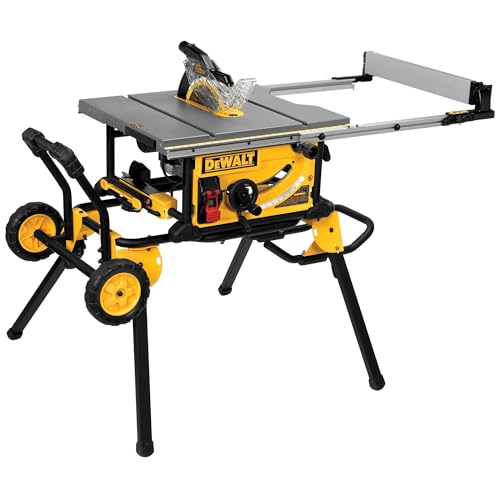
The DEWALT DWE7491RS is a 10-inch jobsite table saw designed for contractors, woodworkers, and serious DIY enthusiasts who demand portability without sacrificing cutting power. This saw combines a 15-amp motor that spins at 4800 RPM with a 32-1/2-inch rip capacity, making it suitable for ripping plywood, hardwood, and pressure-treated lumber. The rack-and-pinion telescoping fence system allows for quick, smooth, and accurate adjustments, which is a standout feature for those who need repeatable precision on the jobsite or in the workshop.
For users tackling home renovations, furniture building, or framing, the saw's power and fence accuracy help improve productivity and reduce material waste. The patented material support and flip-over ripping fence enable narrow rip cuts, adding versatility for custom trim work or dado cuts. The rolling stand is a key practical feature, designed for easy setup and breakdown with telescoping rails that retract for compact storage. This makes the saw a solid choice for mobile contractors who move between job sites frequently.
Build quality is typical of DEWALT's professional line, with a sturdy steel table and durable components that can withstand worksite abuse. The onboard storage system keeps the blade guard, riving knife, miter gauge, wrenches, and push stick organized and within reach, reducing the chance of losing small parts. The 2-1/2-inch dust collection port connects to a vacuum for cleaner operation, though some users may need an adapter for standard shop vac hoses.
One realistic limitation is the saw's weight of 110 pounds, which, while manageable on the rolling stand, can be heavy to lift into a truck bed or up stairs. The price also reflects its professional-grade features, so budget-conscious DIYers may find it an investment. However, for those who prioritize accuracy, power, and portability, the DWE7491RS offers strong long-term value. Based on product specifications and user feedback, this saw is best suited for contractors, serious woodworkers, and homeowners who frequently tackle large projects and demand reliable performance from their tools.
Pros
- Rack-and-pinion fence system ensures consistent fence alignment for accurate cuts
- Folding stand design saves floor space and makes the saw easy to move between job sites
- Micro-adjustment for blade parallelism allows precise tuning without guesswork
- Positive bevel stops at 0 and 45 degrees speed up common angle changes
- Dust port elbow simplifies sawdust management for a cleaner workshop environment
Cons
- Weighs 51 pounds, which may be heavy for some users to lift into a truck or up stairs
- Stock blade may not be suited for fine woodworking; many users may upgrade to a higher-quality blade
- Limited rip capacity compared to larger cabinet saws; not ideal for breaking down full sheets of plywood
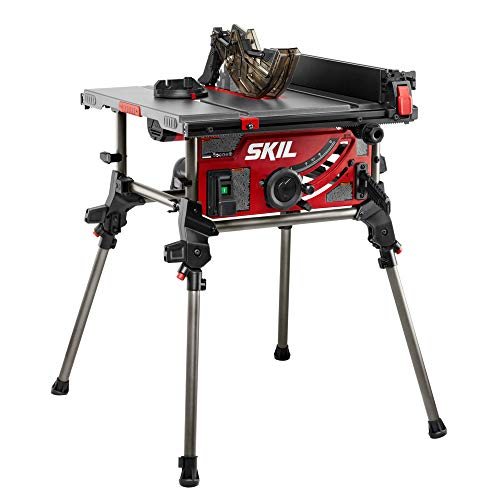
The SKIL 15 Amp 10 Inch Portable Jobsite Table Saw with Folding Stand (model TS6307-00) is a versatile, mid-range table saw designed for a wide range of users. It fits well in DIY home workshops, contractor job sites, woodworking shops, and garage spaces where portability meets accuracy. Whether you are framing a deck, building furniture, or making quick cuts for home repairs, this saw aims to deliver reliable performance without taking up permanent floor space.
Based on product specifications, the saw features a 15-amp motor that provides enough power to rip through 4x4 lumber at 90 degrees and handle most common construction and hobby materials. The rack-and-pinion fence system is one of its standout features. It keeps the fence parallel to the blade, which helps maintain consistent cut accuracy from the front to the back of the blade. This is especially beneficial for repeat cuts when building cabinets, shelving, or trim work.
The integrated folding stand is a major convenience for those who need to set up and break down quickly. The legs fold in without tools, and the saw can be stored upright or laid flat. This makes it easier to transport in a truck bed or SUV, and to stash in a corner of the garage. The parallel blade alignment micro-adjustment allows you to fine-tune the blade so it runs exactly parallel to the miter slot and rip fence. This attention to alignment can improve cut quality and reduce binding.
For bevel cuts, the saw has a quick-release lever and positive stops at 0 and 45 degrees, with a range up to 47 degrees. This design lets you switch between square cuts and common bevels quickly. The dust port elbow is a practical addition that directs sawdust toward a collection bag or shop vac. While not a full dust collection system, it does help keep the work area cleaner, reducing cleanup time.
One realistic limitation is the saw's weight at just over 51 pounds. While this contributes to stability during cuts, it can be heavy to lift into a high truck bed or up stairs. Also, the included blade is adequate for general construction but may not satisfy fine woodworkers looking for ultra-smooth cuts. Many users may choose to upgrade to a higher-quality blade for better results. Additionally, the rip capacity is limited compared to larger cabinet saws, so breaking down full sheets of plywood may require some creative workarounds.
Overall, the SKIL TS6307-00 offers a solid balance of power, portability, and accuracy for its price point. It is well-suited for DIY homeowners, contractors, woodworkers, and anyone who needs a reliable jobsite table saw that can be stored compactly. If you prioritize easy setup, dependable fence alignment, and the ability to tackle 4x4 material, this saw is a worthwhile option to consider for your workshop or job site.

Pros
- Excellent rip capacity for a compact saw
- Smooth and accurate fence adjustment system
- Sturdy metal roll cage base for durability
- Onboard storage keeps accessories organized
- Tool-free guard adjustments save time
Cons
- At 54 pounds, it's not the lightest portable saw
- Some users may prefer a larger table surface for wider cuts
- Limited to 8-1/4 inch blades, which may require specialty blades for certain cuts
The DEWALT DWE7485 is a 15-amp compact portable jobsite table saw designed to deliver professional-grade cutting performance without taking up too much space. With an 8-1/4 inch blade and a 24.5-inch rip capacity, this saw can handle full sheets of plywood and OSB, making it a versatile tool for contractors, woodworkers, and serious DIYers who need to break down materials on site.
One of the standout features is the rack and pinion telescoping fence rails. This system allows for fast, smooth, and accurate fence adjustments, which translates to cleaner cuts and less wasted material. The fence locks securely in place, and the scale is easy to read, so you can set up repeat cuts quickly. For anyone working on framing, cabinetry, or furniture projects, this accuracy is a real time-saver.
Durability is another strong point. The metal roll cage base protects the saw's internal components from the bumps and drops that come with jobsite use. The Site-Pro Modular Guarding System makes guard adjustments tool-free, so you can switch between different cutting modes without hunting for a wrench. The power-loss reset feature is a practical safety addition, preventing accidental startups after a power outage.
Portability and storage are well thought out. The saw is compact, and onboard storage for the guard, fence, wrenches, and miter gauge means you won't lose small parts. At 54 pounds, it's not the lightest option, but the built-in handles make it manageable for one person to load into a truck or carry up stairs. The footprint is small enough to store in a garage or workshop without taking up too much floor space.
That said, there are a few limitations to consider. The 8-1/4 inch blade size means you won't get the same depth of cut as a full-size 10-inch saw, which could be a factor for thicker materials. Some users might also wish for a larger table surface to support wider panels, though the saw does come with a rolling stand option (sold separately) that can help. The price point is reasonable for the quality, but it's an investment for hobbyists on a tight budget.
Overall, the DEWALT DWE7485 is a solid choice for anyone who needs a reliable, accurate, and durable jobsite table saw. Contractors will appreciate the portability and rip capacity, while woodworkers and DIYers will like the precision and ease of use. If you're looking for a saw that can handle daily abuse and still deliver clean cuts, this model is worth a serious look.
Understanding Table Saw Capabilities, Cut Types, and Material Applications
A table saw is primarily designed to cut solid timber, sheet goods, and composite boards to exact widths and lengths with consistent repeatability. Unlike handheld circular saws where the operator steers the tool along a marked line, a table saw remains fixed while the material slides smoothly over a flat cast-metal or aluminum deck. This mechanical arrangement references the workpiece against a rigid fence or miter guide, eliminating the slight wobble and wandering common to handheld tools. Understanding these baseline mechanics explains why carpenters, cabinetmakers, and serious hobbyists treat the tool as an indispensable centerpiece.
Primary Cutting Operations: Ripping and Crosscutting
The single most common task assigned to a table saw is the rip cut. Ripping involves severing a board along the length of its wood grain to reduce its overall width. Doing this by hand or with a jigsaw frequently results in wavy edges that require extensive planing or jointing afterward. The table saw uses an adjustable rip fence aligned precisely parallel to the blade to keep the cut straight from start to finish. Models like the DEWALT DWE7491RS and Evolution R10TS feature rack-and-pinion fence adjustments that allow users to dial in measurements down to fractional increments quickly.
Crosscutting, which cuts across the wood grain to reduce board length, is another core task handled by the table saw. For standard crosscuts, woodworkers use a miter gauge sliding inside an engineered slot on the table surface. The miter gauge supports the end grain perpendicular to the blade, pushing the board safely past the spinning teeth. While dedicated chop saws handle simple crosscuts quickly, crosscutting on a table saw allows for wider boards and specialized compound joinery that small saws cannot clear.
Crosscuts require strict adherence to workholding rules to prevent hazardous binding. Operators should never use the rip fence as a stop block during crosscutting operations because the cut cutoff piece can easily wedge between the fence and the spinning blade, launching backward toward the user. Instead, pairing the miter gauge with an auxiliary block clamped well before the blade provides an accurate length stop without trapping the offcut. Taking the time to understand how stock behaves during both cut types keeps operations clean and safe.
Processing Sheet Goods and Plywood Panels
Breaking down full four-by-eight-foot sheets of plywood, MDF, or OSB represents a major task on residential jobsites and in cabinet shops. Because these large composite panels lack grain direction, they can be processed in any orientation as long as the table saw provides sufficient rip capacity. Portable jobsite units are specially engineered with telescoping fence rails to accommodate these expansive widths without requiring massive cast-iron extensions. For example, a 32-1/2-inch rip capacity enables an operator to slice through the center of a wide cabinet panel easily.
Managing oversized panels on smaller compact saws requires proper infeed and outfeed planning. Compact units such as the DEWALT DWE7485 offer 24.5 inches of rip capacity, which handles half-sheets and standard shelving stock comfortably while remaining easy to lift into a truck bed. If you feed large sheets through any compact machine without outfeed support, the heavy overhang can tip the material up, lifting it off the blade and ruining the cut line. Utilizing built-in rear support bars or rolling outfeed stands keeps sheets flat against the table deck throughout the pass.
The choice of saw blade also plays a vital role when cutting delicate veneered plywood. Standard framing blades with low tooth counts tend to tear out the thin surface veneers, leaving ragged, splintered edges unsuitable for cabinetry. Equipping a 10-inch or 8-1/4-inch table saw with a 60-tooth or 80-tooth carbide-tipped blade creates clean, glue-ready edges on prefinished birch or melamine. Matching the feed speed to the density of the panel prevents burning while keeping the motor running within its optimal power band.
Beveling, Mitering, and Compound Angled Cuts
Table saws are not limited to 90-degree square cuts; their internal trunnion systems tilt the arbor to produce accurate beveled edges. Most modern saws allow bevel adjustments from 0 to 45 degrees, with models like the Skil TS6307-00 extending up to 47 degrees for clean corner relief. Beveled rip cuts are essential when crafting French cleats, bevel-edged trim, column wraps, or chamfered architectural posts. Geared angle selectors and positive mechanical stops allow operators to lock the blade firmly at standard angles like 22.5 and 45 degrees.
Mitered cuts are created by swiveling the miter gauge inside its track across the face of the table. Combining an angled miter gauge setting with a tilted saw blade produces a compound cut, which is commonly used in shadowboxes, flared planters, and complex roof transitions. Although compound cuts demand meticulous setup, the rigid guide slot maintains absolute consistency across multiple identical pieces. This precision makes the machine far more reliable for repeated angled work than attempting freehand adjustments with handheld cutting tools.
Checking table saw alignment before attempting fine bevel work guarantees that the angle on the digital readout or scale matches the actual cut. Using an accurate square or digital angle finder against the blade plate confirms true vertical alignment at zero degrees. Operators should verify that the blade teeth do not tilt into the throat plate opening during heavy bevels. Ensuring adequate clearance around the blade insert prevents friction, heat buildup, and unnecessary blade deflection.
Joinery, Grooving, and Dado Operations
Beyond separating wood into smaller pieces, table saws serve as dedicated joinery machines for fine furniture and built-in shelving. By lowering the blade height below the top surface of the stock, you can make non-through cuts that form rabbets, grooves, and tenons. Cutting a groove down the inside edge of cabinet rails and stiles allows for the insertion of floating center panels. Similarly, running two intersecting non-through cuts along the edge of a board quickly produces a clean rabbet joint for cabinet box construction.
Dado cuts involve milling a flat-bottomed trench across the face or width of a board to house shelves, drawer dividers, or partitions. Certain 10-inch table saws feature extended arbors capable of accepting stacked dado blade sets, which widen the cutting path in a single pass. When using standard blades on saws that do not accept dado stacks, operators can make multiple overlapping kerf passes to hog out the required trench width. Using a crosscut sled provides exceptional stability and depth control for these delicate woodworking operations.
When cutting non-through joinery, standard riving knives and blade guards that mount directly over the blade must be temporarily adjusted. Modern jobsite saws feature tool-free modular guarding and quick-release low-profile riving knives designed specifically to remain below the blade crest during non-through operations. This feature preserves essential kickback protection without blocking the board from passing freely over the blade. Always reinstall the full protective barrier assembly once standard through-cutting resumes.
Specialized Multi-Material and Non-Wood Applications
While wood remains the primary focus for table saws, modern motor engineering and advanced blade compositions have expanded the machine’s material palette. Multi-material saws like the Evolution R10TS utilize high-torque 15-amp motors paired with specialized tungsten-carbide-tipped blades to cut through mild steel, aluminum, plastics, and composites. Cutting thin non-ferrous metals or plastic trim on a jobsite eliminates the need to transport separate chop stations, streamlining construction workflows significantly.
Cutting metals and dense plastics requires careful attention to cutting speed, chip ejection, and blade tooth geometry. If you are exploring alternative tools for cutting metal profiles, reviewing whether you can cut aluminum with a miter saw provides helpful insight into tooth pitch and blade requirements. Table saws cutting aluminum or plastics must maintain steady feed pressure to prevent melting or blade binding. Wearing full-face eye protection is critical because metal chips fly faster and hotter than typical wood sawdust.
Plastics and acrylic sheets also demand dedicated cutting strategies to avoid chipped edges or fused seams. High tooth count blades with triple-chip grind teeth dissipate heat efficiently and cut smoothly through brittle acrylics and PVC sheets. Operators must ensure the material stays firmly pressed against the table bed, as flexible plastic sheets tend to flutter if unsupported. Proper dust collection is equally critical, as synthetic debris can coat internal mechanical gears and impede fence movement if allowed to accumulate.
Craft, Modeling, and Miniature Table Saw Work
Not every cutting task requires a heavy 15-amp jobsite saw; miniature and craft table saws fulfill a specialized role for delicate, small-scale work. Hobbyist units like those from Nicklaua and ONEVAN are built specifically for dollhouse construction, model railroading, architectural modeling, and printed circuit board trimming. These compact tools use small 63mm blades and dual high-speed motors to achieve rotational speeds up to 15,000 RPM, delivering surgical precision on thin balsa, basswood, and plastic extrusions.
Craft saws feature specialized blade selections, including high-speed steel, resin cutoff wheels, and diamond or alloy blades. With cutting depths typically capped around 15mm to 16mm, they allow makers to slice thin strip wood, copper tubes, and acrylic without splintering fragile stock. Many miniature workstations also integrate auxiliary sanding discs, flexible rotary shafts, and drilling chucks directly into the side of the housing. This all-in-one footprint makes them ideal desktop tools for intricate craft environments where full-sized power tools would destroy delicate workpieces.
Controlling vibration is a major engineering consideration on benchtop craft units. Manufacturers counter motor vibration by incorporating weighted aluminum alloy decks and thick, shock-absorbing rubber feet. Dual-switch electrical interlocks keep cutting and sanding motors separated, ensuring the operator never accidentally activates an exposed rotary accessory while feeding small parts. For model builders who work with microscopic tolerances, these compact tools provide control that full-scale workshop equipment simply cannot match.
Jobsite Mobility, Rolling Stands, and Shop Workflows
A table saw’s utility relies heavily on its stability and portability across changing work environments. For residential contractors and mobile carpenters, folding rolling stands transform heavy cutting tools into easily transportable units. Universal aftermarket stands like the VEVOR Portable Table Saw Stand support up to 350 pounds and feature large rubber wheels that roll easily over jobsite debris, gravel, and rough subfloors. Saws like the DEWALT DWE7491RS come integrated with heavy-duty wheeled frames designed to unfold with a single lever press.
Working on a stable base is directly tied to cutting accuracy and operator safety. When feeding an eight-foot piece of framing lumber across a table saw, any wobble or flex in the stand can cause the blade to bind or twist inside the kerf. Quality stands incorporate wide tubular steel legs and solid locking mechanisms that prevent lateral shifting during heavy push cycles. Quick-fold designs also allow the saw to be stored upright against a garage wall or tucked neatly beneath workshop benches when floor space is at a premium.
Managing dust and debris on the jobsite is another critical factor in maintaining equipment longevity. Most 10-inch and compact jobsite saws include integrated 2-1/2-inch dust ports that attach directly to standard shop vacuums. Efficient chip collection prevents sawdust from clogging the rack-and-pinion fence tracks and the geared blade-elevation mechanisms under the table. Clean elevation gears ensure that blade height and bevel angles adjust smoothly without binding or requiring excessive force.
Core Safety Practices and Essential Operation Rules
Operating a table saw safely requires understanding the physical forces generated by a high-speed spinning blade. Kickback is the primary hazard on any table saw, occurring when wood pinches the back teeth of the blade or twists away from the fence. Modern saws minimize this risk through three integrated devices: a riving knife that keeps the cut kerf open behind the blade, anti-kickback pawls that grip the board if it moves backward, and a clear blade guard that keeps hands away from the cutting line. Operators should never remove the riving knife during through-cutting procedures.
Body positioning and push stick mechanics are fundamental to keeping hands safely away from the arbor. The operator should stand slightly to the side of the blade rather than directly behind the workpiece, avoiding the direct trajectory path of any potential kickback. Push sticks or push blocks must always be used whenever ripping narrow stock where the rip fence sits close to the blade. Applying forward and downward pressure simultaneously ensures the workpiece remains flat against the table deck and flush against the guide fence throughout the cut.
Regular maintenance ensures that your table saw continues to deliver safe, accurate cuts across its entire service life. Routine inspections should confirm that the blade remains strictly parallel to the miter slots and that the rip fence locks down dead parallel to the blade plate. Accumulations of pitch and resin should be cleaned from blade teeth periodically using dedicated solvent cleaners to prevent heat buildup and friction burn. Disconnecting power before swapping blades, adjusting internal stops, or vacuuming mechanical housings ensures you can configure the tool with complete peace of mind.
Matching your cutting tool to the actual scale of your project is the final key to achieving professional results. Full-size 10-inch jobsite saws tackle dimensional lumber, cabinetry panels, and multi-material stock with high-torque electric motors and expansive rip fences. Meanwhile, compact craft saws bring precision and control to hobby work, model making, and light decorative trims. Understanding the distinct operational strengths of each design ensures that every cut in your workshop is executed smoothly, accurately, and safely.




Write Your Review
No reviews yet. Be the first to share your experience!