


Tackling Dense Hardwood Without Stalling Your Powerhead
Heavy guide bars often bog down when sinking deep into dense, green hardwood rounds. Long cuts pack the bar groove with sawdust, creating severe friction that drains engine rpm and overheats your cutting setup. Upgrading to a skip tooth chainsaw chain provides the extra clearance needed to eject chips cleanly before the teeth take another bite. By spacing cutters further apart along the drive links, this chain pattern reduces drag on your saw engine, letting a mid-range powerhead pull a 20-inch or longer guide bar with remarkable ease. Whether you are bucking firewood cords or felling storm-damaged timber, matching the right chain pitch and gauge to your power plant makes all the difference in cutting speed.
Based on our detailed comparison of powerhead displacement, bar lengths, and user feedback, running fewer cutters also saves precious time at the sharpening bench. When you tackle heavy timber chores alongside workshop tasks like using a drill for wood to build sturdy sawbucks, efficient cutting tools keep your entire operation moving forward. We evaluated steel toughness, rivet hardness, and cutter geometry to help you pick a replacement loop that holds an edge through gritty bark and long workdays.
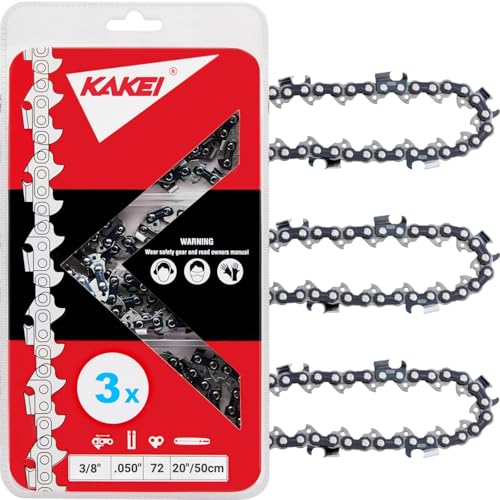
Pros
- Skip-tooth profile reduces saw bogging when burying a 20-inch bar in wide logs
- Chrome-plated cutters stay sharp through multiple cords of clean wood
- Fewer cutters on the skip pattern make routine field filing significantly faster
- Solid value three-pack reduces per-chain replacement costs for busy operators
Cons
- Aggressive full-chisel design presents higher kickback risk and requires experienced handling
- Full-chisel corners dull quicker than semi-chisel profiles if contacting dirt or sandy bark
- Produces a coarser finish cut that is geared toward bucking rather than clean carpentry
The KAKEI 20-inch skip-tooth chainsaw chain is a high-output cutting accessory built for power equipment utilizing a 3/8-inch pitch, .050-inch gauge guide bar with 72 drive links. Designed with an aggressive full-chisel tooth profile spaced in a skip-tooth layout, this chain excels at clearing large chips out of deep cuts. It caters to experienced landowners, farm operators, arborists, and firewood processors who demand fast cutting rates when sectioning medium to large hardwood and softwood logs.
Real-world performance centers on cutting efficiency and saw balance. By providing wider spacing between working cutters, the skip-tooth arrangement requires less horsepower to pull through dense timber compared to standard full-complement chains. This characteristic helps mid-range saws maintain high chain speed without bogging down in 18- to 20-inch logs. The sharp full-chisel corners slice across wood grain cleanly, maximizing cutting production during seasonal firewood preparation or lot-clearing tasks.
Material quality is evident in the manufacturing choices. KAKEI uses German steel with controlled heat treating to produce a flat, resilient chain chassis that resists stretching under load. Rivets are quenched and hardened to minimize friction-induced wear at the tie-strap connections, helping the chain retain proper tension longer. Japanese chrome plating applied to each cutter face provides substantial surface hardness, reducing thermal wear and preserving the sharp edge across tough cutting jobs.
Maintenance and storage are very manageable. Because each loop features fewer cutters than a standard chain, hand-sharpening with a round file takes significantly less bench time. The three chains arrive coated in protective corrosion-inhibiting oil, allowing spare loops to rest inside a workshop drawer, garage cabinet, or chainsaw carry case without developing surface rust until needed.
A critical consideration is operator skill level and safety. This chain does not feature reduced-kickback bumper drive links, meaning it can produce severe kickback if the bar nose contacts limbs or pinch points incorrectly. Casual DIY users or beginner operators should seek low-kickback safety chains instead. Additionally, full-chisel teeth are sensitive to abrasive ground contact, making this setup best suited for clean, elevated bucking and felling.
For operators running compatible models such as the Husqvarna 455 Rancher, Husqvarna 460 Rancher, or Stihl MS311 and MS391 fitted with matching bar specs, this KAKEI three-pack offers a dependable, budget-conscious cutting solution that keeps chain saws operating at peak productivity.
The skip-tooth sequence on this 72-drive-link chain provides generous chip clearance space in the bar groove. In deep cuts where standard chains often pack with wood shavings, the extra gap allows sawdust to exit freely, reducing bar friction and motor strain.
Coupled with square-cornered full-chisel cutters, the chain delivers aggressive self-feeding action in both green timber and seasoned firewood. This configuration is particularly beneficial for operators using 50cc to 60cc saws who want to run a 20-inch bar without sacrificing engine RPM.
Matching your saw configuration is essential before ordering. This chain requires a 20-inch guide bar with a 3/8-inch pitch, .050-inch (1.3 mm) drive link gauge, and exactly 72 drive links. It fits select Husqvarna, Stihl, Poulan Pro, and Craftsman saws equipped with standard 3/8-inch sprockets and bars.
Always verify the stamped numbers on the tail end of your chainsaw guide bar to confirm drive link count, pitch, and gauge, as bar mount patterns and drive sprocket teeth can vary across specific model production years.
Frequently Asked Questions
What is the main advantage of a skip tooth chainsaw chain?
A skip tooth chainsaw chain cuts down on engine drag while significantly improving chip clearance in wide logs. Because there is a wider gap between cutting teeth, each cutter takes a bite without packing the guide bar groove with excess debris. This spacing allows saws with moderate engine displacement to pull longer bars through dense timber without stalling.
Is a skip tooth chainsaw chain safe for inexperienced woodcutters?
No, skip tooth loops carry a higher risk of severe kickback hazard compared to semi-chisel or low-kickback safety chains. With fewer cutters contacting the wood at any given moment, the chain can grab aggressively if the bar nose contacts limbs or knots. Operators should always have solid experience, maintain a firm grip on the anti-vibration handle, and ensure the inertia chain brake operates correctly before running these chains.
How do pitch, gauge, and drive links determine chain fitment?
Every saw requires an exact match between chain pitch, chain gauge, and the overall drive link count. Pitch measures the distance between drive links, gauge represents drive link thickness inside the bar groove, and the link count determines total loop length. For instance, pairing a 3/8-inch pitch and .050-inch gauge chain with a 72-link guide bar ensures seamless alignment with the drive sprocket and smooth lubrication from the automatic chain oiler.
Does a skip tooth chain take less time to sharpen?
Yes, sharpening takes far less time because a skip sequence features roughly one-third fewer cutters than a standard full-complement chain. Woodcutters spend less time with a round file and depth gauge tool in the field, getting back to firewood bucking or storm cleanup quickly. Maintaining equal cutter angles remains vital to ensure straight, chatter-free cuts through seasoned logs.
Can I run a skip tooth chainsaw chain on small guide bars under 20 inches?
While technically possible if specs match, running a skip tooth chain on guide bars shorter than 20 inches is generally not recommended. Shorter bars do not produce enough wood chips to cause friction drag, so standard chains provide a much smoother cut. When building heavy wooden sawhorses or bucking stands for shorter logs, pairing solid lumber with quality drill bits for impact driver fasteners helps create a stable cutting station for your saw work.



Write Your Review
No reviews yet. Be the first to share your experience!