


Achieving clean, repeatable crosscuts and crisp joinery often starts with understanding your cutting station before ever squeezing the switch. Learning how use miter saw setups properly allows woodworkers, trim carpenters, and home renovators to make tight miter joints, square framing cuts, and accurate bevels without tear-out or dangerous kickback. Whether trimming out door casings or prepping structural lumber, knowing the fundamental mechanics behind your saw helps you work faster and significantly safer.
Different cutting tasks require distinct approaches to blade selection, workholding, and feed rate. If you plan to cut diverse materials like plastics or non-ferrous metals alongside dimensional lumber, pairing your saw with a dedicated blade to cut aluminum or specialized plastics can keep edge burrs to a minimum. Let us review the primary tool configurations and essential methods needed to operate these precision saws with total confidence.

Pros
- Lightweight and portable at only 30 lbs., easy to carry between job sites or store in small spaces
- Cut line indicator system improves accuracy and reduces material waste, great for trim and crown molding work
- Stainless steel miter detent plate resists wear and corrosion, maintaining precision over time
- Adjustable bevel and miter stops allow quick setup for common angles, boosting productivity
- Compatible with DEWALT 20V MAX battery system, eliminating cords and allowing use in remote locations
Cons
- Tool-only purchase means you need a separate battery and charger, adding to the upfront cost if not already in the DEWALT 20V MAX system
- 7-1/4-inch blade limits cutting capacity compared to larger 10 or 12-inch miter saws, not ideal for heavy dimensional lumber
- Plastic blade guard may feel less rugged than all-metal guards, though it helps keep weight down
The DEWALT DCS361B is a 20V MAX cordless 7-1/4-inch miter saw designed for professionals and serious DIYers who need a compact, portable solution for trim work, light framing, and detailed cuts. As a tool-only model, it relies on the DEWALT 20V MAX battery platform, making it a natural addition for those already invested in that system. This saw is best suited for contractors, woodworkers, electricians, and homeowners tackling crown molding, baseboards, and other finish carpentry projects.
Performance-wise, the DCS361B excels in accuracy and convenience. The integrated cut line cross-cut positioning system provides a shadow-free indication of the blade path, allowing users to make precise cuts without manual adjustment. The stainless steel miter detent plate offers 11 positive stops, from 0 to 50 degrees in both directions, which speeds up repetitive cuts. The oversized bevel scale is easy to read and adjust, with a range from 0 to 48 degrees for compound cuts. According to user feedback, the saw delivers clean cuts in materials like pine, oak, and PVC trim, with sufficient power for most stock up to 3-5/8 inches thick.
Build quality is typical DEWALT: tough, reliable, and job-ready. The base fence is machined steel for flatness and durability, and the miter detent plate is stainless steel to resist rust and wear. The cam lock miter handle allows quick angle adjustments without tools, reducing downtime. Weighing just 30 pounds, the saw is easy to carry to and from job sites or store in a garage cabinet. The compact footprint (25.35 x 21 x 16.1 inches) means it fits on smaller workbenches without dominating the space. For maintenance, periodic cleaning of the cut line indicator and checking blade alignment are all that's needed.
One realistic limitation is the 7-1/4-inch blade size, which limits depth of cut compared to larger saws. This saw is not designed for heavy framing or cutting 4x4s; it shines on trim, moldings, and light dimensional lumber. The tool-only purchase is a consideration for those new to the DEWALT 20V MAX system, though many users already have batteries from other tools. The plastic blade guard, while lightweight, may not feel as robust as aluminum guards, but it has held up well in normal use.
Overall, the DEWALT DCS361B is a smart choice for professionals and DIYers who need a lightweight, accurate cordless miter saw for finish work. Its combination of portability, precision features, and compatibility with a popular battery platform makes it a valuable addition to any workshop or job site. For those who frequently move between locations or lack space for a stationary saw, this model offers an excellent balance of performance and convenience.
The DCS361B is designed with portability in mind. At only 30 pounds and with compact dimensions, it is easy to carry up stairs or into tight attics. The integrated carry handle is comfortable and well-placed for balancing the load. The cordless nature means no extension cords to trip over, making it ideal for contractors working in multiple rooms or on different floors. For storage, the saw fits neatly on a shelf or in a rolling tool chest. The compact size also allows it to sit on a workbench without taking up excessive space, leaving room for other tools.
Precision is a key strength of the DCS361B. The cut line cross-cut positioning system gives a clear line of where the blade will cut, reducing errors and material waste. The stainless steel miter detent plate with 11 positive stops allows for quick, repeatable angle changes, while the cam lock miter handle ensures those angles lock firmly in place. The oversized bevel scale is easy to read and adjust, and the machined base fence provides a flat, stable reference for your workpiece. Together, these features deliver the accuracy needed for professional-grade trim work.
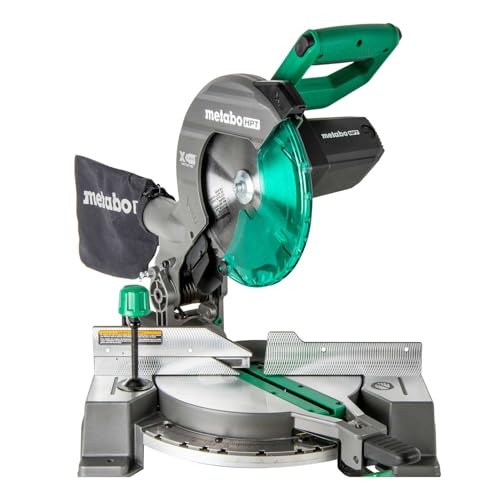
Pros
- High power-to-weight ratio - strong 15-amp motor in a portable 24-lb saw
- Shadow line guide is intuitive and helps achieve accurate cuts without adjusting lasers
- Easy miter and bevel adjustments with clear scales and positive stops
- Large table provides good material support for longer workpieces
- Includes a quality 40T TCT blade, ready to use out of the box
Cons
- Single bevel (left only) limits compound cutting versatility for some users
- No built-in laser guide, though the shadow line serves a similar purpose
- Some users may prefer a sliding miter saw for wider crosscuts
The Metabo HPT C10FCG2 is a 10-inch single bevel compound miter saw designed for a wide range of users from DIY homeowners to professional contractors. This saw combines a powerful 15-amp motor with a lightweight 24-pound frame, making it an excellent choice for anyone who needs a reliable miter saw for trim work, baseboards, crown molding, framing, and general woodworking projects. Its compact size and portability are especially appealing for electricians, plumbers, and carpenters who frequently move between job sites.
Performance-wise, the 15-amp motor delivers up to 5,000 RPM, providing enough power to cut through hardwoods, pressure-treated lumber, and composite materials with ease. The Xact Cut Shadow Line is a standout feature - it projects a precise shadow onto the workpiece, allowing you to see exactly where the blade will cut without the guesswork of laser guides. This is especially helpful in bright job site conditions where lasers can be hard to see. The improved miter scale and controls make adjustments accurate and repeatable, while the vice clamping system holds the workpiece securely for safer, cleaner cuts.
Build quality is typical of Metabo HPT's Japanese engineering - durable components and a solid feel despite the light weight. The saw's base and fence are sturdy, and the bevel and miter locks engage positively. The included 40-tooth TCT blade is a nice bonus, ready for most general cutting tasks. For storage and transport, the saw's 24-pound weight and compact footprint make it easy to carry in one hand or store on a shelf. It also fits well on a portable miter saw stand or workbench.
In terms of versatility, the saw offers a miter range of 0 to 52 degrees left and right, and a bevel range of 0 to 45 degrees left. This is sufficient for most common angle cuts, but the single bevel design means you can only tilt the blade to the left. For compound cuts requiring bevel in the opposite direction, you'll need to flip the workpiece. The 10-inch blade limits the maximum crosscut capacity to around 6 inches at 90 degrees and less at bevels, so it's not ideal for cutting wide boards or large dimensional lumber.
For maintenance, keeping the blade clean and checking the bevel and miter calibration periodically will ensure long-term accuracy. The saw's warranty (5 years) provides peace of mind for heavy use. While it doesn't have a built-in laser, many users may prefer the shadow line for its visibility and simplicity. Overall, this saw is a practical investment for DIY woodworkers, garage workshop users, and tradespeople who need a dependable, portable miter saw for everyday cutting tasks.
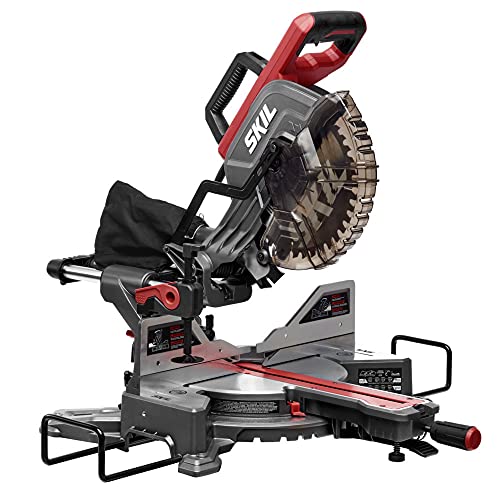
Pros
- Powerful 15-amp motor with 4800 RPM for fast cuts through tough materials
- LED shadow line is more accurate and durable than lasers with no calibration needed
- Dual bevel capability allows bevel cuts in both directions without flipping the workpiece
- 11 positive stops for common miter angles save time on repetitive tasks
- Decent cutting capacity for a 10-inch saw – crosscuts up to 2x12 at 90 degrees
Cons
- At 39.4 lbs, it's not the lightest for frequent job site transport
- The LED shadow line may be less visible in bright sunlight without a dedicated workspace light
- Some users may prefer a laser guide for visual alignment
The SKIL 10-inch Dual Bevel Sliding Compound Miter Saw (model MS6305-00) is a versatile power tool designed for accurate crosscuts, miter cuts, and bevel cuts in wood, trim, and molding. It combines a powerful 15-amp motor with a sliding compound mechanism, giving users the ability to cut wider boards without upgrading to a larger saw. The LED shadow line system replaces traditional laser guides, offering consistent precision without the hassle of periodic alignment.
This miter saw is best suited for DIY homeowners tackling trim work or deck projects, woodworkers creating furniture or cabinetry, and contractors who need a reliable saw for framing or finish carpentry. Its dual bevel function allows bevel cuts at 48 and 45 degrees left, 0 degrees, and 45 degrees right, which simplifies crown molding and other angle-intensive tasks. The sliding rails extend the cutting capacity to handle 2x12 lumber at 90 degrees and 2x8 lumber at 45 degrees, making it practical for common construction materials.
Performance-wise, the 15-amp motor spins the 10-inch blade at 4,800 RPM, delivering clean, fast cuts through hardwoods, pressure-treated lumber, and engineered wood products. The LED shadow line projects a sharp, true-cut shadow onto the workpiece, eliminating the flickering and calibration issues often seen with laser guides. Users can adjust the bevel and miter scales easily using the positive stop detents – 11 stops at the most frequently used angles (including common cuts for molding and framing). The sliding mechanism runs smoothly on linear bearings, although some users may notice slight play if the rails are not kept clean.
Build quality is solid for the price point, with a robust aluminum base, steel rails, and a durable motor housing. The saw weighs 39.4 pounds, which is manageable for a rolling stand or truck bed but not for constant carrying up stairs. The ergonomic handle and trigger switch provide comfortable control, and the included blade wrench stores conveniently on the saw. Dust collection is effective when connected to a shop vacuum, though the provided bag helps for quick jobs.
Setting up the saw is straightforward: mount it to a workbench or a portable stand, adjust the miter detents, and you are ready. The bevel adjustments lock firmly, and the sliding mechanism requires minimal maintenance (just occasional lubrication). The compact footprint (35.4 x 22.4 x 14.2 inches) saves space in a home workshop or garage. One realistic limitation is the LED shadow line's visibility in bright outdoor conditions; users who work primarily on sunny job sites may want to add a work light. Also, the saw does not include a built-in work light, which some competitors offer.
Overall, the SKIL MS6305-00 delivers strong value for its price. It offers the key features of a higher-end miter saw – dual bevel, sliding head, and a precision guide system – without the hefty price tag. For DIYers upgrading from a basic miter box or professionals needing a backup saw, this model provides reliable accuracy and productivity. It pairs well with a rolling stand for job site mobility, and its 10-inch blade keeps tool costs lower than 12-inch models. If you prioritize precision and ease of adjustment over lightweight portability, this saw is a practical choice for workshops, garages, and construction sites alike.
The SKIL MS6305-00 miter saw features a die-cast aluminum base that resists corrosion and maintains flatness over time. The steel sliding rails are reinforced to reduce flex during extended cuts, and the motor housing is made from impact-resistant composite materials. The bevel and miter detents are machined metal components that click into position positively, reducing wear from repeated adjustments. The blade guard and trigger switch are well-designed for safety, and the overall assembly feels sturdy for its weight class. While not a heavy-duty industrial saw, it is built to withstand regular use in a home workshop or on a contractor's job site with proper care.

Pros
- Multi-material cutting capability reduces tool swaps and increases efficiency on mixed-material jobs.
- Strong 1500W motor with optimized gearbox delivers reliable power and extends blade life.
- Laser cutting guide helps achieve precise cuts with less measuring and marking.
- Included accessories like the blade, clamp, and dust bag add value and convenience.
Cons
- 7-1/4 inch blade size limits depth of cut compared to larger 10 or 12 inch saws, making it less ideal for thick stock.
- No built-in stand or support - users may need to purchase a separate work surface or stand.
- Stock dust collection bag is small and may require a shop vacuum for larger projects.
The Evolution Power Tools R185SMS+ is a 7-1/4 inch sliding miter saw that stands out for its ability to cut a wide range of materials. Unlike traditional miter saws that are limited to wood, this model uses Evolution's patented multi-material cutting technology. It comes with a premium tungsten carbide tipped (TCT) blade that can handle mild steel, aluminum, wood with embedded nails, plastic, and more. This makes it a practical choice for contractors, woodworkers, metal fabricators, and DIY homeowners who frequently switch between materials on the job.
Performance-wise, the R185SMS+ packs a 1500 watt motor paired with an optimized gearbox and blade system. According to the product specifications, this setup reduces sparks, heat, and burrs when cutting mild steel, which is a common pain point with abrasive saws. The saw also includes a laser cutting guide to improve accuracy, and it offers 0 to 45 degrees of bevel capacity and 50 degrees of miter range in both directions. The 210 mm sliding capability lets you cut wider boards without flipping or repositioning, saving time on longer cuts.
Build quality appears solid for a saw in this price range. The tool is designed with a carry handle for easy transport, and it comes with a premium 3-piece clamp to secure workpieces firmly. The included TCT blade is specifically engineered for multi-material use, so you don't have to buy additional blades for common jobs. The 3-year manufacturer warranty adds peace of mind, especially for professionals who depend on their tools daily.
In terms of storage and maintenance, the saw's dimensions (48 x 24 x 12 inches) mean it will take up a fair amount of bench or shelf space. The dust collection bag helps contain some debris, but serious users will likely want to connect a shop vacuum for better dust management. Blade changes are straightforward, and the laser guide battery is easy to replace when needed.
However, there are realistic limitations. The 7-1/4 inch blade size means the depth of cut is less than that of a 10 or 12 inch saw, so it's not the best choice for cutting thick lumber or large beams. Additionally, the saw does not include a stand or work support, which may be an extra expense if you need a stable setup for long workpieces. The dust bag is on the smaller side, so expect to empty it frequently on bigger projects.
Overall, the Evolution R185SMS+ is a strong value for anyone who needs a single miter saw that can handle various materials. Contractors working on mixed-material job sites, woodworkers who occasionally cut metal, and DIY enthusiasts tackling home repairs will find this saw practical and time-saving. If you need a compact, versatile sliding miter saw with solid features and a good warranty, this model is worth considering.
The R185SMS+ is specifically designed to cut multiple materials without changing blades. The included TCT blade is engineered to handle mild steel, aluminum, wood with nails, and plastic. This is a major time-saver on job sites where you may need to cut metal studs, wooden framing, and plastic trim all in one day. According to the manufacturer, the blade produces virtually no sparks, heat, or burrs when cutting mild steel, which is a significant advantage over abrasive cutoff wheels. The saw's optimized gearbox also helps maintain blade speed and longevity under load.
For woodworkers, the saw cuts cleanly through dimensional lumber, plywood, and even reclaimed wood with embedded nails. The laser guide improves accuracy for repeat cuts, and the sliding function allows cutting boards up to roughly 8 inches wide (depending on angle). For metal workers, the saw can handle steel angle, aluminum extrusions, and thin-wall tubing. The clamp holds workpieces securely, reducing vibration during cuts.
One realistic note: while the saw handles a variety of materials well, the 7-1/4 inch blade size means it won't replace a dedicated metal chop saw for heavy-duty steel cutting. However, for light to medium metal fabrication, it performs admirably. The dust collection bag is sufficient for occasional use, but for a cleaner workspace, connecting a vacuum is recommended.

Pros
- Accessible, plain-language instruction tailored for beginner woodworkers and DIYers
- Compact 6 x 9 inch size stores easily right at your workbench or jobsite toolbox
- Strong focus on cut accuracy, blade safety, and safe workpiece clamping
- Covers essential fundamentals that save costly wood scraps and prevent mistakes
Cons
- Paperback reference guide rather than a hands-on physical tool or accessory
- Experienced carpenters and seasoned woodworkers may find the concepts too basic
- Lacks extensive project plans for advanced compound trim builds
Operating a miter saw can feel intimidating for beginners stepping into the workshop for the first time. This beginner woodworking manual from Majosta serves as a focused instructional resource, explaining how to set up, operate, and maintain one of the most essential cutting tools in the shop. Rather than wading through dense manufacturer safety booklets, this paperback offers an approachable walk-through of basic saw mechanics, workpiece positioning, and accurate angle adjustment.
The guide is ideally suited for DIY homeowners tackling their first trim jobs, hobbyist woodworkers setting up a garage workshop, and beginner remodelers who want to avoid common cutting errors. While seasoned framing contractors and cabinetmakers likely already know these techniques, novice builders will appreciate the clear breakdown of crosscuts, miter cuts, bevel cuts, and compound joints. It helps take the mystery out of angle gauges and alignment steps.
From a workshop utility perspective, the book emphasizes safe operating habits and precision cutting efficiency. Safe workpiece clamping, proper support for long boards, and kickback prevention are vital topics that protect both the user and the workpiece. By following structured alignment checks, woodworkers can eliminate sloppy cut lines, excessive blade tear-out, and wasted lumber on weekend trim projects.
In terms of format and practicality, the book measures a portable 6 by 9 inches and weighs only a few ounces. That compact footprint means it slips easily into a portable tool chest, rests on an assembly bench, or stores on a garage shelf without taking up valuable shop space. The print layout is straightforward, making it quick to flip open for a fast refresher before firing up the saw.
As a beginner-oriented guide, the book has realistic limitations. It does not replace hands-on muscle memory, nor does it dive into advanced crown molding jigs or commercial-scale carpentry techniques. However, for anyone who recently purchased their first miter saw and wants to build confidence, work safely, and achieve clean, accurate cuts, this handbook provides solid entry-level guidance at a minimal investment.
A well-prepared workshop relies just as much on solid technique as it does on sharp blades. Keeping an instructional guide nearby allows novice users to verify miter angle settings, workpiece stop setups, and blade clearances before hitting the trigger.
By standardizing simple safety habits such as allowing the blade to stop before raising the arm and securing short workpieces with clamps, this guide helps users prevent standard DIY accidents and build long-term confidence in their garage setup.
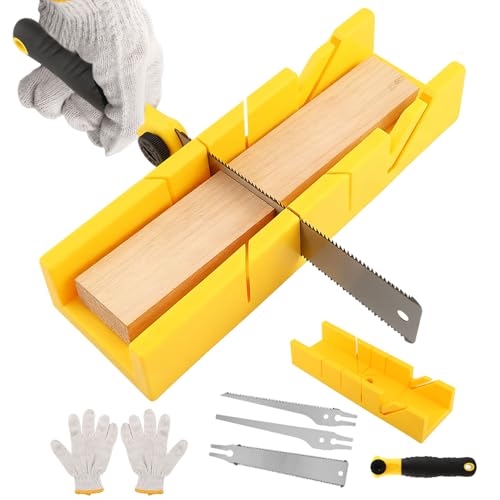
Pros
- Convenient all-in-one kit featuring three blade options and safety gloves
- Preset angle slots guide accurate 45-degree and 90-degree miters
- Lightweight and compact design makes it easy to store in any workshop or DIY kit
- Integrated 12-inch ruler simplifies quick layout measurements
Cons
- Plastic miter box requires steady clamping and careful saw alignment to avoid guide wear over time
- Not intended for heavy structural lumber or high-volume framing tasks
The Oryqvane 4-in-1 Miter Box and Saw Set is an entry-level manual cutting system designed to simplify angled cuts for smaller trim and craft materials. Packaging a 12-inch plastic miter box, an ergonomic saw handle, three interchangeable cutting blades, and a pair of work gloves, this kit serves as an all-in-one package for users who need clean joinery without investing in an expensive motorized miter saw.
This tool set is particularly suited for DIY homeowners, hobbyists, craft enthusiasts, and beginner woodworkers. It proves handy for apartment dwellers or weekend hobbyists handling small home improvement tasks like installing shoe molding, building picture frames, trimming chair rails, or cutting soft PVC piping. Because it generates minimal dust and requires zero electricity, it functions well on small workbenches or kitchen tables where space is limited.
In terms of practical cutting performance, the preset 45-degree, 90-degree, and 135-degree slots help guide the saw blade along precise paths to ensure proper corner joints. The inclusion of three swappable blades allows users to match tooth configurations to various materials, ranging from softwoods and MDF to gypsum board and thin plastics. The integrated 12-inch ruler molded along the side provides a convenient reference point for quick cuts without constantly reaching for a tape measure.
The build quality focuses on lightweight utility and convenience. Weighing just over a pound, the set features a reinforced plastic guide box and a contoured, non-slip handle designed to minimize hand fatigue over extended sawing sessions. While the plastic construction keeps the kit portable and easy to wash down, users should avoid forcing the saw blade against the channel walls to keep the guide slots from widening with repeated friction.
Storage and maintenance are straightforward. The slim profile fits neatly into standard toolboxes, utility drawers, or workshop shelves. Wiping down the steel blades with light oil after use protects them from surface rust, and keeping the blades secured prevents accidental edge dulling inside your gear bag.
For homeowners and hobbyists seeking an economical, space-saving solution for small trim, dollhouse construction, or craft carpentry, the Oryqvane 4-in-1 Miter Box and Saw Set offers dependable value. It delivers the essential angles and blade versatility needed to produce tidy joints on light materials without the expense or noise of power equipment.
This manual miter saw setup is tailored for detail-oriented home improvement and hobby projects. It excels at cutting delicate wood trim, quarter-round molding, decorative frames, and miniature woodworking components where a high-speed power blade could cause splintering.
Craft builders working with balsa, basswood, PVC conduit, or cork will appreciate the controlled stroke of the hand saw. By using a secure clamp to anchor the miter box to a steady work surface, hobbyists can achieve consistent, repeatable angles on every cut.

Pros
- Visual instructions and diagrams make complex cut setups easy to understand
- Covers crucial safety rules and workpiece securing techniques
- Compact dimensions allow quick storage on a workbench or tool chest
- Helpful baseline reference for DIY trim carpentry and framing
Cons
- Paperback cover may suffer wear or staining in dusty workshop environments
- Focuses on beginner fundamentals rather than advanced commercial joinery
- Does not replace model-specific manufacturer service manuals
The Majosta beginner miter saw guide is an instructional workshop handbook designed to bridge the gap between opening a new power tool box and making clean, confident cuts. Rather than relying on dense manufacturer text, this reference relies on clear visual layouts, photos, and targeted diagrams. It is tailored specifically for DIY homeowners, beginner woodworkers, and garage hobbyists who want to understand the fundamentals of stationary power saw operation before starting home improvement projects.
In terms of practical workshop performance, the guide focuses on achieving reliable cut accuracy and maintaining proper workshop safety. Readers learn essential principles including checking blade squareness against the fence, compensating for blade kerf, and setting accurate bevel and miter angles. Proper workpiece support, hold-down clamping, and correct blade entry speeds are explained clearly, helping users avoid common pitfalls such as dangerous kickback, blade binding, and rough splintered edges on finished trim.
From a usability standpoint, the guide is printed in a practical 6 by 9-inch paperback format with a slim profile. This makes it convenient to slip into a modular tool tote, stack on a garage workbench shelf, or keep beside your miter saw stand for quick reference during a project. The layout separates basic crosscuts from more complex compound angles, allowing operators to progress at their own speed as their comfort with cutting tools increases.
There are a few realistic limitations to keep in mind. Because this is a standard paperback book, keeping it in an active woodworking environment exposes the pages to sawdust, moisture, and shop grease over time. Additionally, experienced finish carpenters or commercial framing contractors will likely find the technical depth too basic, as the manual focuses primarily on introductory techniques, tool anatomy, and foundational safety rules.
Overall, this guidebook serves as a reliable, cost-effective companion for anyone adding a miter saw to their garage workshop. Whether you are installing baseboard molding, framing utility shelving, or building outdoor patio furniture, having a straightforward printed reference close at hand improves both cutting accuracy and shop safety.
For homeowners tackling weekend repairs, learning proper miter saw technique is essential for professional-looking results. This manual provides direct application guidance for building basic shadow boxes, squaring dimensional lumber for workbenches, and trimming molding for interior door frames.
The visual diagrams clarify how workpiece orientation affects the direction of the cut, making it much easier to plan compound angles for crown molding or decorative trim without wasting expensive stock on incorrect test cuts.

Pros
- Compact and lightweight footprint makes storage and transport easy for home workshops
- Built-in laser guide provides clear cutting line visibility for accurate board alignment
- Sliding design accommodates wider workpieces than conventional fixed chop saws
- Supplied with practical accessories including extension bars and spare motor brushes
Cons
- 7.5A motor requires a slower feed rate when slicing through thick, dense hardwoods
- Single-bevel action means workpieces must be flipped manually for opposite bevel angles
- Included cloth dust bag catches larger chips but allows fine airborne dust to escape
The Hoteche 7-1/4-Inch Compound Miter Saw is a compact benchtop power tool engineered primarily for DIY homeowners, hobby woodworkers, and garage builders. While production job sites often rely on heavy 10-inch or 12-inch saws, this smaller 7.5-amp unit occupies a practical middle ground for light home renovations, deck maintenance, baseboard installations, and everyday craft builds. Its compact design fits comfortably in tight garage setups or basement workshops where bench space remains at a premium.
Equipped with a 7.5-amp copper motor delivering a no-load speed of 5,000 RPM, the saw produces crisp crosscuts in softwoods, composite decking, PVC pipe, and delicate trim. The integrated laser guide aids cutline visualization, allowing users to align the blade with workpiece markings quickly before engaging the trigger. The sliding rail design extends cutting capacity across wider stock, easily accommodating standard 2x4 lumber at 90 degrees while maintaining compound miter capability for angled joints.
The saw rests on a cast aluminum base outfitted with rubber dampening feet that resist sliding during operation. For precision trim work, the miter table incorporates preset positive stops at 0, 15, 22.5, 30, and 45 degrees, which cuts down on setup time when building picture frames or cutting crown molding. The kit also supplies dual extension bars to support overhanging workpieces, an adjustable material clamp to keep fingers clear, and extra carbon brushes for straightforward motor maintenance down the road.
As a single-bevel 7-1/4-inch chop saw, there are practical boundaries to observe. The 7.5-amp motor lacks the deep torque of heavy-duty 15-amp models, requiring a controlled, patient feed rate when crosscutting thick or knotty hardwoods. Additionally, the single-bevel configuration requires flipping long boards over to complete opposing bevel cuts. The fabric dust bag collects coarse chips adequately, but indoor users will likely prefer attaching an external shop vacuum to manage fine dust.
For general home improvement, framing partition walls, fitting laminate flooring, and assembling basic woodworking projects, this Hoteche model delivers reliable cutting utility without demanding heavy lifting or excessive storage room. It represents a practical, budget-conscious choice for weekend renovators and DIY hobbyists who want a dedicated miter saw ready for quick jobs.
Based on product specifications, the 5,000 RPM motor speed provides clean, splinter-resistant cuts across typical trim boards, casing, and soft framing lumber. The positive miter detents allow rapid switching between common angles, helping users maintain consistent rhythm during flooring projects and decorative carpentry.
The sliding arm design increases crosscut reach to 120mm at 90 degrees, offering enough stroke to slice cleanly through 2x4 material. For the best cut quality on finished cabinetry or visible trim, pairing the machine with a high-tooth-count fine-finish blade will help minimize tearout.
The package arrives equipped with standard operational accessories right out of the box. Side extension wings slide directly into the aluminum base to support longer boards, keeping work level and reducing bind risk during cuts. Dedicated hex wrenches are included for blade changes and bevel calibration.
A pair of replacement carbon brushes is also provided to extend the overall service life of the motor. The fabric dust bag handles immediate debris capture, though an auxiliary dust extractor remains recommended when cutting composite materials or working indoors.
Essential Steps and Techniques to Master Your Miter Saw
Operating a miter saw cleanly requires a firm grasp of tool anatomy, workpiece security, and systematic cutting motion. A miter saw is engineered primarily for precision crosscutting, swinging across horizontal angles and tilting for beveled edges. Taking time to establish reliable habits before making your first cut eliminates wasted material and protects your fingers from common workshop hazards.
Understanding Miter Saw Anatomy and Control Points
Every motorized miter saw centers on a pivoting cutting head mounted above a slotted rotary table and fixed fence. The fence acts as the primary reference surface, bearing lateral cutting pressure as the spinning blade enters the board. The rotating table turns horizontally to set miter angles, usually secured by a cam lock handle or detent pin that snaps into common angles like 22.5, 30, and 45 degrees.
Bevel controls are situated behind or beneath the pivot post, allowing the motor and blade assembly to tilt sideways for angled surface profiles. A compound miter saw tilts in one direction, whereas a dual bevel design can lean both left and right without requiring you to flip your workpiece over. Identifying these control knobs and latches on your specific tool ensures you never force an adjustment when making compound cuts.
Modern units often incorporate guide aids such as LED shadow lines or projected laser guides to assist with alignment. An LED shadow system casts the actual blade kerf directly onto the stock, providing daylight-visible accuracy that does not drift out of calibration over time. Familiarizing yourself with the power trigger, lock-off button, and lower blade guard mechanism forms the foundation of predictable operation.
Workspace Preparation and Safe Workholding Principles
Stable footing and adequate material support are non-negotiable prerequisites for accurate cutting. Place the saw base on a sturdy workbench or a purpose-built miter saw stand equipped with outfeed extension supports. Long boards tend to tip downward if the overhang is unsupported, lifting the stock away from the fence and pinching the blade during cut completion.
Always maintain a strict hand clearance boundary, keeping hands at least six inches away from the blade path at all times. Use hold-down clamps or auxiliary hold-downs whenever working with small workpieces or narrow trim moldings that place fingers too close to the blade. Never cross your arms across the cutting line while securing lumber with your off hand.
Inspect raw timber before pressing it against the tool fence to verify it sits flat against both horizontal and vertical reference planes. Cupped, twisted, or bowed lumber can rock during a cut, leading to intense blade binding or dangerous kickback. Place the hollow, concave side against the fence and table to guarantee stable two-point contact through the entire cut stroke.
Standard 90-Degree Crosscut Execution
A standard 90-degree square cut serves as the most frequent operation you will execute on a chop or miter station. Begin by marking your desired length on the board with a sharp mechanical pencil or layout knife. Position the marked lumber flat on the table, pressing the rear face firmly against the aluminum back fence.
Bring the blade down with the power switch completely off to verify where the tooth kerf will strike relative to your pencil line. Always position the blade teeth on the waste side of the layout line so your finished piece retains its exact measured dimension. Once aligned, return the cutting head to its upright resting position before engaging the motor.
Squeeze the power trigger and allow the motor to accelerate to maximum operating speed before introducing the teeth to the wood grain. Lower the saw head in a slow, steady, controlled vertical stroke without forcing the tool beyond its natural cutting cadence. Once the cut separates the stock, release the trigger and keep the blade lowered until it comes to a complete standstill before lifting the head.
Adjusting and Cutting Precise Miter Angles
Miter angles involve turning the saw table left or right away from the perpendicular 90-degree mark, commonly used for picture frames and corner trim. To set a miter, loosen the main locking handle and press the detent release lever with your thumb. Swing the table until the pointer aligns with your designated angle mark on the graduated scale plate.
Positive stops quickly seat the table into standard architectural angles like 45 degrees for four-sided assemblies. If you must adjust for out-of-square room corners, override the positive detent mechanism and clamp the table firmly at your custom angle setting. Retighten the locking knob completely so the table cannot wander under heavy lateral blade torque.
Lateral cutting pressure increases slightly during angled passes, meaning your workpiece requires extra clamping grip against the fence. Smooth feed rates help prevent the wood from creeping outward along the angled fence surface. If cutting delicate plastic moldings or conduit, using a dedicated blade for cutting PVC pipe delivers cleaner cuts with fewer chipped edges.
Mastering Bevel Cuts and Compound Angles
Bevel cuts tilt the blade head vertically relative to the table surface while the miter angle remains set at zero. These cuts produce sloped edges on the thickness of the board, frequently utilized in baseboard splices and cabinet carcass joinery. Release the rear bevel lock lever and lean the heavy motor casting until the bevel indicator matches your target angle.
Single-bevel saws tilt solely to the left, which occasionally requires flipping boards end-for-end to complete opposite-hand cuts. Dual-bevel saws eliminate that extra handling step by swinging freely in either direction, maintaining grain orientation across matched molding runs. Always inspect clearance between the tilting blade guard and the sliding fence before turning on the power switch.
Compound cuts unite both a miter angle on the table and a bevel angle on the vertical pivot at the same moment. This compound alignment is essential when cutting crown molding flat on the bed rather than nested against the fence. Verify your compound bevel angle stops carefully, as slight calibration errors multiply across four-corner joint assemblies.
Operating Sliding Miter Saws on Wide Stock
Sliding miter saws feature linear rails that permit the spinning blade to travel horizontally, substantially expanding crosscut capacity across wide lumber. A standard 10-inch chop saw might crosscut six-inch wide boards, whereas a sliding mechanism can span 2×12 structural lumber with ease. Utilizing this travel requires a fundamentally different pushing technique compared to a standard vertical chop stroke.
Never pull the spinning blade toward your chest through the wood, as climbing cuts can yank the saw head upward out of control. Instead, pull the cutting head fully forward while raised, squeeze the switch to attain full speed, and plunge the blade down into the front edge of the board. Push the spinning blade smoothly backward through the wood toward the rear fence to complete the severance.
The fence and table support the full reactionary thrust when you push backward, providing optimal mechanical stability throughout the wide stroke. Keep rail lock knobs loose for wide sliding passes, but lock them securely tight whenever executing narrow cuts or transport maneuvers. This keeps linear slide bearings rigid and preserves tight tolerances on repetitive narrow cuts.
Manual Miter Boxes for Intricate Hand Cutting
Not every precision cut requires a heavy motorized appliance on a workshop bench. Manual miter box assemblies paired with fine-tooth backsaws provide exceptional control for miniature craft projects, delicate picture frames, and small trim repairs. A slotted miter box uses preset guide grooves positioned at 45 and 90 degrees to hold the hand saw blade in true perpendicular alignment.
Place the manual box on a non-slip work surface or secure it in a wood vise to prevent shifting during saw strokes. Hold the small workpiece firmly against the inside rear wall of the box with your non-dominant hand or small auxiliary wedges. Slide the blade teeth through the corresponding alignment slots before starting your forward and backward rhythmic strokes.
Let the sharp teeth do the cutting work without forcing downward muscle pressure on the thin blade spine. High tooth counts and thin kerf hand blades yield remarkably smooth surfaces on softwoods, polystyrene, and thin PVC moldings. For small repair jobs or indoor spaces where dust extraction and motor noise pose challenges, a manual miter kit remains a versatile option.
Blade Selection and Tooth Geometries for Clean Results
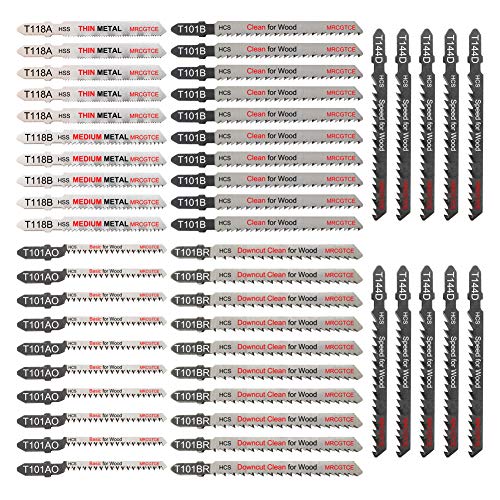
The quality of your finished cut is determined by matching blade tooth geometry and plate diameter to the target material. Saws fitted with 24-tooth to 40-tooth blades crosscut construction 2×4 framing studs quickly but leave torn wood fibers on fine veneers. Transitioning to an 80-tooth fine-finish blade with alternate top bevel teeth delivers glass-smooth ends on finish moldings and hardwoods.
Multi-material blades utilize specialized carbide formulations with negative rake angles to shave cleanly through non-ferrous metals and mild steel without grabbing. When dealing with specialized building materials like subfloor panels or rigid structural pipe, learning which blade works best on similar jobs can save you frustration. For example, comparing the performance of a dedicated blade to cut ABS pipe highlights how negative rake teeth reduce material melt and ragged chipout.
Always inspect the arbor size stamped on your saw plate before purchasing replacement blades for your machine. Common miter saw diameters range from 7-1/4 inches up to 10 and 12 inches, using either 5/8-inch or 1-inch central arbor bores. Never install a blade that exceeds your tool model’s maximum specified diameter rating or rated no-load motor speed.
Squaring, Calibrating, and Maintaining Your Saw
Factory alignments often drift after rugged jobsite transportation, making routine calibration checks vital for reliable carpentry. Unplug the saw from line power or remove the lithium battery pack before checking squareness. Lower the blade head down completely and engage the downward travel lock pin to keep the blade fixed in place.
Place an accurate machinist square flat against the table bed with one leg resting against the body of the blade plate. Make sure the square rests flat on the metal plate rather than against the protruding carbide teeth, which will distort your reading. If daylight appears between the square and blade, adjust the bevel stop screws until the gap disappears completely.
Next, test the 90-degree angle between the blade body and the horizontal aluminum fence using the same precision square. Loosen the fence mounting bolts slightly if an angle discrepancy exists, aligning the fence face perpendicular before retightening. Clean resin buildup from the rotary turntable and keep the lower clear blade guard free from packed sawdust so it pivots effortlessly.
Consistent cutting accuracy on any miter saw comes down to disciplined setup, proper workpiece clamping, and allowing the blade to achieve full operational velocity before touching the wood. Verify your fence alignment periodically, select the correct blade geometry for each project, and keep your hands safely outside the blade perimeter on every stroke.




Write Your Review
No reviews yet. Be the first to share your experience!