


Rough cuts, increased friction, and burned workpieces often signal that a cutting edge has lost its keenness. When metal or wood stock begins chattering under pressure, understanding how sharpen chop saw blade techniques helps restore smooth operation and maintain cut consistency across workshop projects. Choosing the right method depends heavily on whether your chop saw uses a solid steel blade, a carbide-tipped disc, or an abrasive cut-off wheel. For specialized non-ferrous tasks, matching the right grind profile with a dedicated saw blade to cut aluminum ensures burr-free edges and reliable tooth longevity.
While many craftspeople assume every blade on a chop saw can undergo resharpening, safety and construction realities dictate different approaches. Dedicated electric blade sharpeners restore toothed metal and woodworking blades by dressing individual rake and bevel angles. Conversely, bonded abrasive cut-off wheels cannot undergo sharpening and must be replaced once worn down. Reviewing the equipment options below highlights the primary tools used for sharpening toothed blades alongside common replacement wheels for mini and standard cut-off equipment.

Pros
- Compact and portable design fits easily in a garage or workshop without taking up much space.
- Dual wheel system (diamond and emery) handles both carbide and steel blades, increasing versatility.
- Tilting motor block allows sharpening of various tooth angles, improving precision for different blade types.
- Die cast aluminum construction offers good stability and durability for regular use.
- Indexing arm speeds up the sharpening process, boosting productivity for users with many blades to maintain.
Cons
- At 11.79 pounds, it is somewhat heavy for a compact sharpener, which may limit portability for some users.
- The learning curve for proper indexing and angle adjustment might be steep for beginners or casual DIYers.
- Limited to blades with arbors up to 1 inch, so larger industrial blades may not be compatible.
The YWTR 120 Volt Electric Circular Saw Blade Sharpener is a practical tool designed to help you maintain sharp blades without the hassle of sending them out for service. It combines a 4-inch diamond wheel for carbide-tipped blades and a 4-inch emery wheel for standard steel blades, giving you the flexibility to handle a range of cutting tools. This sharpener is best suited for DIY homeowners, mechanics, contractors, woodworkers, and anyone who regularly uses circular saws in their garage, workshop, or on the jobsite.
In terms of real-world performance, this sharpener focuses on restoring cutting efficiency and extending blade life. The motor block tilts 25 degrees left and right, allowing you to match the original tooth geometry of most blades. The indexing arm helps you position each tooth accurately, which can lead to consistent results and improved cutting performance after sharpening. For users who go through many blades, this tool can significantly boost productivity by reducing downtime spent waiting for sharpening services.
Build quality is a key consideration, and the YWTR sharpener uses a die cast aluminum base and indexing arm for stability. This construction helps reduce vibration during operation, which is important for achieving a clean edge on each tooth. The compact design means it won't take up much space in your workshop or garage, and the included diamond and emery wheels are ready to use right out of the box. The specialized blade receiver accepts arbors up to 1 inch, covering most common circular saw blades used in woodworking and construction.
Setup and use are straightforward, though there is a learning curve when it comes to indexing the blade and setting the correct angle. The manual provides guidance, and many users find that after a few tries, the process becomes quick and efficient. Storage is easy thanks to the compact footprint, and maintenance mainly involves keeping the wheels clean and replacing them when they wear out. The sharpener plugs into a standard 120-volt outlet, so no special wiring is needed.
One realistic limitation is the weight: at nearly 12 pounds, it is not the lightest portable sharpener, but it is still manageable for moving around a shop or taking to a job site. Also, the arbor size limit means larger industrial blades may not fit, so this is best for typical 7-1/4 to 10-inch blades used by most tradespeople and DIYers. Beginners might need some practice to get consistent results, but the indexing arm helps reduce guesswork.
Overall, the YWTR 120 Volt Electric Circular Saw Blade Sharpener is a solid investment for anyone who wants to keep their blades sharp without the recurring cost of replacements or sharpening services. It is particularly useful for contractors, woodworkers, and serious DIYers who value productivity and want to get the most out of their tools. If you regularly use circular saws and want a reliable, compact sharpener for your garage or workshop, this model is worth considering.
The YWTR sharpener features a die cast aluminum base and indexing arm, which provide a sturdy foundation for repeated use. The aluminum construction helps resist corrosion and keeps the tool stable during operation. The motor housing is made from durable materials, and the included diamond and emery wheels are designed to handle regular sharpening tasks. Overall, the build quality is appropriate for a workshop or garage environment where tools see consistent use.
In a workshop setting, this sharpener can help maintain a variety of circular saw blades, from carbide-tipped framing blades to steel combination blades. The tilting motor block allows you to match the tooth angle of most blades, which is important for achieving clean cuts. The indexing arm speeds up the process, so you can sharpen multiple blades in a short time. This can be a real time-saver for woodworkers and contractors who rely on sharp blades for quality work.
For garage users, the compact design of the YWTR sharpener means it can be stored on a shelf or in a cabinet without taking up valuable bench space. It plugs into a standard outlet, so no special electrical setup is needed. Whether you are a DIY homeowner working on weekend projects or a mechanic who occasionally uses a saw, this sharpener can help keep your blades in good condition. The dual wheel system adds versatility, allowing you to sharpen both carbide and steel blades.

Pros
- Fast, aggressive cutting on various ferrous metals, improving job efficiency
- Long wheel life due to high-quality aluminum oxide and proprietary bonding
- Smooth operation with reduced vibration, enhancing cut accuracy and user comfort
- Affordable price point for both professionals and DIY enthusiasts
- Fits most 14-inch chop saws, offering broad compatibility
Cons
- Designed specifically for metal cutting—not suitable for wood or masonry
- May wear faster on thicker or hardened metals compared to premium carbide-tipped blades
- Requires proper wheel mounting and safety guard use to avoid breakage (standard for all cut-off wheels)
The DEWALT DW8001 is a 14-inch metal cut-off wheel engineered for chop saws used in metalworking. This abrasive wheel is built with high-performance aluminum oxide grain, which is known for its fast cutting action and long service life. It is specifically designed for cutting through steel, stainless steel, and other ferrous metals, making it a go-to accessory for mechanics, contractors, fabricators, and serious DIY homeowners.
Who benefits most from this blade? It is ideal for anyone who regularly cuts metal in a garage, workshop, or on a construction site. DIY enthusiasts working on home repairs, auto mechanics performing vehicle maintenance, and professional tradespeople like metal fabricators and welders will appreciate its aggressive cutting performance. The high grain concentration allows the wheel to slice through material quickly, reducing time spent on each cut and boosting overall productivity.
In terms of real-world performance, the DW8001 delivers fast, efficient cuts on common metals like angle iron, rebar, pipe, and sheet metal. The proprietary material mix ensures the wheel holds up under repetitive use, resisting premature wear. Many users report that the wheel runs smoothly with minimal vibration, which translates to better control and cleaner cut edges. This is especially important when precision matters, such as in structural or finishing work.
Build quality is typical of DEWALT's abrasive line: durable, heat-resistant construction that stands up to the friction of metal cutting. At 1.2 pounds, the wheel is lightweight and easy to handle during installation. No special tools are needed to mount it on a standard chop saw arbor. Storage is straightforward—since it's a single wheel, it can be kept in a toolbox, on a shelf, or hung on a pegboard. No maintenance beyond proper storage (dry area to avoid moisture damage) is required.
One realistic limitation is that this wheel is dedicated to metal cutting. It should not be used on wood, plastic, or masonry, as it could wear quickly or pose safety risks. Additionally, while the aluminum oxide grain offers great value, users tackling very thick or hardened metals may find the wheel wears faster than premium alternatives. Standard safety precautions—always wear eye protection and use the blade guard—are a must, as with any abrasive cut-off wheel.
Overall, the DEWALT DW8001 is a practical, budget-friendly choice for anyone needing a reliable metal cut-off wheel. It performs well for general fabrication, repair work, and job-site metal cutting. For the price, it offers a good balance of speed, durability, and ease of use. Whether you're a weekend DIYer or a full-time contractor, this wheel can handle your metal cutting tasks effectively.
The DEWALT DW8001 is constructed with high-performance aluminum oxide abrasive grain and a proprietary bonding material that gives the wheel its long-lasting edge. The material mix is engineered to resist overheating and glazing, which are common causes of premature wheel failure. While it is not a carbide-tipped blade, the bonded abrasive is well-suited for repeated use on standard ferrous metals. The wheel’s dimensions (14 x 14 x 0.1 inches) are consistent across quality cut-off wheels, ensuring a snug fit on most chop saw arbors. It is lightweight yet dense enough to maintain structural integrity during high-speed cutting.
In a workshop or on a construction site, the DW8001 shines when cutting metal quickly and cleanly. Mechanics use it to cut bolts, exhaust pipes, and brackets. Contractors rely on it for trimming rebar, angle iron, and steel studs. DIY homeowners find it handy for custom metal shelving, gate repairs, and auto projects. The wheel’s aggressive cutting action reduces the effort required, and its smooth running minimizes vibration, which is a plus for fatigue reduction during long cutting sessions. It is a staple accessory for any metalworking chop saw.
Pros
- Fine 100-tooth configuration yields smooth, splinter-free cuts on delicate workpieces
- Slim 0.5mm kerf puts minimal strain on low-wattage hobby chop saw motors
- Broad material versatility covers brass tubing, model wood, and rigid plastics
- Multi-pack provides spare blades for continuous project work
Cons
- Limited to compact benchtop saws designed specifically with a 3/8-inch arbor
- Not engineered for cutting ferrous metals such as carbon steel or iron
- Thin body profile requires a light, controlled feed rate to avoid blade deflection
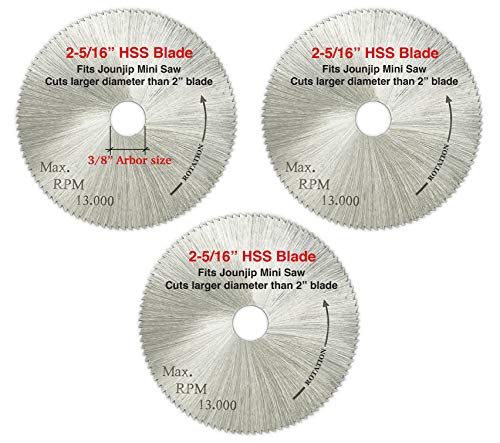
The JOUNJIP 2-5/16-inch HSS Saw Blade 3-Pack is an essential power tool accessory designed specifically for miniature benchtop chop saws and compact cut-off tools. Measuring 58.7mm in outer diameter with a standard 3/8-inch arbor, each blade features a dense 100-tooth layout built around a slender 0.5mm kerf. This setup caters directly to high-precision trimming where full-sized workshop miter saws or hand-held circular saws would simply destroy fragile components.
This blade set is ideally matched for scale model builders, miniature woodworkers, electronics hobbyists, jewelry fabricators, and DIY crafters working out of a home garage or dedicated craft bench. Whether you are sizing brass architectural tubes, trimming custom arrow shafts, fitting dollhouse moldings, or sectioning rigid PVC tubing, these small-diameter discs provide the delicate handling needed for detailed craft projects.
Cutting performance stands out thanks to the combination of high tooth count and minimal kerf thickness. The closely spaced teeth shear smoothly through workpieces rather than grabbing or tearing them, resulting in clean edges that demand minimal sanding or deburring. Rated for speeds up to 13,000 RPM, the blades maintain steady cutting velocity without binding, which helps low-power benchtop chop saw motors run without overheating or losing momentum.
The build quality centers on high-speed steel that resists edge dulling when processing softer metals like aluminum, copper, and brass. Unlike abrasive cut-off wheels that create substantial dust, odor, and ragged margins, these toothed HSS blades slice cleanly and keep the workbench tidy. Each blade is compact and lightweight, making it easy to store all three in a standard small-parts organizer, drawer tray, or portable tool case.
A realistic consideration is that these accessories are strictly engineered for miniature cut-off machines and non-ferrous applications. Attempting to cut nails, steel bolts, or hardened metals will quickly strip the fine teeth. Because the 0.5mm plate is intentionally thin to optimize cutting speed, operators should apply steady, light downward pressure to prevent bending the disc during deeper passes.
For hobbyists, craft woodworkers, and garage fabricators who already rely on a mini cut-off saw with a 3/8-inch arbor, this JOUNJIP three-pack offers a practical and dependable cutting solution. Having multiple blades on hand ensures you can dedicate one disc to soft metals and another to clean plastics and woods, maintaining crisp cuts across all your detail-oriented workshop projects.
These blades are designed to fit the JOUNJIP mini benchtop chop saw alongside an array of standard hobby cut-off saws equipped with a 3/8-inch mounting arbor. The 2-5/16-inch diameter provides adequate clearance and cutting depth for small rods, tubes, and trim strips commonly used in craft fabrication.
For best results when cutting softer metals such as brass or aluminum, using a gentle feed rate helps prevent chatter and tooth loading. Storing the extra blades flat inside their packaging or an indexed organizer prevents tooth damage and keeps cutting edges sharp for future tasks.

Pros
- Powerful motor and high RPM deliver fast sharpening performance.
- Dual wheel setup offers versatility for different blade types and conditions.
- Precise angle adjustment helps maintain factory edge geometry.
- Sturdy aluminum base provides stability and reduces vibration during operation.
- Compact footprint makes it easy to store on a shelf or in a toolbox.
Cons
- May require a learning curve to set up the correct sharpening angle for each blade.
- Arbor size range (15-35mm) may not fit all specialty or very large blades.
- The sharpener is relatively lightweight, which might need clamping for heavy-duty use.
The VEVOR Circular Saw Blade Sharpener is an electric bench-top sharpening machine designed to restore the cutting edge on dull circular saw blades. It's a practical tool for woodworkers, DIY homeowners, contractors, and anyone who regularly uses circular saws in their workshop or on the job site.
Powered by a 140W motor spinning at 3800 RPM, this sharpener can quickly remove material and bring back a sharp edge. The dual wheel setup includes a ceramic grinding wheel for general sharpening and a diamond wheel for more hardened or tungsten carbide blades. According to the product specifications, the grinding wheel can be tilted up to 25 degrees left or right, allowing you to replicate the original tooth angle for consistent cuts. This precise adjustment is key to maintaining cutting efficiency and reducing blade wobble.
The machine sits on a wide aluminum base that provides stability and helps dampen vibration during operation. The base is compact, measuring about 11.4 inches by 9.1 inches, so it won't take up too much space on your workbench. The sharpener accepts blades from 3.5 to 15.7 inches in diameter and arbor sizes from 15 to 35 mm, covering most common circular saw blades used in woodworking and construction.
Maintenance is straightforward: occasional cleaning of the grinding wheels and ensuring the blade is securely mounted before each use. One realistic limitation is that setting up the correct sharpening angle may take some practice, especially for users new to blade sharpening. Additionally, the machine's lightweight design (about 10.4 pounds) means it may shift slightly during aggressive grinding unless bolted or clamped to the work surface.
For DIYers and professionals who go through multiple blades each year, this VEVOR sharpener offers a cost-effective way to extend blade life and keep cuts sharp. It's especially useful in small workshops, garages, and for contractors who want to sharpen blades on-site. While it won't replace industrial sharpening equipment, it's a solid entry-level machine that balances affordability with performance.
Pros
- Significantly extends the usable life of expensive oscillating multi-tool blades.
- Triangular anti-wobble shank mounts securely into standard corded or cordless drill chucks.
- Frameless design allows direct sightlines and flexible angles while shaping cutting teeth.
- Durable diamond abrasive coating grinds through hardened metal teeth efficiently.
Cons
- Restricted to blades with a maximum cutting width of 35mm (1-3/8 inches).
- Requires proper technique and intermittent grinding to avoid overheating the blade steel.
- Needs a stable drill setup or bench vise for safe and controlled sharpening.
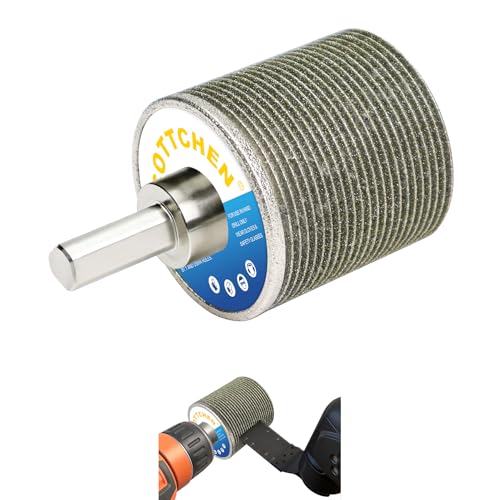
Oscillating multi-tools are staples on job sites and in home workshops, but replacement blades quickly become a major recurring expense. The SCOTTCHEN Oscillating Saw Blade Sharpener is a specialized power tool accessory designed to tackle that problem directly. Featuring a heavy-duty diamond abrasive layer bonded to an iron core, this rotary attachment mounts directly into a standard hand drill chuck to reshape and sharpen worn cutting teeth.
This tool accessory is suited for finish carpenters, flooring installers, drywallers, plumbers, and DIY remodelers who frequently chew through multi-tool blades on nails, plaster, and dense hardwoods. Instead of discarding a blade once the teeth flatten or burn out, users can mount this attachment in a cordless or corded drill to put a fresh cutting edge back on their accessories.
In terms of practical mechanics, the sharpener utilizes a triangular shank that prevents the bit from slipping inside a three-jaw chuck under rotational torque. SCOTTCHEN opted for an upgraded single-sided frameless build, which eliminates the restrictive outer housing found on older styles. This open format gives users clear line of sight to the contact point, making it easier to follow the natural contour of the blade teeth without gouging adjacent metal.
Achieving clean cutting teeth requires a bit of technique. Running the sharpener intermittently prevents excessive heat buildup that could ruin the temper of the blade steel. The manufacturer recommends lifting and shifting the blade slightly sideways across passes so the teeth form sharp, distinct points rather than broad, flat tips. Clamping the drill securely in a bench vise or against a stable work surface provides the necessary control for consistent results.
The sharpener is limited to blades measuring up to 35mm (1-3/8 inches) wide, meaning wider specialty scraping or broad plunge blades will not fit in a single pass. However, for standard wood and metal multi-tool blades, this accessory provides a cost-effective, space-saving solution that easily pays for itself after rescuing just a few dull blades from the scrap bin.
Setting up the SCOTTCHEN sharpener in a workshop or garage is straightforward. Securing a cordless drill into a bench vise allows you to hold the multi-tool blade with two hands, maximizing control against the spinning diamond wheel. Light, deliberate contact produces the best tooth geometry without burning the steel.
Because diamond abrasives cut cleanly without loading up as quickly as standard grinding stones, maintenance remains minimal. Keeping a light touch and allowing the abrasive to do the work ensures the diamond coating stays bonded for dozens of blade sharpening cycles.

Pros
- Double-reinforced construction with fiberglass resin offers good durability and break resistance for consistent cutting performance.
- Versatile compatibility with mini miter saws, cut-off saws, benchtop saws, and rotary tools with 3/8-inch arbor - fits many common power tools.
- 6-pack provides good value and multiple spare discs, reducing the need for frequent replacements during metal cutting jobs.
- Effective on a variety of metals including steel, brass, bronze, nuts, bolts, and screws, making it useful for general workshop and garage tasks.
Cons
- Limited to 2-inch diameter, which may not be suitable for larger metal cutting jobs or thicker materials - best for small-scale work.
- Safety precautions are essential as sparks are emitted during use, requiring proper protective gear and a safe workspace.
- Some users may find the discs wear out relatively quickly on harder metals, though the 6-pack helps offset this for occasional use.
The JOUNJIP 2-inch metal cutting discs are a set of six abrasive wheels designed for cutting through various metals. These discs are specifically made for mini miter saws, cut-off saws, benchtop saws, and rotary tools that accept a 3/8-inch arbor. Each disc measures 2 inches in diameter with a 1/16-inch kerf thickness, making them suitable for small to medium metal cutting tasks around the home workshop, garage, or job site.
These discs are best suited for DIY homeowners, mechanics, contractors, woodworkers, and hobbyists who need to cut through steel, bronze, brass, nuts, bolts, screws, and other ferrous and non-ferrous metals. Their compact size makes them ideal for detailed work, such as trimming bolts, cutting small brackets, or shaping metal parts in automotive repairs, plumbing projects, or general fabrication. They also work well for electricians and plumbers who occasionally need to cut small metal components on site.
Performance-wise, the double-reinforced fiberglass resin construction provides good stability and resistance to breaking during use. Users can expect smooth, precise cuts when working on softer metals, though harder materials like steel may require a steady hand and moderate pressure. The discs are designed to cut efficiently, but like all abrasive wheels, they will wear down over time, especially with heavier use. The 6-pack ensures you have spare discs on hand, reducing interruptions during longer projects.
Build quality is decent for the price point. The discs are made with a fiberglass resin bond that adds strength and helps prevent shattering. However, it's important to follow all safety precautions - always use a blade guard and wear safety glasses, gloves, and appropriate clothing, as sparks are emitted during cutting. The discs fit securely on tools with a 3/8-inch arbor, and installation is straightforward with a simple arbor nut.
Storage and maintenance are simple: keep the discs in their packaging or a dry toolbox to prevent moisture damage. They are compact enough to fit in a small drawer or pouch alongside other accessories. One realistic limitation is the 2-inch diameter, which may not be suitable for larger cuts or thicker materials. For heavy-duty metal cutting, larger discs or different tools may be needed. Also, the discs can wear quickly on hard metals, so they are best for occasional or light-duty use.
Overall, the JOUNJIP 2-inch metal cutting discs are a practical and affordable option for anyone needing a set of small abrasive wheels for occasional metal cutting tasks. They offer good compatibility with common power tools and provide decent cutting performance for the price. For DIY enthusiasts, mechanics, and workshop users who work with small metal parts, this 6-pack is a solid choice that delivers value without breaking the bank.
Essential Principles for Sharpening and Maintaining Chop Saw Blades
Understanding how sharpen chop saw blade procedures starts with identifying the blade type mounted on your machine. Toothed circular blades made from high-speed steel or tipped with tungsten carbide can be resharpened using rotary grinding wheels. In contrast, composite abrasive cut-off discs cannot be sharpened under any circumstances because their structural matrix breaks down continuously by design. Attempting to regrind an abrasive disc creates severe fracture risks and tool failure. Discerning whether a disc requires sharpening or outright disposal protects both the operator and the machinery.
Distinguishing Toothed Blades from Abrasive Cut-Off Wheels
Chop saws typically fall into two categories: dry-cut cold saws that run toothed metal or wood blades, and abrasive cut-off saws that operate fiber-reinforced composite wheels. Products like the DEWALT 14″ Chop Saw Blade feature aluminum oxide grain bound by resin, engineered to wear away gradually during heavy metal cutting. Because these abrasive discs have no teeth, there is no bevel or rake angle to restore. Once an abrasive wheel wears down to a reduced diameter that restricts cut depth, you must install a fresh replacement disc.
Toothed chop saw blades, such as the HSS Saw Blades for Mini Chop Saws, 2-5/16″, 100T from JOUNJIP, feature distinct teeth that slice mechanically through brass, copper, aluminum, wood, and plastic. These high-speed steel or carbide-faced teeth dull over time due to heat and mechanical friction. When dullness occurs, the tooth edges round off, causing binding and ragged cuts. These toothed discs are prime candidates for sharpening with specialized rotary sharpener units designed to dress tooth faces accurately.
Mini cut-off saws also utilize compact composite wheels, such as the JOUNJIP 2″ Inch Black Metal Cutting Discs, which feature fiberglass resin reinforcement. Similar to standard 14-inch metal cut-off wheels, these miniature discs operate through abrasive friction rather than shearing. Confusing toothed high-speed steel discs with abrasive discs remains a common error for beginners. Knowing the mechanical difference ensures you never attempt to dress an abrasive wheel on a grinding machine.
Evaluating Blade Condition and Tooth Geometry
Before mounting any toothed blade on a sharpening station, conduct a thorough visual inspection under good task lighting. Look for chipped carbide tips, cracked gullets, bent blade plates, or missing teeth along the circumference. If a blade exhibits cracks radiating from the arbor hole or deep within the tooth gullets, resharpening is unsafe and the blade must be discarded. Minor dullness characterized by rounded cutting corners and light pitch accumulation can be corrected easily with proper grinding equipment.
Tooth geometry dictates how the sharpening wheel must interact with each cutting surface. Chop saw blades designed for wood or non-ferrous metals often feature alternate top bevel or triple chip grind profiles. An alternate top bevel configuration angles consecutive teeth in opposite directions, requiring the sharpener head to tilt left and right alternately. Triple chip grind designs alternate a flat raker tooth with a higher trapezoidal tooth, demanding precise height indexing during the resharpening process.
Pitch and resin buildup often mimic dullness by increasing friction and causing burn marks on workpieces. Clean the blade thoroughly with a dedicated pitch remover or mild solvent before assessing tooth sharpness. A clean blade allows accurate seating on the sharpener arbor receiver and ensures the grinding wheel contacts bare metal rather than baked-on residue. Once clean, running a fingernail gently across the cutting face reveals whether the edge still bites or slides off smoothly.
Selecting the Right Sharpener and Grinding Wheels
Sharpening circular blades accurately requires consistent angle control that freehand files or hand-held rotary tools rarely achieve. Dedicated benchtop sharpening machines provide rigid indexing arms, stable motor blocks, and precise angle dials. The VEVOR Circular Saw Blade Sharpener illustrates this design, featuring a 140-watt motor turning at 3800 RPM alongside a wide aluminum base that minimizes vibration. Such machines accommodate blades ranging from 3.5 to 15.7 inches in diameter, covering a vast assortment of workshop cut-off blades.
Choosing the correct grinding wheel depends on the composition of the saw blade teeth. Diamond grinding wheels are essential for tungsten carbide teeth because carbide is exceptionally hard and brittle. For high-speed steel blades, ceramic or emery wheels offer superior performance by grinding cleanly without loading up prematurely. Machines like the 120 Volt Electric Circular Saw Blade Sharpener include both a 4-inch diamond wheel and a 4-inch emery wheel, allowing operators to switch abrasives depending on the workpiece material.
Specialty hand-drill attachments also exist for smaller cutting accessories, such as the SCOTTCHEN Oscillating Saw Blade Sharpener, which utilizes a diamond-coated iron substrate on a triangular shank. While designed specifically for oscillating multi-tool accessories, its diamond abrasive layer operates on the same metallurgical principles needed to dress hardened tool steel. For circular chop saw blades, however, a dedicated benchtop machine with a rigid arbor centering pin remains necessary to maintain concentricity across all teeth.
Step-by-Step Procedure for Sharpening Toothed Chop Saw Blades
Begin the sharpening process by disconnecting the chop saw from its power supply and removing the blade carefully. Wear protective gloves when handling sharp cutting edges to prevent accidental cuts. Mount the clean blade onto the receiver arbor of your benchtop sharpener, using appropriate centering adapters to ensure zero radial play. Secure the clamping collar firmly so the blade can rotate smoothly on its axis without wobbling laterally during grinding passes.
Adjust the motor block tilt angle to match the specific bevel of the teeth being sharpened. For instance, both the VEVOR and YWTR sharpening machines feature motor blocks that tilt 25 degrees left and right to accommodate angled tooth configurations. Align the grinding wheel with the face of the first tooth, adjusting the blade stop or indexing arm until the wheel makes light, uniform contact. Mark the starting tooth clearly with a permanent marker to track your progress around the blade circumference.
Power on the sharpener motor and gently advance the grinding wheel against the tooth face using short, controlled passes. Remove only a minimal amount of material, generally between one and two thousandths of an inch, to restore the keen edge without overheating the steel. Advance the blade tooth by tooth using the indexing arm to maintain uniform spacing and grinding depth. If the blade features an alternate top bevel, sharpen all teeth angled in one direction first, then tilt the motor head to the opposite angle and complete the remaining teeth.
Inspect each tooth after completing the full circumference to verify that uniform facet lines have formed. When cutting synthetic building materials, using a properly ground edge or switching to a specialized saw blade for cutting PVC ensures that melted plastic does not adhere to freshly dressed tooth faces. Wipe the blade down with light machine oil after grinding to prevent surface oxidation while stored in your tool cabinet.
Operational Safety and Heat Management
Managing heat during grinding is vital to preserve the temper of high-speed steel and protect the brazed joints of carbide tips. Excessive grinding pressure generates high temperatures that can turn tool steel blue, indicating loss of hardness. Use light contact pressure and intermittent grinding strokes to allow friction heat to dissipate naturally. If sharpening heavy-gauge steel blades, keep a damp sponge or light water mister nearby to cool tooth bodies between passes.
Personal safety equipment is non-negotiable whenever operating blade sharpening machines. Always wear ANSI-rated safety goggles or a full face shield to guard against flying abrasive dust and metal sparks. Hearing protection dampens high-frequency motor noise, while a fitted dust respirator prevents inhalation of fine ceramic, resin, and metal particles. Secure loose clothing, tie back long hair, and remove jewelry before starting any motorized rotary tool.
Ensure the sharpening station is anchored securely to a level workbench to eliminate operational chatter. A vibrating machine produces irregular tooth bevels and risks gouging the blade body. Inspect the grinding wheel periodically for glaze or grooving, using a wheel dressing stick to true up ceramic or emery surfaces when necessary. Maintaining a balanced, clean grinding wheel ensures smooth material removal and extends wheel life significantly.
Troubleshooting Common Sharpening Errors
Uneven tooth heights represent one of the most common issues encountered after home sharpening. When individual teeth protrude further than others, the high teeth carry the entire cutting load, leading to rough cuts, vibration, and premature dulling. To prevent this, ensure the blade stop arm engages each tooth at the exact same relative reference point. Light, consistent lever pressure across all teeth maintains concentricity around the arbor hole.
Burr formation along the rear of the cutting edge can also compromise cut quality after sharpening. Although grinding the tooth face sharpens the cutting lip, it often pushes a microscopic wire edge backward. Remove this wire edge by gently stroking the flat top and sides of the tooth with a fine diamond hand stone or slip stone. Taking time to deburr teeth ensures crisp entry into dense materials like hardwood and structural plastics.
Blade binding and burning during subsequent cuts often indicate altered tooth rake angles. Grinding too aggressively into the tooth face can inadvertently reduce the hook angle, causing the blade to rub rather than slice. For plumbing and pipe installations, cross-referencing your setup against a dedicated saw blade to cut ABS pipe highlights how correct tooth pitch and relief angles minimize friction in tough polymer stock.
Practical Decision Making: When to Sharpen Versus Replace
Determining whether to sharpen a blade at home, send it to a commercial grinding shop, or replace it involves practical cost and time trade-offs. Small diameter high-speed steel blades, like miniature hobby cut-off discs, are relatively inexpensive and can be replaced in value packs when worn beyond simple dressing. However, larger multi-tooth chop saw blades represent a significant investment where investing in a benchtop sharpener pays for itself after servicing multiple blades.
Carbide-tipped blades can typically withstand three to five sharpenings before the carbide pads become too thin for safe operation. If inspection reveals multiple broken carbide tips, the cost of re-tipping often approaches the price of a brand-new blade. Conversely, if all teeth remain intact with only minor face wear, a quick pass on an electric sharpener restores factory-like cutting speed and accuracy. Keeping a balanced rotation of sharp blades on hand prevents unnecessary project delays.
Ultimately, mastering how sharpen chop saw blade procedures empowers craftspeople to maintain high cutting precision across a wide range of metalworking and woodworking tasks. Respecting the fundamental boundary between toothed steel blades and disposable abrasive discs ensures safe workshop practice. By utilizing rigid benchtop sharpeners with appropriate diamond and emery wheels, you can extend the functional lifespan of quality cutting tools while achieving clean, dependable results on every chop saw cut.




Write Your Review
No reviews yet. Be the first to share your experience!