


Operating a gas chainsaw across multiple cutting angles requires a specialized fuel delivery system that never starves the engine of gasoline and 2-stroke oil. Whether felling a tree horizontally or bucking firewood logs flat on the ground, understanding how does chainsaw carburetor work reveals why these compact components function reliably under severe operating vibrations. Unlike gravity-fed float bowl carburetors found on lawn mowers, a chainsaw depends on an all-position diaphragm mechanism driven by internal engine pressure waves. This sealed mechanical design allows continuous fuel atomization regardless of the powerhead orientation during demanding wood-cutting tasks.
Maintaining proper air and fuel mixture ratios protects your two-stroke cylinder against lean engine scoring and frustrating pull-start failures. Similar diaphragm carburetors manage fuel induction across other handheld outdoor power tools, such as brush cutters for small saplings that clear woody vegetation. When you understand how atmospheric pressure, crankcase pulse signals, and fuel metering needles interact, diagnosing tune-up problems or installing replacement units from brands like Hipa, Kuupo, and Ferilter becomes much more straightforward. Proper maintenance keeps your saw cutting smoothly and extends the working life of your powerhead.

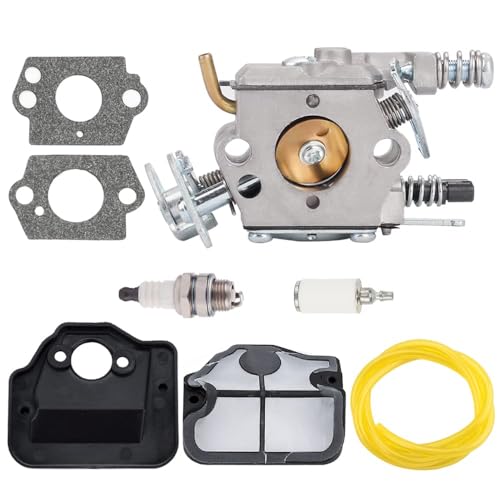


Mechanics of the Chainsaw Diaphragm Carburetor
A chainsaw carburetor mixes liquid fuel with incoming air at an exact ratio of approximately 14.7 parts air to 1 part fuel by weight. Two-stroke engines operate at rotational speeds often exceeding 12,000 RPM, requiring immediate throttle response and consistent fuel delivery under varying cutting loads. Diaphragm carburetors overcome gravitational limits by utilizing sealed chambers, flexible rubber membranes, and mechanical check valves to manage fuel flow under pressure.
The Purpose of an All-Position Diaphragm System
Traditional utility engines rely on a vented float bowl that stores a pool of standing gasoline at the base of the carburetor. If an operator rolls a float-equipped engine on its side, liquid gasoline spills out through atmospheric vents or floods the intake tract, causing the engine to stall. Chainsaws eliminate this standing fuel pool by sealing gasoline inside an enclosed metering chamber bounded by a flexible rubberized fabric diaphragm. Atmospheric air pressure acts on the external side of this diaphragm, while internal vacuum controls fuel entry through a spring-loaded needle valve.
This balanced diaphragm design ensures that fuel remains pressurized against the internal jets regardless of the powerhead orientation. Whether cutting downward through an oak log, making an upward undercut, or boring with the tip of the guide bar, the fuel level within the metering cavity remains constant. Powerheads ranging from compact 33cc trim saws to heavy 50cc firewood models depend entirely on this atmospheric pressure differential to feed fuel reliably. Replacement carburetors engineered for saws like the Poulan Pro PP4218 or Husqvarna 445 preserve this multidirectional cutting capability.
Crankcase Impulse Pulses and the Fuel Pump Diaphragm
Chainsaws do not feature external electric or camshaft-driven fuel pumps to pull gas from the tank. Instead, the carburetor houses its own built-in fuel pump driven by the reciprocating movement of the engine piston inside the crankcase. As the two-stroke piston travels upward toward top dead center, it creates a temporary vacuum inside the sealed crankcase cavity. When the spark plug ignites the air-fuel charge and drives the piston downward, it creates positive crankcase pressure that compresses the crankcase vapor before transfer ports open.
A dedicated impulse passage connects the crankcase directly to the fuel pump chamber on the side of the carburetor body. These alternating positive and negative pressure waves strike a thin rubber fuel pump diaphragm, forcing it to flex back and forth rapidly thousands of times per minute. Flap valves cut directly into the diaphragm gasket act as one-way check gates during this cycling movement. The vacuum stroke pulls fuel through the clunk filter in the fuel tank, while the pressure stroke forces fuel past the inlet check valve into the metering section.
The Metering Chamber and Spring-Loaded Inlet Needle
After fuel passes through the internal fine-mesh strainer screen, it reaches the metering chamber where precise volume regulation occurs. This chamber serves as a miniature pressurized holding reservoir immediately behind the fuel discharge jets. Fuel cannot freely pour into the chamber because a small viton-tipped inlet needle valve rests firmly against a machined brass seat. A calibrated coil spring pushes against a pivoting fulcrum lever to keep this needle tightly closed against incoming pump pressure until fuel is required by the engine.
The outer surface of the metering diaphragm is exposed to ambient atmospheric air through a vent hole in the carburetor stamped metal cover plate. When the engine intake stroke draws fuel out through the discharge orifices, pressure drops inside the sealed metering chamber. Ambient air pressure then pushes the metering diaphragm inward, depressing the lever arm and lifting the inlet needle off its seat to admit fresh fuel. If the fulcrum lever height is bent too high during a rebuild, the needle stays open and floods the engine cylinder with raw fuel.
The Venturi Effect and Low-Pressure Fuel Atomization
Fuel delivery into the combustion chamber ultimately relies on the venturi effect, a physical principle derived from fluid dynamics. The carburetor bore features an hourglass profile that constricts the intake passage directly above the fuel discharge ports. As the chainsaw piston rises and creates intake suction, ambient air rushes through the air filter and enters the wide inlet of the carburetor bore. When that air reaches the narrowed venturi throat, it accelerates significantly to pass through the smaller physical diameter.
According to Bernoulli’s principle, as the velocity of moving air increases inside the venturi, its static pressure drops correspondingly. This localized vacuum siphons fuel from the metering chamber into the fast-moving air stream through precision jet orifices. The rushing air violently shears the liquid gasoline stream into microscopic droplets, forming a fine, combustible vapor mist that enters the crankcase. Two-stroke chainsaws rely on the premixed 50:1 or 40:1 two-cycle oil suspended in this atomized fuel mist to lubricate crankcase bearings, connecting rods, and piston rings.
Idle, Low-Speed, and High-Speed Fuel Circuits
Small engine carburetors incorporate distinct internal fuel circuits to supply appropriate mixtures across different engine operating states. When a chainsaw idles with the throttle trigger released, the circular throttle butterfly plate rests in a nearly closed position across the carburetor bore. Because airflow through the main venturi is minimal at idle, the engine draws fuel through tiny idle discharge holes located slightly behind the edge of the throttle plate where localized manifold vacuum is highest. The low-speed circuit, regulated by the L needle screw, delivers fuel to prevent engine stumbling as the throttle plate begins to open.
At wide-open throttle, the butterfly plate swings completely parallel with the incoming airflow, eliminating localized vacuum at the idle ports. High-velocity air now sweeps through the narrowed venturi throat, activating the main high-speed fuel nozzle positioned directly in the center of the air stream. The high-speed needle screw, marked with the letter H on the carburetor body, meters the maximum volume of fuel flowing to this main jet. Saws like the Craftsman 42cc or Husqvarna 450 require careful calibration of the high-speed jet to sustain cutting torque in dense hardwood without over-revving.
How Choke Mechanisms and Purge Bulbs Prime the Engine
Cold two-stroke engines require a significantly richer fuel-to-air mixture to start because cold metal cylinder walls cause atomized gasoline to condense back into liquid droplets. The choke mechanism consists of a secondary butterfly or sliding plate mounted at the entrance of the carburetor bore ahead of the venturi. Closing the choke restricts incoming air while the operator pulls the starter rope, forcing the full suction of the engine piston to act upon the fuel jets. This intense intake vacuum pulls a heavy charge of fuel into the cold engine, providing the rich mixture needed for initial combustion.
Many modern chainsaws also feature a flexible transparent primer bulb mounted on or near the carburetor body. A common misconception among equipment owners is that pushing this bulb squirts liquid gasoline directly into the carburetor throat or engine cylinder. In reality, modern purge bulbs pull air and stale fuel out of the metering chamber, venting it through a return hose back into the fuel tank. Depressing the bulb several times draws fresh, bubble-free gasoline directly into the carburetor, eliminating vapor locks and reducing starter cord pulls.
Diagnosing Fuel Delivery Symptoms and Operational Failures
Carburetor malfunctions generate distinct engine symptoms that help operators isolate mechanical issues before replacing parts. A flooded engine occurs when excess liquid fuel drenches the spark plug electrode, preventing an electric arc from igniting the compressed mixture. Flooding often traces back to an inlet needle that fails to seal against its seat due to dirt contamination, a deteriorated viton tip, or an incorrectly set fulcrum lever. Clearing a flooded engine requires setting the choke to off, holding the throttle wide open, and pulling the recoil cord until excess vapor clears the combustion chamber.
A lean running condition represents a far more dangerous mechanical fault that can cause rapid cylinder scoring or engine seizure. Symptoms of a lean condition include an erratic racing idle, delayed return to idle after releasing the throttle, and severe power loss under load. Fuel starvation also occurs when fine sawdust or ethanol deposits clog the internal inlet screen positioned above the fuel pump chamber. Routine fuel filtration maintenance prevents these restrictions, which is just as vital on chainsaws as it is when maintaining outdoor clearing tools like brush cutter blades for heavy clearing and brush clearing machines.
Adjusting Carburetor Screws with Dedicated Service Tools
Small engine carburetors feature three external adjustment screws: the idle speed screw (labeled T or LA), the low-speed mixture screw (L), and the high-speed mixture screw (H). To comply with emissions regulations and prevent operators from running engines excessively rich, manufacturers use tamper-resistant screw heads rather than standard slotted screws. Common head configurations include Pac-Man, Single D, Double D, and Splined profiles, as featured in dedicated screwdriver sets from brands like LIYYOO. Attempting to force regular screwdrivers onto these security heads strips the brass adjusters and ruins the carburetor housing.
A standard baseline adjustment begins by gently turning both the L and H screws clockwise until they lightly seat against their internal stops. Overtightening these delicate screws will gall the aluminum casting and permanently damage the needle orifices. Once lightly seated, back each screw counterclockwise by the manufacturer baseline setting, typically one full turn open. Fine-tuning involves setting the idle speed screw so the saw chain remains stationary at idle, while adjusting the high-speed screw to prevent lean overheating when the guide bar cuts through hardwood logs.
Preventative Maintenance and Fuel System Preservation
Gasoline containing ethanol represents the primary cause of small two-stroke carburetor degradation. Ethanol absorbs atmospheric moisture through fuel tank vents, causing phase separation and forming corrosive acid compounds that attack aluminum castings and brass jets. Furthermore, alcohol degrades flexible rubber fuel lines, stiffens delicate metering diaphragms, and turns pliable primer bulbs brittle over time. Operators should consistently run 89+ octane ethanol-free gasoline mixed with high-quality synthetic 2-cycle oil to preserve internal rubber components and maintain reliable fuel metering.
Routine air filter cleaning prevents abrasive wood dust from bypassing the intake tract and lodging inside delicate carburetor passages. Fine sawdust that enters the venturi throat can foul the tiny idle discharge holes, wedge the inlet needle open, or accelerate cylinder wall wear. When small engine carburetors suffer from prolonged storage with stale fuel, complete replacement tune-up kits from brands like Hipa, HUSWELL, and HUZTL provide pre-calibrated assemblies. Swapping out a contaminated carburetor restores factory starting behavior and steady fuel delivery across all cutting positions for dependable wood-cutting performance.






Write Your Review
No reviews yet. Be the first to share your experience!