


Rough tear-out, motor strain, and burned edges quickly ruin expensive cabinet grade plywood and hardwood lumber. Upgrading your table saw or miter saw with premium tooling transforms standard cuts into ready-to-finish joints without extensive sanding. Discerning woodworkers and finish carpenters often study freud saw blade reviews to select the exact carbide geometry required for splinter-free sheet goods, chip-free melamine, and mirror-flat glue-line rips. Selecting the right blade profile also matters when preparing tricky materials like laminate or post-form tops, where using the best saw to cut countertop surfaces prevents unsightly surface chipping.
Careful analysis of tooth count, plate thickness, and carbide formulation ensures your saw motor runs smoothly without bogging down in dense stock. Premium TiCo high-density carbide teeth hold a sharp edge through abrasive composite materials, while laser-cut anti-vibration slots dampen harmonic chatter for truer tracking along the fence. Perma-Shield coatings lower friction and resist sticky pitch accumulation, keeping cut temperatures low and preventing burnt timber. Evaluating these technical specifications alongside real user experiences helps you choose the perfect dedicated ripping, crosscut, or combination blade for your shop workflow.

Pros
- Exceptional cut quality with minimal splintering on laminates and veneers
- Long-lasting carbide edge reduces frequency of sharpening or replacement
- Anti-vibration slots provide smooth, stable cuts even in dense hardwoods
- Versatile enough for both ripping and crosscutting without changing blades
- Non-stick coating keeps the blade clean and reduces friction during use
Cons
- Premium price point may be higher than entry-level blades, but performance justifies the cost for serious users
- Not ideal for heavy-duty framing or demolition work where a rougher cut is acceptable
- Some users may prefer a dedicated rip or crosscut blade for specialized tasks
The Freud P410 Next Generation Premier Fusion General Purpose Saw Blade is a 10-inch, 40-tooth circular saw blade engineered for woodworkers, contractors, and DIY enthusiasts who demand clean, precise cuts across a variety of materials. This blade is designed to handle both ripping and crosscutting tasks in wood, laminate, veneered plywood, hardwoods, and melamine, making it a versatile addition to any workshop or jobsite.
At the heart of the P410 is Freud's Fusion Trio Tooth design, which combines a 30-degree Hi-ATB grind, double grind, and axial shear face grind. This advanced geometry allows the blade to slice through material with minimal tear-out, producing polished, splinter-free edges that often require little to no sanding. The TiCo Hi-Density Carbide tips are formulated to hold a sharper edge longer than standard carbide, so you can maintain that clean cut quality through extended use.
Build quality is a standout feature. The blade body is laser-cut with anti-vibration slots that reduce harmonic vibration and sideways movement during the cut. This not only improves cut accuracy but also extends the blade's lifespan by reducing stress on the carbide tips. The Perma-Shield non-stick coating further enhances durability by protecting against corrosion and preventing pitch and resin buildup, which can degrade cutting performance over time.
In practical use, the P410 excels in workshop settings where finish quality matters. Whether you're crosscutting hardwood for furniture, ripping plywood for cabinets, or trimming laminate for countertops, this blade delivers smooth, clean results. It's also well-suited for contractors who need a reliable general-purpose blade that can transition between materials without sacrificing performance. The blade's 5/8-inch arbor fits most standard circular saws, miter saws, and table saws.
One realistic limitation is the price. At around $80, this blade sits at a premium compared to budget options. However, for users who prioritize cut quality and blade longevity, the investment often pays off in reduced waste and less time spent sanding or re-cutting. It's also worth noting that while the P410 is versatile, it's optimized for finish work rather than heavy framing or rough construction where a more aggressive tooth geometry might be preferred.
Overall, the Freud P410 is a top-tier choice for woodworkers, cabinet makers, finish carpenters, and serious DIYers who want professional-grade results from their saw. Its combination of advanced carbide, vibration-dampening design, and versatile tooth geometry makes it a reliable workhorse for any project where cut quality matters. If you're looking to upgrade from a standard blade and value clean, efficient cuts, this blade is well worth considering.
The Freud P410 is built with a laser-cut steel body that incorporates anti-vibration slots to minimize noise and wobble during operation. The TiCo Hi-Density Carbide tips are brazed onto the blade with precision, ensuring they stay securely attached even under heavy use. The Perma-Shield non-stick coating is applied to the entire blade, protecting against rust and resin buildup while reducing friction. This combination of materials and construction techniques results in a blade that maintains its performance and longevity over many cuts.
In a workshop environment, the P410 shines on table saws, miter saws, and circular saws. Its 40-tooth configuration with Hi-ATB grind produces exceptionally smooth crosscuts and clean rips in hardwoods, plywood, and melamine. The anti-vibration slots keep the blade stable, reducing the chance of burning or chattering, even when cutting dense materials. Users will appreciate the reduced need for sanding or jointing after cutting, which speeds up project completion.
This blade is designed to handle a wide range of materials commonly found in woodworking and construction. It cuts wood, laminate, veneered plywood, hardwoods, and melamine with equal proficiency. The recommended cutting depths are 3/8 to 3-1/2 inches for crosscuts and 3/4 to 1-1/2 inches for rips. While it's not a specialty blade for non-ferrous metals or masonry, it covers the vast majority of cutting tasks a woodworker or contractor encounters daily.

Pros
- Excellent value with two 60-tooth carbide blades included in the package
- Produces minimal tear-out on delicate veneer and finished trim boards
- Laser-cut stabilizer vents reduce harmonic vibration and cutting chatter
- Universally compatible with standard 10-inch miter saws and table saws
Cons
- Not designed for heavy rip cuts in thick, dense framing lumber
- Carbide grade is suited for DIY and intermediate shop work rather than industrial production runs
The AvantiPro by Freud 10-Inch 60-Tooth Fine Finish Saw Blade 2-Pack (model P106060PP) is designed for woodworkers, DIY remodelers, and finish carpenters who require smooth, accurate cuts without paying premium industrial prices. Running on either a standard 10-inch table saw or miter saw, these blades are specifically engineered to slice through cabinet plywood, hardwood trim, softwoods, and composite laminates. Having two dedicated finish blades on hand helps keep shop workflow smooth without unexpected downtime.
Cutting efficiency is centered around the 60-tooth carbide-tipped geometry, which excels at crosscutting and fine trimming. The tooth layout shears wood fibers cleanly rather than tearing them, significantly cutting down on tear-out and splintering along the cut line. This clean finish saves considerable sanding and prep time on crown molding, baseboards, and cabinet face frames. With a maximum rating of 6000 RPM, the blade maintains smooth feeding through dense stock while keeping edge burn to a minimum.
In terms of build quality, the blades feature laser-cut stabilizer vents etched directly into the steel body. These vents serve a critical practical purpose by dampening vibration, reducing blade deflection, and channeling heat away during sustained cuts. By minimizing wobble, the blade tracks truer through long cuts, delivering flatter glue-line joints and tighter miter seams. Durable carbide tips hold their sharp edge significantly longer than basic high-speed steel blades, even when cutting through abrasive glue lines in sheet goods.
Setting up these blades is straightforward on standard 10-inch arbor saws. Routine maintenance simply involves wiping pitch and resin off the teeth with standard blade cleaner to keep the carbide slicing freely. Because this is a two-pack, you can keep one blade mounted in your miter saw for precision trim work while reserving the second for your table saw or storing it safely in a shop drawer. Storing them hanging flat or separated with cardboard spacers prevents tooth chipping when not in use.
While these 60-tooth blades excel at fine crosscutting and finish work, they are not intended for heavy ripping through two-inch thick framing timber, where a lower tooth count is needed to clear sawdust efficiently. For home workshop builders, garage hobbyists, and light residential remodelers, this 2-pack provides a solid balance of clean cut quality and overall value. It stands as a sensible, cost-effective upgrade over stock blades for anyone looking to step up their woodworking finish quality.
Fine finish carpentry relies on true, chatter-free cuts, and the AvantiPro design incorporates specific features to maintain cut stability. The laser-cut stabilizer slots prevent thermal distortion, allowing the blade body to expand evenly under friction rather than warping out of true.
With 60 precision-ground carbide teeth, the blade distributes cutting force evenly across small increments of wood. This yields crisp 45-degree miter joints that close cleanly without requiring heavy sanding or gap filler on baseboard and picture frame assemblies.

Pros
- Delivers exceptionally clean, chip-free edges on plywood and melamine.
- Anti-vibration technology improves cut precision and blade stability.
- Non-stick coating reduces maintenance and pitch accumulation.
- High tooth count allows for fine crosscuts with minimal sanding.
Cons
- Higher tooth count may be slower for ripping or thick stock; best for crosscutting.
- Premium price point may not suit casual DIYers on a budget.
- Requires a saw with sufficient power to drive 80 teeth effectively.
The Freud LU80R010 is a 10-inch circular saw blade designed specifically for cutting plywood, melamine, and other sheet goods. With 80 teeth arranged in a High Alternate Top Bevel (Hi-ATB) grind, this blade is built to produce exceptionally smooth, splinter-free edges on both sides of the cut. It is part of Freud's Ultimate line, which focuses on professional-grade performance for woodworking and finish carpentry.
This blade is best suited for woodworkers, cabinetmakers, contractors, and serious DIYers who regularly work with panel materials. If you are building cabinets, installing laminate flooring, or cutting melamine shelving, the LU80R010 can help you achieve a near-polished finish that reduces the need for sanding or edge banding. It is less ideal for ripping solid lumber or heavy framing work, where a lower tooth count would be more efficient.
In real-world performance, the Hi-ATB tooth geometry and the laser-cut anti-vibration slots work together to minimize tear-out and blade wobble. Users can expect straight, clean cuts even when using a handheld circular saw, where blade stability is often a challenge. The TiCo Hi-Density carbide tips hold their edge well through abrasive materials like MDF and particleboard, and the Perma-Shield non-stick coating helps prevent pitch and resin from building up on the blade body, which in turn reduces heat buildup and extends cutting life.
Build quality is a strong point for this blade. The plate is made of hardened steel with precision-ground expansion slots to control heat expansion. The carbide tips are brazed on with a high-temperature alloy, ensuring they stay secure even during demanding cuts. The .126-inch kerf is thin enough to be efficient but still offers good stability. The blade comes with a standard 5/8-inch arbor and can be used on most worm-drive, sidewinder, or table saws with a 10-inch capacity.
Storage and maintenance are straightforward. While the blade does not include a hard case, it is easy to store in a blade sleeve or drawer. Keeping the Perma-Shield coating clean is simple - a quick wipe with a solvent after use helps maintain its non-stick properties. The anti-vibration slots also help reduce noise during cutting, which is a nice bonus in a workshop setting.
Realistically, the main limitation is the price - around $94 is a significant investment for a single blade, especially for hobbyists who may not use it frequently. Also, because of the high tooth count, this blade is slower when ripping thick materials. It is definitely a specialist tool for crosscutting sheet goods. For anyone who values a pristine, chip-free cut and wants to skip post-cut sanding, however, the Freud LU80R010 is a worthwhile addition to the toolbox.
The Freud LU80R010 is engineered for high precision in crosscutting sheet materials. The Hi-ATB tooth design alternates bevel angles to shear the wood fibers cleanly, reducing chip-out on both the top and bottom surfaces. This is especially important when cutting melamine or veneered plywood, where a rough edge can ruin the finished look.
The laser-cut anti-vibration slots are a key feature for accuracy. They dampen harmonic vibrations that can cause the blade to wander slightly during the cut. This translates to straighter lines and less need for cleanup. The 2-degree hook angle is mild, which helps keep the cut smooth and reduces the tendency for the blade to grab or self-feed aggressively.
For woodworkers who demand square, splinter-free cuts - like those building cabinets or furniture - this blade provides the level of precision that reduces sanding and edge banding time. When paired with a high-quality saw and a sharp blade, the results are consistently impressive.
Freud is known for using premium materials, and the LU80R010 is no exception. The carbide tips are made from a TiCo Hi-Density blend that resists chipping and wear better than standard carbide. This helps the blade stay sharp longer, even when cutting abrasive materials like MDF or particleboard.
The blade body is laser-cut from hardened spring steel, and the expansion slots are precisely positioned to manage heat without compromising rigidity. The Perma-Shield non-stick coating is applied to both sides of the plate, reducing friction and preventing corrosion. This coating also makes cleanup easier - pitch and resin do not adhere as strongly, so the blade can be wiped down quickly after use.
Each blade is balanced and tensioned at the factory to minimize runout. While no blade is perfect at every price point, the LU80R010 offers a level of consistency that professional woodworkers can rely on. The 5/8-inch arbor fits most common saws, and the blade is also available with a 1-inch arbor for certain table saws.
Pros
- Eliminates melted edges and blowout on fragile acrylics and plastic sheets
- Negative hook angle provides excellent feeding control and increased operator safety
- Silver Ice coating reduces thermal friction and stays clean during repetitive cuts
- Direct fit on standard 10-inch table saws and miter saws without arbor adapters
Cons
- Specialized tooth profile is not suitable for cutting solid lumber or framing materials
- Higher price point compared to standard general-purpose woodworking blades
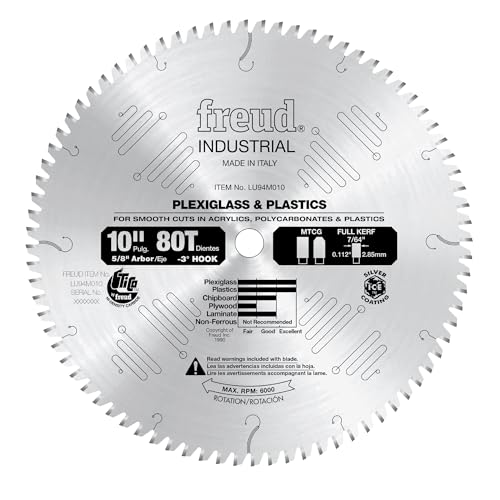
The Freud LU94M010 is a specialized 10-inch, 80-tooth circular saw blade designed specifically for clean, accurate cuts through plastic, acrylic, polycarbonate, and synthetic materials. Cutting plastics with a standard woodworking blade frequently results in fractured edges, chipping, or melted seams that weld the kerf back together. This dedicated blade solves those fabrication headaches, making it a valuable power tool accessory for sign makers, cabinet shops, trim contractors, and serious garage woodworkers working with synthetic materials.
Cutting performance centers on Freud's Modified Triple Chip Grind (MTCG) tooth design combined with a high 80-tooth count. This geometry distributes the cutting load evenly and chips away minute plastic particles rather than tearing them out. Working alongside this grind is a negative 3-degree hook angle. The negative rake creates a passive cutting stance that stops the teeth from aggressively grabbing thin or brittle sheets, producing clean, smooth edges that require minimal scraping or flame polishing.
Build quality matches Freud's reputation for dependable workshop accessories. The blade features TiCo Hi-Density Carbide teeth formulated specifically to resist the abrasive wear typical of dense plastics. The exterior plate is treated with a Silver Ice coating that reduces operational friction and protects against corrosion. This coating also prevents melted plastic swarf from sticking to the plate surface, keeping the blade running cool during long rips on a cabinet saw or repetitive cuts on a miter saw.
With a standard 5/8-inch arbor, a 0.110-inch kerf, and a 0.087-inch plate thickness, setup is straightforward on almost any 10-inch stationary or portable table saw and compound miter saw. Routine maintenance simply involves keeping the carbide clean with a mild blade cleaner and storing it with tooth guards to protect the sharp micro-grain edges. Users should keep in mind that this blade is engineered exclusively for plastics and composite polymers; using it for conventional lumber or construction framing will lead to slow cutting speeds and unnecessary carbide dulling.
For shops and fabricators frequently dealing with architectural PVC trim, custom acrylic displays, polycarbonate safety shields, or plastic prototyping sheets, the Freud LU94M010 is a dependable, high-yield solution. It eliminates wasted stock and saves substantial labor hours otherwise spent cleaning up rough, melted cut lines.
In custom fabrication shops, achieving a factory-smooth edge on extruded acrylic or clear polycarbonate typically requires specialized tooling. The Freud LU94M010 handles these challenging substrates cleanly by controlling heat buildup through its 80-tooth distribution and MTCG geometry. Users can feed sheet goods through table saws without the chatter and blade pull that typically ruins brittle acrylic sheets.
Beyond clear plastics, this blade performs exceptionally well on cellular PVC boards and vinyl trim packages popular in modern construction. Exterior carpenters can make fine miter cuts on synthetic crown molding and exterior trim boards without chipping the delicate outer skins, ensuring tight, professional joints right off the saw.

Pros
- Versatile cutting performance across multiple materials
- Anti-vibration technology improves cut quality and user comfort
- Thin kerf reduces waste and makes cutting easier on lower-horsepower saws
- Perma Shield coating keeps blade clean and reduces binding
- Industrial carbide holds edge well for long-term use
Cons
- Thin kerf blades may be more prone to deflection in heavy cuts compared to full kerf
- Premium price compared to standard blades, but justified by performance
- Not recommended for extremely thick or dense hardwoods without proper setup
The Freud LU83R010 is a 10-inch, 50-tooth thin kerf combination saw blade that blends rip and crosscut capabilities into one versatile tool. Designed with a TiCo high-density carbide blend and a unique tooth geometry, it excels in cutting solid wood, plywood, chipboard, and laminates. The thin kerf design removes less material, which translates to faster cuts and less strain on your saw motor.
This blade is best suited for woodworkers, contractors, and serious DIY enthusiasts who need a go-to blade for everyday workshop or jobsite tasks. Whether you're framing, building cabinets, or working on home renovation projects, the LU83R010 offers reliable performance across a range of materials. It's a practical choice for both garage workshops and professional construction environments.
Real-world performance is where this blade shines. The TiCo carbide blend holds its edge longer than standard carbide, reducing the frequency of sharpening. The anti-vibration slots help minimize chatter, resulting in smoother cuts with less noise and fatigue. Users often report cleaner edges in plywood and laminates, with minimal chipping. The Perma Shield coating further reduces friction and prevents resin buildup, keeping cuts consistent and efficient.
Build quality is industrial-grade, with no need for stabilizers thanks to the blade's balanced design. The Perma Shield coating also adds a layer of corrosion resistance, prolonging blade life in humid garage conditions. Storage is straightforward - a standard blade case or wall-mounted rack works well. Maintenance involves occasional cleaning of resin off the coating, which is easy due to the non-stick surface.
One realistic limitation is that thin kerf blades can deflect under heavy cuts, especially in thick hardwoods or when feeding too aggressively. The LU83R010 is not ideal for very thick stock without a stable setup. Additionally, its premium price may be a consideration for budget-conscious shoppers, but the durability and cut quality often justify the investment over time.
Based on product specifications and user feedback, the Freud LU83R010 is a strong recommendation for anyone needing a high-quality combination blade. It strikes an excellent balance between rip speed and crosscut finish, making it a versatile addition to any workshop or jobsite toolkit. For woodworkers, contractors, and dedicated DIYers, this blade delivers consistent, clean results.
Pros
- Produces glue-ready edges, eliminating the need for jointing or sanding.
- Thick kerf and reinforced plate provide excellent stability and flatness.
- Anti-vibration slots extend blade life and improve cut quality.
- Perma-Shield coating reduces maintenance and protects against corrosion.
- Premium carbide blend offers long edge retention and consistent cutting.
Cons
- Premium pricing may not suit budget-conscious DIYers.
- 30-tooth design is specialized for ripping; not ideal for crosscuts or fine joinery.
- Heavier than standard blades due to thick kerf and plate.
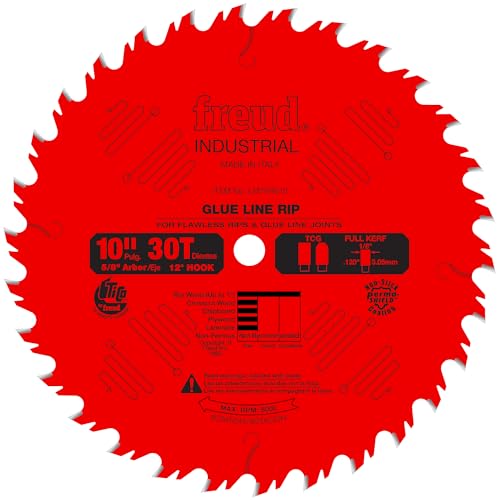
The Freud Industrial Glue Line Ripping Saw Blade (model LM74R010) is a specialized 10-inch, 30-tooth blade designed for woodworkers, contractors, and serious DIY homeowners who demand exceptionally smooth, true-cut surfaces from their ripping operations. This blade features a triple chip tooth (TCG) grind combined with a premium TiCo (Titanium-Cobalt) high-density carbide blend, allowing it to power through hardwoods and softwoods alike while leaving a finish that is often glue-ready straight from the saw.
Who is this blade best suited for? It is an excellent choice for cabinet makers, furniture builders, and finish carpenters who need clean, splinter-free edges without the extra step of jointing or sanding. It also works well for contractors and workshop users who regularly rip large panels or dimensional lumber and want to minimize post-cut finishing work. The blade's heavy-duty construction, with a thick kerf and reinforced plate, provides the stability needed for consistent, accurate cuts in demanding applications.
In terms of real-world performance, the combination of the TiCo carbide blend and anti-vibration laser-cut slots results in reduced vibration and sideways movement during the cut. This translates to a smoother operation, longer blade life, and a cleaner cut edge. The Perma-Shield non-stick coating further enhances performance by reducing friction and heat buildup, as well as preventing pitch and resin from accumulating on the blade teeth. This means less downtime for cleaning and more consistent cutting over time.
Build quality is a standout feature. The blade uses a thick carbide formulation that holds its edge well, even when cutting dense or abrasive materials. The reinforced plate resists warping and maintains flatness, which is critical for achieving straight cuts. The anti-vibration slots are laser-cut for precision, and the Perma-Shield coating adds corrosion resistance, making this blade suitable for both workshop and job site environments where moisture and dust are present.
Storage and maintenance are straightforward. The blade can be stored in a standard blade case or hung on a wall peg. The Perma-Shield coating makes cleaning easy; a simple wipe with a solvent or blade cleaner removes most pitch buildup. However, users should note that this blade is specifically designed for ripping operations. Its 30-tooth configuration and TCG grind are optimized for cutting with the grain, not for crosscutting or delicate joinery. If you need a blade for multiple tasks, you may want to pair this with a combination or crosscut blade.
Overall, the Freud LM74R010 is a practical investment for woodworkers and contractors who prioritize cut quality and productivity in ripping applications. While its premium price may be a consideration for casual DIYers, the time saved on finishing and the consistent results make it a worthwhile addition to any serious workshop or job site tool collection.
The Freud Industrial Glue Line Ripping Saw Blade is built with a thick kerf and a reinforced plate to ensure maximum stability and flatness during heavy use. The plate is laser-cut from high-quality steel, and the anti-vibration slots are precisely engineered to minimize noise and wobble. The TiCo carbide tips are brazed onto the blade with a high-temperature process that ensures they stay firmly attached even under stress. The Perma-Shield coating is applied evenly and provides a durable non-stick surface that resists corrosion and resin buildup. Overall, this blade feels substantial and well-engineered, suitable for daily professional use.
In a workshop setting, this blade excels at ripping hardwood boards, plywood, and MDF with minimal tear-out. The triple chip tooth design produces a flat, smooth edge that is often ready for gluing without additional planing or sanding. The anti-vibration slots keep the blade running true, even when feeding stock quickly. The thick kerf does remove more material than a thin-kerf blade, but the trade-off is increased stability and longer blade life. For woodworkers who do a lot of ripping, this blade can significantly reduce finishing time and improve overall workflow.

Pros
- Versatile tooth pattern works equally well for ripping and crosscutting, reducing blade changes
- TiCo carbide edge retention means fewer sharpenings and longer usable life
- Anti-vibration slots produce noticeably smoother cuts with less chatter
- Perma-Shield coating keeps the blade clean and corrosion-free with minimal maintenance
- Excellent balance of speed and finish quality for a general-purpose blade
Cons
- Premium price point compared to entry-level combination blades
- Not ideal for heavy, repeated ripping of thick hardwoods - dedicated ripping blade may be better
- Slightly heavier than some thinner-kerf blades, which can affect saw motor strain on smaller saws
The Freud LU84R011 is a 10-inch, 50-tooth combination saw blade that brings together two essential cutting actions in one package. It uses an advanced tooth configuration with one flat-top tooth for efficient ripping and four alternate top bevel (ATB) teeth for smooth crosscutting. This makes it a practical choice for woodworkers, contractors, and serious DIY homeowners who need a single blade that can handle everyday cutting tasks on a miter saw or table saw.
When it comes to real-world performance, this blade really shines. The high-density TiCo carbide blend keeps edges sharp longer than standard carbide, so you get consistent cuts across a range of materials from soft pine to dense oak. The large gullets positioned in front of the flat-top raker teeth do an excellent job of clearing chips quickly, which reduces heat buildup and keeps the cut moving smoothly. Users report noticeably less burning and binding, even on longer rip cuts, and the ATB teeth leave a clean, splinter-free edge on crosscuts and miters.
Build quality is a strong point here. The plate is laser-cut with precision, and the anti-vibration slots effectively dampen chatter and sideways movement. This stability extends blade life and contributes to that crisp, accurate finish many users appreciate. The Perma-Shield coating adds another layer of practicality - it cuts friction, prevents pitch and resin from sticking, and protects the blade from rust. You don't need to use stabilizers or listen to excessive noise; the blade runs true right out of the box.
Storage and maintenance are straightforward. After use, a quick wipe with a dry cloth or a bit of blade cleaner keeps the coating working. The blade fits standard 5/8-inch arbors, so it works with most miter saws, table saws, and radial arm saws. There's no need for special tools or adapters. One realistic limitation is the price - it costs more than entry-level combo blades. Also, if your work involves mostly heavy ripping of thick hardwoods, a dedicated rip blade might still outperform it. For the vast majority of mixed cutting tasks, though, this blade offers a very good balance.
In terms of a buying recommendation, the Freud LU84R011 is ideal for anyone who wants a single, high-quality blade that can handle both ripping and crosscutting with minimal compromise. It's especially well-suited for workshop users, cabinetmakers, and contractors who value clean finishes and reliable performance. If you're a DIY homeowner tackling furniture projects, shelving, or trim work, this blade will give you professional-looking results without needing to swap blades constantly. It's a solid investment for the serious tool user.

Pros
- Exceptional cut quality on double-sided melamine and veneer plywood with minimal tear-out.
- TiCo carbide teeth stay sharp significantly longer than standard carbide blades.
- Positive hook angle makes feeding easier without sacrificing finish quality.
- Perma-Shield coating keeps the blade clean and reduces drag during long cuts.
- Versatile thickness range suits both sheet goods and dimensional lumber.
Cons
- Premium pricing may be overkill for occasional DIY users or rough framing work.
- 60-tooth count is optimized for crosscuts; not ideal for aggressive ripping of thick hardwoods.
- Requires careful handling to avoid damaging the Hi-ATB tooth geometry during cleaning or storage.
The Freud LU73R010 is a 10-inch circular saw blade built specifically for crosscutting tasks where finish quality matters most. With 60 teeth arranged in a high alternate top bevel (Hi-ATB) grind, this blade is engineered to produce exceptionally clean edges on materials like double-sided veneer plywood and melamine, which are notorious for chipping with lesser blades.
This blade is best suited for woodworkers, cabinetmakers, finish carpenters, and serious DIYers who demand smooth, splinter-free cuts in hardwood, softwood, plywood, and chipboard. It's also a strong choice for contractors working on kitchen cabinets, built-ins, or trim work where visible surfaces must be pristine. The positive hook angle helps the blade feed faster than typical crosscut blades, improving productivity without compromising cut quality.
Real-world performance is driven by Freud's TiCo Hi-Density carbide blend, which combines titanium and cobalt for exceptional edge retention and wear resistance. Users can expect the blade to stay sharp through many cuts, reducing downtime for changes. The Perma-Shield coating further enhances performance by minimizing friction and preventing resin buildup, which is especially useful when cutting resinous softwoods or plywood with synthetic glues.
Build quality is outstanding. The blade body is precision-ground and tensioned to reduce vibration, and the carbide teeth are brazed securely. The Hi-ATB grind alternates the bevel angle at 38 degrees, effectively slicing through the top layer of melamine or veneer before the tooth exits, minimizing chipping. This design is a hallmark of Freud's cabinetmaker series and reflects a focus on professional-grade results.
Setup is straightforward—mount the blade on any 5/8-inch arbor saw (table saw, miter saw, or circular saw) and ensure proper alignment for best results. Maintenance involves keeping the blade clean; the Perma-Shield coating makes this easier, but occasional cleaning with a blade cleaner will extend life. Storage in a protective sleeve or case is recommended to protect the fragile tooth geometry.
A realistic limitation is that this blade is not a general-purpose workhorse. Its 60-tooth count and Hi-ATB grind excel at crosscuts but are less efficient for ripping thick lumber. Also, the premium price reflects its specialized nature. For woodworkers who prioritize cut quality over versatility, the LU73R010 is a worthwhile investment that delivers consistent, clean results project after project.

Pros
- Outstanding cut quality for ripping applications, producing ready-to-glue edges
- Long-lasting carbide tips that hold up well in dense and abrasive materials
- Reduced vibration contributes to both better cuts and less user fatigue
- Non-stick coating makes cleanup easier and extends blade life between sharpenings
- Thin kerf saves material and reduces strain on the saw motor
Cons
- Designed specifically for ripping, not suitable for crosscutting or miter cuts
- Premium pricing compared to standard contractor-grade blades
- Thin kerf may deflect slightly under extreme feed pressure or with very thick stock
The Freud LM75R010 is a 10-inch industrial thin kerf glue line ripping blade, purpose-built for making long, straight cuts along the grain in solid wood. It’s part of Freud’s high-end lineup, featuring 30 teeth with a Triple-Chip Grind (TCG) and a 12-degree hook angle that’s optimized specifically for ripping on table saws, radial arm saws, and some circular saws. This blade is designed for users who demand furniture-grade results directly from the saw, without needing extra jointing or planing steps.
This blade is best suited for serious woodworkers, cabinet makers, finish carpenters, and contractors who work with hardwoods, softwoods, plywood, and engineered panels. DIY homeowners tackling big projects like building a deck, workbench, or bookshelves will also appreciate the smooth finish and time savings. It’s not intended for crosscutting, but for ripping it excels, making it a specialized tool for those who do a lot of that type of cutting.
In terms of real-world performance, the LM75R010 delivers exceptionally clean cuts with minimal tear-out, even on challenging grain patterns. The thin kerf (0.091") removes less material than a standard full-kerf blade, which means less waste and easier feeding, especially on underpowered saws. The Perma-Shield coating reduces friction and helps prevent pitch from sticking, so the blade stays sharper longer and produces more consistent results. Users report that it leaves a surface that often requires no sanding before gluing.
Build quality is a strong suit. The blade uses Freud’s TiCo HI-Density carbide, which is a premium blend that resists chipping and holds an edge well. The plate is laser-cut from high-grade steel and includes anti-vibration slots that noticeably dampen noise and wobble. The Perma-Shield coating also protects against rust and corrosion, making the blade suitable for workshop environments with varying humidity. The arbor is 5/8", which is standard for most table saws and many circular saws.
Storage and maintenance are straightforward. The blade comes in a reusable plastic sleeve that protects the teeth during storage. Regular cleaning with a resin remover and occasional sharpening by a professional will keep it performing at its best. There’s no specialized storage case included, so you may want to add a blade case or store it carefully in your shop drawer.
One realistic limitation is that this is a ripping-only blade. If you need to do crosscuts or miters, you’ll need a separate combination or crosscut blade. Also, the thin kerf can be more prone to deflection if you push the stock too hard or try to cut very thick material in one pass. Take light to moderate passes for best results. Overall, for woodworkers who prioritize ripping quality and blade longevity, the Freud LM75R010 is a worthwhile investment that performs well above its price point.

Pros
- Exceptional cut quality on veneered and coated materials with virtually no chipping.
- Durable TiCo carbide holds sharpness longer than standard carbide blades.
- Anti-vibration slots dramatically reduce chatter for smoother cuts.
- Perma-Shield coating prevents resin buildup and corrosion, simplifying maintenance.
Cons
- Thin kerf design may be less stable for deep or aggressive ripping in thick hardwoods.
- Premium pricing compared to standard blades, though justified for professionals.
- Limited user reviews available, so real-world long-term performance is unconfirmed.
The Freud LU79R010 is a 10-inch, 80-tooth thin kerf circular saw blade engineered specifically for crosscutting plywood, melamine, and laminates. Its high alternate top bevel (Hi-ATB) tooth geometry creates a shearing action that minimizes tear-out, making it a top choice for finish carpentry, cabinetmaking, and fine woodworking projects where edge quality is critical.
This blade is best suited for woodworkers, cabinetmakers, finish carpenters, and DIY homeowners who regularly work with veneered plywood, melamine, and delicate moldings. The thin kerf design removes less material, reducing waste and placing less strain on the saw motor, which can help extend tool life and improve cut control. Many users appreciate that the blade delivers clean, polished edges without the need for sanding or filling.
Performance is driven by the premium TiCo high-density carbide blend, which Freud touts for its edge retention and durability. Combined with the laser-cut anti-vibration slots, the blade stays stable during cuts, reducing sideways movement and vibration. This translates to a crisp, splinter-free finish even on materials prone to chipping. The Perma-Shield non-stick coating further enhances performance by reducing friction and heat buildup, preventing pitch and resin accumulation, and protecting against corrosion.
Build quality is solid, with a hardened steel body and the Perma-Shield finish ensuring longevity. The blade does not come with a storage case, so users may need to purchase a blade saver or sleeve for safe storage. Setup is straightforward on any standard 10-inch circular saw, miter saw, or table saw with a 5/8-inch arbor. Maintenance is minimal thanks to the non-stick coating, which helps keep the blade clean.
One realistic limitation is that thin kerf blades can deflect under heavy loads, so this blade is not ideal for deep ripping in thick hardwoods or for aggressive jobsite use. It excels in crosscutting applications where finish quality matters most. The price point is higher than entry-level blades, but professionals and serious hobbyists often find the investment worthwhile for the consistent, chip-free results.
For anyone involved in fine woodworking, cabinet assembly, or any task requiring perfectly clean edges on coated materials, the Freud LU79R010 delivers on its promise. Based on product specifications and user feedback, it is a reliable upgrade over standard blades for those who prioritize cut quality and reduced waste in their workshop.
Frequently Asked Questions
What makes the Hi-ATB grind effective for double-sided melamine and fine veneers?
A High Alternate Top Bevel grind slices delicate surface veneers with an extreme shearing action rather than chopping into the wood fibers. The steep bevel angle acts like a razor knife at the cut line, preventing splintering on both the face and underside of pre-finished sheet goods. This specialized tooth profile yields glass-smooth edges on veneered plywood and delicate trim work, though it requires gentle feed rates to prolong sharpness.
When should you choose a thin kerf blade over a standard full kerf plate?
Thin kerf blades are ideal for portable jobsite saws and lower-horsepower motors rated under two horsepower. By removing less material during each pass, a thin kerf plate reduces motor drag and prevents bogging down in thick hardwoods. Full kerf blades offer greater plate stiffness for heavy commercial table saws, but thin kerf designs preserve valuable lumber and feed effortlessly on standard tools.
Can a dedicated glue-line ripping blade replace a jointer for edge gluing?
Yes, a dedicated glue-line ripping blade creates an ultra-smooth edge that allows direct panel glue-ups without preliminary jointing. The combination of a flat-raker Triple Chip Grind and thick plate stability eliminates swirl marks along the cut face. Achieving this seamless glue joint requires an accurately aligned rip fence and steady feed rate through straight, dry hardwood lumber.
Why does a plastic-cutting saw blade utilize a negative hook angle?
A negative hook angle pushes material gently downward against the table rather than aggressively grabbing and lifting delicate sheets. When cutting extruded plastics, acrylics, or thin vinyl pieces, aggressive positive teeth cause chipping, cracking, or dangerous climb-cutting. Controlled negative rake angles maintain stable feeding and work equally well when preparing to cut lattice panels without fracturing brittle plastic joints.
How do laser-cut vibration slots improve overall cut quality on table saws?
Laser-cut vibration slots absorb harmonic resonance and prevent sideways blade deflection while the plate spins at high speed. Uncontrolled blade flutter introduces micro-wobble, leading to scored edges and rough kerf lines in delicate crosscuts. Built-in expansion slots also relieve heat tension during extended cuts, keeping the core plate flat and ensuring accurate 90-degree square edges.


Write Your Review
No reviews yet. Be the first to share your experience!