


Rough cuts, dangerous tear-out, and unpredictable blade wander can ruin delicate stock before a project even gets off the ground. Slicing micro-thin laths, inlays, or edge banding requires rigid control and a blade that glides smoothly without binding. Pairing a high-grade pull saw or a specialized ripping jig with the best saw for cutting thin strips of wood keeps workpieces stable while protecting your hands from close blade contact. Thin-kerf cutting requires patience, steady feed pressure, and reliable zero-clearance backing to prevent slender pieces from dropping into the throat plate.
Woodworkers tackling precision joinery or miniature modeling often shift between flexible Japanese hand saws and table saw jigs. Thin rip guides mount directly to standard miter slots to turn standard workshop saws into repeatable strip cutters, while razor-sharp Ryoba pull saws deliver micro-clean edges on delicate hardwoods without power tool chatter. Comparing gear options like fine-kerf blades against a compound miter saw setup helps clarify how to maintain high accuracy without splintering fragile wood fibers.

Pros
- Affordable price point for a quality Japanese pull saw
- Versatile dual TPI options for different wood types and cut styles
- Lightweight and comfortable wood handle enhances control and reduces strain
Cons
- 6-inch blade may be too short for larger woodworking projects
- Wood handle may be less durable than plastic or rubberized grips over time
- Limited to hand saw applications; not suitable for heavy-duty construction framing
The VPQZUPG 6 Inch Japanese Pull Saw is a compact hand saw designed for precision woodworking tasks. It features a blade made from SK5 high-carbon steel, heat-treated to a hardness of HRC60-63, ensuring long-lasting sharpness and wear resistance. The double-edged design offers 17 teeth per inch (TPI) on one side for hardwoods and 11 TPI on the other for softwoods, allowing both rip cuts and cross cuts with a smooth finish.
This pull saw is best suited for DIY homeowners, woodworkers, carpenters, and hobbyists who need a lightweight tool for detailed trimming, small joinery, or model making. Its compact 6-inch length makes it easy to maneuver in tight spaces, and the wood handle provides a comfortable, traditional grip that reduces hand fatigue during repetitive cuts. The Japanese pull saw technique (cutting on the pull stroke) gives users greater control and accuracy compared to Western push saws.
In terms of real-world performance, the blade's triple-ground teeth deliver clean, splinter-free cuts in both directions. The 17 TPI side excels at cutting hardwoods like oak or maple, while the 11 TPI side handles softwoods like pine or cedar efficiently. Users will appreciate how little effort is required to make precise cuts, which can improve productivity on small projects such as furniture repairs, picture frames, or hobby crafts.
Build quality is solid for the price. The SK5 steel blade is flexible yet strong, resisting bending during use. The wood handle is securely attached and offers a natural feel, though it may not be as ergonomic as modern rubberized handles. The saw is lightweight and easy to store in a toolbox or workshop drawer, requiring minimal maintenance beyond occasional cleaning and oiling to prevent rust.
One realistic limitation is the 6-inch blade length, which restricts its use to smaller workpieces. For larger framing or construction cuts, a longer saw would be more appropriate. Additionally, the wood handle may absorb moisture over time if not stored properly, potentially affecting durability. However, for its intended use as a detail saw, these drawbacks are minor.
Overall, the VPQZUPG 6 Inch Japanese Pull Saw is a practical choice for anyone needing an affordable, sharp, and precise hand saw for woodworking projects. It's especially valuable for DIY enthusiasts and workshop users who want a reliable tool for fine cuts without breaking the bank. The included full refund policy from the brand adds peace of mind for buyers.

Pros
- Ultra-thin design avoids lifting stock off the saw table
- Leaves no sticky adhesive residue on tool surfaces during removal
- Fast visual reference reduces measurement and marking time
- Affordable 5-pack handles multiple blades and dado setups
Cons
- Sacrificial material will wear down over time and requires periodic replacement
- Does not replace the full structural support of a dedicated phenolic zero-clearance insert
The Fabbay Zero Gap Woodworking Tape is a specialized power tool accessory designed to cover saw throat plates and insert slots on table saws and miter saws. By applying this self-adhesive strip directly over the blade opening and raising the spinning blade through it, users create an exact, zero-clearance slot tailored to their specific blade kerf. This quick modification creates an accurate visual cut guide while supporting wood fibers right at the cut line.
This tape is best suited for cabinetmakers, finish carpenters, fine woodworkers, and DIY hobbyists who frequently work with delicate sheet goods, pre-finished plywood, or hardwoods prone to splintering. It offers an easy way to achieve cleaner edges without needing to fabricate or purchase expensive custom insert plates for every specialized blade or bevel angle.
Regarding workshop performance, the tape helps minimize underside chip-out by holding wood grain tight against the cut. Because the tape measures only 0.3 mm thick (roughly 0.01 inches), it maintains flush contact between the workpiece and the table surface without introducing annoying ridges that could tilt your board. The resulting kerf slit shows you exactly where the blade will make contact, taking the guesswork out of lining up tick marks on critical joinery pieces.
The build quality centers on durable PVC material that resists premature tearing during stock feeding. Its adhesive backing provides solid grip on cast iron, aluminum, and composite inserts, preventing the tape from bunching or shifting as lumber passes overhead. When it is time to switch blades, cut bevels, or replace worn strips, the adhesive pulls up cleanly without leaving gummy residue on your machine table.
While this accessory provides noticeable cut improvement, buyers should keep in mind that tape is inherently sacrificial. Continuous friction from rough lumber will eventually wear down the edges, meaning strips will need regular replacement depending on shop workload. For woodworkers seeking an accessible, low-cost way to improve cut precision and reduce finish sanding, this 5-pack is a smart addition to any garage or workshop setup.
Achieving clean, splinter-free cuts on veneered plywood and delicate trim often requires zero-clearance support. By cutting directly through the applied Fabbay PVC tape, the edge of the slit matches your blade teeth perfectly, giving immediate backing to the workpiece fibers as the blade exits the cut.
In addition to tear-out prevention, the precise kerf mark serves as an immediate visual alignment aid. Users can bring their cut line directly against the kerf slit on the tape, significantly reducing alignment errors and speeding up repetitive crosscutting tasks on both table saws and miter saws.

Pros
- Easy peel-and-stick application requires no drilling or plate modifications
- Slim 0.01-inch thickness preserves cut angle accuracy without tilting thin workpieces
- Clear kerf mark gives an instant visual guide for precision workpiece positioning
- Removes cleanly without requiring harsh solvent cleanup on table saw surfaces
- Generous 10-pack provides multiple replacements for different blade kerfs
Cons
- Changing blade bevel angles cuts through the tape, requiring a replacement strip for accurate zero-gap support
- Rough, unplaned lumber can abrade or peel the tape edges faster than smooth hardwood
- Requires thorough degreasing of the insert plate before application for optimal adhesion
The Fabbay Zero Gap Woodworking Tape is a specialized workshop accessory engineered to enhance cutting precision and reduce tear-out on table saws and miter saws. Acting as a flexible zero-clearance surface over factory throat plates, this product gives woodworkers a quick way to achieve cleaner cuts on veneered plywood, melamine, and delicate hardwoods without fabricating custom wooden zero-clearance inserts for every setup.
This tape is primarily tailored for cabinetmakers, furniture builders, DIY garage enthusiasts, and general woodworkers who demand crisp cut lines. Standard throat plates often leave large gaps around the blade, allowing unsupported wood fibers to splinter along the bottom edges of the cut. By covering the opening and running the blade up through the tape, users establish an exact kerf boundary that supports wood fibers right up to the blade teeth.
Regarding build quality and workshop utility, each strip is produced from a tough PVC material measuring 2 inches wide by 14 inches long. With a thickness of approximately 0.3 mm (0.01 inches), the profile remains flat enough to avoid snagging approaching stock while maintaining adequate body to resist stretching during application. The adhesive backing holds securely against metal and phenolic surfaces yet lifts off cleanly when it comes time for a fresh strip, saving you from scraping sticky residues off your machinery.
Using the tape is straightforward. After cleaning dust and oil from your saw insert, align the self-adhesive strip over the blade slot and press down firmly. Raising the spinning blade through the tape leaves an exact blade kerf trace. This incision provides an immediate optical alignment reference, making it substantially easier to line up cut marks on workpieces before engaging the motor.
Realistic limitations must be acknowledged for heavy jobsite usage. The tape is best suited for smooth sheet goods and surfaced stock, as unplaned lumber or coarse framing timber can catch edges over time. Additionally, because the cut line matches a single blade configuration, adjusting blade bevels or swapping to a different kerf width will slice through the tape profile, necessitating a fresh application to retain zero-clearance benefits.
For woodworkers seeking a clean cut solution without the time investment of machining dedicated zero-clearance throat plates, this 10-pack offers practical shop utility. It delivers an efficient, budget-friendly way to preserve tear-out-free edges and speed up cut-line alignment across various shop projects.
Achieving clean, splinter-free cuts requires zero-clearance support directly adjacent to the spinning blade teeth. The Fabbay tape forms a tight border around standard blade slots, preventing delicate veneers and crosscut fibers from blowing out on the underside of workpieces.
The visible incision line left after raising the blade functions as an immediate crosscut guide. Users can align pencil marks directly against the slit in the tape, boosting visual accuracy when setting up critical joinery or repetitive trim cuts on miter saws and crosscut sleds.
Fabricating dedicated phenolic or wooden throat plates for every blade and dado configuration demands substantial shop time. This adhesive alternative lets you prep a saw for fine finish cuts in under two minutes, making it well-suited for fast-paced home workshops and small production spaces.
The generous 10-piece package allows woodworkers to dedicate separate strips to crosscut sleds, miter saw throat areas, and table saw inserts. When a strip wears out or a bevel cut compromises the edge, peeling and replacing it requires minimal downtime.
Pros
- Sharp 65Mn steel blade stays durable and holds an edge well
- Comfortable TPR handle with non-slip grip reduces hand strain
- Versatile for cutting multiple materials on the job site or at home
- Lightweight and easy to carry in a tool bag
- Affordable price point for a professional-grade hand saw
Cons
- Blade may be too thin for heavy-duty framing or demolition work
- Plastic sleeve on teeth can slide off if not secured tightly
- Some users may prefer a longer blade for larger cutting tasks
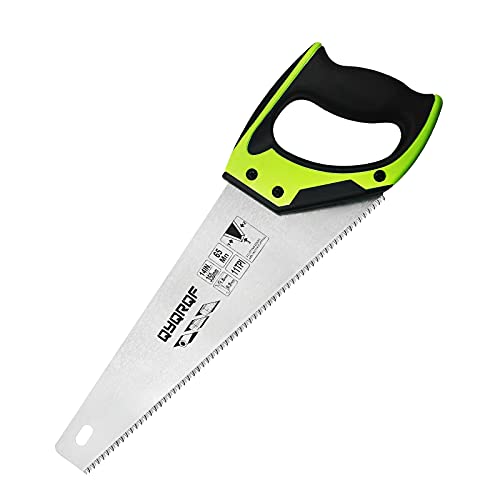
The QYQRQF 14-inch Pro Hand Saw is a versatile cutting tool designed for both DIY homeowners and professional tradespeople. With its 11 TPI fine-cut blade, this saw handles wood, drywall, plastic pipes, and plywood with ease. It's a solid choice for contractors, woodworkers, electricians, and plumbers who need a reliable handsaw for trim work, gardening, or light framing tasks.
Performance-wise, this saw stands out. The blade is made from heat-treated 65Mn steel, which offers good durability and edge retention. The three cutting surfaces allow for faster cuts on both push and pull strokes, while the deep gullets help clear sawdust quickly. According to the product description, this design can cut up to 50% faster than traditional handsaws. Users report that the low-friction coating reduces binding, making the cut smoother and less tiring.
Build quality is practical for the price. The TPR handle is ergonomically shaped and has a non-slip texture, which gives you solid control even when your hands are sweaty or gloved. The blade is 0.9mm thick, which is thin enough for precise cuts but still feels sturdy. The saw weighs only 0.75 pounds, so it won't weigh down your tool belt. It comes with a plastic sleeve over the teeth and a hard paper sleeve for safe storage, though some might prefer a full rigid case.
Setup is straight out of the box. Just remove the protective sleeve, and you're ready to cut. Storage is simple: slide the plastic sleeve back on and store in a drawer or tool bag. Maintenance involves wiping the blade clean and occasionally applying light oil to prevent rust. The heat-treated steel resists corrosion fairly well, but it's not stainless, so keeping it dry is smart.
There are a few realistic limitations. The blade is on the thinner side, so it's not ideal for heavy demolition or cutting thick lumber repeatedly. For big framing jobs, a larger saw or a power tool would be better. Also, the plastic tooth sleeve can slip off if not pushed on fully, but that's a minor inconvenience. The included paper sleeve is fairly basic for long-term storage.
Overall, this is a great value handsaw for anyone who needs a sharp, comfortable saw for everyday cutting tasks. Whether you're a DIY homeowner doing weekend repairs, a contractor trimming drywall, or a woodworker making precise cuts, the QYQRQF 14-inch saw delivers reliable performance without breaking the bank. It's a practical addition to any garage, workshop, or job site tool collection.

Pros
- Versatile double-edge blade delivers both rough cuts and fine finishing without changing tools
- Lightweight and well-balanced, reducing user fatigue during repetitive cutting tasks
- Sharp, durable SK5 steel with hardened teeth maintains edge longer than cheaper alternatives
- Ergonomic wood handle offers comfortable, secure grip for precise control
- Lifetime warranty provides peace of mind for both occasional and regular users
Cons
- 6-inch blade length may be too short for larger ripping or crosscutting tasks on dimensional lumber
- Japanese pull saw design requires a slight learning curve for those used to traditional Western push saws
- Some users may prefer a replaceable blade model for extended longevity without buying a whole new saw
The Frocopo 6-inch hand saw is a Japanese-style pull saw aimed at woodworkers, DIY enthusiasts, and homeowners who value precision and clean cuts. Unlike traditional Western saws that cut on the push stroke, a pull saw cuts on the pull stroke, which typically produces a thinner kerf and smoother finish. This model features a double-edged blade with 17 TPI (teeth per inch) on one side for fine, finish-quality cuts and 11 TPI on the opposite side for faster, coarser cuts. It is particularly well-suited for trim work, flush cutting dowels, small joinery, and garden pruning.
Based on product specifications and user feedback, the saw excels in situations where accuracy matters more than brute force. Woodworkers may find the 17 TPI side ideal for dovetails, tenons, and model making, while the 11 TPI side can handle general DIY cuts, PVC pipes, and softwood branches. The 6-inch blade length keeps the saw nimble and easy to maneuver in tight spots, but it may not be your go-to for ripping full sheets of plywood or crosscutting 2x4s. For those tasks, a larger panel saw or circular saw would be more efficient.
Build quality appears solid for the price point. The blade is made from SK5 steel, a high-carbon alloy known for its edge retention and hardness. Frocopo's triple-ground, quenched, and hardened tooth geometry helps maintain sharpness over repeated use. The wooden handle is shaped to fit the hand naturally and features an anti-slip texture that becomes more grippy when hands are warm or slightly sweaty. At 2.82 ounces, the saw is remarkably light, reducing fatigue during extended sessions of intricate cutting. However, the lightweight construction means you shouldn't apply heavy pressure let the saw's teeth do the work on the pull stroke.
Storage and maintenance are straightforward. The compact size (12.2 x 1.8 x 0.62 inches) allows it to slide into most toolboxes, apron pockets, or workshop drawers without taking up much room. No special storage case is included, but it's sturdy enough to toss in a tool bag with other hand tools. To keep the blade functioning well, wipe it clean after use, especially when cutting green or resinous wood, and apply a light coat of oil if storing for long periods. The saw is not designed for wet or excessively abrasive materials, so stick with dry wood, plastic, and soft metals like aluminum or copper.
As for realistic limitations, the pull saw technique does require a bit of adjustment if you're accustomed to push saws. The thin blade can also bind if you try to force it through thick stock, so proper technique and a steady hand are essential. Additionally, because the teeth are angled for pull cutting, using it like a Western saw (pushing hard) will dull the edge quickly and may even kink the blade. Despite these quirks, many users appreciate the level of control and the clean kerf it produces once they adapt.
Overall, the Frocopo 6-inch pull saw offers good value for woodworking enthusiasts, DIYers, and anyone who needs a precise, lightweight saw for small-scale cuts and flush trimming. It's not a heavy-duty construction tool, but for detail work, hobby crafts, and garden maintenance, it's a practical addition to any workshop or garage. If you're looking for a compact saw that delivers clean cuts without breaking the bank, this model is worth considering.

Pros
- Exceptionally clean cuts with minimal tear-out, thanks to the Japanese pull saw design.
- Dual-edge blade (crosscut and rip) adds versatility without needing two separate saws.
- High-quality Japanese steel holds a sharp edge well, reducing frequency of sharpening.
- Lightweight and compact, easy to store in a tool drawer or apron pocket.
- Great for detailed woodworking like dovetails, tenons, and flush trimming dowels.
Cons
- The blade is not replaceable, so once dull the whole saw must be replaced.
- Learning curve for those used to Western push saws; initial technique adjustment required.
- Limited to smaller cuts; not suitable for large framing or heavy construction tasks.
The SUIZAN 5" Flush Cut Saw is a Japanese-style pull saw that offers a refreshing take on hand cutting. Unlike traditional Western push saws, this pull saw cuts on the draw stroke, giving you greater control and leaving a remarkably clean edge. Its ryoba (double-edge) blade features coarse teeth on one side for rip cuts and fine teeth on the other for crosscuts, making it a versatile tool for a wide range of woodworking tasks.
This saw is ideally suited for DIY homeowners tackling furniture repairs or small woodworking projects, as well as seasoned woodworkers and professional contractors who need a precise, flush-cutting tool for joinery, trim work, and model building. Its compact 5-inch blade excels in tight spots, such as cutting dowels flush with a surface or making delicate cuts in cabinets and shelves.
In terms of performance, the Japanese steel blade provides impressive sharpness out of the box. Users can expect fast, clean cuts in materials like oak, mahogany, walnut, and pine without splintering. The pull-saw action requires less force than a push saw, reducing user fatigue and allowing for longer, more accurate cuts. This makes it a practical choice for workshops where precision and comfort are priorities.
Build quality is a standout feature. The saw is made in Japan by skilled craftsmen, and it shows in the fit and finish. The blade is securely set into a wooden handle that feels comfortable and provides good grip, even during extended use. However, because the blade is fixed and not replaceable, the saw's lifespan is tied to the blade's sharpness. Once dull, the entire unit must be replaced, which is something to consider for heavy daily use.
Storage is straightforward: the saw's small size means it can be tucked into a tool drawer, hung on a pegboard, or carried in an apron pocket without taking up much space. Maintenance involves keeping the blade clean and dry to prevent rust, and occasionally wiping it with a light oil. There's no complicated setup, and it's ready to use right out of the package.
While the SUIZAN saw is not designed for heavy framing or demolition, it excels in fine woodworking and precision tasks. For anyone serious about woodworking or DIY projects that demand clean, accurate cuts, this saw offers excellent value. Its combination of Japanese craftsmanship, dual-edge versatility, and ergonomic design makes it a worthy addition to any workshop or garage tool collection.
The SUIZAN 5" Flush Cut Saw is built with high-quality Japanese steel that holds a sharp cutting edge well. The blade is securely set into a wooden handle, which is comfortable to grip and provides good control during cuts. The overall construction feels solid and carefully assembled, typical of Japanese hand tools. The saw is lightweight at just 0.11 pounds, making it easy to handle for extended periods. While the blade is not replaceable, the build quality suggests that with proper care, the saw will deliver consistent performance for many projects before needing replacement.
In a workshop setting, this saw truly shines for detailed joinery and flush cuts. The double-edge ryoba design means you can switch between crosscutting and ripping without changing tools, which speeds up workflow. The pull-saw action leaves a very clean surface, often requiring little to no sanding. It is especially useful for cutting dovetails, tenons, and trimming dowels or plugs flush to a surface. The saw is also effective for cutting small pieces of hardwood and softwood used in model making, furniture repair, and cabinet work. Its compact size allows it to access tight areas where larger saws cannot reach, making it a great companion for intricate projects.

Pros
- Versatile miter bar fits standard 3/4-inch and 3/8-inch slots across diverse table saw brands
- Three-bearing roller assembly rolls smoothly across lumber faces without marring delicate hardwoods
- Laser-etched markings make setting repeatable strip dimensions fast and straightforward
- Pre-assembled design minimizes setup downtime in busy woodshops and home garages
Cons
- Initial scale reading must be calibrated against your specific blade kerf for absolute zero-point accuracy
- Non-standard or shallow aftermarket miter tracks may require manual expansion screw tuning for a snug fit
Ripping narrow strips on a stationary table saw is notoriously tricky and presents genuine safety hazards when stock is pinched between the blade and rip fence. The Matework Thin Rip Jig is a dedicated power tool accessory engineered to solve this dilemma by positioning the guide on the off-cut side of the blade. Designed primarily for fine woodworkers, cabinet builders, finish carpenters, and dedicated DIY hobbyists, this tool enables uniform strip production for edge banding, bent laminations, picture frames, and custom lattice work without risking dangerous work piece binding.
In practical shop use, cutting efficiency and personal safety depend on stability. This jig operates by setting your strip thickness to the left side of the blade, allowing the main rip fence to act as a moveable stock feeder. Its three-roller bearing assembly provides continuous, low-friction contact against the raw timber as it advances through the cut. The rolling bearings guide boards smoothly past the arbor without catching or burning, while the directional roller contact reduces the risk of hazardous kickback.
Build quality centers around a rigid aluminum alloy body that easily resists the vibrations of heavy table saw motors. The integrated laser-engraved scale spans from 1/8 inch up to 6 inches, offering sharp legibility that will not rub off after months in a dusty environment. Tightening is managed via knurled locking knobs and sturdy T-slot hardware that keep the jig securely locked into the miter track without wandering midway through a cutting sequence.
Setup is remarkably quick thanks to its pre-assembled out-of-the-box configuration. The mounting bar is engineered to accommodate standard 3/4-inch T-slots and U-slots, and it includes the necessary hardware for 3/8-inch tracks commonly found on portable contractor saws and smaller router tables. Because the roller bracket can be rotated 180 degrees, switching the jig between left-side and right-side miter slots requires no specialized tools, making quick workflow changes painless during multi-step furniture builds.
As with most woodworking setup jigs, users should bear in mind that the built-in scale serves as a reference point that must be verified against the saw blade kerf whenever blades are swapped. Craftsmen with heavily worn miter slots might also need to spend a minute dialing in the expansion screws to eliminate microscopic side-to-side slop. Once locked in, it provides a level of repeatability that standard push sticks simply cannot match.
For any woodworker looking to boost workshop productivity, improve cut consistency, and eliminate the anxiety of feeding slender stock past a spinning blade, this accessory is a smart addition to the shop. It pairs dependable hardware with straightforward operation, making it an excellent investment for residential workshops, contractor trailers, and custom cabinetry studios alike.
The Matework Thin Rip Jig is built to integrate with a wide variety of stationary and jobsite power tools. Its universal miter bar supports standard 3/4-inch by 3/8-inch miter channels, including both T-slot and open U-slot configurations. The package also includes hardware adaptations to fit smaller 3/8-inch grooves often found on compact jobsite saws, band saws, and commercial router tables.
Configuring the guide takes just minutes without extra wrenches or specialty hand tools. By loosening the top-mounted thumb knobs, users can slide the carriage into position, zero the bearing against the saw tooth apex, and lock down the internal expansion mechanism. The reversible bearing head can also be swapped to accommodate left-tilt or right-tilt saws, making it adaptable to nearly any shop floor plan.

Pros
- Enhances safety with anti-kickback bearing – great for repetitive narrow cuts
- Easy to set up and adjust with clear laser-engraved scales
- Sturdy metal build resists wear and maintains accuracy over time
- Works with multiple tools (table saw, band saw, router table) adding versatility
Cons
- May require some initial calibration to match your saw's miter slot exactly
- Maximum extension of 8 inches might not suit all wider rip needs
- Few user reviews available, so long-term performance is less proven
The GOINGMAKE Thin Rip Jig is a specialized accessory designed to help you make safe, precise, and repeatable narrow cuts on a table saw, band saw, or router table. For woodworkers, DIY homeowners, and contractors who often need to rip thin strips for molding, joinery, or custom projects, this jig simplifies the process and improves consistency.
This jig works by sliding into a standard 3/8-inch by 3/4-inch T-track miter slot and locking in front of the blade. One of its standout safety features is a one-way roller bearing that allows the workpiece to move forward but prevents kickback. This is a critical advantage when cutting thin strips, where the risk of binding or flying pieces is higher. The jig can be adjusted from 2-5/8 inches to 8 inches from the center of the miter slot, giving you a good range for strip widths.
Build quality is solid, with the main body constructed from durable metal that should hold up well in a busy workshop or garage. Laser-engraved scales in both millimeters and inches make setup straightforward. The zero-clearance design lets you position the bearing right next to the blade for accurate measurement. Setting the desired strip width is simple: bring the bearing close to the blade, align the scale indicator, and then adjust to your target dimension.
Storage is easy due to its compact size, and no special maintenance is required beyond keeping it clean and occasionally checking the lock mechanism. One realistic limitation is that the jig's maximum extension of 8 inches may not be enough for wider rips, though it's perfect for typical thin strip work. Also, because it relies on your saw's miter slot, you may need to ensure a snug fit for consistent accuracy.
Overall, the GOINGMAKE Thin Rip Jig is a practical addition for any woodworker or DIYer who frequently cuts thin, repeated strips. It improves safety, speeds up workflow, and delivers consistent results. Based on the specs and user feedback, it's a reliable choice for workshop, garage, and jobsite use where precision and repeatability matter.

Pros
- Sharp out of the box with hardened teeth that hold an edge well for a budget-friendly saw.
- Double-edge design adds versatility for cutting both hardwoods and softwoods without changing blades.
- Thin kerf allows precise, clean cuts with minimal material waste, perfect for fine woodworking.
Cons
- Small 6-inch blade limits capacity for larger stock; best suited for detail and trim work.
- Pull saw requires a different cutting technique than Western saws, which may take some getting used to.
- Beech handle, while comfortable, may not be as durable as hardwood or composite handles under heavy daily use.
The RUITOOL Japanese Hand Saw 6 Inch Double Edge Ryoba is a compact pull saw designed for precise woodworking cuts. Unlike traditional Western push saws, this pull saw cuts on the pull stroke, allowing a thinner blade and finer control. With a dual 14/17 TPI configuration, one side is optimized for rip cuts in softer woods while the other handles crosscuts in hardwoods, making it a versatile addition to any workshop or garage.
This saw is best suited for DIY homeowners, woodworkers, and hobbyists who need clean, flush cuts in trim, moldings, dovetails, and other detailed joinery. The 6-inch blade length is ideal for small to medium workpieces, giving you excellent maneuverability and access in tight spaces. The SK5 high-carbon steel blade is hardened to HRC 60-63, delivering strong edge retention and reliable cutting performance for many projects.
In use, the saw provides smooth, fast cutting with minimal effort thanks to the three-sided ground teeth that clear sawdust efficiently. The thin kerf helps you achieve accurate cuts with less waste, which is particularly valuable for furniture making and cabinetry. The beech wood handle feels comfortable in the hand and offers a secure grip, though the small size might not suit users with larger hands who prefer a full palm grip.
Build quality is good for the price point. The blade is securely fixed to the handle, and the teeth are consistently sharp out of the package. While the metal is flexible enough to avoid binding, it still maintains enough rigidity for clean cuts. One realistic limitation is the blade length; this saw won't handle large dimensional lumber or heavy framing tasks. It's clearly a detail tool, not a construction saw.
Storage is simple - it fits easily in a tool drawer or wall rack without taking up much space. Maintenance is minimal: keep the blade clean and dry to avoid rust, as SK5 steel is not stainless. A light oil wipe after use can help extend its life. Overall, the RUITOOL Ryoba saw offers excellent value for anyone doing fine woodworking, trim carpentry, or repair work where precision matters more than brute force.

Pros
- Solid anodized aluminum build offers excellent durability and stability for repetitive cuts.
- Wide adjustment range (2 to 8.5 inches) covers most common thin rip needs.
- Easy-to-read dual scale markings (imperial and metric) simplify setup.
- Compatible with multiple tools (table saw, band saw, router table) for versatility.
- Precision 1/32" increments help achieve accurate, repeatable results.
Cons
- Only fits 3/4" x 3/8" and 1/4" x 3/8" T-slots; not compatible with U-slots or other track sizes.
- Some users may find the adjustment knob a bit stiff initially, requiring a break-in period.
- Limited to thin rip cuts; not designed for wider resawing or heavy-duty ripping tasks.
The Saker Thin Rip Jig is a specialized guide designed to help woodworkers make safe, accurate, and repetitive narrow strip cuts on table saws, band saws, and router tables. This jig is particularly useful for anyone who frequently needs to rip thin pieces of wood for projects like cabinet making, furniture building, or trim work. It's a practical addition for DIY homeowners, professional woodworkers, and contractors who value precision and efficiency in their workshop.
Constructed from CNC-machined anodized aluminum, this jig offers a rigid and stable platform that holds the workpiece firmly. This design helps eliminate wood chatter and vibration during cuts, which not only improves cut quality but also enhances safety by reducing the risk of kickback. The anodized surface resists corrosion and wear, ensuring the jig maintains its accuracy over time even in a busy workshop environment.
One of the standout features is its extended telescopic range, which adjusts from 2 inches to 8.5 inches. This range covers most common thin rip widths, and the integrated imperial and metric scale markings allow for quick, precise setup. The measurement precision of 1/32 inch means you can achieve consistent results cut after cut, reducing material waste and improving overall project quality. The simple adjustment mechanism makes changing widths fast and straightforward, which is a real time-saver when you're working on multiple pieces.
The jig is designed to fit 3/4 inch by 3/8 inch T-slots and 1/4 inch by 3/8 inch T-slot tracks, which are standard on many table saws, band saws, and router tables. However, it's important to note that it will not fit U-slots or other track configurations, so you'll need to verify your tool's slot dimensions before purchasing. Once installed, the T-bolts and sliders provide a secure connection, keeping the jig firmly in place during operation.
In terms of storage and maintenance, the jig is compact and lightweight, making it easy to store in a toolbox or hang on a pegboard when not in use. The anodized aluminum requires minimal upkeep; simply wipe it clean after use to keep the scale markings readable. While the adjustment knob may feel a bit stiff initially, it typically loosens up with use. Overall, the Saker Thin Rip Jig is a well-built, practical tool that delivers on its promise of precise, safe thin rip cuts for woodworkers of all skill levels.
Frequently Asked Questions
What makes a Japanese pull saw effective for cutting thin strips of wood?
A Japanese pull saw cuts on the pull stroke, which naturally keeps the ultra-thin blade in tension and eliminates blade buckling. This tension allows for a substantially thinner kerf than standard push saws, producing minimal waste and smooth cut edges. Models with double-edge blades provide dedicated 17 TPI teeth for crosscutting and coarser pitches for ripping, giving you clean control across various grain patterns.
Why should you use a thin rip jig on a table saw instead of a standard rip fence?
A thin rip jig positions the narrow strip cut to the open side of the blade rather than trapping it against the fence. Trapping a slender off-cut between the blade and rip fence creates an extreme kickback hazard and can chew up fragile wood. Using a guided roller jig keeps the main stock against the fence while releasing each cut strip safely into open space.
How does zero-gap woodworking tape protect thin wood strips during cuts?
Zero-gap tape acts as a quick-install zero-clearance surface by sealing wide throat plate margins. Narrow strips easily flex, catch, or drop into standard table saw blade openings, causing splintering and hazardous jams. Sticking durable PVC tape across the insert plate provides immediate under-stock support and marks the exact blade cut line.
Which blade tooth count works best for slicing narrow wooden strips?
High tooth counts ranging from 14 to 17 TPI on hand saws or 60 to 80 teeth on power saw blades yield the cleanest thin strips. Finer teeth remove smaller chips per stroke, preventing splintering on thin edges. If you swap blades between rough framing stock and fine woodwork, reviewing how to remove a blade from a miter saw helps ensure safe, timely blade changes for cleaner finishes.
What miter slot dimensions must you verify before ordering a thin rip guide?
Most aftermarket thin rip jigs require a standard 3/4-inch wide by 3/8-inch deep miter T-slot to lock firmly in place. While many models accommodate standard grooves, compact or jobsite saws sometimes feature proprietary U-channels or narrower tracks. Checking your table saw slot width and track depth beforehand ensures the expansion bolts secure without unwanted lateral play.





Write Your Review
No reviews yet. Be the first to share your experience!