


Gapping joints and splintered edges can ruin an otherwise clean room trim project within seconds. Installing trim requires tight 45-degree angles, crisp end cuts, and zero tear-out on finished wood or MDF molding. Finding the best saw for cutting baseboard comes down to matching your room layout with proper cutting capacity, fine tooth counts, and stable fence support. Power tools like dedicated compound miter saws make fast work of long walls and repetitive bevel cuts, while fine-pitch manual pull saws allow whisper-quiet flush cuts right against door jambs without damaging adjacent drywall.
Careful review of blade diameters, miter detents, and angle-measuring accessories helps prevent ruined baseboards and uneven corner seams. Compact single-bevel miter saws offer high blade speed to slice delicate profiles without chipping the face profile, whereas specialized manual saws give you pinpoint control on tricky coping cuts and tight corners. Many DIY renovators pair motorized chop saws with precision angle finders to read crooked out-of-square corners accurately before locking in their cuts. Evaluating motor amperage, table support extensions, and blade tooth configuration ensures every molding joint closes tight across your entire installation.
Pros
- Sharp 65Mn steel blade stays durable and holds an edge well
- Comfortable TPR handle with non-slip grip reduces hand strain
- Versatile for cutting multiple materials on the job site or at home
- Lightweight and easy to carry in a tool bag
- Affordable price point for a professional-grade hand saw
Cons
- Blade may be too thin for heavy-duty framing or demolition work
- Plastic sleeve on teeth can slide off if not secured tightly
- Some users may prefer a longer blade for larger cutting tasks
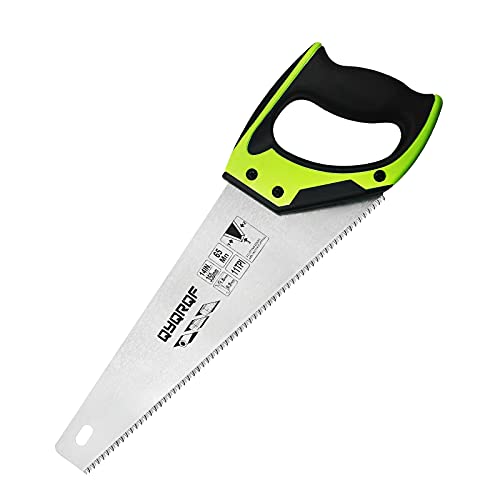
The QYQRQF 14-inch Pro Hand Saw is a versatile cutting tool designed for both DIY homeowners and professional tradespeople. With its 11 TPI fine-cut blade, this saw handles wood, drywall, plastic pipes, and plywood with ease. It's a solid choice for contractors, woodworkers, electricians, and plumbers who need a reliable handsaw for trim work, gardening, or light framing tasks.
Performance-wise, this saw stands out. The blade is made from heat-treated 65Mn steel, which offers good durability and edge retention. The three cutting surfaces allow for faster cuts on both push and pull strokes, while the deep gullets help clear sawdust quickly. According to the product description, this design can cut up to 50% faster than traditional handsaws. Users report that the low-friction coating reduces binding, making the cut smoother and less tiring.
Build quality is practical for the price. The TPR handle is ergonomically shaped and has a non-slip texture, which gives you solid control even when your hands are sweaty or gloved. The blade is 0.9mm thick, which is thin enough for precise cuts but still feels sturdy. The saw weighs only 0.75 pounds, so it won't weigh down your tool belt. It comes with a plastic sleeve over the teeth and a hard paper sleeve for safe storage, though some might prefer a full rigid case.
Setup is straight out of the box. Just remove the protective sleeve, and you're ready to cut. Storage is simple: slide the plastic sleeve back on and store in a drawer or tool bag. Maintenance involves wiping the blade clean and occasionally applying light oil to prevent rust. The heat-treated steel resists corrosion fairly well, but it's not stainless, so keeping it dry is smart.
There are a few realistic limitations. The blade is on the thinner side, so it's not ideal for heavy demolition or cutting thick lumber repeatedly. For big framing jobs, a larger saw or a power tool would be better. Also, the plastic tooth sleeve can slip off if not pushed on fully, but that's a minor inconvenience. The included paper sleeve is fairly basic for long-term storage.
Overall, this is a great value handsaw for anyone who needs a sharp, comfortable saw for everyday cutting tasks. Whether you're a DIY homeowner doing weekend repairs, a contractor trimming drywall, or a woodworker making precise cuts, the QYQRQF 14-inch saw delivers reliable performance without breaking the bank. It's a practical addition to any garage, workshop, or job site tool collection.
Pros
- Rugged all-metal build stands up to frequent jobsite use without bending or breaking.
- Laser-engraved scales stay readable even after years of handling and exposure.
- Smooth rotating motion helps lock in precise angles quickly.
Cons
- May require a learning curve for users unfamiliar with protractor-to-miter-saw transfer.
- 7-inch length may be less convenient for very large workpieces or wide angles.
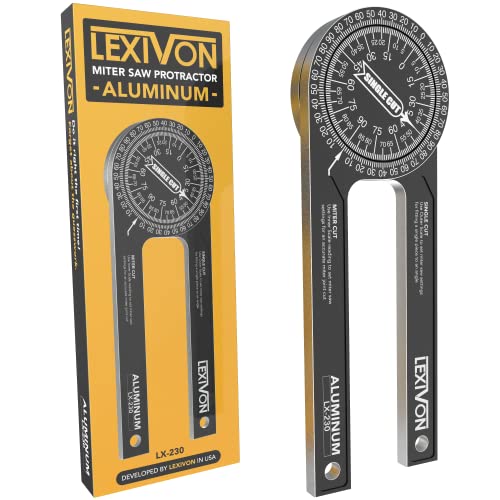
The LEXIVON LX-230 is a dedicated miter saw protractor designed to take the guesswork out of angle measurement for crown molding, trim work, baseboards, and general carpentry. It's a precision angle finder built from CNC-machined anodized aluminum, making it a solid upgrade over plastic versions common in many workshops or garage toolkits.
This tool is a natural fit for DIY homeowners tackling weekend projects like installing crown molding or trimming window casings, as well as for professional woodworkers, carpenters, and contractors who need reliable angle transfer on the jobsite. Plumbers and electricians may also find it useful for cutting raceways or pipe supports where precise miter cuts are required.
When it comes to performance, the laser-engraved scales provide clear, legible markings that won't fade or wear off with regular use. This is a big plus over printed scales that can become unreadable over time. The internal Teflon O-ring mechanism allows the tool to swivel smoothly and lock onto inside and outside corners without binding, helping you transfer the angle directly to your miter saw for an accurate cut. According to product specifications, the 1/4-inch thick aluminum construction resists bending, which means you can count on consistent repeatability when setting up compound cuts.
Build quality is a strong point here. The rust-proof anodized finish protects the tool from moisture and corrosion common in basement workshops or damp garage environments. The compact 7-inch size stores easily in a toolbox drawer or can be hung on a pegboard without taking up much space. Maintenance is minimal - just wipe it clean after use. No special care is needed beyond keeping the pivot point free of sawdust or debris to maintain smooth operation.
One realistic limitation is that, like any angle finder, it requires a bit of practice to master transferring the reading to your saw's miter gauge. Beginners may need to run a few test cuts on scrap material before committing to final pieces. Also, the 7-inch length, while convenient for storage, might require multiple measurements on very wide moldings or long workpieces, which could slow down production in high-volume trim work.
Overall, if you're a DIYer, woodworker, or contractor who regularly cuts crown molding or trim, the LEXIVON LX-230 offers a durable, precise, and easy-to-read solution for under $30. Its aluminum build and laser-engraved scales make it a practical addition to any workshop or garage tool collection, providing reliable angle measurements for years to come.
Pros
- Two-in-one functionality eliminates extra steps and potential errors
- Sturdy build with stainless steel and plastic components feels solid for the price
- Covers a wide angle range suitable for most common miter cuts in trim work
Cons
- Requires a back saw or similar manual saw; not compatible with power miter saws as a guide
- Limited angle range of 85-180 degrees may not cover acute angles below 85 degrees
- May have a slight learning curve for users unfamiliar with manual miter tools
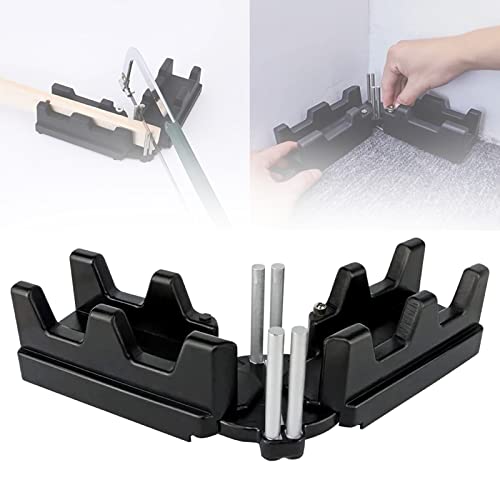
This 2-in-1 miter measuring and cutting tool from AUSTUFF is designed to simplify one of the trickiest parts of woodworking and home improvement: getting perfect corner cuts for baseboards, crown molding, picture frames, and other trim work. Instead of measuring an angle with a separate tool, then trying to transfer that reading to your saw, this tool combines both steps into a single device. You measure the angle directly on the work piece, lock it in, and then use the built-in guide to make your cut with a back saw.
This tool is best suited for DIY homeowners, woodworkers, carpenters, and contractors who regularly install trim or do finish carpentry. It's also useful for plumbers or electricians who need to cut conduit or pipe trim at precise angles. The product description highlights a measurement range from 85 to 180 degrees, which covers the vast majority of interior and exterior corner angles you'll encounter in typical residential construction.
Real-world performance revolves around accuracy and ease of use. The two moving arms allow you to capture the exact angle of a corner, and the integrated guide pin and guide plate are designed to work with a standard back saw for a clean, precise cut. According to user feedback and product specs, the stainless steel components resist corrosion and maintain accuracy over time. The ABS and PC housing feels durable enough for regular job site use, though it's not intended for heavy impact.
Build quality is reasonable for the price point. The materials are not premium but are practical for a manual measuring and cutting aid. The tool is lightweight at 0.63 pounds and compact, making it easy to store in a toolbox or apron. No special setup is required; you simply adjust the arms to the corner, lock them, and place the tool on your workpiece. Maintenance is minimal - just keep it clean and dry to preserve the stainless steel parts.
One realistic limitation is that this tool is designed for use with a back saw (a manual saw with a rigid spine), not with power miter saws. That means it's best suited for smaller jobs like trim work or picture frames where hand sawing is practical. Users who prefer power tools might find it less convenient. Also, the angle range stops at 85 degrees, so very acute angles (like those in some crown molding layouts) won't be captured directly.
Overall, this is a practical, affordable solution for anyone who needs to cut precise miter angles without investing in a full miter saw or digital angle finder. It's a smart addition to a DIYer's tool collection or a contractor's trim kit. For woodworkers and home improvement enthusiasts who frequently deal with baseboards and moldings, this tool can save time and reduce waste.
The AUSTUFF 2-in-1 miter tool is constructed from ABS, polycarbonate (PC), and stainless steel. The plastic body is lightweight and resists cracking under normal use, while the stainless steel components provide the necessary rigidity for accurate angle measurement and saw guiding. The moving arms operate smoothly and lock securely in place. The guide plate and pin are made of stainless steel to prevent rust from humid job site conditions. Overall, the build quality reflects the price point - it is functional and durable enough for regular use but not intended for heavy-duty or industrial applications.
This tool is ideal for woodworking shops and garage workbenches where installing trim, baseboards, or crown molding is common. It can also be used for cutting picture frame corners, making mitered boxes, or fitting quarter round. DIYers working on home renovation projects will find it especially handy for measuring and cutting odd angles found in older houses. For professional carpenters, it serves as a reliable backup or a quick alternative when a power miter saw is not available. Its compact size means it can stay in a tool belt or apron without adding much weight.

Pros
- Fast 4900 RPM blade speed leaves crisp, clean cuts on finish lumber and trim
- Laser cutline projection speeds up alignment on repetitive workshop cuts
- Compact and lightweight footprint makes it easy to stow away in small garages
- Includes helpful accessories like support wings, work clamp, and spare motor brushes
Cons
- Compact 8-1/4-inch non-sliding design limits crosscut capacity on boards wider than 4-1/2 inches
- Single-bevel action requires flipping boards manually when cutting opposing compound angles
- Basic cloth dust bag captures moderate debris and works best paired with a dedicated vacuum adapter
The SEESII 8-1/4-Inch Compound Miter Saw is a compact, benchtop cutting machine engineered for light framing, interior trim, picture framing, and general home repair tasks. Rather than taking up the massive footprint of a standard 10-inch or 12-inch sliding saw, this smaller unit provides the basic miter and bevel operations required for common residential projects. It serves as an accessible option for DIY homeowners, weekend woodworkers, craft enthusiasts, and garage workshop owners who need reliable angle cuts without sacrificing valuable shop space.
Equipped with a motor that delivers up to 4900 RPM, this saw provides plenty of blade speed to slice cleanly through common softwoods, oak, poplar, baseboard molding, and PVC materials. The high rotational speed reduces tear-out on delicate trim profiles when equipped with a fine-tooth blade. While it is not designed to plow through heavy wet timbers on commercial construction framing jobs, it handles standard dimensional lumber like 2x4 boards and window casings with ease.
Accuracy is guided by an integrated laser marker that casts a bright reference line directly across the surface of the workpiece. This setup helps users align pencil marks quickly without continually lowering the stationary blade to inspect teeth contact. The turntable miter scale and 0 to 45 degree single bevel mechanism allow users to tackle crown molding, shadowbox frames, and casing miters. Side extension wings and an adjustable hold-down clamp help keep workpieces steady against the fence, preventing hazardous board rotation mid-cut.
Safety and stability receive thoughtful attention on this model. The machine features tilt protection geometry to resist tipping backward when tilted over at maximum bevel angles. The operating handle requires a dual-switch engagement, reducing the chance of accidental starts when repositioning materials on the table. Rubber footing on the base dampens vibrations and resists slipping across smooth workbenches during extended use.
Maintenance requirements remain straightforward. The kit includes blade-changing wrenches alongside replacement carbon brushes, ensuring the motor can be serviced down the road without hunting for rare spare parts. The unit comes practically ready out of the box, requiring only quick fence and laser checks before making your first cuts.
For contractors needing to crosscut 12-inch shelving boards, a larger sliding miter saw remains necessary due to the physical crosscut width limitations of an 8-1/4-inch blade. However, for everyday DIY repairs, hobby woodworking, framing interior doors, or building backyard planters, the SEESII compound miter saw represents a capable, budget-conscious choice that packs essential cutting accuracy into a neat, transportable package.
The built-in laser guide provides an immediate visual path across the timber, helping users quickly index their cut marks before engaging the trigger. Coupled with clearly marked miter degree scales on the turntable, setting up common angles like 45 degrees for picture frames or trim corners takes minimal time.
To maintain repeatable accuracy, the included hold-down clamp secures stock firmly against the rear fence. This prevents workpiece drift caused by blade torque during entry, resulting in tighter joint fit-up on finish carpentry projects.
The package comes equipped with practical add-ons to streamline workshop productivity right away. Side extension bars slide into place to support longer trim pieces, preventing sag and uneven bevel cuts on distant ends.
A fabric dust bag helps catch a portion of the sawdust generated during dry cutting, while the included hex wrenches allow for quick blade swaps. The manufacturer also provides replacement carbon brushes, extending the working life of the motor through routine tool maintenance.

Pros
- Lightweight and portable for easy transport and storage
- LED shadow line is more accurate and durable than laser guides
- Compact rail system reduces footprint and allows flush-to-wall placement
- Quick miter lock and detents make angle changes fast and repeatable
Cons
- Single bevel only tilts left, limiting some compound cut versatility
- Stand sold separately adds to overall cost for those needing a mobile setup
- 7-1/4 inch blade limits depth of cut compared to larger 10 or 12 inch saws
The SKIL MS6306-00 is a 7-1/4 inch single bevel miter saw designed for users who need a compact, portable cutting solution without giving up accuracy. It combines a fixed compact rail system with an LED shadow line to deliver precise cuts in tight spaces, making it a strong contender for DIY homeowners, woodworkers, and contractors working on trim, molding, and shelving projects.
This saw is best suited for those who prioritize portability and workspace efficiency. At under 25 pounds, it's easy to carry from a garage workshop to a job site or even up a flight of stairs. The compact rail system allows the saw to sit flush against a wall, which is a real plus for anyone working in a cramped basement shop or a crowded job site corner. The 10 amp motor spins at a solid 4,800 RPM, providing enough power for crosscutting 2x10 lumber and handling 3-1/2 inch crown molding nested.
In terms of real-world performance, the LED shadow line is a standout feature. Unlike laser guides that can drift or require calibration, the shadow line is generated by a bright LED and a precision-machined shadow blade, giving you a clear, accurate cut line that doesn't fade over time. This is especially helpful for cutting baseboards, casing, and crown molding where precision matters. The quick miter lock and preset detents at common angles (0, 15, 22.5, 31.5, 45 degrees left and right) speed up repetitive cuts, reducing setup time and boosting productivity on the job.
Build quality is solid for the price point. The saw feels sturdy without being overly heavy, and the single bevel mechanism operates smoothly from 0 to 45 degrees left. The included quick work clamp secures materials safely, which is a nice safety touch. While the saw is compact, it still offers an expansive miter range of 0 to 47 degrees left and 0 to 50 degrees right, giving you flexibility for angled cuts. The overall dimensions are manageable, and the saw stores easily on a shelf or in a truck bed without dominating your space.
One realistic limitation is the single bevel design, which only tilts to the left. This means you'll need to flip your workpiece for some compound cuts, which can slow you down on more complex crown molding installations. Also, the 7-1/4 inch blade limits your depth of cut compared to larger 10 or 12 inch saws, so it's not ideal for heavy timber framing. The stand is sold separately, which is something to factor into your budget if you need a mobile setup.
Overall, the SKIL MS6306-00 delivers a practical balance of portability, accuracy, and ease of use. It's a great choice for DIY homeowners tackling weekend trim projects, woodworkers building shelves or furniture, and contractors who need a lightweight saw for punch lists and finish work. If you value a compact footprint and precise cuts without breaking the bank, this miter saw is worth a close look.
The SKIL MS6306-00 features a durable construction with a sturdy base and miter mechanism that feels solid for its lightweight design. The bevel lock and miter detents engage positively, and the LED shadow line system is built to last without the calibration issues common with laser guides. The 10 amp motor is enclosed in a well-ventilated housing to keep it cool during extended use. While not a heavy-duty industrial saw, the build quality is appropriate for frequent DIY use and light professional work.
In a workshop setting, the SKIL MS6306-00 excels at trim work, crosscuts, and molding projects. The compact rail system allows it to sit closer to the wall, freeing up bench space for other tools. The LED shadow line provides a bright, accurate cut indicator that works well in typical workshop lighting. The quick miter lock and detents make angle changes fast, which is a time-saver when cutting multiple pieces of baseboard or crown. The 4,800 RPM motor cuts through pine, oak, and hardwoods smoothly, though you'll want a sharp blade for dense materials.
One of the strongest selling points of this miter saw is its portability. Weighing under 25 pounds, it's easy to carry with one hand, and the compact footprint means it takes up minimal space in a truck bed, garage shelf, or storage closet. The saw doesn't come with a stand, but its lightweight design makes it easy to mount on a portable workbench or a separate miter saw stand. For those with limited workshop space, this saw can be stored on a wall bracket or simply placed on a shelf when not in use.

Pros
- Sharp out of the box with hardened teeth that hold an edge well for a budget-friendly saw.
- Double-edge design adds versatility for cutting both hardwoods and softwoods without changing blades.
- Thin kerf allows precise, clean cuts with minimal material waste, perfect for fine woodworking.
Cons
- Small 6-inch blade limits capacity for larger stock; best suited for detail and trim work.
- Pull saw requires a different cutting technique than Western saws, which may take some getting used to.
- Beech handle, while comfortable, may not be as durable as hardwood or composite handles under heavy daily use.
The RUITOOL Japanese Hand Saw 6 Inch Double Edge Ryoba is a compact pull saw designed for precise woodworking cuts. Unlike traditional Western push saws, this pull saw cuts on the pull stroke, allowing a thinner blade and finer control. With a dual 14/17 TPI configuration, one side is optimized for rip cuts in softer woods while the other handles crosscuts in hardwoods, making it a versatile addition to any workshop or garage.
This saw is best suited for DIY homeowners, woodworkers, and hobbyists who need clean, flush cuts in trim, moldings, dovetails, and other detailed joinery. The 6-inch blade length is ideal for small to medium workpieces, giving you excellent maneuverability and access in tight spaces. The SK5 high-carbon steel blade is hardened to HRC 60-63, delivering strong edge retention and reliable cutting performance for many projects.
In use, the saw provides smooth, fast cutting with minimal effort thanks to the three-sided ground teeth that clear sawdust efficiently. The thin kerf helps you achieve accurate cuts with less waste, which is particularly valuable for furniture making and cabinetry. The beech wood handle feels comfortable in the hand and offers a secure grip, though the small size might not suit users with larger hands who prefer a full palm grip.
Build quality is good for the price point. The blade is securely fixed to the handle, and the teeth are consistently sharp out of the package. While the metal is flexible enough to avoid binding, it still maintains enough rigidity for clean cuts. One realistic limitation is the blade length; this saw won't handle large dimensional lumber or heavy framing tasks. It's clearly a detail tool, not a construction saw.
Storage is simple - it fits easily in a tool drawer or wall rack without taking up much space. Maintenance is minimal: keep the blade clean and dry to avoid rust, as SK5 steel is not stainless. A light oil wipe after use can help extend its life. Overall, the RUITOOL Ryoba saw offers excellent value for anyone doing fine woodworking, trim carpentry, or repair work where precision matters more than brute force.
Frequently Asked Questions
What saw type works best for cutting baseboard molding?
A compound miter saw delivers the cleanest and most consistent results for cutting baseboards. Motorized miter units feature positive angle stops at 45 and 90 degrees, allowing quick, repeatable cuts across dozens of molding lengths. The fixed back fence keeps boards stable to prevent wandering blade paths. Hand saws with fine teeth also serve well for smaller rooms or tight coping work around existing door frames.
How many teeth should a baseboard cutting blade have?
A blade with 60 to 80 teeth is ideal on standard 10-inch or 12-inch miter saws to prevent tear-out. For compact 7-1/4-inch or 8-1/4-inch saws, a fine-finish blade with 40 to 60 teeth provides the necessary tooth density. Baseboards feature exposed pre-primed or stained faces that chip easily under coarse framing blades. High tooth counts and thin kerfs slice smoothly through wood fibers to leave ready-to-install edges.
Can I use a hand saw to cut baseboards effectively?
Yes, a fine-cut pull saw or traditional miter back saw can cut baseboard cleanly if paired with a stable guide box. Japanese pull saws with 14 to 17 TPI produce remarkably thin kerfs and clean edges on softwoods and MDF. Manual tools provide excellent control for flush cuts and small trim repairs. They require more physical effort than power saws, but they produce minimal airborne dust inside finished rooms.
How do I handle baseboard corners that are not square?
A dedicated miter protractor or angle finder is the most reliable way to measure out-of-square wall corners. Drywall corners rarely measure a perfect 90 degrees due to accumulated joint compound. Measuring the true angle with an aluminum protractor lets you divide the angle precisely and transfer that exact setting to your saw table. You can also review techniques in our guide on miter saws for crown molding to master compound joint calculations.
Should baseboards be cut standing upright or laying flat?
Cutting baseboards standing vertically against the fence is fastest if your saw blade diameter provides enough vertical clearance. Standard baseboards up to 3-1/2 inches fit comfortably against the fence on most compact miter saws. Taller baseboards exceeding fence height must be laid flat on the table, requiring a compound bevel tilt cut rather than a standard miter angle to produce the matching corner joint.





Write Your Review
No reviews yet. Be the first to share your experience!