


Running a two-stroke chainsaw through dense hardwood puts severe thermal stress on the cylinder, piston ring, and crankcase assembly. Factory exhaust silencers are engineered with tight internal baffles and restrictive exit ports to meet strict noise thresholds, which inevitably traps intense combustion heat directly against the powerhead exhaust port. Learning how to modify chainsaw muffler components allows power equipment operators to drop operational cylinder temperatures while significantly reducing exhaust backpressure. This modification helps two-cycle engines breathe freely and spool up quickly under sustained cutting resistance.
While landowners often weigh mechanical bucking speed against traditional manual techniques like wood splitting with an axe, optimizing your chainsaw exhaust system provides noticeable torque gains during heavy bucking sessions. Modifying an exhaust canister requires careful mechanical steps, including opening internal baffles, installing spark arrestors, and executing immediate carburetor retuning. Relieving factory restrictions changes the engine air-fuel ratio instantly, making proper high-speed needle calibration vital for long-term engine survival.




Engineering Principles and Practical Workflow for Chainsaw Muffler Modifications
Modifying a two-stroke chainsaw muffler is one of the most effective mechanical adjustments for lowering cylinder head temperatures and unlocking usable cutting torque. Stock exhaust canisters force burned fuel gases through a maze of internal baffles, crimped tubes, and undersized exhaust outlets. Opening up this pathway allows spent combustion gases to escape rapidly, reducing thermal soak and improving volumetric efficiency. Carrying out this upgrade safely requires a structured approach covering component selection, port sizing, spark protection, and mandatory fuel mixture adjustments.
Thermodynamics and Fluid Dynamics of Chainsaw Exhaust Flow
Two-stroke chainsaw engines rely on pressure pulses inside the cylinder and exhaust port to scavenge spent exhaust gases and trap fresh fuel charges. Heavy factory baffling creates substantial backpressure that forces hot exhaust gases to linger near the exhaust port and piston face. This trapped thermal energy raises operating temperatures across the cylinder head, spark plug, and crankcase. Relieving restriction drops combustion chamber heat, which helps protect internal needle bearings and piston skirts from thermal fatigue during extended firewood bucking.
Excessive backpressure also dulls engine acceleration and causes the saw to bog down when buried in wide hardwood logs. When exhaust gases vent smoothly, the piston encounters less mechanical resistance during the exhaust stroke, allowing the engine to recover RPM faster when the saw chain encounters dense grain. Two-stroke engines still require a balanced level of scavenging resistance to prevent unburned fuel charges from escaping completely before the piston closes the exhaust port. Enlarging the exhaust opening to roughly seventy to eighty percent of the cylinder exhaust port area achieves optimal flow without sacrificing usable low-end torque.
Workshop Safety, Fire Prevention, and Essential PPE
Modifying small-engine exhaust components introduces distinct safety hazards involving hot metal filings, sharp sheet steel edges, and increased operational noise levels. Always dismount the muffler entirely from the powerhead and secure it firmly in a bench vise before cutting, drilling, or grinding. Never attempt to drill or grind a muffler while it remains bolted to the chainsaw engine cylinder. Stray metal chips can easily migrate through the open exhaust port into the combustion chamber, causing catastrophic cylinder wall scoring within seconds of startup.
Personal protective equipment is mandatory both during modification and throughout subsequent saw operation. Heavy leather work gloves protect hands from razor-sharp canister burrs, while ballistic eye protection stops high-speed metal shavings during drilling operations. Once a muffler is modified, operational sound levels increase significantly compared to factory decibel ratings. Operators must wear high-grade hearing protection, such as earplugs paired with ear muffs, alongside standard chainsaw safety chaps, a forestry helmet, and steel-toe boots during all cutting tasks.
Stock Muffler Modification vs Installing Aftermarket Exhaust Units
Woodcutters must decide whether to alter their original equipment manufacturer canister or purchase an affordable aftermarket replacement unit to modify. Modifying an original factory muffler permanently alters an expensive component and voids manufacturer warranties on newer saws. Sourcing dedicated aftermarket assemblies, such as the Carbhub MS290 replacement for Stihl rancher models or the Haishine exhaust kit for Husqvarna saws, provides an economical blank canvas. Modifying an inexpensive secondary muffler preserves the pristine original part in case factory noise compliance or warranty service is needed later.
Certain modern chainsaws benefit from specialized aftermarket engineering rather than manual sheet metal fabrication. High-output professional saws like the fuel-injected Stihl MS500i can utilize precision CNC-machined 6061-T6 billet aluminum performance exhausts like the RCKIM muffler upgrade. Billet aluminum dissipates combustion heat substantially faster than stamped steel while providing factory-engineered high-flow exhaust pathways. On standard utility saws and imported platforms like Chinese 4500 and 5200 engines, standard steel replacement mufflers from brands like SGBTB remain the practical choice for custom baffle removal.
Step-by-Step Baffle Modification and Dual-Port Installation
The modification process begins by separating the muffler halves or accessing internal chamber plates to inspect factory restriction points. Most stamped steel canisters contain internal baffles, sound tubes, and diverter plates that divide the internal volume into multiple expansion chambers. Using a rotary deburring tool or drill, operators can enlarge internal baffle pass-through holes to allow gases to travel directly toward the outer shell. Removing restrictive internal tubes reduces internal turbulence while allowing the entire canister volume to act as a unified expansion chamber.
Adding a secondary discharge port is the standard method for increasing total exhaust exit area. Pre-fabricated dual-port kits, such as the stainless steel dual-port deflector kit designed for Stihl 029 and MS290 series saws, streamline this installation. When opening auxiliary discharge ports or riveting deflector brackets, using durable drill bits for boring holes through stamped sheet metal or stainless steel ensures clean apertures without distorting the thin canister walls. Secure the external deflector using stainless steel pop rivets or machine screws paired with locking nuts to prevent vibration loosening.
Orientation of the secondary exhaust port is critical for operator comfort and machine protection. Never point the exhaust deflector downward toward plastic chain brake handles, polymer crankcase walls, or chain oil reservoirs. Direct the exiting exhaust stream forward and slightly away from the powerhead body, pointing clear of dry wood chips and bar oil delivery channels. Before reassembling the muffler onto the chainsaw, wash the entire canister thoroughly in solvent and blow it dry with compressed air to flush every metallic fragment.
Spark Arrestor Screen Integration and Wildfire Compliance
Operating a modified chainsaw without an intact spark arrestor screen creates severe wildfire hazards and violates United States Forest Service (USFS) regulations on public timberlands. Two-stroke engines naturally produce glowing carbon particles that break free from the piston crown and exhaust port under heavy load. A fine stainless steel mesh screen traps these glowing embers within the muffler canister until they cool down safely. Any custom exhaust port or enlarged factory outlet must incorporate a securely fastened screen covering the entire aperture.
Standard replacement screens typically feature thirty-mesh stainless steel wire cloth that balances effective ember containment with unrestricted exhaust flow. Stainless steel construction resists oxidation and burn-through despite continuous exposure to red-hot exhaust pulses. Inspect the spark arrestor screen regularly during firewood processing, as unburned two-cycle oil and carbon can accumulate over time. Soaking a clogged screen in carburetor cleaner or brushing it clean with a brass wire brush restores open gas circulation and prevents sudden engine power loss.
Heat Shield Installation, Gaskets, and Powerhead Protection
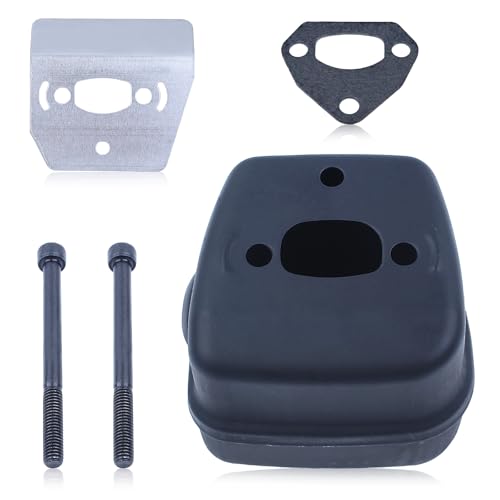
Opening exhaust flow increases the volume of hot gas passing through the muffler, making thermal shielding around the powerhead vital. Chainsaws featuring polymer or clamshell engine housings, such as the Stihl MS210 through MS250 series or Husqvarna 137 models, rely heavily on metal cooling plates. Replacement assemblies like the yoogande MS250 exhaust kit supply dedicated muffler cooling plates that sit directly between the cylinder face and the muffler body. This metal barrier reflects radiant heat away from plastic oil tanks, throttle linkages, and rubber anti-vibration mounts.
A fresh, high-density exhaust gasket must always be installed during reassembly to guarantee an airtight seal against the cylinder exhaust port. Reusing an old, compressed, or brittle exhaust gasket invites hot exhaust leaks that can scorch surrounding crankcase components and draw air into the exhaust tract. Tighten the mounting bolts evenly to manufacturer torque settings using a standard scrench or socket, ensuring the muffler sits completely flush against the heat shield. Check these mounting bolts after the first full tank of fuel, as thermal cycling can occasionally cause new fasteners to settle.
Critical Carburetor Retuning: Protecting the Engine from Lean Seizure
A modified muffler allows spent gases to exit faster, which simultaneously draws a greater volume of fresh air through the engine cylinder. Because the engine now breathes more air, the existing fuel-air mixture becomes dangerously lean unless more fuel is introduced. Running a modified exhaust on a factory carburetor setting will starve the cylinder of essential two-stroke lubrication oil, leading to scorched piston rings, scored cylinder walls, and engine seizure. Carburetor retuning is not an optional fine-tuning step; it is an absolute requirement for engine survival.
Standard two-stroke carburetors feature Low (L) and High (H) needle adjustment screws that meter fuel delivery across idle and wide-open throttle. After installing the modified muffler, turn the High-speed needle counter-clockwise roughly one-eighth to one-quarter turn to richen the high-RPM fuel mixture. Start the chainsaw, allow it to reach operating temperature, and verify that the engine exhibits a distinct four-stroking flutter sound when held at wide-open throttle out of the cut. When the guide bar bites into a log under load, that fluttering sound should immediately transition into a crisp, powerful, clean two-stroke hum.
Modern electronically managed chainsaws, including computerized auto-tuning units and fuel-injected platforms like the Stihl MS500i, manage fuel calibration through onboard sensors and microprocessors. When installing a high-flow exhaust upgrade on these models, the operator must execute a formal electronic calibration cycle. This usually involves starting the engine in a cold state, letting it idle uninterrupted for several minutes, and conducting sustained wide-open cuts in heavy timber. The electronic control unit registers the increased airflow and adjusts injector pulse widths to maintain optimal stoichiometric fuel delivery.
Diagnostic Symptoms and Mistakes That Ruin Modified Saws
The most frequent error among novice saw modifiers is making the exhaust opening excessively large. Removing the entire front face of the canister or drilling multiple oversized holes destroys all exhaust backpressure, causing fresh fuel charges to blow straight out of the cylinder before combustion completes. This leads to poor low-end torque, erratic idling, and massive fuel consumption without delivering any meaningful cutting speed improvement. Restrict overall discharge modifications so the combined exit area remains slightly smaller than the cylinder exhaust port dimension.
Ignoring spark plug color after completing an exhaust modification is another dangerous oversight. After making several heavy bucking cuts under full load, immediately stop the saw and pull the spark plug to inspect the ceramic insulator electrode. A healthy, properly tuned engine displays a light caramel or chocolate brown coloration across the porcelain tip. If the insulator appears chalky white, gray, or blistered, the engine is running dangerously lean and requires immediate richening of the high-speed carburetor jet before cutting resumes.
Field Verification and Cutting Performance in Heavy Hardwood
Real-world cutting tests reveal the practical benefits of a well-executed muffler modification. In dense, seasoned red oak or frozen maple, an opened exhaust lets the saw maintain higher chain speeds without bogging when dogs are set into the bark. Operators will immediately notice crisper throttle response when feathering the trigger through tricky limb cuts. Before running a modified, louder powerhead across overgrown ground, clearing ground tangle and low branches with a dedicated brush cutter for clearing saplings establishes clear retreat paths and a safe cutting envelope.
Lower powerhead operating temperatures also reduce the likelihood of vapor lock during hot summer firewood sessions. When factory mufflers superheat the crankcase, fuel can boil inside the carburetor metering chamber, causing stubborn hot-restart failures. By routing thermal energy out of the canister and away from the fuel tank, modified saws restart reliably even after intense bucking cycles. Always pair this mechanical upgrade with premium high-octane ethanol-free fuel mixed accurately with quality synthetic two-cycle oil to maximize internal component longevity.
Executing a successful chainsaw exhaust upgrade balances mechanical breathing gains with responsible powerhead stewardship. By using dedicated replacement canisters, integrating secure spark arrestor screens, fitting proper cooling plates, and diligently enriching the carburetor fuel mixture, operators achieve cooler running temperatures and faster cutting cycles. Regular inspection of muffler mounting hardware, exhaust gaskets, and spark plug coloration ensures your modified chainsaw delivers reliable, heavy-duty performance across years of rigorous wood-cutting service.








Write Your Review
No reviews yet. Be the first to share your experience!