


Overcoming Blade Wander and Log Resaw Challenges
Rough bark and uneven trunk contours can easily derail a saw pass before you produce a usable slab. When heavy timber binds against a blade, inadequate guide support triggers severe blade drift that wastes valuable lumber. Selecting the best 60 inch log bandsaw mill or log milling setup requires examining structural rigidity, guide accuracy, and proper blade tensioning. Based on manufacturer specifications and user feedback, pairing the right sawmill frame, dedicated miter log sled, or tough bi-metal blade keeps your cuts flat and prevents motor stall.
Whether you are squaring bowl blanks on a stationary workshop table or slicing fallen trunks into slabs, dependable cutting capacity is essential. Flimsy clamping jaws and wandering teeth create rough, washboard surfaces that take hours to flatten. After rough timber comes off the guide rails, smoothing out saw marks often demands a dependable tool like the best oscillator sander to prepare surfaces for final joinery. Solid steel v-jaws, standard miter bar dimensions, and durable bi-metal teeth ensure you will not struggle with drifting cuts on stubborn grain.
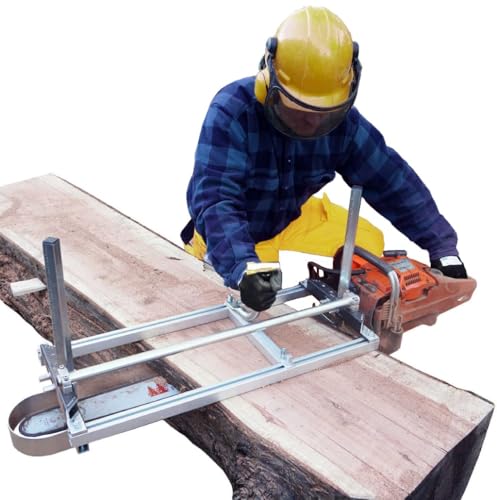
Pros
- Versatile bar clamp fits standard chainsaw bars from 14 to 36 inches
- Corrosion-resistant aluminum and stainless steel frame stands up to damp woods
- Broad thickness adjustment handles everything from thin boards to heavy mantel beams
- Lightweight profile makes it easy to pack into backcountry cutting spots
Cons
- Requires a high-displacement chainsaw and dedicated ripping chain for smooth operation
- Initial bolt assembly and squareness tuning require patient setup time
- Clamping bolts need periodic tightening checks due to ongoing saw vibration
The Alpha Forestry Portable Chainsaw Sawmill is an adjustable slabbing attachment designed to mount directly onto standard chainsaw guide bars. Built for woodworkers, homesteaders, arborists, and rural property owners, this tool converts a standard cutting chainsaw into a mobile plank-milling station. Instead of letting downed trees rot or paying expensive commercial sawyer fees, users can process raw logs into workable dimensional boards, live-edge slabs, or thick structural posts on-site.
Material selection plays a large role in how a mill handles the vibration of a roaring powerhead. This unit combines extruded aluminum guide rails with stainless steel uprights and hardware. The aluminum components keep total weight around 16.5 pounds, making field transport manageable, while the stainless steel brackets resist the rust and moisture inherent in wet timber environments. The crossbars lock securely in place to maintain a flat cutting plane across the log surface.
In practical cutting scenarios, the mill handles guide bars between 14 and 36 inches, yielding a maximum slabbing width of around 36 inches depending on the powerhead dogs and bar tip clearance. The height adjustment brackets allow cuts ranging from 0.5 inches up to 13 inches in thickness. When paired with a properly filed ripping chain and a chainsaw possessing sufficient engine displacement, the mill glides steadily across the wood to create consistent, parallel lumber faces.
Setting up the rig takes some care during the first assembly. Aligning the rails precisely square to the chainsaw bar is critical for preventing binding and achieving straight lumber. For the initial cut, woodworkers will need to use a straight guide board or aluminum ladder clamped atop the log to establish a true reference face. Once that primary slab is removed, the mill rests directly on the freshly flattened surface for all subsequent passes.
A realistic consideration with any chainsaw milling attachment is the physical demand on your cutting equipment. Milling creates sustained high-load friction, meaning users will want a well-lubricated chain, sharp cutters, and a saw with ample horsepower to avoid bogging down in hardwood. Additionally, checking bolt tightness between cuts is good practice because engine vibration can loosen clamping hardware over time.
For DIY builders, woodworkers, and land managers seeking an economical path to custom lumber, the Alpha Forestry mill provides dependable rigidity without excessive weight. It packs down neatly into a truck bed or workshop shelf, making it a valuable addition to any rural tool lineup or custom furniture shop.
Using a portable chainsaw mill offers distinct advantages for custom wood sourcing. Woodworkers can salvage fallen urban timber or specialty hardwood logs that commercial mills often reject due to size or irregular shapes. The wide 36-inch capacity allows the production of expansive live-edge dining table tops, bar tops, and outdoor bench blanks that command high retail prices.
The dual-clamp mounting system holds the guide bar firmly without requiring through-bar drilling, keeping your chainsaw bar intact for normal bucking duties. With steady forward feed pressure and a consistent throttle, the guide rails slide evenly over rough bark and flat reference faces, producing clean boards with minimal chain track marks that clean up quickly with a planer or belt sander.

Pros
- Bi-metal tooth geometry resists premature dulling and tooth stripping on thin stock
- 14 TPI pitch delivers clean cuts with minimal chattering on hollow tubes
- Smooth weld joint runs quietly through bearings without catching
- Standard 60 x 1/2 inch dimensions fit numerous popular small metal-cutting saws
Cons
- 14 TPI is too fine for efficient cutting of thick, solid bar stock
- Requires proper blade tensioning and break-in to maximize tooth life
The Imachinist S601314 is a replacement metal-cutting band saw blade measuring 60 inches in overall length, 1/2 inch in width, and featuring a 14 teeth-per-inch (TPI) configuration. Crafted with a bi-metal structure, this blade is built specifically for slicing through non-ferrous metals, thin tubing, and light structural profiles. For metal fabricators and garage hobbyists using compact horizontal or vertical metal-cutting saws, this blade provides a targeted tooth geometry intended to eliminate common issues like snagging and tooth stripping on thin wall materials.
This blade is best suited for automotive mechanics, DIY fabricators, plumbers, electricians, and maintenance technicians who frequently work with conduit, exhaust tubing, angle iron, and light sheet profiles. Having the right tooth pitch makes a tremendous difference when processing thin-walled workpieces. The 14 TPI layout keeps at least two to three teeth engaged in thin cross-sections, preventing the material from dropping between teeth and shearing them off.
In terms of real-world cutting efficiency, the bi-metal composition offers a noticeable performance upgrade over standard carbon steel blades. The tooth tips are composed of high-speed steel welded to a flexible spring-steel backing. This combination allows the blade to flex around small drive wheels without developing fatigue cracks while maintaining sharp cutting edges through repeated cuts in mild steel, brass, and aluminum. The uniform 1.8mm tooth spacing provides smooth chip evacuation, minimizing burrs and leaving edges that require minimal deburring.
Practical usability is enhanced by a clean, flush-welded joint that feeds smoothly through upper and lower blade guides. Improperly ground weld joints can cause annoying vibrations and inaccurate cuts, but this blade tracks steadily along guide bearings once tensioned properly. The 1/2-inch blade beam provides sufficient beam strength to minimize blade wander on straight 90-degree cuts, making it a reliable option for fabrication projects where square cuts are essential for clean weld joints.
As with any cutting accessory, there are practical boundaries to keep in mind. A 14 TPI blade is optimized for light sections and thin tubing; using it on large, solid billets of dense steel can quickly clog the gullets with swarf and slow cutting speeds significantly. For general light fabrication, exhaust repairs, and small shop maintenance, the Imachinist S601314 offers a reliable, cost-effective cutting solution that balances wear resistance and cut quality.
This blade is designed to fit any horizontal or vertical metal-cutting band saw that specifies a 60-inch blade loop with a 1/2-inch width capacity. These dimensions are common among compact benchtop metal saws, small stationary horizontal cut-off saws, and select portable conversion stands used in home garages and small repair shops.
Recommended materials include thin-wall steel tubing, copper pipe, electrical metallic tubing (EMT conduit), aluminum angle, brass bar, and mild steel structural shapes up to moderate wall thicknesses. Users cutting solid steel stock greater than one inch thick should consider coarser pitch alternatives, while this 14 TPI blade remains ideal for hollow profiles and sheet fabrication.
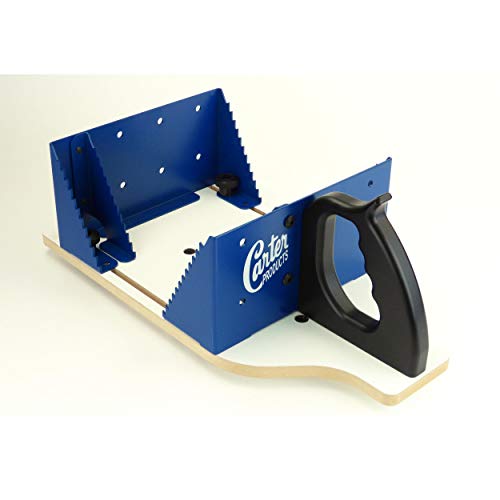
Pros
- Greatly improves user safety when slicing round, uneven logs on a band saw
- Steel V-jaws grip bark and rough wood firmly to prevent shifting during cuts
- Smooth-sliding miter bar adjusts to eliminate track play for straighter lines
- Comfortable ergonomic handle gives positive feed control through tough grain
Cons
- Requires a standard 3/4-inch by 3/8-inch miter slot, limiting use on small benchtop saws
- Capacity tops out around 9 to 10 inches depending on your saw throat clearance
- Takes up a fair amount of shelf storage space when not mounted on the saw
The Carter Bandsaw Accuright Miter Mill is a specialized band saw sled designed to conquer one of the most hazardous tasks in the workshop: cross-cutting round logs. Cutting unsquared branches or raw trunk sections freehand on a band saw invites dangerous blade grabbing and log rotation. This fixture eliminates that risk by gripping the stock inside heavy-duty steel jaws and guiding it straight through the blade via your table miter slot.
Woodturners, carvers, and DIY woodworkers who source local green wood or downed yard trees will appreciate what this fixture offers. Instead of rigging temporary wooden sleds or risking dangerous kickback, the Miter Mill gives you a dedicated platform to slice bowl blanks, trim end grain, and square up turning blocks. Its heavy-gauge steel tooth V-jaws bite aggressively into rough bark or wet timber, locking the workpiece firmly in place throughout the cut.
Feed control and operator safety remain the standout operational strengths. The unit features an ergonomically contoured handle that sits upright and away from the cutting line. This design allows you to exert steady downward and forward feeding pressure without placing your fingers near the running band saw blade. The steel guide bar underneath is fully adjustable to take up slop in standard 3/4-inch by 3/8-inch miter channels, which helps maintain a true 90-degree path without binding.
Setting up the sled takes just a few moments. Loosening the adjustment points allows the front jaw to slide out to accommodate logs up to roughly 9 inches in diameter, making it suitable for mid-sized turning stock. Maintaining the tool requires little beyond occasionally blowing off pitch-heavy sawdust, applying paste wax to the underside for smooth table travel, and checking jaw fastener tension before heavy cutting sessions.
There are a few practical limits to keep in mind. Compact benchtop band saws with non-standard miter slots or shallow throat depths will not accommodate this jig effectively. Log diameter is also constrained by your saw height capacity and the jaw opening width. For woodworkers running a 14-inch or larger band saw with standard tracks, the Carter Accuright Miter Mill is a rugged, time-saving addition that makes rough timber prep significantly safer and more accurate.
The Carter Accuright Miter Mill is built around the industry-standard 3/4-inch wide by 3/8-inch deep miter gauge slot found on most full-sized 14-inch and larger workshop band saws. The miter bar features set screws to dial out side-to-side play, ensuring straight travel across cast iron tables.
Before purchasing, check your band saw throat clearance and table dimensions. The sled body measures approximately 16.8 inches long by 8.7 inches wide, requiring adequate infeed and outfeed room to complete cuts safely. Saws with stamped steel tables or proprietary narrow miter slots will require modification or may not be compatible.
Frequently Asked Questions
Can a 60-inch bandsaw blade cut raw timber logs?
No, a standard 60-inch metal-cutting blade cannot cleanly cut raw timber logs. While a 60-inch bi-metal blade like the Imachinist S601314 Bi-Metal Metal Cutting Band Saw slices soft metals and thin tubing with its 14 TPI profile, green timber requires aggressive 3 to 4 TPI wood blades with deep gullets to prevent clogged teeth and severe overheating.
How do you safely secure round logs on a bandsaw table?
Round logs must be locked securely into a dedicated sliding carriage or miter sled. Freehand cutting allows the blade teeth to grab the round log, spinning the wood unpredictably. Fixtures like the Carter Bandsaw Accuright Miter Mill clamp logs up to 9 inches in diameter using heavy steel teeth, providing rigid control through standard miter slots.
What log capacity does a portable chainsaw mill offer?
Portable lumber mills typically handle log diameters up to 36 inches. The Alpha Forestry Portable Chainsaw Sawmill adjusts to cut logs from 14 to 36 inches wide, producing slabs between 0.5 and 13 inches thick. Its lightweight aluminum and stainless steel frame allows woodworkers to mill fallen trees right where they drop.
What miter slot size is standard for bandsaw log jigs?
Standard 3/4-inch wide by 3/8-inch deep miter slots are standard for log-cutting sleds. Accessories engineered for stationary bandsaw tables feature adjustable guide bars that slide smoothly in these grooves. Proper slot fit eliminates lateral wobble so you get square, parallel cuts when preparing bowl turning blanks.
How do you smooth rough lumber after milling with a Best 60 Inch Log Bandsaw Mill?
Rough-cut timber requires proper air drying followed by systematic surface leveling. Milled planks often show minor blade ripples that need flattening before cabinet or furniture work. For wide stock and floorboards, running the best sander for floorboard restoration will rapidly knock down high spots and create a flat surface.






Write Your Review
No reviews yet. Be the first to share your experience!