


Chuck wobble and wander can quickly ruin delicate pilot holes and accurate mortises when relying on handheld drills. Handheld drilling often introduces unwanted angles, chatter, and bit slippage through dense metals or stubborn hardwoods. Upgrading your workshop with the best drill press under 250 brings repeatable depth stops and rigid spindle stability without consuming valuable floor space. Compact benchtop machines deliver reliable mechanical leverage, reducing operator strain while maintaining true 90-degree accuracy on repetitive workpieces. Combining a steady worktable with a best drill jig setup ensures repeatable hole spacing across multiple production runs.
Motor power and pulley configurations dictate how cleanly you can bore through tough materials like cast iron, aluminum, or maple. Choosing the best drill press under 250 gives DIYers and woodworkers access to induction motors that resist thermal bog-down during heavy cuts. Multi-step pulley systems provide wide spindle speed ranges, giving you high torque for large Forstner bits and fast rotation for small bits. Paired with a proper drill bit to cut stainless steel, these affordable bench units deliver smooth, chatter-free bores that handheld power tools simply cannot match.


Frequently Asked Questions
Can a benchtop drill press drill through steel and other tough metals?
Yes, a benchtop drill press handles steel, aluminum, and brass when set to lower spindle speeds. Lower speeds between 600 and 900 RPM generate the high mechanical torque required for metal cutting without burning the cutting edges of your bits. Both the SKIL 6.2 Amp 10 In. 5-Speed Benchtop Drill Press and the VEVOR Benchtop Drill Press feature multi-step pulleys to dial in suitable speeds. Applying cutting fluid and moderate feed pressure protects your bits and preserves the induction motor.
What is the benefit of a 10-inch swing capacity on a workshop drill press?
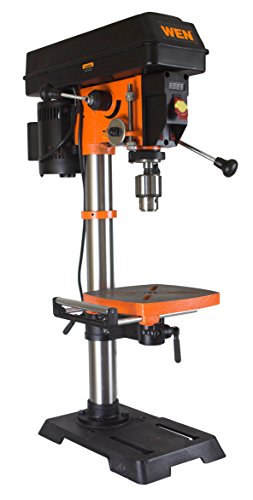
A 10-inch swing capacity allows you to drill directly into the center of a workpiece that measures up to 10 inches across. The distance from the center of the spindle to the main support column is 5 inches, which defines half the total swing size. This throat depth provides adequate clearance for larger panels, furniture legs, and wide sheet metal stock. For standard home workshops and craft benches, a 10-inch swing balances compact footprint with sufficient project clearance.
How do you adjust speeds on a 5-speed benchtop drill press?
You adjust spindle speeds manually by moving the rubber drive belt across tiered motor and spindle pulleys. Opening the top belt housing reveals step pulleys that alter the gear ratio between the induction motor and the drill chuck. Setting the belt to the largest spindle pulley produces lower RPM with maximum torque for large Forstner bits or hole saws. Conversely, moving the belt to smaller spindle steps raises rotation speed for fast, clean pilot holes in softwoods. Learning proper belt positions helps optimize drills to increase speed safely for every specific material.
Why does chuck runout matter on an entry-level benchtop drill press?
Spindle and chuck runout determines whether your drill bit spins dead straight or wobbles off-center. Excessive runout creates oversized, sloppy holes and causes bit wander that ruins dowel joints and metal tap locations. Quality cast iron frames and rigid quill bearings minimize play along the vertical feed path. Keeping the keyed chuck clean of metal debris ensures solid gripping security and consistent hole diameters.
Is a variable-speed drill press better than a manual pulley system for the best drill press under 250?
No single system is strictly superior, but manual 5-speed pulley systems offer exceptional mechanical reliability at budget price points. Mechanical step pulleys avoid complex electronic control boards that can fail under heavy workshop vibrations. Manual belt shifting provides steady torque delivery at low RPM where electronic variable-speed motors sometimes lose driving power. For under $250, mechanical belt designs maximize durability and torque transfer without inflating maintenance costs.
How does an adjustable beveling table improve drilling versatility?
A tilting worktable enables accurate bevel drilling from 0 to 45 degrees without requiring custom angled shims. Loosening the bevel locking bolt under the cast iron table allows operators to swing the surface smoothly to either side. Positive angle indicators make it straightforward to drill repetitive angled holes for chair rungs, stair handrails, and metal brackets. Locking the table securely prevents deflection under heavy quill feed pressure.




Write Your Review
No reviews yet. Be the first to share your experience!