


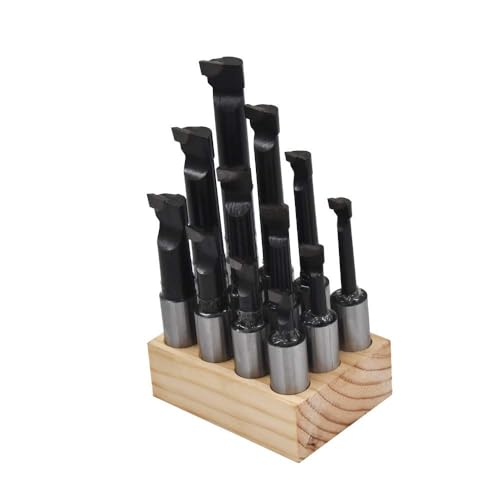
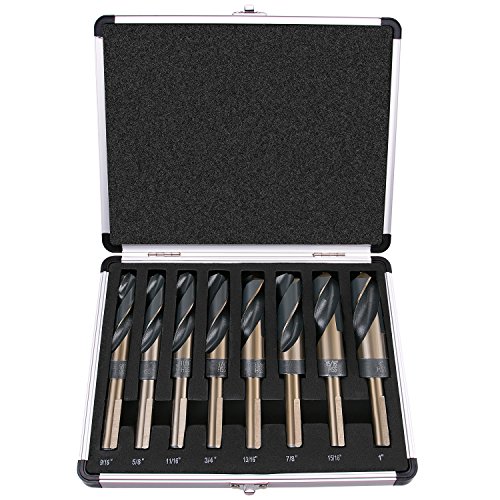
Drill chatter and gummy chip buildup can instantly ruin a precision bore on soft non-ferrous stock. Aluminum tends to gall and weld onto dull cutting lips, turning a straightforward fabrication job into a frustrating mess of ruined workpieces and stalled drill presses. Securing the best drill bit for boring aluminum bar requires sharp rake angles, generous flute clearance, and exceptional shank rigidity to prevent unwanted tool deflection. Manufacturer specifications and workshop feedback indicate that high-speed steel Silver and Deming designs or modular carbide boring bars provide the necessary sustained cutting stability for clean hole enlargement.
Selecting heavy-duty tooling with a secure tri-flatted shank or an R8 taper prevents rotational slipping inside the chuck under heavy radial stress. These rigid toolholders handle continuous friction, keeping hole diameters true across repeated operations in solid bar stock. Once you bore tight openings, deburring edges with a detailing sander for tight spaces delivers an immaculate, snag-free finish. Proper cutting lubrication paired with stiff cutter assemblies ensures smooth chip flow and prevents motor bogging during deep metal passes.


Essential Boring Bar and Drill Bit Insights
Why does aluminum bar stock chatter during deep boring?
Excessive tool overhang and incorrect cutting speeds cause severe harmonic chatter in aluminum bars. The soft, ductile nature of aluminum causes chips to adhere to cutting lips, creating uneven resistance against the boring bar. Keeping tool stickout as short as possible and using rigid carbide tipped boring bars reduces vibration. Applying consistent cutting fluid also prevents aluminum from welding to the cutting edge.
Can Silver and Deming bits serve as the Best Drill Bit For Boring Aluminum Bar?
Yes, Silver and Deming bits are excellent for opening up pre-drilled holes in aluminum on standard machinery. Their 1/2-inch reduced shank fits common chucks, while the 135-degree split point provides aggressive self-centering without walking across the workpiece. Large flutes quickly evacuate ductile aluminum spirals to keep operating temperatures low. They offer an accessible alternative to complex lathe boring heads for clean enlargement tasks in 2026.
What is the advantage of an R8 shank boring head for aluminum?
An R8 shank mounts directly into milling machine spindles for unmatched rigidity and minimal runout. This direct connection eliminates chuck slip and allows micro-metric adjustments down to 0.001 inches for precision inner diameters. Unlike standard drill chucks, a solid boring head withstands the heavy side-load forces generated when sizing tough aluminum billets.
Should you use cutting fluid when boring aluminum bar?
Yes, cutting fluid or WD-40 is essential to prevent aluminum from galling onto cutting surfaces. Aluminum softens quickly under friction, causing built-up edge on drill tips and boring inserts that ruins dimensional tolerance. Proper lubrication ensures smooth chip ejection, prolongs bit sharpness, and yields mirror-like bore finishes. Preparing raw billets often involves pairing drilling tools with a small area sander for detail work to clean up mating faces.
How do indexable carbide inserts compare to high-speed steel for aluminum?
Indexable carbide inserts provide superior hardness and maintain razor-sharp edges longer than standard high-speed steel. Polished carbide inserts designed with high rake angles cut soft aluminum cleanly without material buildup. High-speed steel remains more forgiving against vibration, but carbide tools deliver superior surface finish consistency across multiple production pieces.


Write Your Review
No reviews yet. Be the first to share your experience!