


Melted plastic edges, gummed-up carbide teeth, and chipped outer cap layers quickly ruin an expensive composite deck project. Standard framing blades spin with standard tooth geometry that creates excessive thermal buildup, which fuses synthetic swarf along the cut line instead of clearing it away. Choosing a purpose-built saw blade for trex decking resolves this headache by utilizing modified triple-chip grind teeth, negative or mild hook angles, and non-stick coatings. Much like reaching for purpose-built siding discs such as a saw blade for hardie board, dense polymer-wood materials demand specialized engineering to ensure crisp board ends without burning or gumming.
Evaluating blade specifications helps prevent motor strain while delivering clean cut quality across miter, table, and circular saws. Thin-kerf designs reduce waste and motor drag, while dedicated heat-dissipating expansion slots keep the steel plate flat through repetitive crosscuts. Based on manufacturer technical specifications and field feedback from installers, matching tooth count to saw diameter is vital for clean results. Options like the Freud 84 Tooth Trex Composite Deck D1284CD provide dense tooth spacing for stationary miter work, whereas 7-1/4 inch models such as the DEWALT Circular Saw Blade, 7 1/4 Inch, 40 Tooth offer portable precision directly on the deck frame. Upgrading your blade setup preserves expensive decking boards and guarantees professional joints from start to finish.

Pros
- Produces clean, chip-free cuts without the melted edge build-up typical of standard wood blades
- Laser-cut anti-vibration slots promote straight cuts and reduce tool chatter
- Durable carbide teeth hold a sharp cutting edge through extensive square footage of dense composite
- Compatible with common 10-inch jobsite miter saws and benchtop table saws
Cons
- Priced higher than generic multi-purpose wood construction blades
- Optimized for composites and plastics, making it less practical for framing lumber or rough demolition
The Freud D1072CD is a specialized 10-inch 72-tooth circular saw blade engineered specifically for cutting composite decking, cellular PVC, and capped synthetic lumber. Standard framing or crosscut blades tend to generate excessive heat that melts the plastic casing on composite boards, creating rough burrs and unsightly edge mushrooming. This model utilizes a custom tooth geometry and modified rake angle designed to sheer cleanly through tough wood-plastic blends while keeping friction to a minimum.
This blade is ideal for professional deck builders, general contractors, carpenters, and DIY homeowners investing in premium composite decking systems. Cutting modern synthetic deck boards requires precision, as miscuts or frayed ends cannot easily be hidden or sanded smooth. Whether setting up on a compound miter saw for square ends and miters or using a table saw for rip cuts along fascia boards, users get clean cuts right off the saw table.
In terms of performance, the 72-tooth configuration provides controlled, steady feed rates while leaving crisp edges on both standard uncapped composites and tough polymer capstock. The thin-kerf design minimizes material waste and demands less torque from smaller 15-amp jobsite saws. Integrated laser-cut stabilizer vents keep blade wobble and vibration in check, resulting in smoother cut lines and significantly quieter operation during long installation days.
Freud manufactures this blade using high-density carbide teeth engineered to withstand the abrasive fillers found in modern composite formulas. The exterior features a durable protective coating that shields the steel body against resin buildup, pitch, and corrosion. This heat-resistant coating plays a key role in keeping cut temperatures low, which is essential to prevent synthetic materials from gumming up the gullets.
While this blade excels at cutting composite boards, it is a specialized accessory with clear limitations. Using it on nail-embedded wood, heavy timber framing, or masonry substrates will dull the precision carbide tips quickly. For general rough carpentry, standard framing blades remain the better choice to preserve this blade for finish-grade cuts.
For contractors and homeowners planning a deck build, the Freud D1072CD represents a smart investment in finish quality. It saves valuable time by eliminating the need to file or scrape plastic burrs from exposed board ends, ensuring tight, attractive joints across the entire installation.
On active construction sites, speed and clean results directly affect labor costs. The Freud D1072CD helps crews move quickly through repetitive cuts without stopping to clean melted plastic buildup from the blade teeth or deburr trimmed boards by hand.
The standard 5/8-inch arbor fits easily onto most major 10-inch miter saws and portable jobsite table saws. Its thin kerf allows battery-powered or standard corded saws to maintain full RPM through dense composite material, keeping cuts straight and square.

Pros
- Produces clean, swirl-free cuts without melting composite or PVC material
- Laser-cut anti-vibration vents keep the blade stable throughout heavy crosscuts
- Protective coating resists friction, resin buildup, and rust
- Long tooth life even when cutting abrasive composite compounds
Cons
- Specialized tooth geometry is not ideal for rough framing or ripping standard lumber
- Higher cost than standard multipurpose construction saw blades
The Freud D1284CD composite deck blade is a specialized 12-inch circular saw blade engineered specifically to tackle the unique challenges of modern decking materials. Traditional framing blades frequently burn, melt, or chip composite materials like Trex, TimberTech, and cellular PVC. By incorporating an 84-tooth layout with a dedicated tooth profile, this blade focuses purely on delivering smooth, splinter-free crosscuts and miter cuts on outdoor building sites.
This blade serves professional deck builders, general contractors, carpenters, and ambitious DIY homeowners who want pristine finish quality on high-end outdoor projects. Anyone working with expensive composite planks knows how easily a standard blade can ruin an edge or cause unsightly melting. This specialized accessory eliminates those issues, making it a reliable addition to any jobsite or garage workshop setup where exterior finish quality counts.
In terms of performance, the blade maintains exceptional stability through dense composite boards. The 84 carbide teeth slice cleanly through the blend of plastic resins and wood fibers without mushrooming the surface layer. The integrated laser-cut stabilizer vents absorb vibration and reduce noise, keeping the blade stiff during steep miter cuts. This structural stability prevents blade deflection, resulting in tight-fitting joints and clean, crisp stair treads.
Build quality matches the standards expected from Freud tool accessories. The blade features durable carbide teeth brazed securely to a laser-cut steel plate, offering superior wear resistance against abrasive composite materials. The exterior is coated with Freud's signature red Perma-SHIELD finish, which fights corrosion and prevents hot plastic residue or pitch from clinging to the blade body during continuous cutting runs.
Installing the blade onto standard 12-inch miter saws or compatible slide compound saws is straightforward thanks to its standard 1-inch arbor fit. While it requires the same careful handling and blade-guard clearance checks as any standard miter blade, its thin kerf demands less motor effort, helping saws maintain higher RPMs through thick deck boards. Maintenance is low, requiring only periodic cleaning if plastic resins accumulate after extended cutting sessions.
The main limitation is versatility. Because the tooth geometry is tuned for composite and synthetic decking, using this blade for general framing lumber, plywood, or demolition tasks will wear the fine carbide edges prematurely. For anyone building a composite deck, porch, or railing system, having this dedicated blade on the saw pays off immediately through cleaner joints and eliminated sanding time.
On active deck-building sites, this blade helps maintain a fast workflow by eliminating the need to deburr or file composite plank ends before fastening. Workers can measure, cut, and fasten boards immediately without worrying about melted plastic flashing on the cut line.
The thin kerf design reduces strain on jobsite miter saws, which is particularly helpful when running equipment on long extension cords or portable generators. It produces fine composite shavings rather than melted clumps, making dust collection at the miter station noticeably more effective.
Pros
- TiCo Hi-Density carbide teeth provide extended edge life in abrasive composite decking
- Perma-SHIELD coating minimizes heat buildup to help avoid melting PVC and plastics
- Aggressive 5/7 TPI tooth design delivers fast cuts without excessive binding
- Universal T-shank interface mounts easily in corded and cordless jigsaws
Cons
- 4-inch overall length limits cutting depth on thicker multi-layer workpieces
- Aggressive 5/7 tooth spacing is not intended for ultra-fine finish scrollwork in delicate veneers
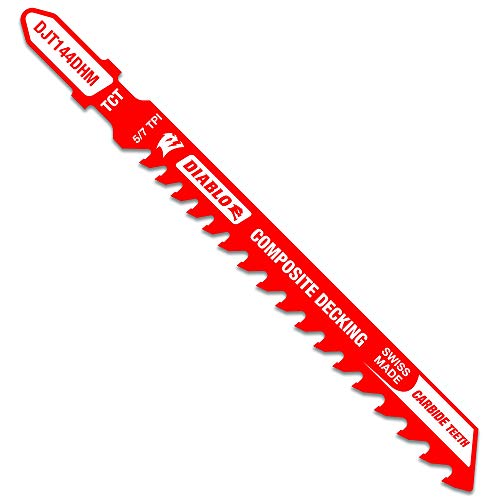
The Diablo 4-Inch 5/7 TPI Carbide T-Shank Jig Saw Blade is a specialized cutting accessory engineered specifically for deck builders, remodelers, carpenters, and DIY homeowners working with dense synthetic and treated materials. Cutting modern composite decking, PVC trim, and pressure-treated wood can quickly dull standard bi-metal or high-carbon steel jigsaw blades due to heavy friction and abrasive binders. This Diablo blade addresses that challenge by pairing TiCo Hi-Density carbide teeth with a heat-resistant non-stick coating.
Designed for demanding materials, the blade features a variable 5/7 TPI tooth configuration with an aggressive geometry. According to product specifications, this tooth layout enables fast material removal while maintaining clean edge definition without binding. The inclusion of Diablo's Perma-SHIELD non-stick red coating is crucial when cutting solid plastic lumber, PVC, and composite decking, as it reduces friction and helps prevent melted plastic from fusing onto the cutline or gumming up the blade teeth.
The build quality centers around Diablo's proprietary TiCo Hi-Density carbide, which the manufacturer states provides up to 50 times longer cutting life compared to standard blades. The blade utilizes a universal T-shank design that locks securely into combo blade clamps and most U-shank jig saws. This makes it compatible with a wide array of corded and cordless jigsaws on the jobsite, maintaining a solid lockup to support controlled curved cuts, sink cutouts, and notched deck board profiles.
Installing the blade is straightforward on modern toolless jigsaw blade clamps thanks to the standard T-shank profile. Because the Perma-SHIELD coating reduces drag, the blade draws less friction-induced resistance, which can benefit users operating on cordless battery platforms during extended decking jobs. The 4-inch overall length offers good maneuverability for scribing around posts and cutting vent openings, though users should always follow their saw manufacturer instructions and disconnect power or detach the battery before changing blades.
A realistic limitation is the blade length and tooth pitch. At 4 inches total length, it is not intended for very thick timber or deep resawing tasks. Furthermore, the aggressive 5/7 TPI tooth geometry favors cutting speed and anti-melting in composites rather than ultra-smooth, splinter-free detail work in fine cabinet veneers. However, for contractors and homeowners building decks, installing PVC trim, or cutting tough pressure-treated framing, this Diablo carbide blade represents a highly practical, durable investment that eliminates frequent blade changes.
The Diablo 4-inch carbide jigsaw blade features a universal T-shank interface, allowing it to fit into standard jigsaw blade holders, combo chucks, and most U-shank saws across both corded and cordless platforms. This broad compatibility ensures that users do not need proprietary adaptors to mount the blade in standard brand-name jigsaws.
In terms of materials, the blade is explicitly designed for composite decking materials, wood, PVC, plywood, and pressure-treated lumber. The aggressive 5/7 TPI tooth configuration and TiCo carbide tips are optimized to withstand abrasive binders found in synthetic boards without the premature dulling common to standard steel blades.
Pros
- Specially engineered for composite and PVC materials, providing noticeably cleaner cuts than general-purpose blades
- Non-stick coating reduces friction and cleaning, keeping the blade performing longer
- High tooth count (64) delivers a smooth, finished edge with minimal chip-out
- Japanese steel provides good durability and sharpness retention over many cuts
Cons
- Limited to composite and PVC materials; not suitable for cutting hardwood or general lumber
- Ultra-thin kerf may be less stable during heavy-duty or deep cuts, requiring careful feed control
- Premium construction may be overkill for occasional composite cutting; a standard blade may suffice for light use
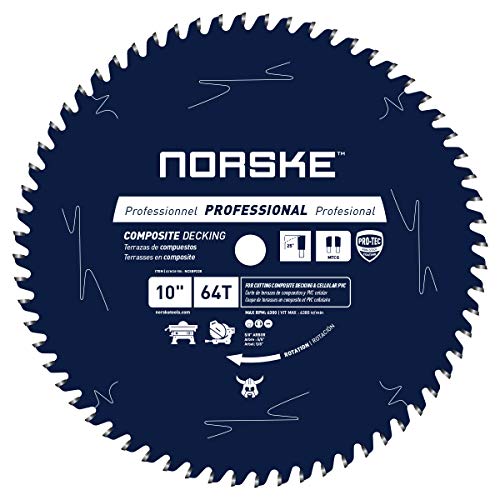
This Norske Tools saw blade is a specialized 10-inch circular saw blade designed to tackle composite decking materials like Trex and bamboo, as well as cellular PVC. With 64 teeth and a modified triple chip grind (MTCG) tooth profile, it aims to deliver a clean, melt-free cut that preserves the integrity of these sensitive materials. The blade also features a non-stick coating and an ultra-thin kerf to minimize drag and material waste.
This blade is best suited for contractors, deck builders, and DIY homeowners who regularly work with composite or PVC decking. It is not intended for general carpentry or cutting standard lumber, as its tooth geometry and grind are optimized specifically for plastics and composites. Workshop users and garage enthusiasts who take on decking projects will find it a valuable addition to their tool collection.
In terms of performance, the MTCG tooth profile combined with the non-stick coating significantly reduces heat buildup during cutting. This helps prevent the plastic within composites from melting and gummy residue from sticking to the blade. The ultra-thin kerf cuts quickly and efficiently, which is especially beneficial when using cordless saws, as it reduces battery drain and speeds through long runs. Users can expect a clean, smooth edge that often requires no additional sanding.
Build quality is a key strength here. The blade is made from Japanese steel, known for its ability to hold a sharp edge through many cuts. The non-stick coating also serves as a corrosion-resistant layer, protecting the blade from moisture and the sticky resin sometimes found in composite materials. The 5/8-inch bore fits most circular saws, and the blade diameter is standard for decking work.
When it comes to storage and maintenance, treat this blade like any precision cutting tool. Store it in a blade sleeve or case to protect the teeth from damage. Clean the blade occasionally with a specialized blade cleaner or warm soapy water to remove resin buildup and maintain performance. The coating helps, but periodic cleaning will extend its life.
A realistic limitation is that this blade is a niche product. If you only cut composite decking occasionally, a high-quality general-purpose blade may produce acceptable results. However, for those who install composite decks regularly, the Norske blade is a worthwhile investment. Based on its design and features, it earns a strong recommendation for professionals and serious DIYers who want consistent, clean cuts and longer blade life on composite projects.
The Norske Tools NCSBP228 saw blade is constructed from Japanese steel, a material known for its hardness and edge retention. This allows the blade to maintain sharpness through repetitive cutting of abrasive composite materials. The body is laser-cut and tensioned to stay flat during high-speed cuts, reducing vibration and improving accuracy.
The non-stick Protective coating is applied to the entire blade surface, including the arbor area. This coating serves multiple purposes: it reduces friction and heat buildup, prevents gumming from plastic residue, and provides a layer of corrosion resistance. The coating is also designed to shed debris easily, which helps keep the blade clean during long runs.
The 64 carbide teeth are brazed onto the blade body and feature a modified triple chip grind geometry. This grind alternates a chamfered tooth with a flat raker tooth, creating a shearing action that produces a smooth finish while reducing the chance of chipping or melting. The teeth are also inspected to ensure consistent height and bevel angles, which contributes to the clean cut quality reported by users.
Overall, the build quality reflects a focus on durability and performance in demanding, high-volume cutting environments. The combination of Japanese steel, a robust coating, and precision-ground teeth gives this blade a professional-grade feel that will hold up well in both job site and workshop settings.

Pros
- Delivers exceptionally clean, chip-free cuts on composite decking, reducing the need for touch-ups
- Laser-cut plate helps prevent blade overheating, which prolongs sharpness and blade life
- Modified triple chip grind geometry is designed specifically for tough composite materials, not just an afterthought
- Affordable price point makes it an accessible upgrade for DIYers and pros alike
- Fits standard 5/8-inch arbor saws, so compatibility is broad across common circular and miter saws
Cons
- Not intended for cutting dimensional lumber or plywood; performance on wood will be mediocre
- 40-tooth configuration may produce slower ripping cuts compared to a dedicated rip blade
- Limited to composite decking applications; not a general-purpose blade for all your sawing needs
The DEWALT DWA31740 is a 7-1/4-inch circular saw blade built specifically for cutting composite decking. It's a specialized tool rather than a general-purpose blade, and that focus shows in its design. Whether you're a weekend DIYer installing a new deck or a contractor finishing multiple backyard projects, this blade aims to make cutting composite materials cleaner and easier.
Who is it for? This blade is best suited for homeowners, deck builders, contractors, and woodworkers who regularly work with composite decking boards. It's not designed for framing lumber, plywood, or hardwood, so if your primary use is wood cutting, you'd be better off with a different blade. But if composite decking is your main material, this blade has the right tooth geometry and heat management to handle it well.
Real-world performance centers on the modified triple chip grind tooth design. This tooth pattern helps reduce chipping and fraying along the cut edge, which is a common problem with composite materials. The laser-cut plate also plays a big role: it keeps the blade running cooler, reducing friction and preventing the composite from melting or gumming up the teeth. The result is a cleaner cut with less cleanup afterward. Many users report that cuts come out smooth and require minimal sanding or trimming, which saves time on the jobsite.
Build quality is what you'd expect from DEWALT. The carbide tips are securely brazed and should hold an edge reasonably well through repeated use. The blade body is flat and runs true, which reduces vibration and helps maintain accuracy. The 5/8-inch arbor fits most circular saws and miter saws, so you can swap it into your existing setup without adapters. Storage is straightforward: it's a standard blade that can go in a blade case or hang on a wall peg.
One realistic limitation is its specialization. This blade excels at composite decking but will not perform well on wood or other materials. Also, the 40-tooth count means it's not the fastest for ripping long boards; it's more suited to crosscutting and mitering. If you need a do-it-all blade, this isn't it.
Overall, the DEWALT DWA31740 is a practical investment for anyone who frequently cuts composite decking. It delivers clean cuts, runs cooler, and is built to last through multiple deck projects. For the price, it's a solid value that can improve both the quality of your work and your efficiency on the job.

Pros
- Minimizes mushrooming, burrs, and melting on composite decking cuts
- Clean 44-tooth finish saves time by reducing edge cleanup and sanding
- Fits standard 7-1/4 inch circular saws used on residential jobsites
- Durable carbide construction resists dulling against dense synthetic materials
Cons
- Higher tooth count cuts slower through rough framing lumber than standard 24-tooth blades
- Carries a higher initial cost than basic multi-purpose construction blades
The Anchor Fasteners 7-1/4-Inch 44-Tooth Trex Saw Blade is a specialized power tool cutting accessory engineered specifically for synthetic decking and exterior finish materials. Unlike standard framing blades that tend to tear, chip, and melt composite cores, this blade utilizes a dedicated 44-tooth design to shear through tough plastic-wood blends smoothly. It operates effectively on standard 7-1/4-inch handheld circular saws, making it an accessible upgrade for existing framing and finish setups.
This blade is ideal for deck contractors, exterior trim carpenters, remodelers, and DIY homeowners undertaking porch or deck renovation projects. Standard framing blades frequently leave rough, melted plastic fringes on composite deck boards that require tedious manual scraping. With this specialized tooth configuration, tradespeople and home improvers can make finished end cuts, picture-frame borders, and stair tread trims with clean, factory-quality edges directly off the saw.
Cutting performance centers on tooth engagement and chip ejection. Composite materials generate fine, sticky shavings that can quickly gum up standard blade gullets and cause friction-induced heat. Based on its tooth arrangement and kerf profile, this blade helps maintain cooler cutting temperatures and expels synthetic dust cleanly. The result is consistent feed speed, reduced motor drag on cordless tools, and crisp edges along capped surfaces without chipping the outer protective shell.
The build quality reflects jobsite durability requirements, featuring carbide-tipped teeth attached to a stable steel body. Composite materials are notoriously abrasive because of dense polymers and mineral binders, which rapidly dull conventional steel teeth. The hardened carbide tips on this blade are built to withstand that friction, preserving tooth sharpness across dozens of board cuts. The rigid plate construction also helps reduce vibration and blade wobble, ensuring precise right-angle cuts across wide deck planks.
Maintenance is straightforward, requiring occasional resin cleaner application if composite dust or pitch builds up over prolonged use. While it excels on composite decking, capped composites, and cellular PVC trim, it is not optimized for rapid demolition or heavy timber ripping. Using it strictly for finish decking cuts and delicate trim will maximize its cutting life and protect your investment.
For any builder or homeowner investing in premium composite decking materials, pairing your circular saw with this Anchor Fasteners 44-tooth blade is a practical choice. It eliminates the frustration of ruined board ends, speeds up installation time, and ensures your outdoor living project looks professionally finished from day one.
On an active deck build, cut quality directly impacts installation speed and visual appeal. Using this blade on a standard circular saw allows workers to square plank ends, cut stair risers, and make angled perimeter miters without having to haul every board over to a stationary miter saw station.
The 44-tooth design reduces friction that typically causes capped composite shells to melt and stick together. By producing clean cut ends on the first pass, installation crews save valuable labor hours that would otherwise be spent trimming burrs with utility knives or sanding plastic whiskers off board ends.

Pros
- Specialized tooth geometry prevents composite material melting
- Leaves clean, factory-grade edge finishes on deck boards
- Direct fit for standard 10-inch miter and table saws
- Durable carbide teeth hold up against abrasive synthetic fibers
Cons
- Specialized primarily for composites and PVC rather than general lumber framing
- Carries a higher initial investment than basic general-purpose utility blades
The Diablo TrexBlade D1072CD is a specialized 10-inch circular saw blade designed expressly for cutting composite decking, capped composite boards, and cellular PVC trim. Standard wood blades frequently overheat when cutting dense synthetic boards, which can lead to melted edges, plastic burrs, and rough end cuts. This model addresses those specific decking challenges by pairing a 72-tooth configuration with specialized tooth geometry that clears swarf efficiently while keeping heat buildup under control.
Professional deck builders, general contractors, carpenters, and DIY homeowners tackling outdoor renovation projects will appreciate the targeted capabilities of this accessory. Fitting typical 10-inch miter saws and compatible jobsite table saws, it provides an upgrade over general construction blades when working on high-cost outdoor building materials where visible crosscuts must look clean and uniform.
On the jobsite or in a home workshop, cutting synthetic materials demands consistent chip clearing to avoid edge gumming. Based on the blade specifications and tooth layout, the 72 carbide-tipped teeth slice through exterior trim and dense composite core stock cleanly. This cut quality helps eliminate the extra step of shaving or sanding plastic fringes off board ends, saving valuable labor time during large deck installations.
Diablo builds the D1072CD with high-density carbide teeth engineered to withstand the abrasive additives and resins found in modern synthetic decking. The blade also features the brand's recognizable red protective coating, which helps lower friction and minimize pitch buildup during extensive cutting sessions. Laser-cut expansion slots assist in absorbing thermal expansion, keeping the blade spinning true through repeated cuts.
While this blade excels on composite decking and cellular PVC profiles, it is not built as an all-around framing blade for thick dimensional lumber or rough site demo. For builders and ambitious DIYers investing in high-end composite outdoor living projects, the Diablo TrexBlade offers reliable cut precision that protects your material investment and speeds up trim work.
Installing modern composite decks requires repetitive precision miters and perimeter cuts where board ends stay exposed to view. Using a standard wood-cutting blade often results in melted plastic flash that demands tedious scraper or utility knife cleanup on every single pass.
The Diablo TrexBlade maintains clean cuts across hundreds of linear feet of deck boards, railing sleeves, and fascia trim. For contractors working against tight deadlines, the reduction in post-cut edge cleanup directly translates into faster deck board fastening and more consistent joint fitment.
Frequently Asked Questions
Can you cut Trex decking with a regular framing blade?
No, standard framing blades generate excessive friction that melts composite plastic cores and chips the protective outer shell. A dedicated saw blade for trex decking uses a modified triple-chip grind (MTCG) tooth pattern to shave synthetic fibers cleanly while ejecting debris rapidly. General framing blades feature alternate top bevel grinds that tear plastic and quickly cake carbide teeth with melted resin.
What tooth count works best for a 10-inch miter saw on composite boards?
A tooth count between 64 and 72 teeth provides the ideal balance of clean crosscuts and efficient heat dispersal on a 10-inch miter saw. Blades like the Freud D1072CD Trex Composite Decking Miter and Tab or the Norske Tools NCSBP228 10 inch x 64T Composite blade cleanly slice through dense cellular PVC and composite boards without bogging down the motor or overheating the cut line.
Why does composite decking melt when cut with a circular saw?
Excess heat generation causes the plastic polymers inside composite decking to liquefy instead of shearing away as fine chips. High friction occurs when using dull carbide, thick-kerf blades, or plates lacking anti-friction coatings. Just as timber resawing requires a specialized bandsaw resaw blade to clear massive sawdust volumes, composite cutting demands non-stick coated plates and optimized tooth geometry to stay cool under friction.
Can a jigsaw cut notches in Trex decking around posts?
Yes, jigsaws cut intricate post notches efficiently when fitted with carbide-tipped blades designed specifically for composite decking. The Diablo Carbide Teeth Jig Saw Blade – 4″ Length features Perma-SHIELD coating and aggressive carbide tooth geometry to create smooth radius cuts and notch profiles without binding or edge melting.
Does cutting composite decking dull saw blades faster than wood?
Yes, composite decking abrades cutting edges much faster than natural wood because of dense mineral fillers, hard resins, and recycled plastic blends. High-density carbide teeth, such as Freud’s TiCo composite formulation, resist dulling and maintain sharp shearing edges across hundreds of repetitive crosscuts.



Write Your Review
No reviews yet. Be the first to share your experience!