


Splintered veneer and jagged door edges ruin an otherwise smooth home renovation project in seconds. Fitting an interior slab or adjusting clearance over fresh carpet demands clean, splinter-free cuts across delicate wood grain. Selecting the best saw blades for trimming doors comes down to matching the blade diameter, tooth geometry, and kerf thickness to your specific cutting setup. Whether you guide a circular saw along a straightedge or set up stock on a miter table, a fine-tooth profile keeps tear-out to an absolute minimum.
High tooth counts slice through solid wood stiles and thin face veneers cleanly without gouging the finish. For precision interior carpentry, pair your fine-finish blades with clean setups, much like choosing a dedicated chop saw blade for laminate flooring to preserve delicate edges. Looking at blade construction, carbide tips and thin kerfs lower motor strain while yielding crisp lines across both hollow-core and solid lumber. A quick pass with a professional belt sander can clean up remaining high spots, but starting with an ultra-fine cut reduces sanding time dramatically.
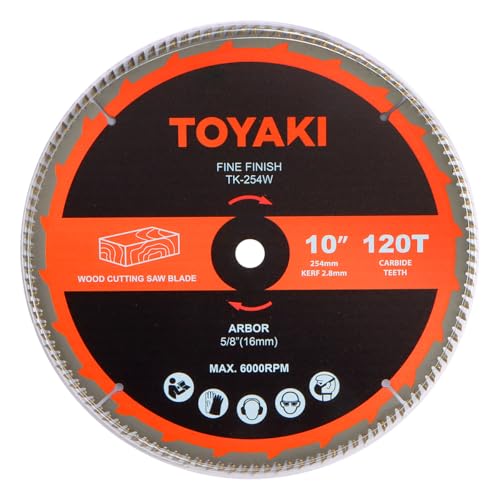
Pros
- Produces a very smooth, fine finish that reduces the need for additional sanding
- 120 teeth provide clean cuts in wood and soft materials with minimal tear-out
- Engineered tooth pattern helps reduce vibration for better accuracy and control
- High-grade steel construction offers good durability and long blade life
- Standard 5/8-inch arbor ensures broad compatibility with popular saws
Cons
- Not suitable for cutting metal, masonry, or hard materials; limited to wood and soft materials
- High tooth count may result in slower cutting speed compared to lower-tooth blades
- Limited user reviews available to confirm long-term performance and durability
The TOYAKI 10-Inch 120-Tooth Miter Saw Blade is a fine-finish woodworking blade designed for users who demand smooth, clean cuts in wood and soft materials. With its high tooth count and engineered tooth pattern, this blade aims to deliver professional-grade results for a variety of cutting tasks. It's a practical option for woodworkers, DIY homeowners, contractors, and anyone who works with trim, molding, cabinetry, or furniture projects.
This blade is best suited for woodworkers, finish carpenters, and DIY enthusiasts who prioritize cut quality over speed. The 120-tooth configuration is ideal for crosscutting hardwoods, softwoods, plywood, and MDF, producing a surface that often requires little to no sanding. For professionals working on trim or cabinet installations, this blade can help reduce finishing time and improve overall productivity. It's also a good fit for hobbyists who want clean, accurate cuts in their workshop projects.
In terms of performance, the blade's engineered tooth pattern is designed to reduce vibration during use, which contributes to smoother cuts and better control. The high-grade steel construction provides durability and consistent cutting quality throughout the blade's lifespan. While it may not cut as aggressively as a lower-tooth blade, the trade-off is a noticeably finer finish. Users can expect clean edges with minimal tear-out, especially when cutting across the grain.
Build quality appears solid, with a black finish that resists rust and corrosion. The standard 5/8-inch arbor ensures compatibility with most miter saws, table saws, and circular saws, making installation straightforward. The blade weighs 1.54 pounds and measures 10 inches in diameter, which is a common size for many saws. Storage is simple, as the blade can be kept in its original packaging or a blade case to protect the teeth.
One realistic limitation is that this blade is designed specifically for wood and soft materials. It should not be used for cutting metal, masonry, or other hard materials, as doing so could damage the teeth or pose a safety risk. Additionally, the high tooth count means it cuts more slowly than blades with fewer teeth, so it's not the best choice for rough framing or fast ripping. Users who need a general-purpose blade may want to consider a lower-tooth option for speed and a finer blade for finish work.
Overall, the TOYAKI 10-Inch 120-Tooth Miter Saw Blade is a solid choice for anyone who values cut quality and finish. It's particularly well-suited for woodworking projects, trim work, and fine carpentry where a smooth edge is essential. While it may not be the fastest blade on the market, its performance and build quality make it a worthwhile addition to any workshop or jobsite. For DIYers and professionals alike, this blade offers a practical solution for achieving clean, precise cuts in wood and soft materials.

Pros
- Exceptional finish quality with minimal tear-out on crosscuts and miters
- Thin kerf allows for efficient cutting with smaller motors and less blade binding
- Compatible with a wide range of 10-inch saws, including some sliding compound miter saws
- Affordable price point for a carbide-tipped blade with 80 teeth
Cons
- Thinner kerf may flex under heavy rip cuts or dense material, not ideal for rough lumber
- Arbor size is fixed at 5/8 inch; reducers may be needed for saws with smaller arbors
- Limited user reviews available to confirm long-term durability
The WEN BL1080 is a 10-inch, 80-tooth carbide-tipped saw blade designed specifically for finish work on miter saws and table saws. It's built for woodworkers, DIY homeowners, contractors, and cabinet makers who demand clean, splinter-free cuts in hardwoods, softwoods, and plywood. Whether you're trimming baseboards, cutting crown molding, or making precise miter joints, this blade aims to deliver professional-grade results without breaking the bank.
In real-world use, the 80 teeth and thin 1/10-inch kerf work together to reduce tear-out and produce a smooth edge that often requires little sanding. The carbide tips stay sharp through extended use on materials like oak, maple, and pine. With a maximum rating of 6000 RPM, it handles fast cuts on most standard saws without bogging down. For workshop users focused on finish carpentry or fine woodworking projects, this blade offers noticeable improvements over general-purpose blades.
Build quality is solid for the price. The blade body is made from a silver-coated steel that resists corrosion, and the carbide teeth are securely brazed. While professional blades from premium brands may use thicker steel or more advanced coatings, the WEN BL1080 holds its own for light to moderate use. The 5/8-inch arbor fits most common saws, but if your saw uses a smaller arbor, you'll need a reducer ring (not included).
Storage and maintenance are straightforward. Keep the blade clean with resin remover and store it in a blade guard or case to protect the teeth. WEN does not include a storage case, so you may want to pick up a blade sleeve or keep it in the original packaging. The blade's lightweight design (just over 1.5 pounds) makes it easy to swap between saws without much hassle.
A realistic limitation is that the thin kerf isn't ideal for heavy rip cuts on thick stock. The blade can flex under pressure, leading to less accurate cuts or potential binding. It's best reserved for crosscutting, mitering, and finer ripping in materials up to about 1.5 inches thick. Additionally, since there are no user reviews yet, long-term durability is unproven, but WEN's reputation for value-oriented tools suggests it should hold up well for most hobbyists and DIY projects.
Overall, the WEN BL1080 is a smart buy for anyone who wants clean, finished cuts without spending a lot. It's especially suited for DIY woodworkers, garage workshop users, and contractors who do a lot of trim or cabinet work. For heavy-duty ripping or high-volume production, you may want a thicker kerf blade, but for everyday finish cuts, this blade delivers reliable performance at a great price.

Pros
- Generous 15-inch length handles thicker tree limbs and hard-to-reach branches with ease
- Triple-ground offset Japanese tooth pattern cuts efficiently through fibrous wet and green wood
- Chrome vanadium steel build offers dependable durability and resists bending under load
- Universal tang fits standard reciprocating saw quick-release blade clamps without adapters
Cons
- Extra length can lead to blade flexing if too much forward pressure is applied during tight cuts
- Coarse 6 TPI Japanese tooth design leaves a rough finish unsuitable for clean carpentry or fine woodwork
- Large blade dimensions require careful storage to avoid bending teeth when stored in standard toolboxes
Yard cleanup and tree maintenance often present a challenge when branches are too thick for manual loppers but do not justify hauling out a heavy gas chainsaw. The SEDY 15-Inch Japanese Teeth Reciprocating Saw Blades offer an efficient solution for DIY homeowners, landscapers, and property maintenance workers looking to turn an existing reciprocating saw into a fast-clearing pruning tool. Sold in a practical three-pack, these extended blades are specifically configured for fast cuts through living limbs, wet logs, and green wood.
The standout feature of these blades is their 15-inch overall length combined with an aggressive 6 TPI profile. Engineered with Japanese-style teeth and an arc edge profile, the cutting surface uses a triple-ground offset tooth structure that establishes three cutting angles. This configuration works directly with deep tooth gullets to clear moist, fibrous shavings rapidly, which helps reduce binding and friction when cutting through thick sap-heavy branches or firewood sections.
Material construction relies on high-strength chrome vanadium (Cr-V) steel, providing the toughness and wear resistance needed for outdoor woodcutting. Green wood generates substantial lateral drag, and standard carbon steel blades can easily bend or lose their temper. The thicker body of these Cr-V blades helps maintain tracking stability and resists warping during demanding limb trimming, while the universal shank design ensures a reliable fit into standard corded or cordless reciprocating saw toolless clamps.
In practical use, these 15-inch blades offer major convenience by extending your reach into dense thickets and upper tree branches from the ground. However, working with a long blade requires mindful tool handling. Because of the extended profile, pressing excessively against stubborn limbs can induce flexing or vibration, especially when cutting closer to the tip. Letting the reciprocating saw stroke and the sharp Japanese teeth pull through the cut yields the cleanest and most controlled cutting action.
Buyers should keep in mind that this 6 TPI arc edge blade is engineered strictly for rough woodcutting tasks like tree pruning, cutting wet logs, and sizing firewood. The aggressive tooth set is not intended for clean finish carpentry, dry dimensional lumber where splinter-free edges are needed, or any metal or nail-embedded material. For seasonal yard prep, storm cleanup, and trail clearing, this SEDY three-pack delivers substantial cutting reach, fast chip evacuation, and strong overall value.
Pruning live trees and shrubs presents distinct cutting challenges because green wood contains moisture and stringy fibers that quickly clog conventional wood blades. The SEDY 15-inch pruning blades address this with deep gullets between the 6 TPI teeth, allowing wet chips to eject freely with each stroke of the reciprocating saw.
The curved arc edge geometry helps maintain optimal contact on rounded branch surfaces, reducing chatter when starting cuts on awkward limb angles. For property owners managing overgrown boundaries, prepping campfire wood, or clearing fallen storm debris, using a cordless reciprocating saw paired with these extended blades offers a lighter, quieter, and lower-maintenance alternative to running a small chainsaw.
Compatibility is straightforward thanks to the standard universal shank, which mounts securely into keyless and keyed reciprocating saw clamps from all major tool brands. The 15-inch total length provides ample stroke clearance even when cutting mid-sized logs up to several inches thick, ensuring the blade teeth do not bottom out or slip out of the kerf mid-cut.
Chrome vanadium (Cr-V) steel composition ensures good edge retention against abrasive bark while remaining pliable enough to absorb reciprocating shock without shattering. Replacing worn blades is quick, and having three identical extended blades in the pack ensures minimal downtime during larger property maintenance projects.
Frequently Asked Questions
Which tooth count works best for trimming wood doors?
An 80-tooth or 120-tooth blade works best for trimming wooden doors because high tooth density minimizes veneer tear-out. These fine-finish configurations slice slowly through fibrous wood layers without blowing out the back edge. If you tackle curved profiles or narrow trim elsewhere, a dedicated band saw blade for tight curves offers better maneuverability, but straight door rails always demand high-tooth precision.
Can you use a 10-inch miter saw blade on a table saw to size doors?
Yes, provided the arbor size and maximum RPM ratings match the table saw specifications. A standard 5/8-inch arbor fits most 10-inch contractor and cabinet table saws safely. Always verify that your table saw motor does not exceed the blade rated operational speed before firing up the machine.
How does a thin kerf benefit door trimming cuts?
A thin kerf blade removes less stock per revolution and dramatically reduces cutting resistance on the saw motor. Lower resistance keeps feed rates smooth and uniform, which directly reduces heat buildup and burning along the door edge. The thinner cut also leaves more material intact if you require micro-adjustments.
When should you use a reciprocating saw blade around door frames?
A reciprocating saw blade works best for rough door removal, trimming bottom shims, or cutting through fasteners in the rough opening. Japanese-tooth pruning blades cut rapidly through framing wood and studs during demolition. However, you should never use coarse reciprocating blades for finishing visible door bottoms where clean edges matter.
How do you prevent veneer blowout on hollow-core doors?
Applying painter tape over the cut line and scoring the cut path with a utility knife stops veneer blowout. Using the best saw blades for trimming doors with sharp carbide teeth also ensures each wood fiber cuts cleanly rather than tearing away. Feeding the saw at a steady, measured pace prevents chipping across the delicate outer skin.




Write Your Review
No reviews yet. Be the first to share your experience!