


Demolition jobs, plumbing repairs, and rough framing often push cutting tools to their absolute limits. When you confront heavy structural framing, thick tree limbs, or cast-iron soil pipes, knowing how thick and deep can a reciprocating saw cut determines whether your project moves smoothly or stalls out with a bent blade. Reciprocating saws do not use a fixed circular blade with a preset depth guard, so their actual cutting depth depends on blade length, stroke length, and motor power. Using quality demolition saw blades designed for aggressive material removal allows a saw to slice through substantial cross sections that circular saws cannot physically clear.
Matching the tool stroke length and motor amperage to the density of your workpiece is equally critical for clean progress. A compact cordless model may handle thin-wall conduit and dimensional lumber easily, but cutting thick structural posts or heavy steel profiles demands sustained torque and adequate heat dissipation. Understanding how shoe position, blade deflection, and tooth pitch interact lets you tackle deep cuts safely without bogging down the motor or snapping accessories mid-cut.

Pros
- Brushless motor provides efficient power and longer battery life
- Three speed settings offer versatility for different materials
- Tool-free blade change makes swapping blades fast and safe
- Included case and accessories (two batteries, multiple blades) provide great value
- Ergonomic grip and one-handed design improve comfort and control
Cons
- No user reviews yet, so long-term reliability is unconfirmed
- Battery capacity and runtime may be limited for heavy continuous use
- Weight of 4.6 pounds might feel a bit heavy for some users during prolonged overhead cuts
The VTEK brushless cordless reciprocating saw is a versatile power tool designed for cutting wood, metal, plastic, and even brick. It features a high-quality brushless motor that delivers up to 3000 strokes per minute, providing efficient power and extended runtime compared to brushed alternatives. This saw is ideal for DIY homeowners tackling home repairs, mechanics cutting exhaust pipes or brackets, contractors working on construction sites, and woodworkers shaping lumber or removing old framing.
Performance-wise, the saw offers three adjustable speed settings that let you match the cutting speed to the material at hand. Lower speeds work well for metal and plastic, while higher speeds handle wood and brick efficiently. The 22mm stroke length provides fast, aggressive cuts, and the tool-free blade release allows you to swap blades in seconds without needing a wrench. This feature is particularly handy when switching between wood and metal cuts on a single project.
Build quality appears solid for its price point. The brushless motor is sealed to reduce dust ingress, and the ergonomic handle with a rubberized grip helps reduce hand fatigue during extended use. The saw includes safety lock and one-handed operation, making it accessible for users with less strength. The included carrying case keeps everything organized, and the two batteries ensure you always have a charged backup ready.
Storage and maintenance are straightforward. The case has cutouts for the saw, charger, and blades, so everything stays in place. The brushless motor requires no brush replacements, lowering long-term maintenance. After use, simply wipe the blade and body clean. The saw is compatible with standard reciprocating blades from other brands, so you can expand your cutting capabilities easily.
One realistic limitation is that there are no customer reviews yet, so actual longevity and battery performance are unverified. The saw weighs about 4.6 pounds, which is moderate but might feel heavy during overhead cuts or extended use. Additionally, runtime on a full charge will depend on the material and speed setting, so heavy users may want a third battery. However, for most home workshops and professional job sites, this saw offers excellent value and versatility.
Overall, the VTEK brushless cordless reciprocating saw is a practical choice for anyone needing a reliable, multi-material cutting tool. Its adjustable speeds, tool-free blade change, and included accessories make it ready to work out of the box. Whether you are a DIY homeowner remodeling a room, a mechanic removing rusty bolts, or a contractor framing a new structure, this saw provides the power and convenience you need for efficient cutting.
The VTEK reciprocating saw is built with a durable housing and a brushless motor that offers better efficiency and longevity than brushed motors. The blade clamp is metal and locks securely, and the tool-free mechanism feels solid. The handle and grip are overmolded with rubber for a non-slip hold, even when hands are sweaty or dirty. Overall, the construction seems robust for the price, though the plastic body may not withstand severe drops.
This kit comes with two 20V batteries, a charger, three wood-cutting blades, two metal-cutting blades, and a hard carrying case. The batteries fit securely and click into place. The case has dedicated slots for each component, keeping everything organized. The included blades are decent for immediate use, and the case protects the saw during transport or storage. This bundle saves you from buying extras separately.
With three speed settings and a 22mm stroke, the VTEK saw can handle a wide range of materials: wood up to 255mm thick, metal up to 5mm, plastic pipes up to 130mm, and masonry with the appropriate blade. The tool-free blade change makes it easy to switch between cutting tasks. It’s suitable for demolition, pruning, plumbing, and metalwork. Just match the speed to the material for best results.
Pros
- Wide range of blade types and sizes covers most common cutting applications in one kit
- Cr-V steel and bi-metal construction offer good durability for heavy use
- Organizer pouch keeps blades accessible and tidy in a toolbox or tool bag
- Compatible with nearly all reciprocating saws, no special adapters needed
Cons
- Pouch is fabric and may not hold up to heavy jobsite abuse as well as a hard case
- Some users may prefer more aggressive tooth geometries for specific materials like thick metal or nail-embedded wood
- Blade tang design may vary slightly, but compatibility with standard saws is generally fine
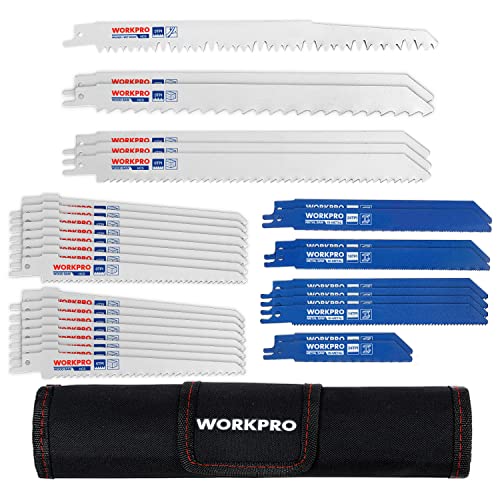
The WORKPRO 32-Piece Reciprocating Saw Blade Set is designed to be a comprehensive solution for anyone who frequently uses a reciprocating saw. Whether you are a DIY homeowner tackling weekend projects, a mechanic cutting exhaust pipes, or a contractor framing a house, this set provides the blades you need most. The combination includes wood blades with 6 and 8 TPI for general wood cutting, 3 and 6 TPI for faster ripping, plus thin and thick metal blades ranging from 14 to 24 TPI. There is also a dedicated pruner blade for wet wood and branches.
Performance-wise, the wood blades are made from chrome vanadium steel, which offers good edge retention and resistance to bending. They cut through dimensional lumber, plywood, and even thick firewood smoothly. The metal blades feature bi-metal construction, meaning they use high-speed steel teeth bonded to a flexible steel body. This design prevents tooth breakage when cutting through metal pipes, angle iron, or thin sheet metal. Based on the product specifications, these blades should handle typical workshop and construction materials without excessive wear.
Build quality is solid for the price point. The blades are heat-treated to reduce brittleness, and the coatings help resist rust. While they may not be the absolute toughest blades on the market, they offer reliable performance for most users. The inclusion of a fabric organizer pouch is a practical touch it keeps the blades separated by type and size, making it easy to grab the right one quickly. The pouch fits comfortably inside a standard toolbox or can be hung on a pegboard.
One realistic limitation is that the pouch is not a hard case, so it may not protect blades from heavy drops or crushing in a packed truck bed. Also, the set does not include specialty blades for cutting nail-embedded wood or abrasive materials. However, for general wood and metal cutting tasks around the home, garage, or job site, this kit covers the basics very well.
Overall, the WORKPRO 32-Piece Reciprocating Saw Blade Set is a practical investment for anyone who wants a versatile blade collection without breaking the bank. It suits DIYers working on home repairs, mechanics performing automotive work, woodworkers shaping lumber, and contractors tackling demolition. The combination of durable materials, thoughtful blade selection, and convenient storage makes it a smart addition to any workshop or job site toolbox.
The wood blades in this set are constructed from chrome vanadium (Cr-V) steel, known for its strength and edge-holding ability. The metal blades use bi-metal technology, which fuses high-speed steel teeth to a flexible steel body, reducing the chance of tooth breakage under stress. Heat treatment during manufacturing adds hardness and wear resistance. While the blades are not the thickest or stiffest available, they are appropriate for typical cutting tasks in wood, metal, and plastic. The pruner blade features a specially ground tooth pattern for efficient branch cutting. Overall, the build quality meets expectations for a mid-priced kit aimed at both DIY and professional users.
The set includes 32 blades in a variety of sizes and tooth configurations: 2x 4-inch thin metal blades (24 TPI), 4x 6-inch thick metal blades (14 TPI), 2x 6-inch thin metal blades (18 TPI), 2x 6-inch thin metal blades (24 TPI), 8x 6-inch wood blades (6 TPI), 8x 6-inch wood blades (8 TPI), 3x 9-inch wood blades (6 TPI), 2x 9-inch wood blades (3 TPI), and 1x 9-inch pruner blade (5 TPI). A bonus fabric organizer pouch is included, which has designated pockets for different blade sizes, making it easy to keep the set organized and portable.

Pros
- Brushless motor provides extended runtime and greater efficiency.
- Compact and lightweight design enhances maneuverability in tight spots.
- Pivoting head allows for flush cutting against surfaces.
- Keyless blade clamp makes blade changes fast and tool-free.
- Variable speed trigger gives user control over cutting speed.
Cons
- Tool only - requires purchase of DEWALT 20V MAX battery and charger separately.
- Premium price point compared to brushed models or other brands.
- No included carrying case for storage and transport.
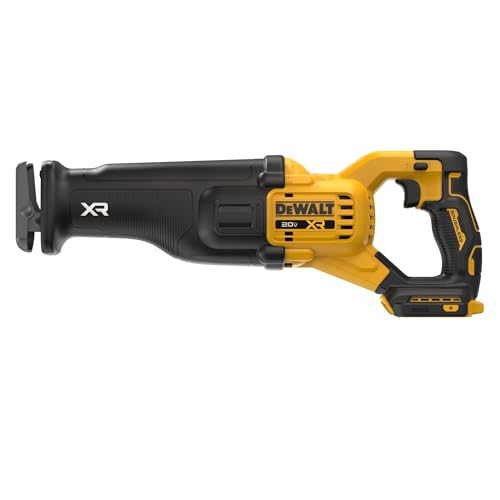
The DEWALT DCS367B is a cordless reciprocating saw designed for professionals and serious DIY enthusiasts. As part of the 20V MAX XR line, it features a brushless motor that delivers up to 2.5 times more runtime than brushed models, making it a reliable choice for extended cutting tasks on construction sites or in home repair projects.
Weighing just 5 pounds and measuring only 14.5 inches in length, this saw is exceptionally compact and lightweight. This makes it ideal for maneuvering in tight spaces like between studs, under sinks, or inside wall cavities. The pivoting head adds versatility, allowing flush cuts against surfaces without obstruction.
The variable speed trigger offers precise control from 0 to 2,900 strokes per minute, while the 1-1/8-inch stroke length provides aggressive cutting action through wood, metal, and plastic. The keyless 4-position blade clamp enables quick, tool-free blade changes, enhancing productivity on the job. An integrated LED light illuminates dark workspaces, improving visibility in crawl spaces and attics.
One consideration is that this is a tool-only purchase. Users will need a DEWALT 20V MAX battery and charger, which are sold separately. Additionally, it does not come with a carrying case, though many users may already have other DEWALT tools and batteries. The saw is backed by a 3-year limited warranty, reflecting the brand's confidence in its durability.
For contractors, electricians, plumbers, and woodworkers who need a portable, powerful saw for tight spots, the DCS367B is a strong performer. Its combination of runtime, lightness, and compactness makes it a practical addition to any tool kit or workshop. While the initial investment may be higher than some alternatives, the long-term value and performance justify the cost for those who use it regularly.
The DEWALT DCS367B is constructed with a rugged housing designed to withstand job site conditions. The brushless motor is built for longevity and efficiency, with no brushes to replace. The keyless blade clamp is made of durable steel, ensuring secure blade retention. The pivoting head mechanism is robust and allows for easy adjustment without tools.
The compact design also includes a rubber overmold on the handle for a comfortable, non-slip hold even with gloves. The LED light is well-protected and positioned to cast minimal shadow on the work area. While not waterproof, the saw is built to resist dust and debris typical of construction and workshop environments.
Pros
- Tool-less blade change speeds up blade swaps on busy project days
- Counter balance system assists in managing cutting vibration
- Sturdy metal gear housing adds solid protection against rough handling
- Pivoting foot helps maintain contact with irregular or curved materials
Cons
- Corded design requires an extension cord and continuous access to an electrical outlet
- At 7.05 pounds, sustained overhead cutting may cause arm fatigue over long sessions
- Does not include an adjustable-depth shoe mechanism in the listed specifications
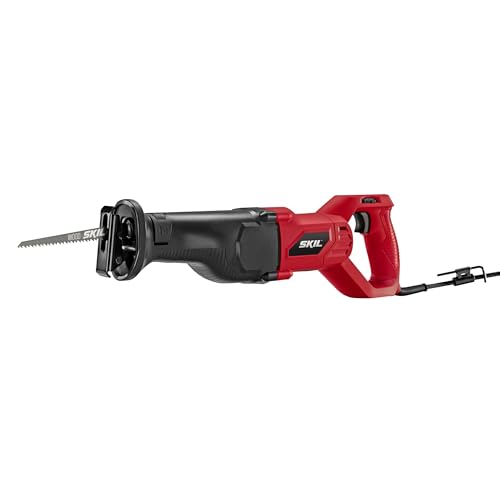
The Skil 9206-02 reciprocating saw is designed for DIY homeowners, remodelers, and property owners who need steady, uninterrupted cutting power for general demolition, framing adjustments, and rough maintenance cuts. Powered by a 7.5-amp corded electric motor, this saw eliminates the concern of drained batteries, making it a reliable option for all-day pruning, pipe trimming, and tearing down old wall assemblies.
In practical cutting scenarios, power management and control are essential. The variable-speed trigger provides immediate feedback, allowing the user to start cuts cleanly before ramping up speed through tough lumber, plastics, or metals when fitted with the appropriate blade. The pivoting foot assists by bracing securely against the workpiece, which helps stabilize the tool and prevents erratic bucking during aggressive rough cuts.
Durability and vibration dampening are central to the saw's construction. Skil built the 9206-02 with a heavy-duty metal gear housing, protecting the drive assembly from the knocks and drops common to demolition environments. Operating alongside the housing is an internal counter balance system engineered to mitigate excess vibration, helping you maintain a firmer grip and reducing physical fatigue during extended cutting sessions.
Everyday handling is straightforward thanks to the tool-less blade change system. Instead of tracking down hex keys mid-project, you can swap between wood-cutting and metal-cutting blades quickly. At roughly 18 inches in length and weighing 7.05 pounds, the tool remains reasonably maneuverable between wall studs, rafters, and tight crawl spaces, while retaining enough physical heft to let the saw's weight do the work.
As with any corded demolition tool, there are practical boundaries to keep in mind. You will need a suitable heavy-gauge extension cord to work across large yards or jobsites lacking nearby power outlets. Additionally, the tool does not feature an adjustable-depth shoe in its listed specifications, meaning blade tooth wear cannot be redistributed along the stroke length as easily as on some higher-end saws.
Overall, the Skil 9206-02 offers a solid balance of power, mechanical durability, and user comfort. For budget-conscious homeowners and weekend renovators tackling rough cuts and teardown projects, this corded reciprocating saw provides consistent utility without the ongoing investment of a proprietary cordless battery platform.
The 7.5-amp motor in the Skil 9206-02 provides consistent, line-powered performance that handles dense framing lumber, PVC, and metal conduit without motor stall under standard load. Because it draws power straight from an electrical outlet, cutting cadence remains steady from the first cut to the last.
Handling is improved by the integrated counter balance mechanism, which directly counteracts the reciprocating mass of the shaft. Combined with the pivoting shoe that stays planted against your cut line, the tool provides the stability needed for cleaner rough openings and reduced kickback tendencies during challenging demolition tasks.

Pros
- Lightweight and easy to maneuver, reducing fatigue during overhead or long cuts
- Tool-free blade change speeds up task switching
- Variable speed trigger offers good control for various materials
- Pivoting shoe improves cut stability
- Compatible with a wide range of BLACK+DECKER 20V tools
Cons
- Battery and charger are included but not the highest capacity; may need extra batteries for heavy use
- Not designed for heavy-duty professional demolition; better suited for light to medium tasks
- Some users may find the stroke length shorter than full-size corded models
The BLACK+DECKER 20V MAX Cordless Reciprocating Saw Kit (BDCR20C) is a versatile cutting tool designed for DIY homeowners, mechanics, contractors, electricians, plumbers, woodworkers, and garage or workshop users. It combines the convenience of cordless operation with essential features for everyday cutting tasks around the home, job site, or automotive garage.
Performance-wise, this saw includes a tool-free blade change system that lets you swap between wood, metal, or pruning blades in seconds, boosting workflow efficiency. The pivoting shoe helps maintain constant contact with the cutting surface, giving you better control and stability. The variable speed trigger allows you to adjust cutting speed based on the material, from slower starts for precise work to faster cuts for demolition. This makes it suitable for cutting lumber, drywall, PVC pipe, thin metal, and even tree branches.
Build quality reflects typical BLACK+DECKER standards with a durable plastic housing and rubberized grip for comfort. Weighing only 4.5 pounds, it reduces user fatigue during extended use—a huge plus for overhead cutting or tight spaces. The ergonomic handle offers a secure grip even with gloves, and the overall construction feels solid enough for regular use.
Storage and maintenance are straightforward. The kit comes with a carrying case that holds the saw, battery, charger, and blades neatly. The battery charges quickly and slots into the handle. Keeping the tool clean and the blade clamp free of debris requires minimal effort. The saw fits easily into a toolbox or onto a shelf in your workshop.
Limitations include the included battery capacity; it’s fine for small to medium jobs, but heavier users may want an extra battery to avoid downtime. It’s not built for constant heavy-duty professional demolition like a corded model, but for light to medium tasks it performs admirably. Some users may prefer a longer stroke for faster cuts, but this saw balances performance and portability well.
Overall, this kit is a practical choice for anyone needing a reliable, cordless reciprocating saw for occasional to moderate use. DIY enthusiasts, mechanics, electricians, and plumbers will appreciate its ease of use and portability. If you already own BLACK+DECKER 20V tools, this saw integrates seamlessly into your existing battery system.
Pros
- Bi-metal blades combine durability with cutting edge retention for extended use
- Wide size selection covers many common cutting tasks without needing separate sets
- Sturdy plastic case keeps blades organized and protects them during transport
- Made by DEWALT with a reputation for reliable tool accessories and long service life
Cons
- Case is plastic and may not withstand heavy drops or extreme abuse on job sites
- Some users may find tooth configurations not aggressive enough for very thick metal
- Lacks specialized blades for specific materials like stainless steel or thick hardwood
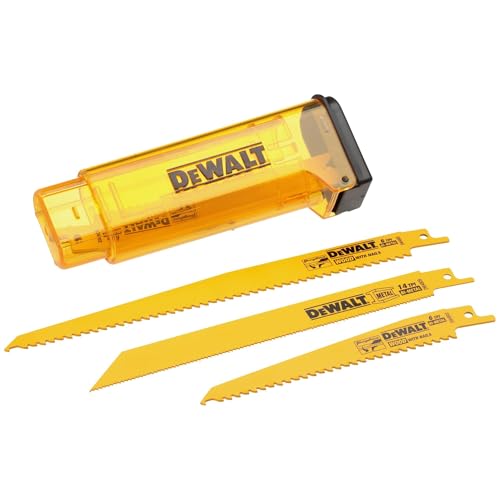
The DEWALT DW4898 is a 10-piece bi-metal reciprocating saw blade set that covers a range of common cutting jobs. It includes blades from 6 to 9 inches, making it suitable for wood, metal, and general demolition work. This combination set is designed for DIY homeowners, mechanics, contractors, electricians, plumbers, woodworkers, and construction professionals who need a versatile blade selection ready at hand.
Performance-wise, the bi-metal construction gives these blades good flexibility while maintaining a sharp cutting edge that lasts through multiple uses. According to product specifications, the heat-treated steel resists wear and breakage, so you can cut through nails, thin metal, wood, and even some pipe materials without frequent blade changes. The set is meant to improve productivity on job sites where switching between materials happens often.
Build quality is typical of DEWALT accessories: the blades feel solid, with laser etching for size and material type. The included plastic case is a strong point - it keeps blades organized and secure, and it's sized to fit inside larger tool boxes or power tool kit boxes. This makes storage and transport much easier, especially for tradespeople who keep multiple saw blades on hand.
One practical limitation is that this set is optimized for general use, not for specialized tasks. If you only cut thick steel or thick hardwood frequently, you may want a dedicated set with more aggressive teeth. The case, while convenient, is plastic and could crack under very rough handling. Also, some users might prefer a case with individual slots for each blade to prevent rattling.
For most garage users, workshop enthusiasts, and professionals, this set offers good value. It's a reliable starting point for anyone who needs a selection of blades for a reciprocating saw. The DEWALT DW4898 is a practical choice that balances versatility, durability, and organization for everyday cutting jobs.
The DEWALT DW4898 blades are made from bi-metal - a high-speed steel edge welded to a flexible back. This construction gives the blades ability to withstand bending without breaking while keeping a sharp edge for longer cuts. The teeth are precision-ground for consistent cutting performance. Each blade features a 1/2-inch universal tang that fits most reciprocating saws. The yellow coating on some blades helps reduce friction and corrosion. The included case is molded plastic with a clear top and snap closure, holding the blades in place securely. While not heavy-duty, it offers acceptable protection for everyday use.
This 10-piece set is designed to cover a variety of materials encountered in home remodeling, construction, and automotive work. With blades ranging from 6 to 9 inches, you can cut through wood, lumber with nails, PVC, drywall, thin metal, and even some light steel. The set includes blades with different tooth patterns: for wood cutting, for metal, and for demolition. For DIYers, it means one purchase for most reciprocating saw projects. For contractors, it's a convenient backup set to keep in the truck. The blades work well for plumbing cuts, electrical box openings, and tree trimming as well. Just be aware that for heavy-duty metal beam cutting or extensive hardwood ripping, you might need a more specialized blade.

Pros
- High-torque 12-amp motor handles tough cutting jobs without bogging down
- 4-position blade clamp enables flush cutting and angled cuts for better access
- Keyless blade changes are quick and easy, saving time on the job
- Variable speed trigger provides precise speed control for different materials
- Sturdy construction and proven DEWALT build quality for long-lasting use
Cons
- Corded design limits mobility compared to battery-powered models, making it less convenient for remote job sites
- At 7.96 pounds, it may feel heavy for extended one-handed use or overhead cutting
- No carrying case or storage bag included, so you'll need to buy or repurpose one for safe transport and organization
The DEWALT DWE305 is a corded reciprocating saw built for serious cutting work. With a 12-amp motor that spins up to 2,900 strokes per minute and a 1-1/8-inch stroke length, it delivers the power and speed needed to cut through lumber, nail-embedded wood, metal pipes, and even masonry when paired with the right blade. This is a tool aimed at contractors, woodworkers, mechanics, plumbers, electricians, and DIY homeowners who tackle heavy demolition, remodeling, or automotive projects on a regular basis.
In real-world use, the variable speed trigger is a standout feature. It lets you adjust the cutting speed from a slow start up to full throttle, so you can trim delicate materials without splintering or power through thick stock when needed. The 4-position blade clamp is another practical feature: you can rotate the blade to cut flush against a surface, which is especially handy when trimming pipes close to a wall or cutting studs in tight corners. The keyless, lever-action clamp makes swapping blades fast and easy, which saves time when switching between wood and metal cutting tasks.
Build quality is solid, as you'd expect from DEWALT. The motor housing is rugged, and the overall construction feels capable of handling the bumps and drops common on a job site. The grip is comfortable, though the saw weighs nearly eight pounds, so prolonged overhead work may cause fatigue. There's also no built-in LED light or dust blower, but these omissions are typical for a saw in this price range. The cord is a standard 8-foot length, which is adequate for most workshops but may require an extension cord on larger job sites.
Storage and maintenance are straightforward. Without a case, you'll need to store the saw in a toolbox or on a shelf. The keyless clamp reduces the need for tools during blade changes, and the saw's simple design means routine cleaning and occasional brush replacement are the only maintenance tasks. The corded nature means you're always tethered to an outlet, which can be limiting on remote job sites, but it also means you never have to worry about battery charge or runtime.
Overall, the DEWALT DWE305 is a capable and reliable reciprocating saw for users who prioritize power and consistency over portability. It's a strong choice for contractors remodeling homes, mechanics cutting exhaust pipes or brackets, woodworkers trimming timbers, and DIY enthusiasts taking on major home repairs. If you need a saw that can handle daily abuse and deliver clean cuts, this model is worth serious consideration.
The DEWALT DWE305 is built with a robust motor and a durable housing that can withstand the rigors of daily job site use. The keyless blade clamp is made from hardened steel, and the gear case is designed to resist impact. While not as lightweight as some cordless options, the saw feels solid and well-balanced. The cord is thick and strain-relieved at the base to prevent breakage. Overall, this saw should hold up well under heavy cutting loads and repeated drops, making it a dependable tool for contractors and tradespeople.
In a workshop or on a jobsite, the DWE305 excels at fast, aggressive cutting. The 12-amp motor provides ample torque for cutting through thick lumber, pallets, and even metal studs. The variable speed trigger lets you feather the speed for precise cuts, while the 4-position blade clamp allows flush cuts along floors, walls, or ceilings. The 1-1/8-inch stroke length helps move through material quickly, reducing fatigue on long cuts. This saw is ideal for demolition projects, framing, plumbing rough-ins, and electrical work where speed and power matter most.
The DWE305 features a comfortable over-mold grip that reduces vibration, though the saw's weight (7.96 pounds) can become tiring during extended one-handed use. The variable speed trigger requires minimal pressure to operate, and the keyless blade clamp makes swapping blades a quick, one-handed task. The 4-position blade clamp is easy to rotate, and the saw's balanced design helps with control. While it lacks a soft-start feature, the trigger response is smooth and predictable. For most users, the ergonomics are good, but those with smaller hands or less upper body strength may find it a bit heavy for prolonged overhead cuts.
Understanding Cutting Depth, Material Thickness, and Stroke Dynamics
The maximum cutting depth of a reciprocating saw is primarily governed by the usable length of the installed blade rather than an internal tool housing limit. While circular saws are physically restricted by their arbor flange and blade guard radius, a reciprocating saw pushes a linear blade forward and backward through an open shoe. This open design allows long accessory blades to reach through thick assemblies, provided the blade body remains rigid enough to resist excessive flexing. Determining how thick and deep can a reciprocating saw cut in practical situations requires calculating the difference between overall blade length, stroke travel, and the contact point of the pivoting shoe.
Calculating True Usable Cutting Depth
Total blade length never equals the maximum depth of cut you can achieve in a solid workpiece. When you insert a six-inch or nine-inch blade into a tool chuck, approximately one inch of the tang remains locked inside the blade clamp mechanism. In addition, the tool stroke length pulls the blade back toward the shoe on every cycle, reducing usable forward clearance. A reciprocating saw with a 1-1/8-inch stroke length, like the corded DEWALT DWE305 or cordless DEWALT DCS367B, pulls the blade back significantly during each reciprocation cycle.
To prevent the tip of the blade from slamming into the interior of the material on the backstroke, the blade must extend past the workpiece thickness by at least the full stroke length plus an additional safety margin. If a blade pulls completely inside a hollow pipe or thick timber during its retraction stroke, the forward stroke will impact the material edge violently, buckling the steel immediately. For a tool with a 1-1/8-inch stroke, you must subtract roughly two to two-and-a-half inches from the total blade length to calculate safe, continuous penetration depth. A standard six-inch blade reliably delivers about three to four inches of actual cutting depth, while a nine-inch blade provides roughly six to seven inches of usable capacity.
Extra-long twelve-inch blades extend practical reach up to nine or ten inches in soft materials like pruning limbs or framed wall openings. However, cutting at these deeper limits requires disciplined feed pressure to avoid dangerous whipping at the unsupported tip. Keeping the pivoting shoe firmly planted against the outer surface of the workpiece ensures the blade travels smoothly along its intended cutline without transferring severe vibration back into the operator’s hands.
Material Thickness Limits Across Wood, Metal, and Plastics
Material density sets strict operational boundaries on how thick a cross section you can cut before friction and thermal buildup stall the tool. When cutting softwood framing, landscape timbers, or tree limbs, published specifications for tools like the VTEK Brushless Cordless Reciprocating Saw list maximum cutting capacities up to 255 millimeters, which equals approximately ten inches. Coarse-tooth wood blades, such as the three to six teeth-per-inch options found in the WORKPRO 32-Piece Reciprocating Saw Blade Set, clear large wood chips rapidly, allowing deep cuts through dense lumber without clogging the tooth gullets.
Plastics and synthetic piping behave differently due to the risk of melting under frictional heat. The VTEK specifications cite a 130-millimeter plastic pipe limit, roughly five inches in diameter, which accommodates standard residential drainage and waste lines. Choosing dedicated saw blades for cutting PVC pipe prevents chipping brittle walls and reduces melted plastic buildup around the blade teeth. When cutting thick thermoplastic pipes, medium tooth counts between eight and fourteen teeth per inch produce clean edge geometry without binding.
Ferrous and non-ferrous metals impose the narrowest thickness limits due to cutting resistance and rapid heat accumulation. Standard bi-metal metal-cutting blades, like those included in the DEWALT DW4898 combination set, handle sheet metal and steel tubing ranging from 0.7 millimeters up to eight millimeters in wall thickness. Trying to cut solid steel billets thicker than one-half inch with a standard reciprocating saw generates severe thermal stress, dulls bi-metal teeth rapidly, and strains the motor. For tubing and structural profiles, the total diameter can span four to five inches, but the individual wall thickness must remain within the blade manufacturer’s recommended gauge range.
Stroke Length and Motor Power in Deep Cutting Operations
Stroke length directly dictates how many teeth pass through the cutting channel on every cycle and how quickly waste material is ejected. Compact cordless models often feature shorter stroke lengths, such as the 22-millimeter travel on the VTEK saw, which delivers greater control in tight quarters but clears waste more slowly in thick timber. Full-sized tools like the DEWALT DWE305 and DEWALT DCS367B utilize a longer 1-1/8-inch stroke length that pulls wood fibers and metal swarf out of deep channels with each stroke. This aggressive travel reduces friction against the blade body, keeping operating temperatures lower during sustained heavy cuts.
Motor power determines whether a tool can maintain its reciprocating speed when a long blade encounters friction along its entire cutting edge. The Skil 9206-02 features a 7.5-amp motor and heavy-duty metal gear housing designed to resist gear deflection under heavy mechanical resistance. Higher-output corded tools, such as the 12-amp DEWALT DWE305, provide continuous electrical draw that prevents bogging down when slicing through embedded nails, framing lumber, and structural metal studs. Cordless brushless motors offer strong electronic speed management, delivering high torque across variable speed ranges up to 2,900 or 3,000 strokes per minute.
Battery capacity and voltage platforms also influence deep cutting performance on cordless models like the BLACK+DECKER BDCR20C and DEWALT DCS367B. Extended cuts through six-inch timbers draw heavy current, which can quickly deplete low-capacity battery packs and cause thermal safety cutoffs. For heavy framing, deep pruning, or thick metal cutting, selecting high-output lithium-ion batteries ensures steady stroke delivery and prevents mid-cut stalls.
Controlling Blade Deflection and Wandering in Deep Cuts
One of the primary challenges when cutting thick workpieces is blade deflection, where the tip of a long blade curves away from the perpendicular cutline. Because reciprocating saw blades are secured only at the chuck end, lateral pressure causes thin blades to flex inside the cut channel. This wandering creates beveled or uneven cut faces on thick posts and can cause the back of the blade to pinch tightly inside the kerf. Once pinching occurs, the motor bogs down immediately and the reciprocating action violently shakes the workpiece.
Thicker demolition blades with a taller profile provide greater beam strength, significantly reducing lateral flex during deep passes. Standard flexible bi-metal blades work well for flush cutting against studs, but rigid heavy-duty blades are essential when maintaining a straight cut across a four-by-four timber or heavy pipe. Matching blade thickness to the cutting application prevents wandering and protects both the blade clamp and the drive mechanism from unnecessary torsional stress.
Applying moderate, steady forward pressure without forcing the tool preserves blade straightness in deep sections. When operators lean excessively on the saw, the blade bows backward, reducing cutting efficiency and causing the teeth to rub rather than shear the material. Letting the tool stroke speed and sharp tooth geometry do the cutting work ensures straight results and extends overall blade longevity.
Pivoting Shoes and Multi-Position Blade Clamps
The shoe assembly at the front of a reciprocating saw serves as the primary leverage point and depth reference against the material. Tools equipped with a pivoting foot, such as the Skil 9206-02 and BLACK+DECKER BDCR20C, automatically conform to curved or angled surfaces, keeping the saw anchored securely. Firm shoe contact prevents the saw body from violently reciprocating against the workpiece, transferring maximum cutting energy directly into the blade teeth. If the shoe lifts away from the surface during a cut, energy is wasted shaking the tool housing, which rapidly tires the operator and increases kickback hazard.
Adjusting the shoe position forward or backward also allows operators to expose unused teeth along the blade body. Because standard crosscuts often wear out only a two-inch section near the shoe, shifting the contact point engages fresh cutting edges, effectively doubling blade life before replacement. This adjustment also provides a mechanical method for limiting cutting depth when you need to avoid severing hidden wiring or plumbing located directly behind a wall plate or subfloor assembly.
Multi-position blade clamps expand physical access and cutting orientation without requiring awkward body positions. The DEWALT DCS367B and DWE305 incorporate a 4-position blade clamp that allows blades to be inserted facing up, down, left, or right. Positioning the blade teeth sideways enables true flush cutting against floor plates and ceiling joists, allowing you to slice through thick framing members flush to the surrounding drywall or subfloor structure without bending the blade tang.
Selecting Blade Length, Tooth Pitch, and Material Composition
Selecting the right blade configuration is just as important as choosing the saw itself when cutting deep or thick materials. Reciprocating saw blades generally range from four inches to twelve inches in length, with specific tooth geometries tailored to distinct material densities. For pruning thick outdoor branches or cutting unseasoned firewood up to seven inches thick, five-tooth-per-inch or three-tooth-per-inch pruner blades feature wide, ground teeth that resist sappy buildup. The WORKPRO set provides dedicated nine-inch pruner blades specifically ground for green wood and coarse branches up to 180 millimeters in diameter.
For clean metal cutting, tooth pitch must ensure that at least three consecutive teeth remain in contact with the material wall at all times. Cutting thin-walled electrical conduit or steel profiles with coarse wood blades strips the teeth off instantly due to severe impact. Conversely, high tooth counts between 18 and 24 teeth per inch cut smoothly through thin sheet metal and structural tubing up to 1/8-inch thickness. When cutting softer non-ferrous metals like copper or structural alloys, specialized metal-cutting saw blades for aluminum prevent galling and chips from welding to the blade body.
Bi-metal construction combines a flexible spring steel backing with a high-speed steel cutting edge, providing the resilience required for heavy demolition work. Sets like the DEWALT DW4898 utilize bi-metal chemistry to resist tooth breakage when encountering hidden nails embedded within thick wall framing. For high-abrasion tasks such as cutting through cast iron, cement board, or dense masonry, standard steel teeth wear flat in seconds, requiring carbide-tipped or diamond-grit blades to penetrate deep cross sections without catastrophic tooth failure.
Safe Operation in Deep Penetration and Blind Demolition Cuts
Executing deep cuts inside closed wall cavities, ceiling voids, or floor joist spaces presents significant safety and mechanical hazards. Before making deep plunge cuts into covered cavities, always inspect the area and disconnect power supplies or shut off water valves whenever possible. Because a long nine-inch or twelve-inch blade penetrates deep into unseen framing bays, blind cutting risks severing live electrical wiring, gas supply lines, or structural fasteners. Setting your shoe depth carefully limits blade penetration, ensuring you only cut through the target surface layer without piercing critical infrastructure behind it.
Plunge cutting requires steady grip control, correct blade orientation, and proper tool speed. To start a plunge cut in thick wood sheathing, rest the leading edge of the saw shoe firmly against the surface with the blade elevated clear of the wood. Start the motor at maximum speed, then slowly pivot the saw down on the shoe edge until the teeth bite smoothly into the grain. Never jam a stationary blade into the material before pulling the trigger, as the sudden tooth engagement will throw the tool backward violently.
Proper personal protective equipment is essential whenever cutting thick lumber, structural tubing, or masonry profiles. High-speed reciprocating action ejects hot metal shavings, fine sawdust, and synthetic particles directly toward the user. Wear impact-resistant safety glasses, heavy-duty work gloves, and appropriate respiratory protection to guard against airborne dust. Keeping both hands firmly on the tool’s ergonomic grip and forward barrel collar maintains full cutting authority and prevents loss of control if the blade encounters a hidden steel obstacle.
Verifying blade condition and clamp security before each deep cut ensures consistent cutting progress and protects internal drive gears. Always remove the battery pack or disconnect the cord before swapping blades or inspecting the pivoting shoe mechanism. By selecting the appropriate blade length for your calculated material depth, matching tooth pitch to material density, and keeping the shoe firmly anchored, you can maximize your reciprocating saw’s cutting capacity safely across every demanding jobsite application.


Write Your Review
No reviews yet. Be the first to share your experience!