


Cutting precise, straight edges is a common challenge for woodworkers because handheld reciprocating tools tend to follow wood grain rather than a rigid path. Learning how cut straight line jigsaw cuts accurately requires understanding tool mechanics, blade dynamics, and rigid workholding. While jigsaws excel at tight curves, loose blade guides and thin metal blades often wander when forced across long, unbroken lines. Setting up a dedicated clamping fence or selecting a thicker, ground-tooth blade provides immediate improvement for everyday sheet goods and framing lumber. If you also work with tough non-ferrous stock, reviewing our blade for cutting aluminum provides helpful context on matching tooth geometry to challenging materials.
Even with excellent technique, a handheld saw reaches practical accuracy limits on thick hardwoods or furniture components that require true joinery edges. Achieving repeatable, splinter-free cuts often means combining clean handheld layout techniques with dedicated shop fixtures. When portable guides cannot deliver a perfectly square, glue-ready line, woodworkers frequently transition their material to stationary cutting setups designed specifically for straight ripping. Comparing different guide setups helps you determine when a clamped fence on your jigsaw is sufficient and when a dedicated shop jig produces superior results.

Pros
- Solid MDF construction with melamine coating offers good durability and a slick surface for smooth feeding
- Adjustable fence and clamps provide secure workpiece hold-down, improving cut accuracy and safety
- Versatile enough for both taper cuts and straight-line ripping, making it a valuable shop accessory
- Clear indexing marks and included tape measure simplify angle setup and repeatability
Cons
- May not fit all job site or benchtop saws due to specific miter slot dimensions; check compatibility before purchase
- Assembly required out of the box, which may take some time for first-time users
- MDF base, while sturdy, may not be as impact-resistant as aluminum or steel alternatives
The POWERTEC 71395 Taper/Straight Line Jig is a practical addition to any woodworking shop, designed to help you make precise, repeatable cuts on your table saw. This jig serves two primary functions: cutting tapered angles for furniture legs, chair parts, and custom shelving, and acting as a stable straight-line ripping jig for long boards. It's a versatile tool that can expand the capabilities of your saw without breaking the bank.
This jig is best suited for woodworkers, DIY homeowners, and contractors who regularly work on projects like building tables, cabinets, or custom furniture. It's also useful for garage users and workshop enthusiasts who want to improve the accuracy of their table saw cuts. The jig is designed to fit full-sized table saws with standard 3/4-inch by 3/8-inch miter slots, so it's important to check your saw's specifications before purchasing, especially if you have a job site or benchtop model.
In terms of performance, the POWERTEC 71395 delivers reliable results. The MDF base with melamine coating provides a smooth, low-friction surface that helps workpieces glide easily. The adjustable fence and hold-down clamps keep your stock securely in place, reducing the risk of kickback and improving cut accuracy. The indexing marks and included tape measure make it easy to set up repeatable angles, which is a big time-saver when you need to make multiple identical cuts. Users report that the jig holds its settings well during use, contributing to consistent results.
Build quality is solid for the price point. The MDF base is thick and rigid, and the melamine coating adds a layer of protection against moisture and wear. The hardware, including T-bolts and screws, feels durable enough for regular shop use. The push knob has an anti-slip grip, which is a nice touch for comfort and control. Assembly is straightforward, though you'll need to follow the included instructions carefully to ensure everything is aligned properly. Once set up, the jig is easy to use and adjust.
Storage is simple since the jig can be hung on a wall or stored flat on a shelf. It doesn't take up much space, which is a plus for smaller workshops. Maintenance is minimal - just keep the melamine surface clean and occasionally check that all hardware is tight. One realistic limitation is that the jig may not fit all saws, so double-check your miter slot dimensions. Also, the MDF base, while sturdy, won't be as impact-resistant as metal alternatives, so it's best to avoid dropping it.
Overall, the POWERTEC 71395 is a well-designed jig that offers good value for woodworkers and DIYers who need precise taper cuts and straight-line ripping capabilities. It's not a replacement for a dedicated jointer, but it's a handy accessory that can improve your table saw's versatility. If you have a compatible saw and regularly work on projects that require angled cuts or straight ripping, this jig is worth considering.
The POWERTEC 71395 jig is built with a 1/2-inch thick MDF base that is coated on both sides with melamine. This construction provides a rigid, flat surface that resists warping and offers a slick, low-friction glide for workpieces. The melamine coating also helps protect against moisture and shop debris. The adjustable fence is made from aluminum, which is lightweight yet sturdy, and the hold-down clamps are metal with plastic knobs for easy tightening. The included miter bar is machined to fit standard 3/4-inch by 3/8-inch slots and slides smoothly. Overall, the build quality is good for the price, though the MDF base is not as durable as all-metal alternatives.
In the workshop, the POWERTEC 71395 jig performs well for both taper cuts and straight-line ripping. The adjustable fence allows for precise angle settings, and the indexing marks make it easy to set up repeatable cuts. The hold-down clamps keep workpieces secure, reducing vibration and improving cut quality. The abrasive grip strips on the base help stabilize the stock, preventing slipping during the cut. Users have noted that the jig works best with full-sized cabinet saws and contractor saws that have standard miter slots. It may require some fine-tuning to get perfect alignment, but once set, it delivers consistent results.
This taper jig is designed to fit table saws with miter slots measuring 3/4-inch wide by 3/8-inch deep. It is compatible with many full-sized saws, including the Dewalt DWE7491RS. However, it may not fit all job site or benchtop saws due to variations in miter slot dimensions. Before purchasing, measure your saw's miter slot to ensure it matches the required size. The jig is intended for use on the right side of the blade, with the inside edge of the right miter slot needing to be between 3-3/4 inches and 6-7/8 inches from the blade, depending on the specific model.
Pros
- Accurate and repeatable tapered cuts with simple angle indexing
- Dual functionality saves space and money by combining taper and straight-line jig
- Heavy-duty clamps hold workpieces firmly for safety and precision
- Smooth, ergonomic handle reduces fatigue during extended use
- Fits most standard table saw miter slots with included 36" miter bar
Cons
- Setup requires initial cut to create zero-clearance support, which may be intimidating for beginners
- Jig is relatively large (over 31 inches long) and may require dedicated storage space
- Compatibility limited to table saws with specific miter slot distances from the blade (3-3/4" to 4-3/8" or 5" to 5-5/8")
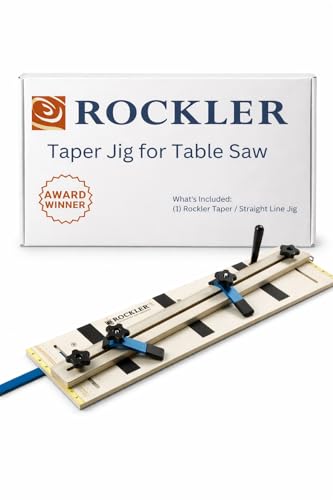
The Rockler Taper Jig/Straight Line Jig is a well-designed table saw accessory that brings precision and versatility to your workshop. This jig allows you to make tapered cuts quickly and accurately for projects like chair legs, table legs, and other furniture components. When you remove the miter bar, it also functions as a stable straight-line ripping jig, making it a two-in-one tool that saves both money and workspace.
This jig is best suited for woodworkers, DIY homeowners, and contractors who frequently work on custom furniture, home renovations, or woodworking projects. It is particularly useful for anyone who needs to create consistent tapers on multiple pieces, such as for chair or table legs. The heavy-duty hold-down clamps and indexed angle settings ensure that each cut is repeatable and precise, reducing waste and improving productivity.
In terms of performance, the Rockler jig delivers smooth, accurate cuts thanks to its ergonomic handle and smooth sliding action. The indexed angle system allows you to set the taper angle quickly without guesswork, and the clamps hold your workpiece securely throughout the cut. The jig also features a zero-clearance support base that minimizes tear-out, giving you cleaner edges on finished wood. This level of precision is essential for professional-looking results in furniture making and cabinetry.
Build quality is solid, with a sturdy construction that feels durable enough for regular use in a busy workshop. The miter bar fits snugly in standard 3/8" x 3/4" slots, and the included 36" bar provides stability during cuts. The ergonomic handle is comfortable to grip, reducing hand fatigue during repetitive operations. While the jig is not made of metal, its composite base is designed to withstand the rigors of table saw use and can be trimmed to create a zero-clearance fit.
Setup is straightforward, though it does require an initial cut to create the zero-clearance support on your specific saw. This step may be a bit intimidating for beginners, but the included guidance booklet walks you through the process. Once set up, the jig is easy to use and adjust. Storage is a consideration due to its length (over 31 inches), but it can be hung on a wall or stored in a dedicated drawer or shelf.
One realistic limitation is compatibility: the jig works best on table saws where the left edge of the right miter slot is 3-3/4" to 4-3/8" or 5" to 5-5/8" from the blade. If your saw falls outside these ranges, you may need to modify the jig or look for an alternative. Additionally, the price point is higher than some basic taper jigs, but the dual functionality and build quality justify the investment for serious woodworkers. Overall, the Rockler Taper Jig/Straight Line Jig is a practical addition to any workshop focused on precision woodworking and furniture making.
Mastering Straight Cuts with Handheld and Workshop Tools
Achieving a true straight cut with a jigsaw requires eliminating mechanical deflection and guiding the tool base along an immovable reference edge. Unlike circular saws with wide, rigid steel bodies, jigsaws operate with a narrow blade held only at the top chuck. Any lateral force exerted by dense wood fibers or unsteady hand pressure pushes the bottom of the blade sideways. This physical reality explains why freehand cuts almost always drift off the cutline. By addressing blade rigidity, shoe alignment, and guide setups, you can produce remarkably straight lines for jobsite framing, cutouts, and utility woodwork.
Why Jigsaws Naturally Wander on Straight Cuts
Blade deflection represents the single largest obstacle to achieving a straight line with any handheld jigsaw. Because the blade is supported solely at the reciprocating drive shaft, the tip is free to bend under lateral cutting resistance. When the teeth encounter alternating earlywood and latewood rings, the blade naturally deflects toward the path of least resistance. This deflection creates a beveled edge underneath the workpiece even when the top cutline appears perfectly straight.
Guide roller wear also contributes significantly to unwanted blade wandering during long cuts. Most modern jigsaws feature a grooved roller guide positioned directly behind the blade to provide back support. If the roller accumulates resin or develops play, the blade slips side to side inside the support assembly. Inspecting the guide mechanism before making critical cuts ensures the roller remains aligned with the drive axis.
Excessive forward pushing force exacerbates both blade flexing and roller slippage. When an operator pushes the tool harder than the teeth can clear sawdust, the blade bows backward and twists sideways. This twisting motion pulls the tool body off your marked reference line. Letting the motor speed and sharp teeth do the cutting work keeps the blade vertical throughout the entire pass.
Choosing the Right Blade to Minimize Blade Deflection
Selecting a thick, wide blade is the most effective way to eliminate blade wandering before cutting begins. Thin scrolling blades bend effortlessly to navigate tight curves, but that same flexibility ruins straight cuts. Premium straight-cutting jigsaw blades feature greater blade depth from the teeth to the back spine, providing substantial beam strength. Using a blade specifically engineered for straight cuts prevents the lower portion from bending away from the line of cut.
Tooth pitch and tooth geometry also dictate how smoothly the saw tracks through different wood densities. Fine-toothed blades with high tooth counts produce clean top surfaces but generate high friction in thick lumber. Coarser blades with milled, side-set teeth clear chips rapidly, keeping heat and cutting pressure low. For materials requiring specialized cutting action, reviewing our guide on specialized saw blade selection guide shows how tooth spacing influences cut stability.
T-shank versus U-shank blade connection systems also affect overall rigidity in modern jigsaws. T-shank designs are now the industry standard because tool-free chucks clamp the blade securely without set screws. A loose blade clamp introduces immediate play at the drive mechanism, causing the blade to track crookedly. Always verify that your blade sits fully seated in the chuck before locking the retention lever.
Setting the Correct Orbital Action and Cutting Speed
Orbital action swings the blade forward on the upstroke and pulls it back on the downstroke to accelerate cutting speed. While aggressive orbital action clears sawdust rapidly in rough construction lumber, it increases blade deflection and causes splintering. For straight cuts that require edge accuracy, set the orbital action selector to zero or setting one. Disengaging the orbital pendulum keeps the blade moving in a strictly vertical line, yielding significantly straighter results.
Motor speed selection must match the density of the workpiece being processed. Cutting dense hardwoods or layered composite sheet goods at maximum speed can overheat the blade, softening the steel teeth and inviting deflection. Dialing the variable speed control down allows the teeth to bite cleanly into tough fibers without generating excessive friction. A moderate, steady cutting speed maintains consistent control against your straightedge guide.
Dust blower and vacuum collection systems keep your cutline visible and prevent debris from wedging between the tool shoe and the fence. Many professional jigsaws feature an integrated chip blower that directs air from the cooling fan across the blade path. If sawdust packs tightly against your straightedge, the saw base can lift or steer away from the guide. Connecting a vacuum hose eliminates dust buildup and ensures the saw base remains flush against your reference rail.
Setting Up a Clamped Straightedge or Track Guide
Using a rigid straightedge clamped securely to the workpiece eliminates human steering error. Aluminum extrusion levels, factory-made edge clamps, or straight strips of hardwood plywood make dependable guide fences. Measure the exact offset distance from the side edge of your jigsaw base plate to the blade teeth before setting your clamps. Clamp both ends of the guide fence tightly so vibration from the saw motor does not shift the alignment mid-cut.
Checking the squareness of the saw shoe relative to the blade is a critical preparatory step. Some jigsaw base plates pivot for bevel cuts, but their factory detents can loosen over time. Use a small engineering square to confirm the base rests at exactly ninety degrees to the blade face. Tighten the shoe bevel locking bolt firmly to prevent unintentional tilting under lateral pressure.
Keep light inward pressure against the guide fence throughout the entire pass. If you press too hard against the straightedge, the stamped metal shoe can bind or tilt slightly, canting the blade into the cutline. Hold the saw body firmly with both hands, maintaining smooth forward motion while keeping the base edge kissing the fence. Steady contact ensures an even line without introducing mechanical binding.
Proper Feed Rate, Body Mechanics, and Workpiece Support
Consistent feed rate allows the blade teeth to cut cleanly without bogging down the reciprocating motor. Forcing the saw forward too quickly bends the blade backward, causing wavy cuts and ragged tear-out on the bottom face. Conversely, moving too slowly burns the wood fibers and dulls the cutting edges prematurely. Listen to the sound of the motor to find a balanced feed rate where the saw advances steadily without slowing down.
Body positioning plays a major role in guiding the tool across long boards or large sheet materials. Stand with your feet spread shoulder-width apart so you can walk along the cut without changing your arm angle. Shifting your grip or reaching excessively at the end of a pass often causes the saw shoe to pull away from the straightedge. Planning your walking path before pulling the trigger keeps your cutting momentum smooth from start to finish.
Supporting the cut off piece prevents the wood from pinching the blade as you complete the line. When cutting panels, place rigid foam insulation underneath the workpiece to support both sides of the kerf fully. For rough remodeling work, contrasting portable cutting tools with reciprocating saw blades for rough demolition highlights how support requirements vary between fine straight cutting and rapid tear-out jobs. Solid underneath support prevents sudden board drops that snap jigsaw blades or tear final wood fibers.
When a Jigsaw Guide Reaches Its Practical Limits
Despite careful blade selection and straightedge setups, jigsaws possess inherent structural limits for fine joinery. The thin reciprocating blade lacks the rotational momentum and lateral stiffness found in circular saws or stationary equipment. In materials thicker than one inch, slight blade drift is virtually unavoidable due to the natural flexibility of the steel shaft. For rough openings, sink cutouts, and curved scribe work, a guided jigsaw is ideal, but it cannot replace a true jointing cut.
Cutting long, furniture-grade rip cuts in solid hardwood boards demands a different tooling approach altogether. While utility cuts can be cleaned up later with a hand plane or flush-trim router bit, doing so across dozens of linear feet is inefficient. When your project demands dead-straight, glue-ready edges on rough or tapered lumber, stationary saw jigs provide the stability that handheld reciprocating tools cannot deliver. Recognizing these tool boundaries saves considerable time and prevents costly material waste.
Heavy framing and flooring projects also present situations where specialized saws outperform guided jigsaws. If you are comparing heavy cutting setups, our practical guide to dedicated saws for cutting subfloor explains how circular cutting blades provide the necessary rigidity for thick sheet materials. Matching the cutting tool to the specific demands of the project ensures cleaner edges and safer operation.
Transitioning to Workshop Straight-Line and Taper Jigs
When woodworking projects require perfectly straight ripping on rough-sawn lumber or live-edge boards, stationary table saw jigs excel. A straight-line ripping jig secures the uneven stock firmly on an MDF base platform, referencing a precision miter bar rather than an irregular board edge. This setup allows the saw blade to cut a true, straight reference line on a board that lacks a flat edge to run against the standard table saw fence. Once that initial straight line is established, the board can be flipped and ripped parallel against the rip fence.
The POWERTEC 71395 Taper/Straight Line Jig for Table provides a versatile solution for workshops handling varied angular and straight-line cutting tasks. It features a thirty-six-inch miter bar engineered to ride smoothly inside standard three-quarter-inch by three-eighths-inch miter slots. The heavy-duty MDF base measures thirty-two inches long by seven and seven-eighths inches wide with durable melamine coating on both faces. Equipped with an ergonomic anti-slip push knob, adjustable fence, and sturdy hold-down clamps, it holds stock firmly to prevent dangerous shifting during feed operations.
Another well-regarded option for workshop straight-line ripping and angle cutting is the Rockler Taper Jig/Straight Line Jig. This accessory includes a thirty-six-inch miter bar that fits standard miter slots and features an indexed angle setting system with a large push handle. With the miter bar removed, the Rockler jig doubles as a stable, straight-line ripping platform for irregular timber and chair leg tapers. On many saws, making the initial cut trims a narrow strip from the jig base to create a zero-clearance edge that minimizes tear-out.
Comparing Dedicated Straight-Line Ripping Solutions
Evaluating the mechanical specifications of stationary straight-line ripping jigs reveals practical differences in workshop compatibility. The POWERTEC unit lists compatibility with table saws featuring an inside miter slot edge distance of three and three-quarters to four and three-eighths inches, five to five and five-eighths inches, or six and one-quarter to six and seven-eighths inches from the blade. It is noted as compatible with popular saws such as the DWE7491RS, though compact benchtop models may require measurement checks. Its included abrasive grip strips provide additional workpiece traction alongside the mechanical clamps.
The Rockler fixture focuses heavily on indexed angle adjustments for tapered furniture parts while maintaining straight-line ripping capability. It requires a miter slot left edge distance of three and three-quarters to four and three-eighths inches or five to five and five-eighths inches from the blade. Both jigs feature thirty-six-inch miter bars, allowing substantial stroke length through the blade for standard board dimensions. Selecting between them depends largely on your table saw top dimensions and specific clamping layout preferences.
Compared to handheld jigsaw setups, these stationary jigs remove human wander entirely by locking the cut path to the table saw miter slot. The workpiece is clamped solidly to a rigid carrier board rather than relying on hand pressure against a thin aluminum fence. While a handheld jigsaw remains essential for portable jobsite tasks and curved cutouts, dedicated ripping jigs provide unmatched accuracy for furniture parts and cabinet framing.
Safe Workholding and Feed Procedures for Board Ripping
Operating any straight-line cutting jig demands strict attention to workholding integrity and personal safety. Before starting your saw, verify that all toggle clamps or hold-down brackets exert firm downward pressure on the stock. If a board vibrates loose mid-cut, it can chatter against the blade or cause dangerous kickback. Test the clamp grip by attempting to wiggle the board by hand with the saw completely turned off.
Ensure the miter bar slides smoothly through the table saw miter slot without binding or excessive lateral play. If the bar fits too tightly, friction will interrupt your forward feeding motion and create burn marks on the wood. Clean the miter slot thoroughly of packed sawdust and lubricate the steel or aluminum bar with dry silicone or paste wax. A smooth, uninterrupted gliding motion yields the cleanest cut surfaces.
Always maintain control using the designated ergonomic handles rather than placing hands near the cutting line. Keep blade guards, riving knives, and personal protective equipment in place throughout every cutting operation. Disconnect power before mounting, adjusting, or cleaning the jig assembly on your saw table. Establishing disciplined safety habits ensures your workshop remains both productive and safe.
Final Practical Checklist for Consistent Straight Cuts
Producing reliable straight cuts comes down to selecting the correct tool setup for the precision your project requires. For on-site sheet trimming and rough openings, equip your jigsaw with a thick, straight-cutting blade, disengage the orbital pendulum, and clamp a rigid straightedge securely across the cut path. Maintain steady, gentle forward feed pressure and let the sharp teeth clear the kerf without forcing the tool body. When furniture building and cabinet joinery call for dead-square reference edges on rough lumber, transitioning your stock to a dedicated table saw straight-line jig delivers the stability and accuracy needed for clean, repeatable craftsmanship.




Write Your Review
No reviews yet. Be the first to share your experience!