


Installing a circular saw disc correctly is one of the most critical steps for clean cutting results and operator safety. When working with hand-held power saws, many beginners and DIYers wonder exactly which way circular saw blade go during a changeout. Handheld circular saws cut on the upward stroke, meaning the cutting teeth at the bottom of the blade must always point upward toward the front of the tool. If you often cut composite plumbing lines or building panels, reviewing a saw blade for cutting PVC pipe can help you see how tooth direction and blade style influence edge quality.
Mounting the disc backward can create severe friction, heat discoloration, severe kickback risk, and ruined workpieces. Looking closely at the printed directional arrows stamped directly on the saw guard and the blade face provides immediate clarity. Choosing the right disc, whether a 24-tooth framing option or a 60-tooth fine finish blade from brands like DEWALT, WORKPRO, or FOXBC, ensures efficient performance across various timber and board applications. Taking a few seconds to inspect the arbor, flange, and rotation path before securing the retaining bolt will keep your tool running properly.

Pros
- High 60-tooth count helps minimize splintering and tear-out on plywood and finish materials
- Standard 5/8-inch arbor fits common 7-1/4-inch circular saw models without adapters
- Tungsten carbide tips provide better wear resistance than standard steel blades
- Precision-ground ATB teeth lower feed resistance across diverse wood composites
Cons
- Not optimized for fast rip cuts along thick dimensional lumber compared to low-tooth framing blades
- Cutting wood with embedded nails can dull or damage carbide teeth faster than cutting clean lumber
- Lacks dampening expansion slots or anti-friction surface coatings found on premium-tier blades
The OSTTE 7-1/4-inch 60-tooth circular saw blade is designed for woodworkers, DIY remodelers, and homeowners who need cleaner cuts than standard coarse framing blades can deliver. Built with a 5/8-inch arbor and a high tooth count, this blade targets tasks where clean edges matter, such as breaking down plywood panels, sizing MDF, and crosscutting dimensional lumber for interior trim and shop projects.
Material versatility is a core strength of this blade. The manufacturer notes that it is suitable for softwoods, hardwoods, plywood, laminate, particleboard, and MDF. It is also rated to cut wood with nails, making it useful for light demolition or renovation where hidden fasteners might be encountered. The alternating top bevel (ATB) tooth grind alternates left and right cutting edges to shear wood fibers cleanly, helping to reduce tear-out on both faces of the cut.
Construction centers on tungsten carbide teeth with four-face precision grinding. This grinding pattern is intended to reduce feed resistance as the blade moves through the workpiece, helping the saw maintain rotational speed and reducing blade deflection. With a maximum rated speed of 8,000 RPM, it aligns well with the operating speeds of typical corded and cordless 7-1/4-inch circular saws.
Mounting the blade follows standard workshop practices on any compatible saw with a 5/8-inch arbor. As with any blade installation or swap, users should ensure the tool is disconnected from power or that the battery pack is removed before loosening the arbor bolt. The blade's slim body profile reduces material removal and requires less motor effort to push through dense sheet goods.
There are practical limitations to keep in mind regarding tooth geometry and application. While 60 teeth excel at clean crosscuts and sheet-good sizing, the smaller gullets clear sawdust much slower than a 24-tooth framing blade. Using this blade for deep, continuous rip cuts in thick, damp framing lumber can cause excessive heat buildup. Additionally, while the blade is rated for nail-embedded wood, repeated strikes against steel fasteners will accelerate carbide dulling over time.
For DIY builders, cabinet makers, and budget-minded remodelers seeking a dedicated fine-finish blade for standard circular saws, the OSTTE 7-1/4-inch 60T blade offers an accessible way to achieve smooth cuts across plywood and lumber without spending premium specialty prices.
The 60-tooth arrangement on this 7-1/4-inch blade is engineered specifically for fine-finish cuts. Standard circular saw framing blades typically feature 24 teeth, which rip quickly but leave rough edges and visible tear-out. In contrast, this 60T blade takes smaller bites per revolution, yielding noticeably smoother edges on composite panels, veneered plywood, and decorative trim.
The alternating top bevel (ATB) grind further enhances cut quality by scoring the outer edges of the kerf before clearing the waste core. This slicing motion significantly reduces edge splintering on delicate top laminates and crosscut lumber. Combined with four-face precision grinding on each tungsten carbide tip, the blade delivers balanced cutting resistance across dense wood species.
This blade features an industry-standard 7-1/4-inch diameter paired with a 5/8-inch arbor hole. It is engineered to mount on circular saws that utilize a standard 5/8-inch round arbor configuration. Buyers should verify their saw's arbor size and blade guard clearance before purchasing.
With an 8,000 RPM maximum operational rating, the blade safely accommodates the free-spinning speed of common handheld corded and cordless circular saws. It should not be used on equipment exceeding the maximum RPM rating or on tools designed strictly for abrasive cut-off wheels or masonry blades.
Pros
- Exceptional cut quality on plywood and veneer with minimal sanding required.
- Thin kerf reduces cutting resistance, extending battery life on cordless saws.
- Heat-reducing expansion slots help maintain blade integrity during heavy use.
- Affordable 3-pack offers great value for frequent users.
- Fits standard 5/8-inch arbor saws with easy installation.
Cons
- Not recommended for ripping thick hardwoods or framing lumber due to fine tooth count.
- May require more frequent sharpening on abrasive materials like cement board.
- No storage case included for the spare blades.
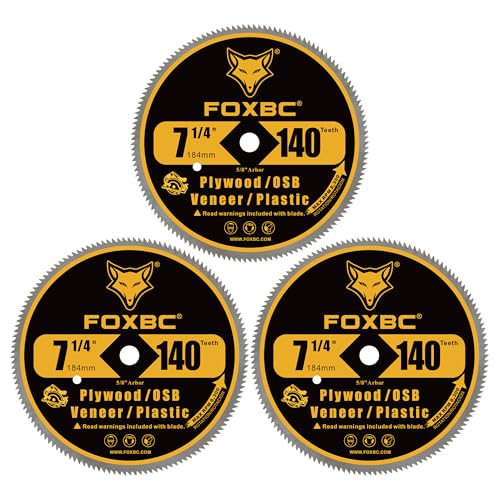
This FOXBC 7-1/4 inch circular saw blade set is designed specifically for fine finish work. With 140 precision-ground teeth and a thin kerf, it excels at making smooth, splinter-free cuts in plywood, OSB, plastic panels, veneer, and vinyl siding. Whether you're a DIY homeowner tackling a weekend project or a contractor installing cabinets and trim, these blades deliver clean edges that reduce the need for sanding and touch-ups.
Performance is where this blade set really shines. The high tooth count and thin kerf combine to produce fast, accurate cuts with minimal tear-out. Expansion slots help dissipate heat, preventing the blade from warping even during extended use. This makes it an excellent companion for cordless saws, as the reduced cutting resistance helps conserve battery power. Many woodworkers and finish carpenters will appreciate the consistent results from blade to blade.
Build quality is solid. Each blade is made from high-quality steel with precision-ground teeth that hold an edge well. The 5/8-inch diamond knockout arbor is a standard size that fits most circular saws, so installation is straightforward. While these blades aren't designed for heavy-duty ripping, they are built to last for plenty of finish cuts before needing sharpening.
Storage and maintenance are simple but require some planning. The 3-pack comes with three blades, but no case is included, so you'll need to store the extras carefully to avoid damage. Keeping them in a blade sleeve or drawer organizer works well. Cleaning pitch buildup occasionally will help maintain performance, but otherwise these blades are low-maintenance.
One realistic limitation is that these blades are not suited for cutting thick solid lumber or framing materials. The fine teeth can dull faster when used on abrasive materials like cement board or hard composites. However, for their intended purpose of cutting sheet goods and thin materials, they are an excellent choice. The affordable price of the 3-pack also makes it easy to keep a sharp blade on hand at all times.
Overall, this FOXBC blade set is a practical investment for anyone who regularly works with plywood, veneer, or plastic panels. DIYers will appreciate the clean results, and professionals will like the value and reliability. If you need a dedicated finish blade for your circular saw, this 3-pack delivers impressive performance without breaking the bank.

Pros
- Affordable three-blade set covers most wood-cutting needs for DIY and professional use
- Strong carbide tips hold up well against abrasive materials like plywood and MDF
- Anti-kickback design adds a layer of safety during aggressive cuts
- Quieter operation compared to many budget blades thanks to noise-reducing slots
- Compatible with a wide range of popular saw brands
Cons
- Limited to wood and wood composites; not suitable for metal, masonry, or abrasive materials
- Some users may prefer a higher tooth count (80T+) for ultra-smooth finish cuts on delicate trim
- Blades may require occasional cleaning to prevent pitch buildup and maintain performance
The Revvstark 3-Pack 7-1/4 Circular Saw Blade Set is a practical, budget-friendly solution for anyone who regularly cuts wood. This combo includes three blades: a 24-tooth framing blade for fast ripping, a 40-tooth blade for general crosscutting and ripping, and a 60-tooth blade for cleaner finish cuts. Whether you're a DIY homeowner tackling weekend projects, a woodworker fine-tuning cabinet parts, or a contractor framing a deck, this set covers the basics without breaking the bank.
Performance-wise, these blades are designed for efficiency. The ultra-thin laser-cut kerf reduces drag and helps your saw motor run cooler, which is especially noticeable when cutting dense hardwood or thick plywood. The carbide-tipped teeth stay sharp through repeated use, and the anti-kickback teeth provide an extra layer of safety during aggressive cuts. Many users will appreciate the noise-reducing perforations and thermal expansion grooves, which help keep the blade running smoothly and quietly on the job site.
Build quality is solid for the price point. The blades are made from premium alloy steel with hardened tungsten carbide tips, and they resist bending and deflection well during straight cuts. The 5/8-inch arbor fits most popular circular saws, miter saws, and table saws from Dewalt, Craftsman, Ryobi, Milwaukee, and similar brands. Just keep in mind these are strictly for wood and wood-based materials like MDF, chipboard, plywood, and laminated panels. They are not designed for metal, masonry, or abrasive materials.
Storage is straightforward since the blades come in a simple plastic sleeve, but many users will want to keep them in a dedicated blade case or drawer to protect the teeth. Setup is as simple as swapping out your current blade, and maintenance involves occasional cleaning with a blade cleaner or resin remover to prevent pitch buildup. Overall, this set is easy to use and store, making it a convenient addition to any workshop or garage.
One realistic limitation is that the 60-tooth blade, while good for finish cuts, may not produce the ultra-smooth edge that an 80-tooth or higher blade would on delicate trim or veneered plywood. For most framing, shelving, and general carpentry, though, it performs admirably. If you need glass-smooth cuts for fine furniture or cabinetry, you might want to supplement with a dedicated high-count blade.
Based on product specifications and user feedback, this Revvstark set offers strong value for DIY homeowners, woodworkers, and contractors who want a versatile, affordable blade selection. It's a practical choice for anyone looking to upgrade their saw's capabilities without investing in multiple expensive single blades. If you frequently cut wood and want reliable performance with good safety features, this combo is worth considering.

Pros
- Thin kerf design requires less motor torque and produces faster, easier feed rates
- Carbide-tipped teeth resist dulling better than standard steel saw blades
- 40-tooth ATB profile delivers a balanced blend of cutting speed and clean edge finish
- Fits standard 7-1/4-inch circular saws from major power tool brands
Cons
- Not intended for cutting masonry, tile, metal, or nail-embedded lumber
- Slower at high-volume rough framing rips than a dedicated 24-tooth framing blade
- May still show light tear-out on delicate ultra-thin cabinet grade veneers compared to higher-tooth finish blades
The WORKPRO 7-1/4-inch 40-tooth circular saw blade is an all-purpose wood-cutting accessory built for everyday circular saws. Designed to strike a balance between fast rough-lumber slicing and smooth trim finishing, this blade is targeted at DIY homeowners, woodworkers, remodelers, and garage builders who need dependable cutting action without having to swap blades between different wood materials.
Performance centers on the combination of 40 tungsten carbide teeth and an Alternating Top Bevel (ATB) tooth grind. This geometry shears cleanly through wood fibers, significantly cutting down on edge splintering when working with plywood subfloors, dimensional lumber, or spruce shelving. The thin-kerf design removes less material per pass, reducing resistance on your tool's motor and helping cordless circular saws conserve valuable battery run time.
Durability is reinforced by the tungsten carbide tips fused to the steel blade plate. Carbide maintains its sharp edge substantially longer than basic high-speed steel, resisting the abrasive heat generated by dense hardwoods, sap, and sheet goods glued with resins. The balanced body helps reduce blade chatter during long rip cuts or fast crosscuts, promoting straight lines and consistent cut depth.
Swapping the blade onto a circular saw is simple and matches standard tool procedures using the saw's arbor wrench. For ongoing care, occasionally wiping off pitch and resin build-up will keep the cutting action cool and free of binding. As with any combination blade, realistic limitations apply. It will not rip through 2x4s as quickly as a coarse 24-tooth framing blade, nor will it replicate the mirror-smooth edge of an 80-tooth ultra-fine finish blade on delicate cabinet plywood.
For general home repairs, shed construction, deck maintenance, and workshop carpentry, this WORKPRO blade offers a reliable balance of cutting speed, clean edge quality, and lasting edge retention. It is a smart addition to any portable jobsite setup or home workshop toolbox.
In garage and workshop environments, woodworkers frequently switch between cutting down sheets of plywood and sizing softwood boards for quick builds. The 40-tooth layout is a proven general-purpose middle ground, providing clean enough cuts for furniture carcasses while maintaining enough chip clearance to power through 2x4 framing lumber without stalling the motor.
The thin kerf noticeably reduces feed resistance on both corded tools and 18V or 20V cordless circular saws. Less motor load means cooler operating temperatures, extended battery run times, and less operator fatigue during repetitive sizing cuts across broad panels.
This blade features standard 7-1/4-inch sizing, making it widely compatible with handheld circular saws from leading jobsite and DIY tool manufacturers. Whether mounted on a lightweight sidewinder or a high-torque worm-drive saw, it slides easily onto compatible standard arbors.
Always verify the arbor diameter and maximum RPM specifications of your specific power tool before mounting the blade. Ensuring proper arbor collar tightening and inspecting the blade before operation helps guarantee safe, wobble-free cutting performance.

Pros
- PTFE coating significantly reduces friction and helps resist resin and gum buildup
- Proprietary heat vents help dissipate heat to prevent blade deflection and burning
- 24-tooth configuration handles rough construction lumber and wet stock efficiently
- Compact 6-1/2-inch format works well with compatible handheld circular saws
Cons
- 24-tooth setup is built for rough framing rather than fine finish woodworking or cabinet trim
- Specific arbor size is not listed in basic packaging data and must be verified against your saw model
- Not rated for cutting masonry, tile, or metal applications
The DEWALT DWA261224 is a dedicated 6-1/2-inch circular saw blade built for quick, aggressive cutting in residential construction and home improvement projects. Featuring a 24-tooth configuration, this blade is primarily designed for framing contractors, remodelers, deck builders, and DIY homeowners who need reliable cutting speed through standard wood stock. Its compact diameter makes it an ideal fit for compatible 6-1/2-inch circular saws, providing a dependable solution for everyday rough carpentry.
In real-world construction, wood is rarely pristine or completely dry. The manufacturer addresses this reality with an optimized tooth geometry designed to power through tough conditions, including wet or pressure-treated lumber. The 24-tooth count strikes a practical balance for rough crosscutting and ripping, clearing chips rapidly while maintaining steady tracking along chalk lines. Whether you are cutting 2x4 framing studs, sizing subfloor panels, or trimming rafters, the tooth spacing helps keep the saw moving forward without stalling.
Heat and friction are constant challenges during repetitive wood cuts, often leading to scorched edges and blade binding. DEWALT integrates a black PTFE exterior coating that helps reduce friction against the kerf walls, which also aids in resisting pitch and sap accumulation. Backing this up is a proprietary heat-vent design built directly into the steel body. These vents help dissipate operational heat, keeping the plate cooler to limit warping and reduce the chance of binding in dense grain.
Handling and maintaining this blade is straightforward on the jobsite or in a home garage. Before mounting, always ensure your circular saw is disconnected from its power source or has its battery pack removed, and verify that the blade diameter and arbor interface match your saw specifications. At just under four-hundredths of an inch in plate thickness, this blade places minimal rotational drag on your saw, supporting smooth operation. Keeping the PTFE surfaces wiped free of heavy sawdust will help maintain its anti-friction benefits over extended use.
There are realistic limitations to keep in mind before buying. A 24-tooth blade is specialized for framing and general construction, not fine cabinetmaking or ultra-smooth finish trim. If you need chip-free results on double-sided melamine, fine veneers, or delicate moldings, a blade with a much higher tooth count will be necessary. Additionally, this blade is strictly intended for wood and engineered lumber tasks, and should never be used on masonry, tile, or ferrous metal.
For homeowners taking on structural DIY tasks or tradespeople looking for a cost-effective, high-utility framing blade, the DEWALT DWA261224 delivers strong everyday value. Its heat-management vents, friction-reducing coating, and rough-lumber readiness make it a smart, practical addition to any circular saw kit.
The DEWALT DWA261224 features a standard 6-1/2-inch diameter suited for portable circular saws commonly used on framing sites and residential remodeling projects. The 24-tooth count is engineered specifically for fast chip evacuation, making it an excellent choice for ripping dimensional lumber, sizing plywood, and rough framing.
The integration of a PTFE coating minimizes contact friction inside the cut, which helps prevent pitch buildup and promotes smoother tool movement. Combined with strategically positioned heat vents that limit plate expansion and thermal distortion, this blade is built to maintain straight tracking and resist binding even under continuous cutting demands.
When purchasing a replacement circular saw blade, always consult your saw manual to confirm required blade diameter, arbor size, and maximum safe operating RPM. Disconnect tool power or remove battery packs prior to any blade change, and ensure the blade rotation arrow matches the direction indicated on your circular saw guard.

Pros
- Quick and aggressive metal cutting performance
- Affordable price point for a specialized blade
- Durable carbide tips hold up well on steel
- Compatible with most 7-1/4 inch circular saws
- Good for occasional use in home or shop metal projects
Cons
- Low tooth count produces rougher cuts than higher-tooth metal blades
- Not suitable for wood or non-ferrous materials
- Manufactured in China may be a concern for some buyers prioritizing domestic origin
The DEWALT DW3330 is a 7-1/4 inch circular saw blade featuring 16 carbide-tipped teeth designed specifically for cutting ferrous metals like steel and iron. This blade is built for users who need to make efficient cuts in metal sheets, pipes, or bars without switching to a dedicated metal-cutting saw.
This blade is best suited for contractors, metal fabricators, auto body workers, and DIY homeowners who occasionally cut metal in their garage or on the jobsite. It is not intended for wood or non-ferrous materials, so it's a specialized tool for metalworking tasks where speed and cut volume matter more than finish quality.
In real-world use, the 16-tooth design provides aggressive material removal. The carbide tips hold an edge reasonably well under normal use, and the thin kerf helps reduce wasted material while also being easier on smaller saw motors or cordless tools. However, keep in mind that the finish left by this blade will be rough when compared to a finer-toothed metal-cutting blade. It excels when you need to make quick cuts that will later be ground or deburred.
Build quality is adequate for the price point. The blade body is made from hardened steel, and the carbide tips are securely brazed. It's manufactured in China under DEWALT's quality standards, which means consistent performance for occasional metal cutting. Installation is straightforward with the standard 5/8-inch arbor and a simple arbor wrench.
Storage and maintenance are simple: keep the blade dry to prevent rust, store it in a blade case or on a magnetic rack, and clean off any pitch or residue after use. Because of its modest price, many users may prefer to replace it when it dulls rather than resharpening.
A realistic limitation is that this blade is not a precision finishing tool. The rough cut may require additional cleanup. Also, it's not designed for cutting non-ferrous metals like aluminum or brass. For contractors and DIYers who need a budget-friendly metal-cutting blade for occasional use, the DEWALT DW3330 delivers reliable performance without breaking the bank.

Pros
- Two blades cover general framing (40T) and fine finish cuts (60T) in one affordable set
- Thin kerf design reduces material waste and puts less load on the saw motor
- Stabilizer vents keep the blade cool and minimize vibration for straighter cuts
- Carbide tips stay sharp through extended use on common workshop materials
Cons
- Blades are optimized for wood only; not recommended for metal, masonry, or abrasive materials
- Some users may prefer a thicker kerf for ultimate stability in heavy-duty framing cuts
- Limited user reviews available at launch, making long-term durability hard to gauge
The FOXBC 6-1/2 inch Circular Saw Blade Combo Pack includes two blades: a 40-tooth version for general framing and a 60-tooth blade for finer finish work. Both feature an ultra-thin kerf of only 0.059 inches, which allows the saw to cut through wood quickly while removing less material. This design puts less strain on the motor of corded or cordless circular saws, making it a practical choice for extended cutting sessions on the job site or in the home workshop.
This combo is well suited for DIY homeowners, woodworkers, and contractors who regularly cut softwood, hardwood, plywood, MDF, and OSB. The 40-tooth blade handles crosscuts and rip cuts efficiently, while the 60-tooth blade delivers clean, splinter-free edges for trim and cabinet work. Switch between blades depending on the task, and you get professional-quality results without buying two separate packages.
Performance-wise, the thin kerf reduces resistance, so the saw feels more responsive and easier to control. The blades run cooler thanks to laser-cut stabilizer vents, which also dampen vibration and noise. Users will notice smoother cuts with less burning, especially on dense hardwoods or laminated panels. The high-density carbide tips hold their edge well, meaning fewer blade changes over time.
Build quality is solid for the price point. The blades are constructed with durable carbide and a sturdy steel body that resists warping under normal use. The 5/8-inch arbor with diamond knockout fits most popular corded and cordless saws from Milwaukee, DeWalt, Ryobi, and others. Storage is simple: slip the unused blade back into its original packaging or a dedicated blade case to keep the teeth protected.
One realistic limitation is that these blades are designed strictly for wood and wood-based composites. Cutting metal, masonry, or abrasive materials will damage the teeth and void any performance guarantee. Also, while the thin kerf is an advantage for speed and efficiency, some heavy-duty framers might prefer a thicker kerf for maximum stability in deep, aggressive cuts. That said, for most general woodworking and construction tasks, this combo offers excellent value.
Overall, the FOXBC 6-1/2 inch Circular Saw Blade Combo Pack is a practical choice for anyone who wants two task-specific blades at a reasonable price. It performs well on a wide range of wood materials and pairs nicely with both battery-powered and corded saws. If you are looking to upgrade your cutting setup without breaking the bank, this set deserves a spot in your toolbox or garage.

Pros
- Fast cutting speed saves time on repetitive metal cutting tasks
- Cool operation prevents discoloration and material weakening
- Long blade life reduces replacement frequency and cost
- Low vibration design improves control and cut accuracy
- Versatile compatibility with most 7-1/4 inch circular saws
Cons
- Not suitable for cutting wood or masonry, limiting multi-material use
- Requires a saw with at least 5800 RPM to reach optimal performance
- Higher upfront cost compared to abrasive discs, though offset by longer life
The FOXBC 7-1/4 inch circular saw blade is specifically designed for cutting metal and stainless steel, making it a specialized tool for DIY homeowners, mechanics, contractors, electricians, plumbers, woodworkers, construction workers, and anyone running a busy garage or workshop. With 70 ceramic carbide teeth and a 5/8 inch arbor, this blade fits most cordless and corded circular saws, ready to tackle steel studs, angle iron, EMT conduit, all-thread, and solid plates up to 1/2 inch thick.
Performance is the standout feature here. According to the manufacturer, this blade cuts up to 10 times faster than standard grinding discs while running up to 50 degrees cooler. That means less heat discoloration on your metal and faster work on repetitive cuts like shearing conduit or slicing through threaded rod. For tradespeople on a jobsite or a mechanic cutting brackets in the garage, that speed can save hours over a week. The ceramic carbide teeth also claim up to 25 times longer life than abrasive wheels, which reduces the frequency of blade swaps and keeps your workflow steady.
Build quality appears solid for the price point. The blade uses Japan-sourced ceramic and metallic materials for the teeth, which should resist wear and hold an edge longer than standard carbide. The laser-cut stabilizer vents are a practical addition they help dampen vibration and noise, leading to straighter cuts and less fatigue during extended use. The red color is purely cosmetic, but the overall construction feels purposeful for heavy-duty metal cutting.
Storage and maintenance are straightforward. Like any circular saw blade, you will want to keep it in a blade guard or case to protect the teeth, and wiping it down after use prevents rust buildup. Because it is a specialty blade for metal, you cannot swap it out for wood cutting without removing it, but that is standard for dedicated blades. It also requires a saw capable of 5800 RPM minimum, so older or low-speed saws may not deliver full performance.
Realistically, this blade is not for every situation. It is not designed for wood, masonry, or thin sheet metal thinner than 1/16 inch, so you will still need a general-purpose blade for other materials. Also, the 70-tooth count means a smoother but slower cut than a lower-tooth blade on lighter stock. For contractors cutting EMT all day, the speed and cool operation are a clear upgrade from abrasive wheels, but DIY users might find the initial price higher than a pack of cutoff discs. However, given the long lifespan, it can be a cost-effective choice in the long run.
Overall, this FOXBC blade is a practical investment for anyone regularly cutting metal with a circular saw. It balances fast, clean cuts with durability and reduced heat, which helps maintain material quality. Whether you are wiring a building, fabricating brackets, or repairing equipment in your shop, this blade can boost productivity and deliver consistent results. Check your saw's arbor size and RPM rating before buying, and you will be set for serious metal cutting work.
Understanding Circular Saw Blade Direction and Safe Installation
On virtually every handheld circular saw, the blade rotates counterclockwise when viewed from the arbor bolt side of a conventional sidewinder model. This mechanical arrangement pulls the saw shoe down firmly against the surface of the timber as the teeth slice into the material. Because the blade cuts upward from the underside of the stock, the sharp carbide teeth at the base must point up toward the front handle. Reversing this orientation causes the back edge of the tooth to rub rather than slice, resulting in smoking wood, rapid motor strain, and uncontrollable wandering.
The Fundamental Rule of Handheld Saw Rotation
Handheld circular saws are engineered to enter the cut from the bottom of the board and exit through the top. This rotation pattern creates an upward cutting force that pulls the tool flat against the workpiece during operation. Because the cutting edge must lead into the wood, the carbide tips at the very bottom of the exposed disc must point upward toward the front shoe. If the teeth at the base are pointing toward the rear handle, the disc is mounted backward.
Table saws and stationary miter saws work in the reverse direction relative to the operator. On a table saw, the blade rotates toward the user so that the teeth point downward toward the table surface to prevent boards from lifting into the air. On a miter saw, the blade spins downward into the base fence to hold the lumber securely in place. Confusing stationary saw orientation with portable handheld saw orientation is one of the most frequent reasons people install handheld blades backward.
When you hold a standard circular saw in cutting position, verify the lowest exposed teeth under the shoe. Those teeth should hook up toward the front of the tool shoe plate. This orientation allows the alternating top bevel tips, like those found on the OSTTE 7-1/4 Inch 60T Circular Saw Blade or WORKPRO 40T models, to cleanly shear fibers on their upward path. Remembering this simple upward-pointing rule prevents confusion regardless of tool brand or blade diameter.
Decoding Directional Arrows on Blades and Housings
Every reputable saw manufacturer stamps or casts a directional rotation arrow directly onto the fixed upper blade guard. This raised or painted arrow shows the exact direction the motor shaft turns when the trigger is pulled. Similarly, quality blades feature a printed or etched arrow on the front face of the plate indicating intended spin direction. Proper installation simply requires matching the arrow on the blade to the arrow on the saw housing.
Relying solely on printed brand logos can sometimes lead to installation errors on certain tool layouts. While the printed graphics on a replacement blade usually face outward toward the operator on standard sidewinder saws, this is not a universal rule. Worm-drive saws and left-blade cordless saws position the arbor on the opposite side of the motor. In those specific saw layouts, the printed graphic may need to face inward toward the motor body to align the directional arrows correctly.
Always inspect the physical rotation arrow rather than focusing on the product label. If a blade lacks a visible directional arrow due to wear, inspect the shape of the carbide teeth directly. The flat cutting face of each tooth must lead into the rotation path, while the angled clearance angle trails behind. Aligning the tooth profile with the motor rotation arrow cast into the guard guarantees proper mechanical orientation every time.
Blade-Left Versus Blade-Right Circular Saws
Circular saws fall broadly into blade-left and blade-right configurations, which alters how the blade sits relative to the motor. Most traditional corded sidewinder saws are blade-right models, meaning the motor sits on the left and the blade is positioned on the right side of the main handle. In contrast, worm-drive saws and many modern cordless compact saws, such as 6-1/2-inch tools, feature a blade-left design that places the cutting wheel to the left of the grip. Both styles rotate upward through the cut, but their arbor bolts face opposite directions.
On a blade-right saw, the retaining bolt is on the right, and the blade label normally faces outward toward the user. On a blade-left saw, the retaining bolt faces left, which means a standard blade installed with the teeth pointing upward will show its printed text facing outward on that side as well. However, if you switch between worm-drive and standard saws, arbor clamping configurations may require extra attention. The constant benchmark remains the upward hook of the bottom teeth toward the front of the shoe.
Different saw configurations also influence cut-line visibility and dust ejection patterns. For projects involving structural framing or subfloor modifications, choosing the right tool layout and blade ensures steady control. You can explore how cutting setups impact deck and floor demolition in our detailed saw to cut subfloor guide. Understanding your specific tool geometry helps ensure accurate alignment and dependable cut tracking.
Step-by-Step Procedure for Changing a Circular Saw Blade
Before touching the blade retaining hardware, disconnect the power source completely to avoid accidental motor activation. For corded saws, pull the plug from the extension cord or wall receptacle; for cordless models, slide the battery pack out of the base. Set the saw on a flat, stable workbench with the shoe adjusted to expose adequate clearance around the arbor assembly. Engaging the tool spindle lock button prevents the shaft from rotating while loosening the retaining bolt.
Most circular saw arbor bolts loosen in the direction of blade rotation to prevent them from spinning loose during normal operation. On a blade-right sidewinder saw, this typically means turning the bolt counterclockwise to loosen and clockwise to tighten. On some blade-left or worm-drive tools, the bolt may use a reverse thread that loosens clockwise. Consult your saw manual if the bolt resists moderate wrench pressure, and always use the correct hex key or arbor wrench to avoid rounding the bolt head.
Remove the outer clamp flange and inspect the inner flange seated against the motor shaft. Clean away packed sawdust, pitch buildup, or loose debris from both flange mating faces with a clean shop rag. Slide back the spring-loaded lower blade guard manually and place the new disc onto the arbor shaft. Verify that the bottom teeth point upward toward the front of the base plate and that the blade rests flush against the inner washer without tilting or binding.
Reinstall the outer flange with its recessed side facing the blade disc correctly. Thread the arbor bolt back into place by hand to avoid cross-threading the internal shaft threads. Engage the spindle lock once again and tighten the bolt securely with the arbor wrench, taking care not to over-tighten and distort the plate. Release the lower guard slowly and cycle it several times by hand to confirm smooth, unimpeded movement over the newly mounted disc.
Managing Arbor Sizes and Diamond Knockouts
Handheld circular saws in the United States generally use either a round 5/8-inch arbor or a diamond-shaped shaft. Standard sidewinder models feature round arbors, which match the circular center hole on blades like the Revvstark 3-pack or DEWALT 6-1/2-inch options. Worm-drive saws, on the other hand, utilize a diamond arbor shaft designed to deliver high torque without shaft slipping under heavy timber loads. Many multipurpose blades feature a perforated diamond knockout in the center of a 5/8-inch round hole.
If your saw has a diamond-shaped arbor, you must remove the center knockout before attempting installation. Place the blade flat over a pair of wooden blocks or an open vise to support the central plate securely. Place a cold chisel or sturdy punch against the knockout tabs and strike firmly with a hammer until the diamond slug pops free. Never try to mount a blade with an intact round arbor onto a diamond shaft, as the outer flange cannot seat flat.
Conversely, if your saw features a standard round 5/8-inch spindle, leave the diamond knockout undisturbed. The blade will center directly on the round spindle without issue. Inspect the fit between the blade bore and the arbor shoulder to verify there is zero excessive lateral play before tightening. An off-center blade produces severe vibration, rough cuts, and premature arbor bearing wear.
Recognizing Symptoms of an Inverted Blade
Installing a blade backward creates unmistakable operational symptoms that you should recognize immediately. Because the back clearance bevel of the carbide tip strikes the lumber instead of the cutting edge, the saw will not feed smoothly. You will encounter extreme resistance when pushing the saw along the cut line, requiring abnormal forward force. The wood fibers will burn rapidly, creating heavy smoke and scorched cut edges along the kerf.
A backward blade also generates intense chatter, screeching noise, and severe tearout on both sides of the board. The motor pitch will drop noticeably as amperage draw spikes under excessive friction, creating a risk of tripping circuit breakers or overheating cordless batteries. Most critically, the tool will tend to climb up out of the cut and kick backward toward the user because the teeth cannot bite into the stock. If your saw smokes or resists forward movement, release the trigger immediately and inspect blade direction.
Operating a saw with an inverted blade also damages the cutting accessory itself. The excessive frictional heat can melt brazing alloy holding tungsten carbide teeth, causing tips to loosen or fracture. Steel plate expansion slots, like those on FOXBC fine finish blades, cannot dissipate heat efficiently when the tool is continuously grinding instead of cutting. Catching an orientation mistake early protects both the motor windings and your expensive saw blades.
Matching Tooth Geometry and Kerf to Your Material
Correct orientation must be paired with appropriate blade selection for the material you intend to cut. Low-tooth-count blades, such as 16-tooth or 24-tooth framing designs, feature large gullets that clear chips rapidly during rough ripping and framing cuts. These blades cut aggressively with minimal motor drag, making them popular for construction lumber. However, their aggressive bite leaves rougher edges and more surface splintering on finish materials.
For plywood, veneered boards, trim, and laminates, higher tooth counts provide far smoother results. Discs featuring 40 to 60 teeth, like the WORKPRO 40T or OSTTE 60T alternating top bevel models, slice through grain cleanly with reduced tearout. High-density tooth profiles, such as the FOXBC 140-tooth carbon blade, are specialized for thin veneers, plastic sheeting, and vinyl where chipout must be minimized. If your workshop handles varied building tasks involving light metals, you can also learn about non-ferrous cutters in our saw blade to cut aluminum guide.
Kerf width also plays an essential role in saw performance, especially on cordless battery platforms. Thin-kerf blades, such as the 0.059-inch FOXBC 6-1/2-inch combo discs or DEWALT 24T blades, remove less stock and require less motor wattage per cut. This reduced cutting resistance preserves battery runtime and decreases binding tendencies in wet or resinous lumber. Full-kerf blades provide greater rigidity for heavy industrial cutting but demand more driving power from corded tools.
Controlling Tearout and Surface Quality
Because handheld circular saw teeth exit through the top surface of the board, tearout naturally occurs on the side of the lumber facing up. As the tooth hooks upward through the wood fibers, unsupported surface grain can splinter or chip along the cut margin. The bottom surface of the workpiece, where the blade enters, receives the cleanest cut with minimal splintering. This mechanical reality dictates how you should position finished stock prior to cutting.
To preserve fine cabinet plywood, prefinished paneling, or decorative trim, always place the good face downward during the cut. Marking your cut line on the back surface ensures that any fiber tearout remains concealed on the unexposed side of the finished installation. If you must cut with the finished face pointing up, applying painter tape firmly along the cut line helps support surface fibers. Scoring the line lightly with a utility knife before sawing also limits chipping.
Zero-clearance cutting strips or auxiliary sub-bases attached to the saw shoe can further reduce edge splintering on delicate laminates. Pairing a high-tooth-count finish blade with slow, steady forward feed rates produces cabinet-grade edges without splintered margins. Taking time to position your lumber with respect to tooth entry direction makes a substantial difference in overall cut quality.
Essential Operational Safety and Verification Steps
After completing any blade installation, perform a quick three-point verification check before plugging the saw in or inserting the battery. First, visually inspect the teeth at the base of the shoe to verify they point up toward the front. Second, pull the lower blade guard fully open by its lever and release it to verify it snaps closed instantly under spring tension. Third, spin the blade carefully by hand with power disconnected to verify it rotates freely without rubbing against the guard housing.
Secure workpieces firmly with clamps rather than holding stock by hand, keeping hands well clear of the cutting line. Set your cutting depth so that the blade teeth extend approximately 1/8 to 1/4 inch below the thickness of the board. Setting excessive depth increases exposed blade area beneath the cut, increasing drag and magnifying kickback forces if the blade binds. Wearing approved eye protection, hearing protection, and a dust mask prevents injury from airborne sawdust and high-speed chips.
Always let the saw motor reach full operating speed before allowing the blade teeth to contact the edge of the lumber. Pushing an unpowered or slow-spinning blade against wood can cause binding, motor stalling, and violent kickback. Maintain a balanced stance with both hands on the tool handles throughout the pass, allowing the sharp teeth to cut at their own natural speed. Once the cut finishes, release the trigger and hold the saw steady until the blade stops completely before lifting the tool from the workpiece.


Write Your Review
No reviews yet. Be the first to share your experience!