


Dull cutters force an operator to lean heavily on the guide bar, generating severe friction, scorched rails, and fine wood dust instead of clean, thick wood chips. Learning how to use electric chainsaw sharpener systems restores cutting teeth to uniform lengths and angles in a fraction of the time required by manual hand filing. Whether handling seasonal firewood cutting or general property cleanup alongside traditional techniques for swinging an axe with power and control, maintaining sharp cutting edges protects your chainsaw engine and transmission from excessive wear.
Electric sharpeners come in two primary configurations, including stationary bench-mounted grinders and portable handheld rotary tools powered by cordless batteries or 12-volt vehicle adapters. Operating either design correctly requires matching the grinding wheel to the chain pitch, locking in precise top-plate angles, and applying gentle, controlled grinding pulses to avoid overheating the cutter steel. Understanding these fundamentals turns a tedious maintenance chore into an efficient workshop routine that keeps every crosscut straight, fast, and safe.

Pros
- Cordless design means you can sharpen in the field, on a ladder, or in the shop without cords
- Multiple wheel sizes included so you can match your chain pitch exactly
- Angle guide ensures each tooth is sharpened identically for balanced cutting performance
- Lightweight at 1.39 pounds, easy to carry and store in a toolbox or chainsaw bag
- Adjustable speed helps prevent overheating and gives a finer edge on each tooth
Cons
- Battery life may limit use for large jobs or multiple chains in one session
- The learning curve for aligning the guide properly can take a few tries for new users
- Plastic housing may not survive a drop on concrete as well as metal alternatives
The Sharp Pebble Cordless Chainsaw Sharpener Kit is a battery powered tool designed to replace the slow and inconsistent hand filing method. It targets anyone who owns a chainsaw and values time savings and a razor sharp edge. That includes DIY homeowners cutting firewood, mechanics maintaining property, woodworkers prepping lumber, and contractors keeping their saws in top shape on the job site.
Performance wise, the biggest advantage is the consistent angle and depth the sharpener provides. Each tooth gets the same treatment thanks to the adjustable angle guide. Users can set the grinding angle, then cycle through the chain, and every cutter comes out equally sharp. The four included file sized wheels cover common chain pitches, so you won't have to buy separate wheels for different chains. The adjustable speed helps manage heat and gives a cleaner finish compared to a fixed speed version.
Build quality is practical for a portable tool. The body is lightweight plastic with an orange and black scheme, and the motor uses high quality bearings for stable disc rotation. The ergonomic grip and trigger make one handed operation possible, which matters when you're holding the saw or working in tight spaces. The angle guide attaches firmly, and the included wrench makes wheel changes quick. It's not a heavy duty industrial unit, but for home and pro use it feels solid enough.
Setup takes a minute: charge the battery (not specified if included, but the kit likely includes a battery; based on typical cordless tools), slide on the appropriate wheel, attach the angle guide, and set the depth stop. The learning curve is short, though aligning the guide perfectly with the chain's top plate takes a few tries. Once locked in, you can sharpen a full chain in minutes. Storage is easy given its compact size; it fits in a toolbox or chainsaw bag without taking much room. No special maintenance beyond keeping the wheels clean and the battery charged.
A realistic limitation is battery life. If you have a half dozen chains to sharpen in one go, you might need a spare battery or a break for recharging. Also, the plastic housing, while light, is less durable than a metal case if dropped. Some users might prefer a corded unit for non stop work, but the freedom of cordless makes up for it in most scenarios. The four wheel sizes cover common chains, but if you have an oddball pitch, you may need to buy additional wheels separately.
Overall, for anyone who regularly uses a chainsaw and wants to keep it cutting safely and efficiently, this Sharp Pebble kit is a solid buy. It saves time, reduces hand fatigue, and delivers consistent results that hand filing can't match. DIY homeowners, mechanics, woodworkers, and contractors will all find it a practical addition to their workshop or garage. Just keep an extra battery handy for extended sharpening sessions.


Pros
- Versatile mounting options for wall, bench, or vise provide installation flexibility
- Saves time and effort versus manual filing for frequent sharpening needs
- Compact and lightweight design is easy to store and transport
- Consistent sharpening angle helps maintain chain performance
Cons
- May not accommodate all chainsaw chain sizes or types, so check compatibility before purchase
- Sharpening wheel or stone may need replacement over time, adding to long-term cost
- Some users may prefer a more robust unit for heavy-duty commercial use
This electric chainsaw sharpener is a practical tool designed for anyone who regularly uses a chainsaw and wants to keep the chain in top cutting condition. It's a wall-mountable, bench-mountable, or vise-mountable unit that brings convenience and efficiency to sharpening tasks, whether you're a DIY homeowner maintaining a backyard saw or a contractor who relies on chainsaws daily.
The primary advantage of this sharpener is its mounting flexibility. You can attach it to a wall in your garage or workshop, clamp it to a workbench, or secure it in a vise for a stable sharpening station. This versatility makes it a great fit for mechanics, woodworkers, construction workers, and anyone with a dedicated workshop or garage space. The compact footprint means it won't hog valuable bench real estate, and it's easy to put away when not in use.
In terms of performance, this sharpener is designed to save time compared to manual filing. It uses an electric motor to drive a sharpening wheel, allowing you to quickly restore a dull chain's cutting edge. The sharpening angle is preset or adjustable, depending on the model, which helps maintain consistent tooth geometry for efficient cutting. This can be especially valuable for professionals who need to keep multiple saws ready for the job site.
Build quality is decent for its price point. The unit weighs 6.6 pounds and features a combination of metal and plastic components. The red and silver color scheme is functional, and the overall construction feels sturdy enough for regular use in a home workshop or light commercial setting. However, users should be aware that the sharpening wheel or stone may wear out over time and need replacement, which is a normal maintenance consideration for any sharpener.
Storage and maintenance are straightforward. The compact design means it can be stored on a shelf, in a cabinet, or hung on a pegboard. Cleaning is simple, as the unit doesn't have complex mechanisms. The main requirement is to occasionally check the sharpening wheel for wear and replace it when needed. This low-maintenance aspect makes it appealing for DIY homeowners and hobbyists who want a reliable tool without constant upkeep.
Overall, this electric chainsaw sharpener is a solid choice for those who want to improve chainsaw maintenance efficiency. It's best suited for DIY users, mechanics, contractors, woodworkers, and workshop enthusiasts who have a need for regular sharpening. While it may not be the most heavy-duty option for industrial use, its mounting versatility, compact size, and time-saving operation make it a practical addition to any garage or workshop. Just ensure compatibility with your chain type before purchasing.
Pros
- Convenient 12V DC power options allow sharpening directly in the field or woods
- Supplied with stones to service almost any standard consumer or pro chain pitch
- Integrated angle guide helps improve sharpening repeatability
- Lightweight and compact enough to keep inside a chainsaw carry case
Cons
- Requires a 12V DC power source and cannot plug directly into 120V wall outlets without a converter
- Stones wear down with routine use and require periodic replacement
- Demands a light touch to avoid taking off too much tooth material
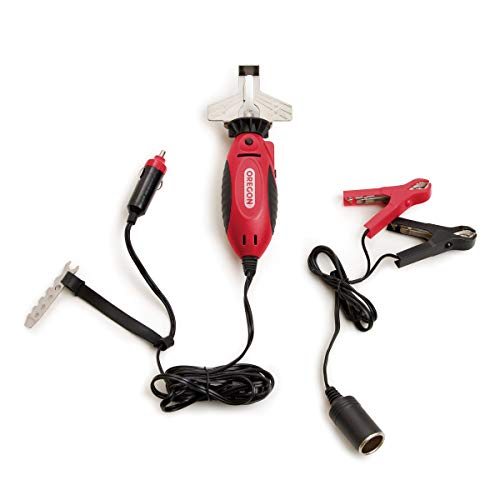
The Oregon 12V Sure Sharp Electric Chain Sharpener is a handheld rotary tool purpose-built for touching up chainsaw cutting teeth away from the workshop. Chainsaw chains inevitably dull from dirt, knotty hardwood, and ground contact. Instead of hauling a heavy bench grinder or spending half an hour with a hand file, this tool delivers fast motorized grinding right from a truck, tractor, or utility vehicle battery.
This sharpener is well suited for rural homeowners, woodcutters, arborists, landscapers, and storm cleanup crews who need immediate chain maintenance in the field. Hand filing in cold or wet conditions can be slow and tedious, especially on hardened semi-chisel or full-chisel cutters. The motorized spindle turns high-grade abrasive stones at high speed, removing burrs and restoring sharp cutting edges with just a few quick taps per tooth.
The package includes three stone sizes: 5/32-inch (4.0mm), 3/16-inch (4.8mm), and 7/32-inch (5.5mm). These cover virtually all standard round-ground chain pitches, from 1/4-inch and 3/8-inch Low Profile homeowner chains up to heavy-duty .325-inch, standard 3/8-inch, and .404-inch professional setups. The built-in angle adjustment guide helps operators hold a consistent 30-degree or 35-degree filing angle, which keeps the saw cutting straight instead of curving into the cut.
Power options are flexible for remote settings. The attached power cord features a standard 12-volt vehicle auxiliary plug, and Oregon includes a set of alligator battery clips for connecting directly to top-post or side-terminal batteries. The entire unit weighs just around one pound, featuring a molded ergonomic barrel that fits comfortably in hand, providing solid control over the grinding contact pressure.
There are practical limitations to keep in mind. Because this runs strictly on 12-volt direct current, using it inside a home garage requires a compatible 12V power supply or a portable jump starter pack. Additionally, users accustomed to manual files must use a light touch, as high-speed rotary stones can quickly remove excess cutter metal if held in place too long.
For anyone managing acreage, cutting cords of firewood, or clearing trails, the Oregon 12V Sure Sharp is a reliable and time-saving addition to any chainsaw field kit. It bridges the gap between slow manual filing and cumbersome bench-mounted grinders, delivering sharp chains and smooth cutting performance wherever your work takes you.
Field maintenance requires tools that are lightweight, resilient, and simple to operate out of a truck bed or tailgate. The Oregon Sure Sharp features an impact-resistant polymer body designed to handle typical outdoor conditions, sawdust exposure, and accidental drops into leaf litter.
The included collet wrench makes stone swaps fast and hassle-free, allowing operators to switch between different pitch saws on multi-tool jobsites without returning to the shop. Storage is straightforward because the slender profile slides effortlessly into standard plastic chainsaw scabbard pockets or soft-sided equipment bags.
Operating an Electric Chainsaw Sharpener with Precision
Operating an electric sharpener requires methodical setup, mechanical awareness, and consistent technique. While manual round files depend entirely on hand-eye coordination and steady wrist control, an electric unit utilizes a high-speed abrasive wheel or rotary stone to grind cutter teeth to uniform angles and depths. Homeowners and woodcutters who transition to powered sharpeners immediately notice significant time savings, especially when rehabilitating rock-struck or severely blunted chains. Mastering this equipment ensures your saw runs cooler, cuts straight through dense timber, and maximizes the service life of both your guide bar and drive links.
Understanding Bench-Mounted Grinders Versus Handheld Rotary Tools
Electric sharpeners generally divide into stationary bench or wall-mounted units and portable handheld rotary sharpeners. Bench-mounted machines, such as workshop grinders equipped with adjustable vises and 5.5-inch abrasive wheels, hold the saw chain securely in a rigid track while a motorized grinding head pivots downward. These units excel in workshop environments where operators sharpen multiple off-saw chains during seasonal maintenance. Handheld electric sharpeners, including cordless lithium-ion models and 12-volt battery-clamp tools, attach directly over the guide bar without requiring chain removal. Choosing between the two formats depends on whether you prioritize stationary precision for batches of chains or field portability for immediate touch-ups.
Selecting the Correct Grinding Wheel and Stone Diameter
Proper cutter sharpening begins with selecting an abrasive wheel or rotary stone that matches the pitch of your saw chain. Chainsaw chain pitch refers to the distance between any three consecutive rivets divided by two, commonly sized as 1/4-inch, 3/8-inch Low Profile, .325-inch, standard 3/8-inch, or .404-inch. Handheld rotary sharpeners utilize cylindrical grinding stones that correspond directly to standard round file diameters. A 3/8-inch Low Profile chain requires a 5/32-inch (4.0mm) stone, a .325-inch pitch chain requires a 3/16-inch (4.8mm) stone, and a standard 3/8-inch or .404-inch chain demands a 7/32-inch (5.5mm) stone. Installing an incorrect wheel diameter changes the gullet profile, creating an improper cutting hook that weakens the tooth corner.
Essential Safety Equipment and Workspace Preparation
High-speed electric grinders throw high-velocity steel dust, abrasive grit, and sparks, making personal protective equipment mandatory before flipping the power switch. Operators must wear ANSI-approved safety glasses along with a clear face shield to protect eyes and facial skin from stray sparks and fractured wheel debris. Snug-fitting leather work gloves protect hands from sharp cutter corners and moving abrasive discs while preserving fine tactile control over adjustments. Hearing protection remains necessary when operating high-rpm motors, particularly with bench grinders spinning at 3,000 RPM or handheld units running at elevated rotary speeds. Work in a clean, well-ventilated space far away from open gasoline containers, fuel mixing jugs, or loose wood shavings that could ignite from grinding sparks.
Preparing and Cleaning the Saw Chain Before Sharpening
Grinding dirty or pitch-covered saw chains causes abrasive wheels to load up quickly, reducing cutting efficiency and increasing friction heat. Before mounting a chain into a bench vise or working along the guide bar, scrub away hardened tree sap, wood debris, and bar oil residue using a wire brush and biodegradable degreaser. Wipe the chain dry with a clean shop rag to inspect the physical condition of the drive links, tie straps, and cutter corners. Look for cracked rivets, bent drive tangs, or excessive under-rail peening that might cause the chain to bind inside the guide bar channel. Chains with bent tie straps or cracked cutter bodies must be retired from service rather than ground down.
Finding the Master Cutter and Setting Consistent Tooth Length
Every saw chain develops uneven tooth wear across working cuts, particularly after striking rocks, sandy dirt, or hidden fencing wire. Before adjusting grinding stops, inspect the entire chain to locate the master cutter, which is the tooth exhibiting the greatest wear or physical damage. Mark the top plate of this reference cutter with a brightly colored grease pencil, permanent marker, or paint pen so you can identify it instantly. All remaining cutting teeth on the chain must eventually be ground down to match the length of this master tooth. Maintaining equal cutter lengths across the left and right sides of the chain prevents the guide bar from pulling to one side or binding inside the kerf.
Configuring Grinding Angles and Vise Stops on Bench Units
Bench-mounted sharpeners rely on precise angular calibrations on the vise base and motor head to replicate factory cutter geometry. Most standard crosscut chains utilize a 30-degree or 35-degree top-plate cutting angle, which is dialed in on the swiveling chain vise platform. Some chain designs also call for a 10-degree down-angle tilt or a 55-degree to 60-degree head angle, depending on whether you are sharpening semi-chisel or full-chisel cutters. Place the chain into the vise rails with the cutter facing the direction of wheel rotation, then engage the mechanical chain stop pawl behind the cutter tooth. Turn the forward feed adjustment knob until the abrasive wheel aligns flush against the working corner and face of the cutter without touching the tie strap.
Operating Handheld Electric Sharpeners on the Guide Bar
Handheld electric sharpeners allow operators to sharpen chains directly on the chainsaw without disassembling the bar or cutting loop. Begin by locking the chainsaw chain brake firmly to prevent the chain from rolling backward during grinding. Attach the angle guide plate to the rotary tool housing, aligning the stamped angle index lines parallel with the guide bar axis to maintain a consistent 30-degree filing stance. Turn on the motor, let the rotary stone reach operating speed, and bring the spinning stone into the inside curve of the cutter tooth gullet. Apply light, smooth pressure moving outward from the inside of the cutter toward the outer cutting edge before releasing the chain brake to advance to the next tooth.
Techniques to Prevent Overheating and Annealing Cutter Steel
Abrasive wheels and stones generate concentrated friction heat that can permanently damage the heat treatment of saw chain steel. If a grinding wheel lingers too long against a cutter face, the steel turns blue or straw-colored, signaling that the metal has lost its temper and edge-holding hardness. To prevent annealing, touch the abrasive wheel to the cutter face in short, controlled pulses lasting no more than one or two seconds each. Allow the stone to slice away minimal metal with each tap rather than forcing the wheel into the tooth with heavy downward pressure. If a tooth requires significant material removal to repair rock damage, grind a small amount across all teeth first, then make a second light pass around the loop.
Reversing the Setup to Grind Opposite-Facing Cutters
Chainsaw loops alternate between left-hand and right-hand cutters along the tie straps to balance lateral cutting forces in the kerf. After grinding all cutters facing in one direction around the entire loop, you must reconfigure the sharpener to grind the opposing set of teeth. On a bench sharpener, loosen the vise turntable and rotate it across center to the identical angle setting in the opposite direction, such as shifting from positive 30 degrees to negative 30 degrees. On a handheld tool, adjust your stance and angle guide orientation so the stone pushes outward through the opposite gullets at the exact same horizontal angle. Regular maintenance of outdoor equipment, whether dealing with chainsaw chains or seasonal tasks like clearing brush and small saplings, relies on this same dedication to balanced cutting geometry.
Checking and Adjusting Depth Gauges
Sharpening cutter top plates lowers their height relative to the leading depth gauges, commonly referred to by sawyers as rakers. The depth gauge sits directly in front of each cutter tooth and controls how deeply the working corner bites into wood fibers during each revolution. Standard chains require a depth gauge clearance between .020-inch and .030-inch, with .025-inch being the standard setting for general firewood cutting. Place a progressive depth gauge tool over the cutters to see if the metal raker tang protrudes above the measurement slot. Lower protruding rakers with a few strokes of a flat hand file or a dedicated flat grinding disc, rounding off the front leading edge to maintain smooth entry into the wood kerf.
Troubleshooting Uneven Grinds, Crooked Cuts, and Grinding Errors
When a chainsaw pulls to the left or right during a bucking cut, the root cause almost always traces back to uneven cutter lengths or mismatched filing angles. If left-hand cutters are ground shorter than right-hand cutters, the saw automatically drifts toward the side with longer, more aggressive teeth. Another common issue occurs when operators set the sharpener depth stop too low, causing the abrasive wheel to notch the structural tie straps or chain chassis. Inspect each link after grinding to verify that the wheel cleared the rivet bases and tie strap shoulders cleanly. Re-check all tolerances before heading into heavy yard clearing or working with heavy duty brush clearing blades, where tool balance is critical.
Final Chain Tensioning, Lubrication, and Verification Test Cuts
Once all cutters and depth gauges have been ground and deburred, prepare the cutting system for active operation. Reinstall the chain onto the guide bar if using a bench grinder, ensuring the cutter points face forward along the top rail toward the bar nose. Adjust chain tension using a scrench until the drive link tangs remain seated inside the bar groove but the chain can still be pulled smoothly by gloved hand. Perform the snap test by pulling down on the chain at mid-bar, verifying that the chain snaps firmly back against the rails without sagging. Add clean bar and chain oil to the reservoir, start the chainsaw in a clear area with the chain brake disengaged, and verify that healthy wood shavings eject during test cuts.
Consistent maintenance using an electric sharpener transforms dull, frustrating chains into precision cutting tools that slice effortlessly through dense logs. By respecting correct pitch measurements, locking in stable grinding angles, and using light, controlled contact, you protect cutting temper while maintaining perfectly balanced cutter teeth. Taking the time to adjust depth gauges and verify proper chain tension guarantees that every firewood bucking session or storm cleanup project proceeds smoothly, quickly, and safely.






Write Your Review
No reviews yet. Be the first to share your experience!