


Mounting a fresh saw loop onto your guide bar should result in a smooth, effortless cut, but ordering the wrong specifications can quickly halt your woodcutting plans. When an operator attempts to force an incorrect pitch onto a drive sprocket or jams a wide drive link into a narrow bar rail, the equipment suffers severe friction, accelerated wear, and elevated kickback risks. Understanding how to choose chainsaw chain requires deciphering the critical physical measurements stamped directly onto your powerhead hardware. Whether you are bucking seasoned firewood on the woodlot or tackling routine acreage maintenance alongside clearing small saplings and brush, getting the proper chain geometry ensures maximum cutting efficiency and operator safety.
A saw chain must align precisely across three specific mechanical interfaces: the engine drive sprocket, the guide bar slot, and the bar nose sprocket. Overlooking even a minor difference between a 3/8-inch standard pitch and a 3/8-inch Low Profile loop can ruin your drive system within minutes of running the engine. Taking time to verify your powerhead displacement, usable guide bar cutting length, and preferred timber cutting conditions prevents costly operational mistakes. By focusing on fundamental measurements such as chain pitch, drive link gauge, and cutter profile design, you can equip your power tool with the exact cutting loop needed for clean, productive work.

Pros
- Complete set with multiple file sizes for various chain pitches.
- Includes depth gauge and flat file for comprehensive chain maintenance.
- Compact and portable pouch with high visibility.
- Ergonomic wooden handle improves comfort.
- Quick gauge tool adds extra functionality.
Cons
- Files may wear out faster than premium brands like Stihl or Oregon.
- Wooden handle may not fit all users' preferences for grip.
- No file guides included, which some beginners might expect.
The Hipa 12-Pack Chainsaw Sharpening File Kit is a complete maintenance set designed for anyone who owns a chainsaw, from weekend DIYers to professional tree service crews. It includes six round files in the most common sizes (1/8", 5/32", 11/64", 3/16", 13/64", and 7/32"), a 6-inch flat file, a combination depth gauge tool (.025" and .030"), and a multi-function quick check gauge. All of these fit neatly into a bright orange zippered pouch for easy transport and storage.
This kit is best suited for homeowners, woodworkers, landscapers, farmers, and contractors who need to keep their chainsaws, pole saws, and other cutting equipment sharp. With the variety of file sizes, you can match nearly any standard chain pitch. The depth gauge ensures you maintain proper raker clearance, which directly affects cutting efficiency and safety. The flat file is handy for dressing off burrs or leveling depth gauges.
In terms of performance, the files are made from hardened steel and are designed to handle the tough task of reshaping chain cutters. While they may not last as long as some premium brands, they provide reliable sharpening for routine maintenance. The ergonomic wooden handle can be swapped between files, offering a comfortable grip and good control. Users appreciate the quick check gauge, which helps verify pitch size, filing angle, and cutter length at a glance.
Build quality is adequate for the price point. The files feature laser-etched size markings that remain legible, and the depth gauge is a simple but effective stamped metal tool. The flat file is standard size and fits the handle securely. The pouch is a basic nylon fabric with a zipper, but it does the job of keeping everything together. For workshop storage, you may prefer to keep the pouch in a drawer or hang it on a pegboard.
One realistic limitation is that the files themselves are individual items without their own handles, so you need to use the supplied wooden handle each time. Some users might prefer dedicated handles for faster changes. Also, the kit does not include file guides, which some beginners find helpful. However, the quick check gauge compensates partially by giving you the correct angles.
Overall, the Hipa chainsaw sharpening kit is a solid value for the money. It offers everything you need to maintain your chainsaw's cutting edge without buying individual tools. Whether you're touching up a chain after a day of cutting firewood or sharpening between jobs, this kit is a practical addition to any workshop or truck box. For the price, it's hard to beat the convenience and completeness.

Pros
- Versatile for multiple applications including towing, lifting, and securing
- Durable build offers reliable performance for heavy-duty tasks
- Easy to store and handle, fitting neatly in a toolbox or garage
- Affordable price point for DIYers and professionals alike
Cons
- May not be rated for extreme heavy lifting or overhead use without proper certification
- Length may be limiting for larger towing or securing jobs
- Finish may show wear over time if exposed to moisture without proper care
This chain is a straightforward, no-frills tool designed for a variety of tasks around the home, garage, workshop, or jobsite. Whether you need to secure a load in your truck bed, tow a vehicle, lift equipment, or hang tools for easy access, this chain provides a reliable and affordable solution. It's a practical addition to any DIY homeowner's, mechanic's, contractor's, or woodworker's toolkit.
In terms of performance, this chain delivers dependable strength for everyday tasks. It can handle towing a small trailer, securing heavy equipment, or lifting moderate loads with confidence. The construction is robust enough for regular use in a workshop or on a construction site, offering good wear resistance and durability. Users will appreciate its ability to get the job done without fuss.
Build quality is solid for the price point. The chain is made from materials that resist corrosion and wear, ensuring it holds up well in a garage or outdoor environment. It's easy to handle, with a manageable weight that doesn't add unnecessary bulk to your tool collection. Storage is simple - it can be coiled up and stored in a toolbox, hung on a wall hook, or tossed in a truck bed without taking up much space.
One realistic limitation is that this chain may not be rated for extreme heavy lifting or overhead use without proper certification. For critical lifting applications, users should verify the chain's working load limit and ensure it meets safety standards. Additionally, the length might be insufficient for larger towing or securing jobs, so consider your typical needs before purchasing.
Maintenance is minimal - just keep it clean and dry to prevent rust. A quick wipe down after use and occasional lubrication will keep it in good working order. Overall, this chain is a practical, budget-friendly option for anyone needing a reliable chain for general-purpose tasks around the garage, workshop, or jobsite. It's a smart buy for DIYers and professionals alike who want a versatile tool without breaking the bank.

Pros
- Affordable price point for occasional use.
- Low-kickback design improves safety.
- Pre-sharpened for immediate use.
- Lightweight for reduced fatigue.
Cons
- May not hold an edge as long as premium chains under heavy use.
- Limited to 45 drive links, so verify compatibility with your saw.
- Not designed for professional or all-day cutting applications.
If you own a 16-inch electric or small gas chainsaw and need a replacement chain without breaking the bank, this 3/8 LP pitch, .043 gauge chain with 45 drive links is a practical option to consider. It's designed for light to medium cutting tasks like pruning branches, cutting firewood, and general yard maintenance. This chain is best suited for DIY homeowners, woodworkers, and hobbyists who need a dependable cutting tool for occasional use.
In terms of real-world performance, the chain offers decent cutting efficiency right out of the box thanks to its pre-sharpened teeth. It can handle softwoods like pine and fir with ease, and it will cut through hardwoods like oak and maple with a bit more effort. The low-kickback design is a nice safety feature, especially for those who are newer to using a chainsaw. However, it's important to note that this is not a professional-grade chain, so you shouldn't expect the same edge retention or durability as a high-end option from Stihl or Oregon.
Build quality is adequate for the price point. The chain is made from standard steel with a chrome plating that offers some corrosion resistance. The cutters are sharp enough for most homeowner tasks, but you may need to sharpen them more frequently if you're cutting dirty or abrasive wood. The chain is lightweight, which helps reduce fatigue during longer cutting sessions, and it doesn't add much weight to your saw.
Setup is straightforward if you know how to install a chainsaw chain. You'll need to loosen the side cover, remove the old chain, and route this one around the bar and sprocket. The 45 drive links are a common size, but always double-check your saw's manual to ensure compatibility. Storage and maintenance are simple: keep the chain clean and lightly oiled, and store it in a dry place. No special case is included, but it's easy to tuck away in a toolbox or garage drawer.
One realistic limitation is that this chain may not hold up well under heavy or prolonged use. If you're cutting large amounts of hardwood or working on a job site, you'll likely wear it out quickly. It's also worth noting that the .043 gauge is thinner than standard .050 gauge chains, so it may not fit all bars. Always verify your bar's gauge before purchasing.
Overall, this chainsaw chain is a solid budget-friendly choice for homeowners and DIYers who need a reliable replacement for occasional cutting tasks. It offers decent performance, safety features, and easy installation at a low price. If you're a professional logger or heavy user, you'll want to invest in a higher-end chain. But for weekend warriors and light-duty users, this chain gets the job done without a big investment.
The Technical Guide to Selecting and Fitting a Chainsaw Chain
Replacing a dull, stretched, or damaged saw chain is an essential maintenance task for every chainsaw owner. Selecting the proper replacement loop requires far more than matching the advertised bar length on the powerhead. Guide bars carrying identical nominal length ratings frequently utilize completely different drive link counts, rail gauges, and pitch specifications. Understanding the exact mechanical measurements behind your saw cutting system ensures clean chip clearance, eliminates binding in the kerf, and protects your powerhead from severe mechanical wear.
Decoding the Three Vital Metrics: Pitch, Gauge, and Drive Link Count
Every saw chain is defined by three fundamental dimensions that must correspond with your guide bar and drive sprocket. These three specifications are the pitch, the drive link gauge, and the total drive link count. If any single one of these dimensions is mismatched, the new loop will either fail to mount, bind inside the bar rails, or slip dangerously off the sprocket during throttle acceleration.
Most guide bar manufacturers stamp these exact specifications directly into the steel near the motor mount tail. Over multiple cutting seasons, exposure to resin, sawdust, and bar oil can rub away these factory stampings. When markings become illegible, you must measure the pitch and gauge manually or consult your equipment documentation before purchasing a replacement loop. Familiarity with each measurement allows you to evaluate aftermarket options with complete confidence.
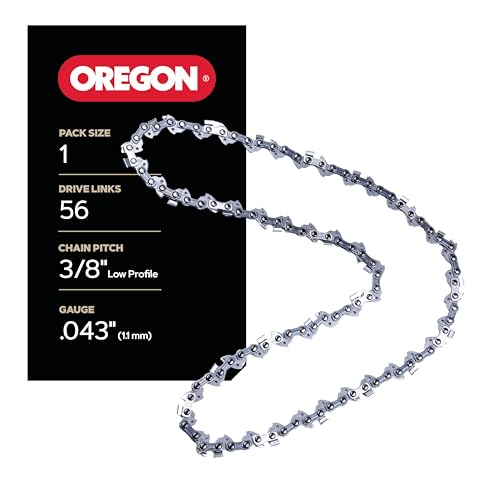
The drive links are the pointed triangular steel tangs on the bottom of the chain that ride inside the bar track and mesh with the drive sprocket. Drive link gauge refers to the precise thickness of these tangs, while pitch describes the centerline spacing between rivets. The drive link count is the total number of drive links around the complete loop. Together, these three values define whether a chain will physically fit your saw.
Matching Chain Pitch to Powerhead Displacement and Sprocket Design
Chain pitch defines the distance between drive links and dictates cutting tooth size. Mathematically, pitch equals the distance between any three consecutive rivets divided by two. Outdoor power equipment primarily utilizes four sizes: one-quarter inch, three-eighths inch Low Profile (often called 3/8 LP), .325 inch, and standard three-eighths inch. Specialized forestry operations occasionally employ .404-inch pitch on commercial timber saws.
Smaller pitch profiles like 3/8 Low Profile feature compact cutters that require minimal engine displacement to pull through timber. This makes low-profile chain standard equipment on compact gas saws up to 40cc, pole pruners, and modern battery-powered chainsaws. Because each cutter takes a modest bite of wood, these chains draw less battery power and significantly reduce rotational kickback energy.
In contrast, .325-inch and standard 3/8-inch pitch chains suit larger powerheads delivering substantial low-end torque. A .325-inch pitch works well on 45cc to 55cc rancher saws bucking seasonal firewood, delivering smooth cutting and rapid chip production. Standard 3/8-inch pitch features larger cutters built for 50cc to 90cc saws tackling dense hardwood logs. Never run a standard 3/8-inch chain on a 3/8 Low Profile drive sprocket, as mismatched profiles destroy the drive system.
Selecting the Correct Gauge to Protect Guide Bar Rails
Drive link gauge represents the thickness of the drive tangs that travel within the guide bar channel. The four common gauge sizes across the industry are .043 inch (1.1 mm), .050 inch (1.3 mm), .058 inch (1.5 mm), and .063 inch (1.6 mm). The chain gauge must match the inner width of the bar rails to maintain stability at cutting speeds exceeding fifty miles per hour.
Installing a .043-inch gauge chain onto a bar designed for .050-inch links creates excessive side-to-side play. This loose fit causes the chain to chatter, tilt in the cut, wander off line, and burr the bar rails. Conversely, forcing a .058-inch or .063-inch drive link into a .050-inch slot binds the chain completely, preventing manual rotation and overheating the centrifugal clutch.
Narrow kerf systems typically pair .043-inch gauge chains with matching slim bars to reduce cutting resistance on compact cordless saws. Standard residential and farm saws in North America rely predominantly on .050-inch gauge hardware due to its reliable durability and widespread availability. Professional loggers and European equipment setups frequently utilize .058-inch or .063-inch gauges to provide stiffer drive tangs that resist bending under sustained lateral loads.
Counting Drive Links: Why Stamped Bar Length Is Never Enough
A common buying mistake is purchasing a saw chain based purely on nominal guide bar length. An eighteen-inch bar from one manufacturer might require 68 drive links, while an eighteen-inch bar for another brand demands 72 drive links. Advertised bar length represents usable cutting reach measured from the front face of the powerhead to the bar tip, not the physical length of the steel bar.
The motor mount pattern, oil hole locations, and tensioner pin travel range determine the required link total. If a replacement loop has even one extra drive link, the tensioner screw bottoms out before removing slack. If the chain is one link too short, you cannot slip it over the sprocket and bar nose.
When bar stampings are unreadable, count the drive links on your existing loop. Remove the chain, lay it on a clean workbench, and mark one drive tang with chalk. Count every drive link around the entire perimeter until you return to the mark. This exact count guarantees that your new loop fits within your saw tensioner travel range.
Full-Chisel Versus Semi-Chisel: Matching Cutter Profiles to Wood Conditions
After confirming pitch, gauge, and drive link count, you must choose the cutter tooth geometry best suited for your woodcutting tasks. Modern chains feature either full-chisel or semi-chisel cutter profiles. Each shape exhibits unique cutting characteristics, edge retention limits, and sharpening requirements that affect your daily productivity.
Full-chisel cutters feature square 90-degree working corners that slice wood fibers with blistering efficiency. When bucking clean, green hardwoods like oak or maple, full-chisel loops produce large chips and fast cuts. However, that delicate square corner dulls quickly upon contacting abrasive grit. Touching sandy bark, dirt, or frozen mud rolls the square corner, drastically reducing cutting speed.
Semi-chisel cutters utilize rounded working corners that sever wood grain with a radiused edge. While semi-chisel cuts slightly slower than full-chisel in clean timber, its rounded edge tolerates abrasive dirt far better. It holds a sharp edge much longer when processing dirty bark, storm debris, or firewood seasoned on the forest floor. For suburban property owners and homesteaders, semi-chisel offers dependable, low-maintenance cutting.
Matching your cutting attachment to wood conditions prevents hours of wasted effort. Just as an operator relies on swinging an axe with controlled power to split tough rounds cleanly, choosing a durable semi-chisel chain avoids frequent sharpening stops during yard cleanup. Reserve full-chisel loops for clean firewood logs or small chainsaw milling projects where timber is completely free of soil.
Chain Sequences: Evaluating Standard, Semi-Skip, and Full-Skip Layouts
The arrangement of cutter teeth along the chain loop also impacts cutting speed and engine load. Standard sequence chains feature a cutter on every other tie strap, alternating continuously between left and right cutters. This standard configuration is the universal factory setup for consumer, ranch, and firewood saws equipped with guide bars under twenty-four inches.
Full-skip chains introduce wider spacing, placing two blank tie straps between consecutive cutter teeth. This configuration reduces the number of teeth cutting the timber simultaneously, which decreases mechanical drag on the powerhead. Professional sawyers run full-skip loops on guide bars measuring twenty-eight inches or longer mounted to high-displacement saws. The reduced cutter contact allows the engine to maintain operating RPM in broad hardwood trunks.
The generous gaps between cutters on full-skip chains also facilitate faster chip clearance in wide cuts where sawdust might otherwise clog the kerf. Semi-skip chains alternate between single and double spacer links to provide a middle ground. For everyday firewood processing with guide bars between sixteen and twenty inches, standard sequence provides the smoothest cutting action and lowest vibration.
ANSI Low-Kickback Safety Standards: Green Versus Yellow Chains
Rotational kickback remains one of the most serious hazards associated with wood-cutting power tools. Kickback occurs when the moving chain in the upper quadrant of the guide bar nose strikes solid wood or becomes pinched. The American National Standards Institute (ANSI) B175.1 standard establishes strict performance criteria to differentiate low-kickback consumer chains from unrestricted professional loops.
Consumer-grade chains carry a green label designation on their packaging to signify compliance with ANSI low-kickback standards. These loops feature raised bumper drive links and ramped depth gauges situated in front of each cutting tooth. These safety ramps deflect wood debris and limit the bite depth when the bar nose brushes against limbs, substantially reducing sudden rotational kickback energy.
Professional saw chains carry a yellow label warning and omit bumper drive links to facilitate smoother plunge cuts. However, yellow-label chains generate severe kickback forces if the guide bar tip makes accidental contact. Unless you are an experienced operator with specialized cutting training and mandatory safety gear, stick with ANSI-compliant green-label chains for routine cutting.
Sharpening Tooling and File Sizing for Replacement Chains
Maintaining a sharp cutter edge is vital for cutting performance, engine longevity, and operator comfort. Dull chains force the operator to apply excessive downward pressure, which overheats the guide bar rails and wears the drive sprocket. Sharpening requires round files sized specifically to your chain pitch, as an improper file diameter alters the top-plate cutting angle.
For instance, 3/8 Low Profile chains use a 5/32-inch round file, .325-inch pitch loops require a 3/16-inch file, and standard 3/8-inch chains utilize a 7/32-inch file. Comprehensive sharpening kits, like the Hipa 12 Pack Chainsaw File set, provide multiple file diameters including 5/32-inch, 3/16-inch, 7/32-inch, 1/8-inch, 11/64-inch, and 13/64-inch options. Having dedicated files along with universal handles ensures you can properly maintain various cutting attachments across your entire tool inventory.
Proper depth gauge or raker maintenance is equally essential alongside cutter filing. As cutters are filed back, the leading rakers must be lowered using a flat file and a progressive depth gauge tool to maintain clearance around .025 inch. Depth gauges that sit too high prevent the tooth from biting wood, producing fine dust instead of chips, while over-filed rakers cause violent grabbing and severe powerhead vibration.
Avoiding Common Fitment, Tensioning, and Lubrication Errors
Even with correct specifications, improper mounting causes immediate component damage. One common beginner mistake is mounting the loop backward on the guide bar. The sharp cutting edge of each top tooth must face forward toward the bar nose along the top rail. Installing a chain in reverse causes the flat heel of each tooth to strike the wood, generating friction smoke without making a cut.
Chain tension also requires careful calibration during initial setup and after the first few cuts. A brand-new chain undergoes minor mechanical seating and link stretching as it warms up under operational load. Use the snap test to verify tension: pull down on the bottom strand of chain and release it. The drive links should snap cleanly back into the groove without binding or hanging below the bar rails.
Never run a freshly mounted chain without confirming active bar and chain lubrication. Before making any cuts, aim the guide bar tip at a clean log or scrap cardboard and run the throttle at half speed for ten seconds. A distinct spray pattern of tacky bar oil should appear on the target surface, confirming that the oil pump passages and guide bar oil ports are completely clear.
Pre-Operation Verification Checklist for Safe Cutting
Before starting your saw with a new cutting loop, perform a quick mechanical walk-around. Verify that all drive links seat fully into the drive sprocket and that the inertia-activated front chain brake snaps firmly into position. Turn the chain along the guide bar by gloved hand with the engine switched off and the brake disengaged to ensure smooth travel without tight spots.
Always equip yourself with certified personal protective equipment before pulling the starter cord. Wear cut-retardant chainsaw chaps, heavy-duty leather gloves, steel-toe boots, eye protection, and a forestry helmet with a face shield and hearing protection. Checking your pitch, gauge, drive link count, and safety features ahead of time ensures that every cut on your property is clean, efficient, and secure.





Write Your Review
No reviews yet. Be the first to share your experience!