


Few shop frustrations compare to watching an expensive piece of walnut veer off your cut line because your blade refuses to track straight. Deep rip cuts generate massive amounts of sawdust that choke fine teeth, which causes friction, blade flutter, and annoying barrel cuts across your lumber. Upgrading your machine with the best bandsaw blade for ripping gives you the deep gullet volume needed to evacuate waste quickly before heat builds up along the band. Getting clean separation along the wood grain demands a blade that balances beam strength with sharp, aggressive tooth angles so your saw motor doesn’t bog down under continuous feed pressure.
Evaluating blade width, tooth pitch, and steel composition helps you match the right setup to your specific saw size and horsepower. Low-tension silicon steel and hardened carbon bands offer distinct advantages for shop owners tackling thick stock on benchtop units or floor-standing 14-inch machines. While a coarse pitch cuts fast, rough surfaces still benefit from quick passes on an oscillating sander for woodworking to get project-ready edges. Looking closely at published tooth geometry and tension requirements ensures your saw delivers reliable, drift-free ripping performance through every board.
Pros
- Thin kerf minimizes material waste, a big plus for costly hardwoods
- Deep gullet design speeds up cutting in thick stock without clogging
- Hardened tooth tips provide good wear resistance for extended use
- Precision weld helps maintain smooth tracking and consistent cut quality
- Exact 62" length ensures compatibility with common 9-inch benchtop saw models
Cons
- Requires careful setup of tension, tracking, and guides to achieve optimal performance
- 4 TPI is coarse, not ideal for fine curve cutting or thin stock
- Only fits saws that accept a 62-inch blade, limiting compatibility to specific models
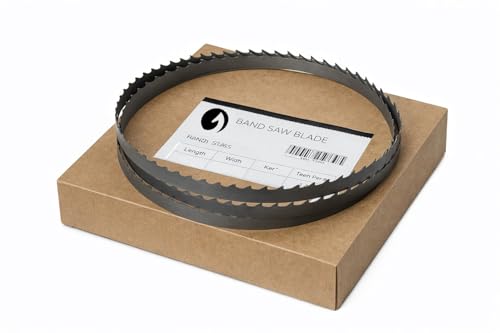
The Dark Stone 62-inch bandsaw blade is a replacement option designed for 9-inch benchtop band saws, offering a 1/2-inch width with a thin 0.020-inch kerf and 4 teeth per inch. This combination makes it especially suited for woodworkers, DIY homeowners, and contractors who frequently resaw or rip hardwood. The thin kerf reduces the amount of material removed during cutting, which can improve yield from expensive lumber like walnut, cherry, or maple.
In terms of real-world cutting performance, the deep gullet between each tooth creates space for chips to clear away quickly, which helps prevent binding and overheating when pushing through thick stock. The hardened tooth tips add a layer of wear resistance, meaning the blade maintains its edge longer than standard steel blades when used in demanding cuts. According to the product specs, these features work together to deliver fast, efficient cuts when the saw is properly set up.
Build quality is a focus here, with a precision weld that promotes consistent tooth geometry and stable tracking. The thin kerf design is a practical advantage in the workshop, as it leaves a narrower cut path and reduces the load on smaller benchtop motors. This blade is best used for straight cuts like ripping boards or resawing stock into thinner pieces. It isn't meant for intricate curves or scrolling work due to the relatively coarse 4 TPI tooth pattern.
Setup does require attention to detail. For reliable tracking and straight cuts, you need to adjust the blade tension, tracking alignment, and guide bearings according to your saw's manual. Once dialed in, many users find the blade runs smoothly and stays on track during longer cuts. Storage is straightforward since the blade can be coiled and stored in a drawer or on a peg hook. No case is included, but that's common at this price point.
A realistic limitation is that this blade only fits saws designed for a 62-inch length. Always verify your saw's blade length before ordering. Additionally, the 4 TPI will leave a somewhat rougher surface on your cuts compared to finer blades, so you may need to plane or sand the edges afterward for a smooth finish. For those focused on productivity and material conservation, this is a worthwhile blade. It delivers good value for woodworkers and shop users who prioritize fast resawing and minimal waste over fine finish cuts.

Pros
- Versatile selection covers resawing, curved contouring, and everyday shop cuts
- Hardened SK5 carbon steel teeth maintain a sharp edge across hardwoods and composites
- Smooth factory weld seams reduce chatter and produce cleaner surface finishes
- Cost-effective alternative to buying individual specialty band saw blades
Cons
- Designed exclusively for wood, plastics, and composites, not suitable for cutting metal
- The 1/8-inch blade requires careful saw guide alignment and tensioning to prevent twisting
The DARTOTEK 93-1/2 Inch Band Saw Blade 3-Pack is a specialized cutting accessory bundle designed for standard 14-inch stationary woodworking band saws. Built to streamline typical workshop cutting tasks, the assortment provides three distinct blade profiles: a 1/2-inch 6 TPI blade for straight-line resawing, a 1/4-inch 6 TPI blade for balanced curved and utility cuts, and a fine 1/8-inch 14 TPI blade for tight scrollwork and intricate decorative curves.
This bundle is particularly well-suited for DIY woodworkers, cabinetmakers, garage hobbyists, and furniture builders who need immediate versatility without purchasing individual specialty blades. From breaking down hardwood blanks and slicing veneer to shaping curved chair legs and cutting puzzle crafts, having these three sizes ready to mount on the saw keeps workshop projects running smoothly.
Manufactured with high-grade SK5 carbon steel, these blades feature precision heat-treated teeth engineered for long-lasting wear resistance and clean chip ejection. The ground, welded joints allow the loops to pass continuously through thrust bearings and guide blocks without the telltale thump common in lower-grade weld seams. This consistent tracking reduces cut chatter, helping woodworkers achieve smooth, predictable feed rates across oak, maple, pine, and composite sheet goods.
Setup on standard 14-inch band saws is straightforward, though attention to tracking and thrust bearing clearances remains essential, especially when mounting the delicate 1/8-inch scroll blade. For shop storage, the coiled blades pack away compactly on wall hooks or in standard blade organizers. Periodic cleaning with a pitch remover and slacking the saw tension during downtime will help maintain band elasticity and prolong service life.
While these blades excel in wood and plastic applications, they are carbon steel and are not intended for ferrous metals or abrasive masonry materials. Woodworkers seeking a practical, all-around blade set for their 14-inch machine will find this 3-pack a dependable, cost-conscious solution for both heavy stock preparation and detailed curve shaping.
Each blade in this assortment serves a clear practical role in the woodshop. The 1/2-inch 6 TPI blade provides the beam strength required for stable resawing, resisting lateral deflection and wandering when splitting thick hardwood boards into thinner project stock.
The 1/4-inch 6 TPI blade functions as a reliable everyday utility blade, offering ample balance between straight-line stability and smooth radius cutting for general furniture parts. For delicate scroll work and pattern making, the 1/8-inch 14 TPI blade turns tight corners effortlessly while leaving a clean edge that requires minimal finish sanding.
These blades are sized at 93-1/2 inches (7 feet 9-1/2 inches), which represents the factory standard loop length for most traditional 14-inch cast-iron woodworking band saws on the market.
They are compatible with popular 14-inch models from brands like Delta, Jet, Grizzly, Rikon, and similar workshop machines. Before mounting, users should confirm their specific machine requires 93-1/2 inch stock loops and does not require longer bands intended for saws equipped with riser block extensions.

Pros
- Versatile selection covers scroll cutting, general curve work, and basic resawing tasks
- Consistent factory welds promote smooth wheel tracking and steady feeds
- Direct fit for standard 9-inch benchtop workshop bandsaws
- Sharp tooth profiling yields clean cuts with minimal tear-out
Cons
- Not engineered for heavy structural steel or thick ferrous metals
- Narrow 1/8-inch blade requires careful tensioning to prevent twisting under load
- Specific 59-1/2-inch length will not fit 10-inch or larger standing bandsaws
The TASP 59-1/2-Inch Bandsaw Blade Set is a versatile cutting accessory kit designed specifically for 9-inch benchtop band saws. Offering three different blade profiles in a single package, this kit targets woodworkers, garage hobbyists, model builders, and home DIYers who need the flexibility to switch between fine scroll patterns and general-purpose rip cuts without buying blades individually.
Benchtop band saws often struggle when forced to use a single all-around blade for every task. This three-piece set solves that bottleneck by providing a 1/8-inch 14 TPI blade for intricate, tight-radius curves, a balanced 1/4-inch 6 TPI blade for general contour cutting, and a sturdier 3/8-inch 6 TPI blade for straighter cuts and light resawing. Based on product specifications and user feedback, each blade provides sharp, consistent teeth designed to eject sawdust efficiently and reduce heat buildup across extended cuts.
Material quality centers on high-carbon steel engineered with heat-hardened tooth tips and a flexible blade back. This metallurgical profile helps the blade flex smoothly over smaller 9-inch drive wheels without suffering premature stress cracks. Smooth weld joints are critical on smaller saws where bumpy seams disrupt guide bearings, and these blades feature clean factory welds to support reliable, wobble-free tracking across the wheels.
Setting up these blades requires standard band saw adjustment practices, including setting proper blade tension, tuning guide blocks, and adjusting thrust bearings. Because the blades come neatly coiled, they store easily in tool chests or wall-mounted shop pegboards. Routine maintenance simply involves keeping the tooth gullets free of pitch and resin buildup using a light shop solvent or wire brush.
While highly practical for everyday woodworking, these carbon steel blades are not intended for heavy structural iron or thick ferrous metals. They perform best in softwoods, hardwoods, acrylics, and thin non-ferrous stock like aluminum. For any home woodworker or craft maker wanting to expand their 9-inch saw capabilities without spending a fortune, this three-pack represents a sensible, high-utility shop investment.
These blades measure exactly 59-1/2 inches in total loop length, making them a standard replacement for many common 9-inch benchtop band saws. They are designed to fit popular machinery from brands such as Ryobi, WEN, Craftsman, Black & Decker, Skil, Tradesman, and Pro-Tech.
Before mounting, users should verify their specific machine requirements in the tool manual, as band saw wheel diameters and frame clearances dictate blade loop size. Using the proper length ensures correct tensioning range and prevents strain on internal tension springs or drive tires.
In real workshop applications, having three widths on hand improves project efficiency. The 1/8-inch blade allows craft makers and toy builders to cut intricate curves with tight turning radii, while the 14 TPI configuration minimizes splintering on delicate plywood and veneers.
For thicker stock, the 1/4-inch and 3/8-inch blades utilize 6 TPI skip-tooth arrangements that clear chips quickly to prevent burning. Whether cutting through oak boards, shaping PVC pipe, or trimming hobby stock, the tooth layout provides a dependable balance between cutting speed and edge smoothness.

Pros
- Milled teeth produce very smooth edge quality with minimal tool marks
- Runs under less tension than typical blades, putting less strain on the saw frame
- Flexible alloy steel resists fatigue failure during prolonged radius cutting
- Performs reliably across both softwoods and kiln-dried hardwoods
Cons
- Narrow 1/4-inch width is prone to wandering during straight resawing of thick stock
- Requires careful tension adjustment as it runs at lower tension than standard blades
The Timber Wolf 1/4-inch by 93-1/2-inch 6 TPI bandsaw blade is a specialized cutting accessory designed for curve cutting, template contouring, and general workshop joinery. Built from high-grade silicon steel rather than standard high-carbon stock, this blade is engineered to flex easily over wheels and deliver clean cuts without demanding excessive machine tension.
This blade is best suited for woodworkers, DIY makers, garage crafters, and patternmakers who regularly cut tight curves, bracket shapes, and small-to-medium decorative components. While contractors occasionally need a reliable bandsaw blade for trim scribing, this accessory truly shines in a dedicated woodshop where clean cuts and tight radius control directly reduce sanding time.
In practical cutting tasks, the milled tooth profile provides a noticeable advantage over standard stamped blades. Because each tooth is individually cut rather than punched, the cutting edge is razor sharp right out of the packaging. The 6 TPI positive claw design provides sufficient gullet clearance to eject chips cleanly in stock up to two inches thick, preventing heat buildup and surface scorching in dense hardwoods like cherry, walnut, and maple.
Build quality is centered around durability and tool longevity. The blade body uses a ductile Swedish silicon steel that resists micro-fracturing along the gullets, while precision induction hardening protects the tooth tips from rapid dulling. Because it requires roughly 20 to 30 percent less tension than conventional blades, it runs cooler and helps extend the lifespan of your bandsaw guide bearings, tension springs, and drive tires.
Setup is straightforward on standard 14-inch bandsaws that accommodate a 93-1/2-inch blade. Users should adjust guide blocks and thrust bearings carefully, setting tension slightly lower than usual to prevent excessive stretch. Keep in mind that a 1/4-inch blade is not made for heavy resawing or deep straight cuts, where wider blades like a 1/2-inch or 3/4-inch model would track better. For intricate scroll patterns and medium-radius shaping, this blade offers a dependable upgrade that enhances workshop productivity.
In standard workshop operations, tracking stability and edge retention are critical factors. This Timber Wolf blade holds its line predictably through tight curves down to approximately 5/8-inch radius without binding against the wood grain. The thin kerf reduces the strain on smaller benchtop and freestanding 14-inch motors, allowing faster feed rates without bogging down.
Dust extraction and chip clearing remain clean during continuous cutting, thanks to the positive claw rake angle. For hobbyists building band saw boxes, rocking chairs, or curved cabinet components, this accessory delivers smooth cut faces that require minimal cleanup with a rasp or oscillating spindle sander.

Pros
- High-grade Swedish silicon steel maintains sharp cutting edges through heavy hardwood milling
- Low-tension setup causes less wear on bandsaw guide blocks, thrust bearings, and tires
- Variable tooth pitch yields minimal vibration and chatter during deep resaw passes
- Direct compatibility with popular commercial 16-inch and 17-inch woodworking bandsaws
Cons
- The 132-inch length is specifically sized for select machines and will not fit standard 14-inch saws
- A 1/2-inch width is too broad for tight radius scroll cutting or delicate curve work
- Requires proper low-tension setup technique rather than standard high-tension blade tuning
The Timber Wolf 132-inch band saw blade, crafted by PS Wood, is an aftermarket cutting accessory engineered for demanding woodworking applications. Sized at a versatile 1/2-inch width with a variable 3/4 tooth-per-inch (TPI) profile, this blade is built for woodworkers, furniture makers, and serious home shop enthusiasts who require clean, reliable cuts across softwoods and dense hardwoods alike. It is directly sized to match larger workshop machinery, including the Laguna LT16, Shopfox 17-inch, and Harvey HW615P saws.
Where this blade stands out is its metallurgical construction. Built from Swedish silicon steel, the alloy features enhanced ductility and heat dissipation compared to traditional high-carbon blades. The defining benefit of the Timber Wolf design is its low-tension capability. Instead of over-cranking the saw tension knob to avoid blade drift, this blade tracks straight with significantly less beam tension. This reduction in load translates to prolonged life for your bandsaw bearings, thrust assemblies, and wheel tires.
In practical cutting performance, the variable 3/4 TPI tooth geometry plays a critical role in managing chip clearing and surface finish. The alternating tooth spacing interrupts harmonic frequencies that often cause blade chatter, resulting in a noticeably smoother off-the-blade surface. Whether slicing thin veneer laminates, ripping rough 8/4 lumber, or executing sweeping curved components, the blade tracks true with minimal barrel or deflection when properly tuned to the workpiece feed rate.
Maintenance and setup demand slight adjustments if you are accustomed to conventional carbon steel blades. To get the best results, users should follow low-tension setup procedures (often utilizing the flutter method) rather than relying strictly on the saw's built-in tension gauge markings. Keeping the gullets clean from pitch buildup with a simple citrus cleaner will help maintain smooth tracking and preserve the integrity of the heat-treated teeth over many board feet of cutting.
A realistic limitation is its specialized geometry. At 1/2-inch wide, it is well suited for straight milling and gentle sweeps, but it cannot make tight radius turns like a 1/4-inch or 1/8-inch scroll blade. Additionally, the 132-inch length is strictly tailored to specific intermediate-to-large capacity bandsaws. For woodworkers who own compatible machinery and want a clean-tracking, cool-running blade that simplifies resawing and lumber prep without punishing their equipment, this blade represents a reliable and cost-effective upgrade.
In a production workshop or serious home garage, machine downtime and inaccurate cuts cost valuable time and materials. The Timber Wolf low-tension profile delivers consistent tracking stability that helps eliminate blade drift, making fence alignment and precision rip cuts straightforward and repeatable.
The variable tooth spacing handles deep cuts without bogging down the saw motor or causing scorching on sensitive hardwoods such as cherry and hard maple. This efficient material removal minimizes wasted lumber and decreases the time needed at the jointer or planer during project dimensioning.

Pros
- Milled tooth geometry produces clean, fast cuts with reduced sawdust drag
- Requires lower blade tension, preserving machine guide bearings and tires
- Ductile alloy core provides excellent resistance to flex cracking
- Versatile balance between contouring capability and straight-line tracking
Cons
- 4 TPI tooth pitch is too coarse for stock thinner than 1/4 inch
- Not engineered for cutting ferrous metals or abrasive composites
- Requires careful tension adjustment rather than standard high-tension blade settings
The Timber Wolf 3/8-inch by 93-1/2-inch 4 TPI bandsaw blade is a specialized replacement accessory tailored for stationary vertical band saws. Built primarily for woodworkers, furniture makers, contractors, and DIY garage hobbyists, this blade targets common fabrication needs including dimensioning lumber, pattern cutting, and light resawing. Its standard 93-1/2 inch length aligns with the vast majority of 14-inch woodworking band saws found in home shops and commercial facilities.
Cutting performance stands out due to the brand milling process. Unlike standard carbon steel blades that utilize stamped or crush-ground teeth, this model uses precision-milled teeth that generate clean, sharp edges right out of the packaging. The 4 TPI spacing paired with a positive claw pattern clears sawdust efficiently, which helps prevent heat buildup when plowing through dense hardwoods such as walnut, maple, or cherry. The induction-hardened tooth tips maintain their keen edge longer than standard carbon steel, keeping feed resistance low and cuts predictable.
A critical advantage of this blade lies in its metallurgy. The blade body is fabricated from a ductile silicon-alloy steel that flexes smoothly around bandsaw wheels without work-hardening prematurely. This structural ductility allows the blade to run cooler and significantly extends flex life, reducing the risk of sudden blade breakage behind the gullets. Because it is engineered to track accurately under lower overall tension, it also reduces mechanical stress on your saw motor bearings, wheel shafts, and rubber tires.
Handling and dimensional versatility make this 3/8-inch profile a reliable daily driver in the shop. It is broad enough to track cleanly through straight rip cuts without wandering, yet narrow enough to maneuver around moderate radius curved workpieces. Users setting up this blade will appreciate the smooth tracking, though it does require setting the saw tension according to low-tension flutter methods rather than relying strictly on the built-in spring gauge on standard saws.
There are practical limitations to keep in mind before mounting it for every task. With a coarse 4 TPI layout, this blade is not suitable for ultra-thin veneers or delicate scroll cuts where fine tooth engagement is necessary to prevent chip-out. It is strictly optimized for timber, plastics, and non-ferrous materials rather than structural steel. For home hobbyists and professional woodworkers seeking a durable, low-stress utility blade that handles both curved and straight woodworking stock, this Timber Wolf blade offers dependable performance and long-term cutting value.
In standard woodworking applications, blade friction and heat buildup are the primary causes of premature tooth dulling and wandering cuts. The combination of milled tooth geometry and induction hardening on this Timber Wolf blade helps keep friction to a minimum, allowing the blade to maintain a straight kerf even during extended ripping sessions in hard maple and oak.
Because the blade is formulated to track properly at lower tension ratings, your bandsaw requires less frame-deflection compensation. This translates directly to smoother operation, reduced vibration across the work table, and less mechanical strain on guide bearings and wheel tires over hours of continuous workshop use.

Pros
- Affordable replacement blade for common 10-inch band saws
- Good balance of speed and finish with 3 TPI for general woodworking
- Carbon steel body offers decent durability for home shop use
- Easy to install and track on compatible saws
Cons
- Not ideal for heavy-duty production or thick metal cutting
- Single blade pack may require buying multiples for frequent resawing
- Some users report slight drift if saw is not properly tuned
The POWERTEC 72-1/2 Inch Bandsaw Blade (model 13223) is a purpose-built replacement blade designed for several popular 10-inch band saws, including the Delta 28-195, Sears Craftsman, Skil, and Dremel models. It measures 72-1/2 inches in length, 1/2 inch in width, and 0.025 inches in thickness, with a tooth configuration of 3 TPI (teeth per inch). This blade is aimed at woodworkers, DIY enthusiasts, and hobbyists who need a reliable, affordable blade for everyday cutting tasks in the workshop.
In terms of performance, the 3 TPI tooth pattern provides a good compromise between cutting speed and surface finish. It handles hardwoods like oak and maple, softwoods like pine, as well as plywood and MDF with minimal tear-out. The carbon steel body is heat-treated for wear resistance, and the welded joint is designed to withstand the stresses of continuous operation. According to product specifications, the flexible hard edge also allows for cutting non-ferrous metals such as aluminum and brass, making it a versatile choice for mixed-material projects. However, for frequent metal cutting, a bimetal blade would offer longer life.
Build quality is solid for the price point. The blade is made from premium carbon steel with a guaranteed weld, which reduces the risk of breakage at the joint. The tooth geometry is precision-ground to promote efficient chip removal and reduce binding. While not as durable as carbide-tipped or bimetal blades, this blade holds up well for light to moderate use in a home workshop or garage. It's best suited for DIY homeowners, woodworkers, and hobbyists who need a dependable blade for general resawing, curve cutting, and straight cuts in wood and soft metals.
Installation is straightforward: the blade fits most 10-inch band saws that accept 72-1/2 inch blades. Users should ensure their saw's tension and tracking are properly adjusted for best results. Maintenance involves keeping the blade clean and dry to prevent rust, and storing it in a safe place when not in use. The blade does not come with a storage case, so users may want to use a blade holder or hang it on a pegboard to avoid damage.
A realistic limitation is that this blade is not designed for heavy production work or thick metal cutting. The 3 TPI is relatively coarse, which may leave a rougher finish on thin materials. Some users have noted that blade drift can occur if the saw is not perfectly tuned, but this is common with many bandsaw blades. For those who frequently resaw thick stock or cut hard metals, a specialty blade would be more appropriate.
Overall, the POWERTEC 72-1/2 inch bandsaw blade offers good value for its price. It's a practical choice for DIY woodworkers, garage users, and hobbyists who need a replacement blade that delivers clean cuts on a variety of materials. If you own a compatible 10-inch band saw and need a reliable blade for general workshop projects, this is a solid option to consider.
Frequently Asked Questions
What is the ideal tooth count for ripping hardwood on a bandsaw?
A blade with 3 to 4 TPI (teeth per inch) is ideal for ripping thick hardwood stock. Fewer teeth create larger gullets between cutting tips, allowing the blade to carry away coarse sawdust before it compacts against the cut face. Using 6 TPI or higher on thick boards packs the gullets with dust, causing friction and burning. Coarse teeth keep the cut running cool and reduce motor strain.
Why does a bandsaw blade wander or drift off the cut line during rip cuts?
Blade wander occurs primarily from insufficient blade tension, dull teeth, uneven tooth set, or misaligned guide blocks. When feed pressure pushes against a loose or dull band, the blade body twists inside the kerf instead of cutting straight through wood fibers. Adjusting thrust bearings close to the blade back and aligning your rip fence to the natural drift angle solves this wandering issue. Selecting a sturdy best bandsaw blade for ripping with strong beam stiffness prevents the band from bowing sideways.
Can benchtop 9-inch or 10-inch bandsaws handle wide 1/2-inch ripping blades?
Yes, provided the blade features a thin kerf design and your saw manufacturer explicitly supports 1/2-inch bands. Compact benchtop saws with smaller wheel enclosures struggle to tension heavy standard-gauge steel bands properly. Specialized options like the Dark Stone 62-inch blade feature a thin 0.020-inch body that tensions smoothly without bending wheel axles. Always verify the maximum blade width listed in your machine manual before buying.
What makes Swedish silicon steel different from standard carbon steel blades?
Swedish silicon steel runs cooler and requires lower overall machine tension than traditional high-carbon steel bands. Silicon alloy blades flex around bandsaw wheels with less metal fatigue, which helps prevent premature cracking at the weld joint. This ductility lets the blade run true under moderate tension, placing less mechanical strain on saw bearings and cast frames. Carbon steel blades remain budget-friendly but tend to wear down faster under heavy resaw loads.
How wide should a bandsaw blade be for straight ripping compared to curve cutting?
Use the widest blade your machine can tension properly, typically 3/8-inch to 1/2-inch for benchtop saws and up to 3/4-inch for larger tools. Wider blade bodies provide longitudinal beam strength that resists front-to-back deflection under heavy feed pressure. Narrow bands flex easily through straight grain, leaving wavy lines that require cleanup with a compact detailing sander or jointer. Pairing a wide blade with a tuned fence ensures flat, parallel cuts.




Write Your Review
No reviews yet. Be the first to share your experience!