


Crooked cutoff passes and blade flutter can ruin expensive metal stock in seconds, turning simple fabrication projects into frustrating scrap runs. A rigid saw frame paired with smooth hydraulic downfeed control solves this problem by keeping continuous, hands-free downward pressure right where the teeth meet the workpiece. Based on manufacturer specifications and builder feedback, selecting the best horizontal bandsaw means balancing motor horsepower, throat capacity, and adjustable blade speeds. Heavy cast iron bows soak up vibration, allowing the blade to track true whether you are cutting structural tubing or solid brass bar stock.
Wobbling blade guides and flimsy sheet-metal vises often force fabricators to spend extra hours squaring up ends on a grinder or prepping parts using a da sander for bodywork. Reliable workshop cutoffs demand dual-voltage motors, solid miter clamping, and steady coolant systems that prevent heat buildup across extended cuts. We examined core motor ratings, gearbox setups, and vise flexibility across leading models like Jet and VEVOR to highlight durable options designed to slice straight stock without stalling workshop progress.

Pros
- Powerful 1.1kW motor with dual voltage capability (110/220V) for reliable performance in home shops or commercial settings.
- Hydraulic downfeed with automatic shut-off reduces fatigue and extends machine life.
- Precise angle cuts up to 45 degrees with a lockable scale for repeatability.
- Versatile material compatibility: cuts steel, aluminum, brass, wood, and plastic with speed changes.
- Portable design with wheels and relatively compact footprint for a machine of this capacity.
Cons
- Heavy at over 300 pounds; two people may be needed for final positioning despite wheels.
- Blade changes require some disassembly and alignment adjustments – not a quick swap for multi-material jobs.
- Limited to 7x12 inch rectangular capacity; larger stock may require multiple passes or a bigger saw.
The VEVOR Metal Horizontal Band Saw is a capable workhorse that brings professional-grade cutting power to home workshops, garages, and light industrial settings. With a 1.1 kW motor and the ability to cut metal, wood, and plastic in both horizontal and vertical orientations, this machine is built for versatility. The four adjustable speeds let you dial in the right blade speed for each material – from 86 FPM for tough steel to 260 FPM for softer woods or plastics – which helps produce cleaner cuts and extends blade life.
This band saw is best suited for DIY homeowners who tackle heavy fabrication, mechanics cutting exhaust pipes or chassis components, contractors needing on-site trimming, and woodworkers who occasionally work with metal inserts or hardware. The 7x12 inch rectangular capacity handles common stock sizes without constant repositioning, and the vertical mode turns the saw into a compact contour cutting station for curved shapes. The quick-lock clamp plate rotates 0-45 degrees with a locking scale, so miter cuts are accurate and repeatable without extra layout work.
In real-world use, the hydraulic downfeed is a standout feature. It lowers the blade smoothly through the cut, reducing operator fatigue and preventing blade binding. When the cut finishes, the automatic shut-off stops the motor – a simple safety feature that also protects the machine from running dry. The cast iron construction provides rigidity that dampens vibration, even during heavy cuts in 1/4-inch steel plate. The chip guard keeps most debris contained, and the emergency stop button is within easy reach for quick shutdowns.
Build quality is solid: the frame is heavy-duty cast iron with a powder coat finish, and the blade guides are adjustable to maintain tracking. The rolling wheels are a practical addition for moving the saw around a shop, though at 304 pounds you will want to lock the wheels during use. The included 5/8 TPI blade works well for general-purpose cutting, but users who frequently cut thin sheet metal or delicate materials may want to swap to a finer tooth blade – a straightforward process once you learn the tension and tracking adjustments.
Storage and maintenance are straightforward. The saw’s footprint is about 47 by 17 inches, so it will fit against a wall or in a corner, and the wheels make it easy to roll out for use. Periodic blade cleaning and tension checks are the main tasks; the bearings and gears are sealed and require minimal attention. The dual voltage wiring (pre-wired 110V) is a bonus for shops with 220V outlets, offering flexibility without a transformer.
Realistically, the weight is the biggest limitation – if you need to move it between floors or into a basement, you will need help or a lift. The 7x12 inch capacity is generous for a saw in this price range, but very large stock will require multiple passes. For the vast majority of garage, workshop, and construction tasks – from cutting rebar and angle iron to trimming wood and PVC – this saw delivers reliable, accurate cuts that save time compared to abrasive chop saws or handheld tools. VEVOR backs it with a reasonable warranty, and replacement blades are widely available. If you need a versatile steel-cutting bandsaw that can handle both straight and contour work, this model is a practical investment that will earn its place on your shop floor.
The VEVOR band saw is built around a heavy-gauge cast iron frame that provides the mass and rigidity needed for vibration-free cutting. The base is equally robust, with four locking casters that keep the machine planted during operation. The blade guides are adjustable and made from hardened steel, and the pulleys run on sealed bearings. Paint finish is durable powder coat that resists chips and oil stains. The quick-lock clamp plate is cast iron with a zinc-plated screw mechanism, and the angle scale is clearly laser-etched for easy reading. Overall, the build matches other mid-range industrial band saws, with attention to the critical wear points.
With four speed settings ranging from 86 to 260 FPM, this saw adapts to different materials without straining the motor. The 1.1kW motor (1.5 hp equivalent) provides enough torque to cut through 1/2-inch steel plate at the lowest speed without bogging down. The hydraulic downfeed allows you to set a controlled descent rate, which is especially useful for thin-walled tubing or delicate profiles that might deform under pressure. The vertical mode adds contour cutting capability – you can saw curves, notches, and internal cutouts by rotating the head 90 degrees. This versatility makes it valuable for fabrication shops that need one machine for both straight stock and custom shapes.
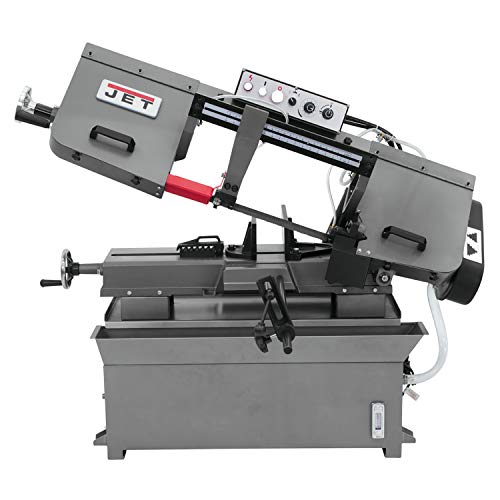
Pros
- Generous 9-inch by 16-inch rectangular cutting capacity easily handles structural beams, pipe, and bar stock
- Smooth hydraulic feed control prevents operator fatigue and eliminates blade bounce during heavy cuts
- Massive 625-pound cast base and frame provide rigid stability that dampens vibration
- Dual-voltage wiring option makes it adaptable to both residential garage subpanels and commercial shops
Cons
- Hefty 625-pound footprint requires dedicated shop floor space and lifting equipment to position
- Coolant reservoir and chip collection tray require routine cleaning to prevent fluid stagnation
- Capacity and price point are geared strictly toward heavy fabrication rather than light hobby use
The JET HBS-916 is a commercial-grade horizontal metal cutting band saw built to tackle demanding stock preparation in fabrication shops, manufacturing plants, automotive repair garages, and structural welding operations. Designed around a heavy cast-iron frame and a high-capacity vise assembly, this stationary tool is engineered specifically for metal fabricators, millwrights, and serious trade workers who require continuous, square cuts across heavy structural tubing, solid round stock, and angle iron.
At the center of its cutting performance is a 1.5 HP single-phase motor capable of running on standard 115-volt power or step-up 230-volt circuits. The dual-voltage flexibility makes it straightforward to integrate into various workshop electrical configurations. Feed rates are managed through a fully adjustable hydraulic downfeed system paired with an independent on and off control valve. This mechanism delivers uniform downward pressure through tough cuts, preventing the blade from dropping too quickly into hollow sections or skating over hardened alloys, which significantly reduces the risk of stripped blade teeth.
Blade tracking and longevity benefit from carbide-faced blade guides backed by parallel double-row ball bearings. This rigid guide arrangement keeps the blade tracking straight under load to prevent drift on wide cross-sections. In addition, an integrated flood coolant system directs fluid straight through the guide blocks onto the cutting zone, suppressing friction heat and flushing debris. A built-in, self-propelled wire brush actively cleans metal swarf out of the tooth gullets before each pass, avoiding chip re-cutting and preserving tooth edges over extended runs.
Material handling is made efficient through the quick-positioning vise, which features fully adjustable jaws that swivel up to 45 degrees. Operators can switch between square cuts and angled miter cuts quickly without wrestling with complicated clamps. Below the cutting area, an oversized chip tray captures stray shavings and fluid run-off, helping prevent slippery workshop floors and cutting down on post-project cleanup time.
Potential buyers should consider the substantial physical footprint and 625-pound overall weight of this machine. It is designed to be a permanent fixture in a shop rather than a mobile tool, requiring equipment like a forklift or engine hoist for initial placement. For industrial maintenance departments, fabrication facilities, and commercial welding shops needing dependable metal cutoff throughput, the JET HBS-916 delivers rigid construction, reliable accuracy, and consistent long-term cutting performance.
In heavy fabrication environments, repeatable square cuts are critical to reducing fit-up time during welding and assembly. The heavy cast iron construction dampens harmonic vibrations that normally cause rough finishes on cut ends. Combined with precision carbide guides, the tool produces clean, uniform surfaces across mild steel, stainless stock, and structural channel.
The hydraulic downfeed mechanism allows operators to set an optimal drop rate and attend to other tasks around the shop while the machine completes the cut automatically. Once the cut finishes, the shutoff trip mechanism powers down the blade, ensuring safe, unattended completion during repetitive multi-piece cut lists.

Pros
- Hefty 805-pound construction absorbs vibration for clean, chatter-free cuts
- Hydraulic downfeed offers reliable hands-free operation during repetitive production cuts
- Direct-reading tension gauge takes the guesswork out of blade setup
- Built-in coolant tray design keeps workshop floors cleaner and safer
Cons
- Substantial weight and footprint demand a dedicated, permanent floor location
- Requires a dedicated 230V single-phase circuit, which may not be available in standard home garages
The JET HBS-1018W is a stationary horizontal bandsaw engineered specifically for metalworking, structural fabrication, and machine shop environments. Driven by a 2 HP motor operating on 230V single-phase power, this tool is built for processing substantial raw stock, including heavy pipe, square tubing, and solid bar material. It serves as a core workhorse for professional fabricators, maintenance technicians, structural contractors, and dedicated metal artists seeking reliable production capability.
Cutting performance centers around a controlled hydraulic downfeed system. Rather than relying on operator force or basic gravity drop, the fully adjustable hydraulic cylinder allows users to fine-tune downfeed pressure based on material hardness and wall thickness. Paired with an independent on/off valve, cuts can be paused or resumed without losing the set feed rate. Once the blade finishes clearing the workpiece, an integrated automatic shutoff switch cuts motor power, which promotes safe operation and frees the operator to tackle other tasks in the workshop.
Durability is reinforced by the saw's massive 805-pound cast and steel framework. This substantial mass plays a critical role in dampening motor and blade vibration, leading to smoother surface finishes and longer blade life. Setup precision is aided by a large handwheel paired with a built-in tensioning gauge, allowing proper blade tension without additional measurement tools. The unit also features an active, self-propelled blade brush that sweeps away metal shavings before they re-enter the cut, protecting both blade teeth and guide bearings from abrasive buildup.
Workholding and cleanup are handled through practical shop-focused features. The quick-positioning vise features adjustable jaws that swivel up to 45 degrees, simplifying angle cuts without requiring tedious re-clamping. Below the cutting area, a proprietary oversized chip tray catches swarf and fluid runoff, substantially reducing mess around the tool base. Maintenance primarily involves regular fluid management, cleaning out the chip pan, and checking guide alignment.
The primary limitations of this machine stem from its industrial scale. Tipping the scales at over 800 pounds, moving it requires heavy equipment, and the dedicated 230V electrical requirement means smaller hobby garages might need an electrical upgrade before installation. For professional fabrication facilities, commercial maintenance departments, and high-output metal shops, the JET HBS-1018W represents a dependable, long-term cutting platform designed for steady production throughput.
In a production workshop or fabrication bay, throughput depends heavily on consistent feed rates and dependable clamping. The hydraulic downfeed mechanism on this model eliminates uneven blade pressure, reducing blade drift on tough alloys and thick-walled structural steel.
Thermal and chip management also contribute directly to cut accuracy. The oversized chip tray handles wet-cutting coolant systems effectively, while the integrated mechanical brush prevents swarf packing in the teeth. These features combine to provide reliable square cuts across extended daily cycles.

Pros
- Versatile horizontal and vertical operation for cross-cutting and contour sawing
- Precision ball bearing blade guides deliver straight, clean cuts
- Heavy-duty steel stand ensures long-term durability and stability
- Auto shut-off feature enhances safety and allows hands-free use
- Easy mobility with large wheels and integrated handle
Cons
- Weighs 115 pounds, which may be heavy for some users to move without assistance
- Premium price point may be a consideration for budget-conscious buyers
- Blade not included, requiring an additional purchase
The JET HVBS-56 is a 5-inch by 6-inch metal cutting band saw that operates in both horizontal and vertical modes, offering flexibility for a range of workshop applications. This tool is best suited for mechanics, contractors, woodworkers, and serious DIY homeowners who need reliable, accurate cuts in metal stock, tubing, and bar stock. Its dual capability means you can use it as a cutoff saw or as a vertical bandsaw for contour work, making it a versatile addition to any garage or professional shop.
In terms of performance, the 1/2 HP motor with three speed options provides plenty of torque for cutting through steel, aluminum, and other metals. The heat-treated steel worm gear and bronze drive gear are designed to handle heavy use without premature wear. Fully-adjustable ball bearing blade guides keep the blade tracking straight, which translates to cleaner cuts and less blade drift. The automatic shut-off feature is a practical safety addition, allowing the saw to stop on its own after a cut is complete - a real timesaver for repeat operations.
Build quality is a standout with this saw. The 14-gauge steel stand and integrated shelf offer rigidity and convenient storage for accessories or workpieces. Large wheels and a handle make it easy to roll the saw around the shop, and the front leveling legs help stabilize it on uneven floors. The motor and electrical components are CSA certified, ensuring they meet North American safety standards. The overall construction feels substantial and built to last.
Setting up the JET HVBS-56 is straightforward, though its 115-pound weight means you'll want a helper for unboxing and assembly. Once in place, the saw is easy to operate with clear controls and adjustable blade tension. Maintenance is minimal, primarily keeping the blade guides clean and occasionally lubricating the gearbox. The included shelf is handy for keeping blades or coolant nearby, though you'll need to purchase your own blade and coolant if you plan to use it for wet cutting.
A realistic limitation is its weight and premium pricing. At 115 pounds, it's not a portable tool you'll toss in a truck easily, though the wheels help with shop movement. Also, the saw is designed primarily for metal cutting - while it can handle some non-ferrous materials, it's not ideal for wood or plastics. However, as a dedicated metal cutting bandsaw in a professional shop or serious home workshop, it delivers excellent value.
Overall, the JET HVBS-56 is a solid investment for users who require reliable, precise metal cutting day after day. Mechanics cutting exhaust tubes, contractors fabricating brackets, or woodworkers working with metal accents will appreciate its versatility and build quality. If you have the budget and the space, this saw will serve you well for years to come.
The JET HVBS-56 is built with heavy-duty materials throughout. The steel stand is made from 14-gauge steel, offering excellent rigidity and minimal vibration during cuts. The gearbox houses a heat-treated steel worm gear and a bronze drive gear, which provide smooth power delivery and long service life. Adjustable ball bearing blade guides reduce friction and extend blade life. The motor is CSA certified, and the entire saw has a durable gray powder-coated finish that resists rust and wear. Large diameter wheels with a sturdy handle allow for easy movement, while the front leveling legs ensure stability on any surface. This is a saw designed to withstand the rigors of a busy workshop or job site.

Pros
- Solid cast iron base and bow provide exceptional vibration dampening and cutting stability
- Hydraulic downfeed with auto shut-off allows safe, hands-free cutting cycles
- Miter adjustments up to 45 degrees swivel without requiring the operator to reposition long stock
- Four-step pulley system easily matches blade speed to metal hardness
- Integrated wheels help maneuver the heavy machine around the workshop floor
Cons
- Substantial weight over 400 pounds requires dedicated lifting equipment or multiple people during delivery and setup
- Speed adjustments require manual belt repositioning across pulleys rather than an electronic dial
- Requires significant floor space, making it better suited for dedicated fabrication shops than cramped garages
The VEVOR Metal Horizontal Band Saw is a floor-standing cutoff machine engineered for structural metal fabrication, automotive repair, and heavy workshop maintenance. Based on manufacturer specifications, this unit operates as both a horizontal cutoff saw and a vertical contour bandsaw. It is tailored toward professional fabricators, machine shop operators, farm mechanics, and dedicated DIY metalworkers who require consistent, straight cuts through dense tube, angle iron, and solid bar stock that abrasive chop saws struggle to process cleanly.
Powered by a 1.1 kW motor running at 1680 RPM, the saw supports dual voltage operation. While pre-wired for standard 110V outlets, it can be converted to 220V circuits to suit industrial electrical setups. The drive system utilizes a step-pulley mechanism with four distinct speeds: 86, 132, 178, and 260 feet per minute. Lower speeds provide the necessary bite and thermal protection for tool steels and stainless materials, while higher speeds slice efficiently through softer aluminum, brass, and plastics. The broad 7 x 8.25-inch rectangular capacity accommodates oversized workpieces that standard compact benchtop saws cannot hold.
Structural rigidity is a primary strength of this machine, thanks to its heavy cast iron components. The rigid bow minimizes blade deflection, ensuring cuts remain square over long cycle times. Material clamping is managed by a quick-lock vise with manual fine-adjustment screw threads that prevent stock slippage under heavy downfeed pressure. Instead of loosening and repositioning long tubing to achieve angled joints, the bow base pivots smoothly from 0 to 45 degrees with an integrated angle scale, simplifying clean miter cuts for weld prep.
Operational convenience centers around the hydraulic downfeed system. Users can adjust the cylinder valve to dictate exact cutting rates depending on material hardness and cross-section thickness. Once the blade finishes the cut, an integrated limit switch triggers automatic motor shut-off, protecting the workpiece and blade from over-cycling while freeing the operator to prep the next cut. An emergency stop switch and protective chip guards provide standard workshop safety during high-volume production cycles.
Prospective buyers should account for the physical footprint and mass of this bandsaw. Weighing over 400 pounds, uncrating and initial assembly demand careful planning and adequate shop equipment. Speed changes require manually slipping the V-belt across the pulley sheaves, which takes a few moments compared to electronic variable dials. For metal fabrication facilities, automotive chassis builders, and mechanical repair garages needing reliable, burr-minimized cutoff performance without abrasive dust, this band saw represents a sturdy and practical workshop investment.
In daily workshop fabrication, cutting speed and thermal management dictate blade life. The four-speed pulley setup on this saw allows operators to select the optimal surface speed for varied alloys, reducing tooth stripping on stainless materials and preventing gumming when slicing structural aluminum. The included 93-inch blade with 5/8 TPI tooth spacing offers a balanced profile suitable for varied cross-sections and mixed wall thicknesses.
The dual-configuration design expands its utility beyond simple 90-degree stock cutoff work. When placed into vertical orientation, users can perform contour cuts, notch sheet goods, and trim custom brackets. The hydraulic feed regulator ensures smooth descent without operator intervention, producing square cuts that reduce subsequent surface grinding time prior to welding.
Built primarily with heavy-gauge cast iron components, the saw bow and base deliver the mass required to neutralize cutting harmonics. The substantial weight keeps the unit anchored to the floor during tough passes through solid billet, preventing chatter that degrades surface finish and wears out teeth prematurely.
The quick-acting vise mechanism features solid clamping jaws designed to resist flexing against cylindrical tubing and irregular profiles. Mobility is addressed through integrated steel wheels and a pull handle, allowing users to shift the saw when rearranging workspace or clearing floor area for long stock handling.

Pros
- Dual horizontal/vertical capability handles both cutoff and contour cutting without needing a second machine
- Toolless quick lock vise with preset miter angles speeds up repetitive cuts and improves workflow
- Robust cast iron construction and flanged blade wheels deliver long-term durability and reliable performance
- Built-in coolant system reduces heat and friction, extending blade life and improving cut quality
Cons
- Heavy at 374 pounds, making it less portable for those without a dedicated workshop or hoist
- Premium pricing may be a barrier for DIY homeowners or hobbyists on a tight budget
- Learning curve for vertical mode operation and coolant system maintenance for first-time users
The JET 7" x 12" Deluxe Metal Cutting Horizontal/Vertical Band Saw (model HVBS-712D) is a serious piece of equipment designed for professional metalworkers, contractors, mechanics, and advanced workshop users. This saw combines horizontal cutoff capability with vertical contour sawing, giving you two machines in one footprint. With a 3/4 HP motor that runs on 115 or 230V single-phase power, it's built to handle tough jobs in fabrication shops, auto repair garages, and construction job sites.
Who is this saw best suited for? It's ideal for contractors who need accurate, repeatable cuts on metal stock, mechanics cutting exhaust pipes or brackets, and woodworkers who occasionally work with non-ferrous metals. The built-in coolant system and chip tray are a big plus for production environments where blade life and clean cuts matter. DIY homeowners might find it overkill unless they have heavy metalworking needs, but for serious hobbyists with a dedicated workshop, it's a worthwhile investment.
Performance-wise, the JET HVBS-712D delivers smooth, precise cuts thanks to its flanged cast iron blade wheels and sturdy frame. The toolless quick lock vise with preset miter positions at 15, 30, and 45 degrees makes angled cuts fast and repeatable. The coolant system helps reduce heat buildup, which improves cutting efficiency and extends blade life. Users can expect clean edges with minimal burrs, reducing secondary finishing work.
Build quality is excellent. The saw features a heavy-duty steel stand with a built-in storage cabinet and chip tray, keeping your workspace organized. The four 8-inch rubber wheels allow for easy repositioning, though at 374 pounds, it's not a tool you'll move around casually. The large 9x12 infeed table provides solid support for longer workpieces, enhancing accuracy during horizontal cuts. The blade wheels are made from flanged cast iron, which adds durability and ensures smooth blade tracking over time.
Setup and maintenance are straightforward for a machine of this class. The saw comes mostly assembled, and the manual provides clear instructions for adjusting blade tension, tracking, and coolant flow. The chip tray and coolant system require regular cleaning to prevent buildup, but that's standard for any wet-cutting band saw. The storage cabinet is a nice touch, keeping blades, wrenches, and coolant nearby.
One realistic limitation is the weight. At 374 pounds, you'll need a dedicated spot in your shop or a heavy-duty cart to move it. The price tag is also on the high side, so it's best for professionals or serious enthusiasts who will use it frequently. However, if you need a versatile, durable metal cutting saw that can handle both horizontal and vertical work, the JET HVBS-712D is a top-tier choice that will serve you well for years.
The JET HVBS-712D is built like a tank. The frame and stand are constructed from heavy-gauge steel, and the blade wheels are flanged cast iron for long-term durability. The vise is a toolless quick-lock design with preset miter stops, so it stays accurate even after repeated use. The coolant system components are well-integrated, and the chip tray is removable for easy cleaning. Overall, this saw feels solid and professional, with no cheap parts or flimsy components.
In the workshop, this saw excels at cutting steel, aluminum, and other metals cleanly and quickly. The horizontal mode is perfect for cutting stock to length, while the vertical mode allows for contour cutting, notching, and even light woodworking. The coolant system keeps the blade cool and lubricated, reducing heat distortion and extending blade life. Users report that cuts are smooth and accurate, with minimal vibration thanks to the heavy base and cast iron wheels.
Switching between horizontal and vertical modes is straightforward, though it does require some manual adjustment. The toolless vise makes clamping quick and secure, and the preset miter stops speed up angled cuts. The saw's controls are intuitive, with a clear on/off switch and an adjustable blade guide. The four rubber wheels make it easy to roll into position, though you'll want a smooth floor. Overall, it's user-friendly for anyone familiar with band saws.
Frequently Asked Questions About the Best Horizontal Bandsaw
Can a horizontal bandsaw cut wood effectively?
Yes, but only if you adjust the blade speed and tooth pitch to match wood stock. Wood requires higher blade speed than structural steel, so running a bandsaw at low metal-cutting speeds like 86 FPM will cut wood very slowly and can scorch the fibers. Setting the pulley drive closer to 260 FPM with a coarse-pitch blade yields cleaner results, though fine furniture parts might still need edge smoothing on a oscillator sander.
What blade speed in FPM works best for structural steel?
Blade speeds between 80 and 140 FPM work best for mild and structural steel. Lower blade speeds prevent excessive friction and heat buildup, which rapidly dulls blade teeth and work-hardens steel stock. Saws with stepped pulleys offer settings around 86 to 132 FPM specifically to keep bimetal teeth cutting efficiently without stripping.
What causes a horizontal bandsaw blade to cut at an angle?
Loose blade tension, worn guide bearings, and excessive downfeed pressure are the primary causes of angled cuts. When the hydraulic cylinder forces the saw bow down faster than the teeth can clear chips, the blade flexes laterally between the guides. Tightening the blade tension handwheel and sliding the adjustable blade guide arms as close to the stock as possible keeps the cut perpendicular.
Do you need a flood coolant system for everyday workshop cutting?
No, dry cutting works fine for thin tubing, plastics, and intermittent cuts, but flood coolant is essential for solid bar stock and high-volume runs. Coolant flushes away metal swarf from the kerf and dramatically lowers cutting temperatures, preventing blade tooth fatigue. Larger floor models feature integrated pumps and oversized chip trays specifically to keep blades cool during continuous workshop cutting.
Can a 1.5 HP or 2 HP horizontal bandsaw run on a standard 115V wall outlet?
No, while 1.5 HP dual-voltage motors can run on 115V circuits, 2 HP motors usually demand a dedicated 230V single-phase circuit. A 1.5 HP motor wired for 115V can draw upwards of 15 amps during heavy startup torque, which risks tripping standard household breakers. Larger saws come pre-wired for 230V to guarantee stable power delivery without overheating workshop wiring.
Why is an automatic shut-off switch important on a metal bandsaw?
An automatic shut-off switch is a vital safety and machine protection feature that cuts motor power the second the cut finishes. Once the saw bow completes its downward travel, a mechanical trip arm triggers the limit switch. This stops the motor immediately, preventing unnecessary blade wear, eliminating wasted electricity, and allowing you to step away safely during long cutoff cycles.



Write Your Review
No reviews yet. Be the first to share your experience!