


Blade drift throwing a rip cut off the layout line wastes valuable stock and tests any woodworker’s patience. Thin stamped frames flex under feed pressure, while weak motors bog down the moment you push a thick piece of maple through the cut. Selecting the best entry level bandsaw requires looking past basic catalog numbers to examine frame stiffness, wheel balance, and guide stability. After analyzing manufacturer motor specifications and user feedback on fence alignment, it becomes clear that dependable performance starts with solid construction. Even when rough curved cuts leave saw marks behind, pairing your cuts with an oscillator sander for woodworking helps clean up parts quickly.
A reliable setup gives you the confidence to tackle tight scroll work, straight ripping, and small-scale resawing without endless realignment headaches. Features like precision-ground cast iron wheels, balanced dynamic tires, and dual dust extraction ports make a massive difference in daily shop routines. Based on a detailed comparison of motor ratings, throat capacities, and user feedback, investing in solid baseline hardware prevents annoying blade flutter right out of the box. Whether you need an instructional deep dive on blade tuning or a compact 10-inch machine with serious resaw height, starting with the right gear keeps your cuts true and your projects on schedule.
Pros
- Comprehensive coverage of band saw selection, setup, use, and maintenance
- Practical troubleshooting section helps solve common issues quickly
- Written in clear, accessible language suitable for beginners and experienced users
- Focuses on real-world workshop and garage applications
Cons
- Focuses on band saws only, not covering other saw types
- Some techniques may require additional practice to master
- Physical book format may not be as convenient as a digital reference for some users
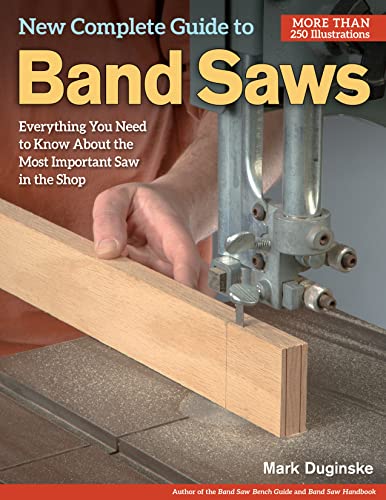
The New Complete Guide to Band Saws from Fox Chapel Publishing is a thorough resource for anyone who owns or plans to own a band saw. This book covers the entire spectrum of band saw ownership, from choosing the right machine for your workshop to setting it up for peak performance, using it effectively for various cuts, and maintaining it for long-term reliability. Whether you are a DIY homeowner tackling weekend projects, a woodworker crafting furniture, or a contractor needing precise cuts on the jobsite, this guide provides practical, step-by-step advice.
Band saws are often called the most important saw in the shop because of their versatility. This guide helps you unlock that potential by explaining blade selection, tensioning, and tracking for different materials and cuts. You will learn techniques for resawing, cutting curves, making joinery cuts, and even using jigs for repetitive work. The book emphasizes safety and efficiency, helping you get the most out of your band saw while minimizing waste and frustration.
Build quality of the book itself is solid, with clear diagrams, photographs, and easy-to-follow instructions. The content is organized logically, starting with the basics and progressing to advanced techniques. The troubleshooting section is particularly valuable, addressing common problems like blade drift, vibration, and poor cuts, and offering practical solutions. This makes the guide a handy reference to keep near your saw for quick problem-solving.
For workshop and garage users, this book is a practical investment. It helps you avoid costly mistakes by guiding you through proper setup and maintenance, which can extend the life of your band saw and improve its performance. The maintenance tips cover cleaning, lubrication, and blade care, ensuring your saw stays in top condition for years. The book also discusses storage and organization of blades and accessories, which is useful for keeping your workspace tidy.
One realistic limitation is that the book focuses solely on band saws, so if you need guidance on other saw types, you will need additional resources. Also, some techniques, like advanced resawing or joinery, may require practice to master, but the book provides a solid foundation. Overall, this guide is an excellent resource for anyone serious about woodworking or using a band saw in a professional or hobbyist setting.
Based on product specifications and user feedback, this guide is highly recommended for woodworkers, DIY enthusiasts, contractors, and workshop users who want to improve their band saw skills and get the most out of their equipment. It is a practical, no-nonsense reference that will pay for itself many times over in improved cuts, reduced waste, and fewer headaches. If you own a band saw, this book belongs on your workbench.

Pros
- Cast iron wheels provide exceptional stability rarely seen on 10-inch benchtop models
- Substantial 5.75-inch resaw clearance expands versatility for slicing thicker lumber
- Quiet, dependable 1 HP induction motor handles challenging grain patterns smoothly
- Dual dust collection ports help maintain a cleaner and healthier workshop environment
Cons
- Heft of 95 pounds requires a very sturdy workbench or dedicated mobile base
- Requires LTL freight delivery coordination and scheduled curbside drop-off
- Throat depth remains limited to 10 inches for wider sheet goods or large curved panels
The Laguna V:10 represents a thoughtful upgrade to the compact benchtop bandsaw category. Built around a capable 1 HP induction motor and a robust frame, this machine gives woodworkers the precision and cutting capacity typically reserved for larger floor-standing units. Rather than cutting corners with lightweight stamped components, Laguna built this tool for consistent accuracy across curved cuts, rip work, and detailed scrollwork.
This bandsaw is particularly well suited for small-shop woodworkers, garage hobbyists, furniture makers, and DIY craftspeople who need dependable performance without dedicating half their workspace to machinery. For cabinet makers needing to trim small components or carvers cutting blanks from hardwoods, the tool provides reliable power delivery and refined control right on a standard shop bench.
Real-world cutting efficiency stands out thanks to the combination of a continuous-duty 1 HP induction motor and heavy cast iron wheels. The extra mass in the wheels creates valuable flywheel inertia, smoothing out feed resistance when pushing dense materials like maple, oak, or walnut through the blade. With a 5.75-inch resaw height, users can slice thin project veneers and bookmatched panels that would stall or exceed the capacity of lesser benchtop saws.
Build quality is apparent across the design, from the rigid steel housing to the dual-port dust collection system. The thru-table extraction design helps pull chips away directly beneath the cutline, keeping the work surface clear and reducing airborne dust in enclosed garage spaces. An integrated LED light illuminates the cutline clearly, while the extra 120V outlet on the machine frame adds convenience for additional work lamps or shop accessories.
Because the unit weighs in at approximately 95 pounds and ships via freight, initial unboxing and placement require some planning. Setting up proper blade tension and tracking is straightforward, but users will want a flat, sturdy bench to anchor the machine. While the 10-inch throat naturally limits cut widths on broad sheet materials, the vertical clearance and motor strength offer outstanding capability within its footprint.
For woodworkers seeking high precision and durability in a compact package, the Laguna V:10 offers an exceptional balance of power, dust control, and structural stability. It serves as a dependable cutting station capable of handling demanding custom projects for years of shop use.
Vibration dampening is a critical factor for achieving clean bandsaw cuts, and the cast iron wheels on the Laguna V:10 make a noticeable difference in blade stability. The added rotational mass keeps the blade tracking true along curved layout lines and reduces drift during straight rip operations.
Dust management is another area where this model excels in typical home shops. By utilizing dual extraction ports, including below-table suction, the saw directs waste away before it can pack into internal wheel housings or obscure user sightlines, promoting cleaner air and longer blade life.
Frequently Asked Questions
What motor horsepower should you look for in the best entry level bandsaw?
At least 1 HP on a standard 120V circuit is ideal for general woodworking. While smaller benchtop models often feature 1/3 HP or 1/2 HP motors, they tend to bog down when cutting hardwoods thicker than two inches. A 1 HP induction motor draws manageable amperage on common household breakers while supplying the steady torque needed for light resawing.
Can a 10-inch benchtop bandsaw handle resawing lumber?
Yes, provided the machine offers at least 5 to 6 inches of vertical resaw capacity. Modern compact machines like the Laguna V:10 deliver up to 5.75 inches of resaw height alongside rigid cast iron wheels that support proper blade tension. You will want to install a dedicated 1/2-inch wide blade with 3 or 4 TPI to clear sawdust efficiently through thick cuts.
How do you eliminate blade drift on a compact bandsaw?
Aligning the rip fence parallel to the natural travel line of the blade eliminates wandering cuts. Blade drift usually happens when uneven tooth set or poor tracking forces the blade off a straight line. Adjusting tracking to center the blade on crowned tires and fine-tuning guide bearing clearance prevents stock from binding against the fence.
Why are cast iron wheels preferable to aluminum wheels?
Cast iron wheels provide superior rotational inertia and vibration damping compared to lighter aluminum alternatives. The added flywheel weight maintains cutting momentum when feeding dense hardwoods, preventing sudden RPM drops. This extra mass also keeps the machine anchored, smoothing out cut surfaces so you spend less time cleaning up edges with a detailing sander for tight spaces.
What dust collection port size works best for small shop bandsaws?
Dual ports or a single 4-inch port connected to active extraction deliver the cleanest results. Bandsaws produce fine airborne particles that quickly pack into the lower wheel housing if airflow is inadequate. Models featuring thru-table extraction or 2-1/2 inch to 4-inch ports direct dust away from rubber tires, preserving tracking stability and shop air quality.
What blade widths are best for entry-level workshop projects in 2026?
Blades ranging from 1/8 inch to 1/2 inch provide the most versatile performance across typical shop tasks. A narrow 1/8-inch or 1/4-inch blade easily cuts tight curves and scroll patterns without binding in the kerf. For ripping or resawing thicker boards, moving up to a 1/2-inch blade provides the beam strength needed to prevent scalloped cut surfaces.





Write Your Review
No reviews yet. Be the first to share your experience!