


Demolition projects inside vintage homes often turn messy when crumbling lime mortar and hidden metal lath quickly ruin standard cutting blades. Excessive vibration shakes the entire wall loose, causing jagged plaster blowout and messy dust throughout the work area. Selecting the best saw blade for lathe and plaster prevents ragged edges and spares you from constantly swapping ruined accessories mid-cut. Tough abrasive plaster rapidly dulls standard carbon steel, while hidden nails can snap delicate teeth instantly. Getting a clean opening requires a blade with fortified tooth geometry, bi-metal construction, or tough carbide grit designed specifically to endure intense abrasive resistance.
Renovators tackling historic homes often face the same aggressive wear that tradespeople encounter during demolition work and cutting fence panels, where unexpected fasteners hide behind older materials. Based on manufacturer specifications and user feedback, blades built with 6 TPI reinforced teeth or carbide coatings help stabilize the cut line while keeping blade chatter under control. The right blade also minimizes unnecessary plaster cracking around electrical boxes and plumbing cutouts, saving hours of patching compound later. Whether you need a flexible reciprocating saw blade for plunge cuts or an abrasive rod blade for intricate shapes, matching tooth count to wall density makes all the difference.

Pros
- Reinforced teeth hold up better against unexpected nails and fasteners inside plaster walls
- Narrow profile geometry supports tight-radius cuts and precise scribing outlines
- Anti-stick coating helps reduce gumming and friction during extended cuts
- Practical 5-pack provides reliable back-up blades for multi-room remodeling tasks
Cons
- 6-inch length is not intended for extra-deep structural timbers or thick layered demolition
- Coarse 6 TPI profile is focused on plaster removal rather than smooth, splinter-free trim work
- Specialized profile is less suitable for heavy metal pipe or structural steel cutting
The DEWALT DW4851 Reciprocating Saw Blade set is a specialized accessory tailored for cutting plaster during renovation, repair, and electrical rough-in projects. Older plaster and lath walls present serious challenges for general-purpose demolition blades, which can quickly dull or bind when encountering abrasive plaster matrices and hidden fasteners. This five-pack provides remodelers, trade professionals, and DIY homeowners with blades designed specifically to overcome those obstacles.
A primary highlight of these 6-inch blades is their unique profile geometry. Unlike wide, rigid demolition blades built strictly for straight-line tearing, these blades feature a profile that allows for tight radius cuts. This capability aids users who need to scribe cutouts, trace irregular patterns, or create access openings for junction boxes, plumbing fixtures, and drywall patches without unnecessarily blowing out surrounding plaster surfaces.
Durability is reinforced through a strengthened tooth profile engineered to endure contact with nails and foreign objects hidden within walls. When opening up wall assemblies, hitting an old wire nail or framing fastener is common. The reinforced tooth design helps prevent tooth stripping, keeping the blade cutting longer than standard thin-kerf wood blades under similar conditions.
DEWALT also treats these blades with an anti-stick coating formulated to minimize friction and prevent gumming. Cutting through old wall material, plaster dust, and adhesive residue often causes heat build-up and binding. The low-friction finish promotes smoother strokes and supports cleaner dust evacuation along the cut line.
While this blade set is capable and focused, it does have natural boundaries. The 6-inch length and 6 TPI configuration prioritize maneuverability and rapid plaster clearance over ultra-smooth finishing cuts or deep structural demolition. Users cutting heavy-gauge metal pipes or seeking mirror-clean finish cuts in cabinetry will want dedicated metal or fine-tooth blades.
For anyone tackling renovation work involving plaster, lath, and wall scribing, the DEWALT DW4851 5-pack is a sensible, specialized accessory purchase. It delivers the tooth toughness, reduced friction, and steering control needed to navigate difficult wall surfaces reliably.
The 6 TPI tooth configuration on the DEWALT DW4851 provides an aggressive bite that cuts through plaster and underlying wood lath without immediately clogging. The tooth spacing leaves adequate gullet space to clear abrasive pulverized plaster and debris quickly.
Thanks to the anti-stick coating, the blade moves with reduced resistance through dense wall sections. This helps keep tool motor strain manageable and aids in keeping stroke cadence consistent throughout tricky plunge cuts or sweeping curved passes.
Pros
- Exceptional finish quality with minimal tear-out on crosscuts and miters
- Thin kerf allows for efficient cutting with smaller motors and less blade binding
- Compatible with a wide range of 10-inch saws, including some sliding compound miter saws
- Affordable price point for a carbide-tipped blade with 80 teeth
Cons
- Thinner kerf may flex under heavy rip cuts or dense material, not ideal for rough lumber
- Arbor size is fixed at 5/8 inch; reducers may be needed for saws with smaller arbors
- Limited user reviews available to confirm long-term durability
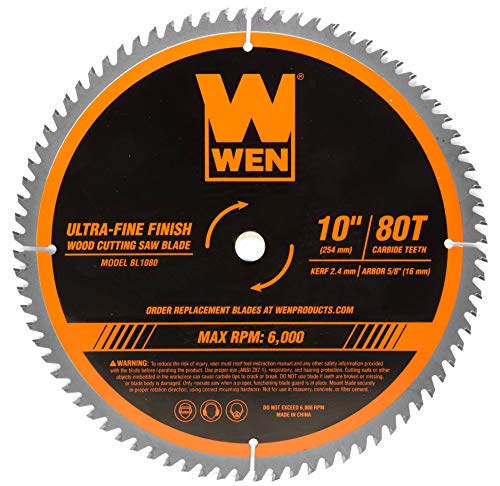
The WEN BL1080 is a 10-inch, 80-tooth carbide-tipped saw blade designed specifically for finish work on miter saws and table saws. It's built for woodworkers, DIY homeowners, contractors, and cabinet makers who demand clean, splinter-free cuts in hardwoods, softwoods, and plywood. Whether you're trimming baseboards, cutting crown molding, or making precise miter joints, this blade aims to deliver professional-grade results without breaking the bank.
In real-world use, the 80 teeth and thin 1/10-inch kerf work together to reduce tear-out and produce a smooth edge that often requires little sanding. The carbide tips stay sharp through extended use on materials like oak, maple, and pine. With a maximum rating of 6000 RPM, it handles fast cuts on most standard saws without bogging down. For workshop users focused on finish carpentry or fine woodworking projects, this blade offers noticeable improvements over general-purpose blades.
Build quality is solid for the price. The blade body is made from a silver-coated steel that resists corrosion, and the carbide teeth are securely brazed. While professional blades from premium brands may use thicker steel or more advanced coatings, the WEN BL1080 holds its own for light to moderate use. The 5/8-inch arbor fits most common saws, but if your saw uses a smaller arbor, you'll need a reducer ring (not included).
Storage and maintenance are straightforward. Keep the blade clean with resin remover and store it in a blade guard or case to protect the teeth. WEN does not include a storage case, so you may want to pick up a blade sleeve or keep it in the original packaging. The blade's lightweight design (just over 1.5 pounds) makes it easy to swap between saws without much hassle.
A realistic limitation is that the thin kerf isn't ideal for heavy rip cuts on thick stock. The blade can flex under pressure, leading to less accurate cuts or potential binding. It's best reserved for crosscutting, mitering, and finer ripping in materials up to about 1.5 inches thick. Additionally, since there are no user reviews yet, long-term durability is unproven, but WEN's reputation for value-oriented tools suggests it should hold up well for most hobbyists and DIY projects.
Overall, the WEN BL1080 is a smart buy for anyone who wants clean, finished cuts without spending a lot. It's especially suited for DIY woodworkers, garage workshop users, and contractors who do a lot of trim or cabinet work. For heavy-duty ripping or high-volume production, you may want a thicker kerf blade, but for everyday finish cuts, this blade delivers reliable performance at a great price.

Pros
- Fits standard 12-inch hacksaw frames without needing specialized mounting hardware
- Bonded carbide grit design eliminates broken or dulled teeth on abrasive stock
- High heat and wear resistance supports cuts through difficult composite and masonry surfaces
- Lightweight and compact for simple toolbox storage alongside standard hacksaw blades
Cons
- Cuts via abrasion rather than shearing teeth, resulting in slower stock removal
- Produces fine abrasive dust during use that requires proper cleanup and ventilation
- Sold as a single-blade pack, so heavy-duty projects may require stocking spares
The RemGrit E0406180 is a specialized 12-inch by 0.100-inch rod saw blade engineered to turn a common hacksaw frame into an abrasive cutting tool. Unlike traditional stamped hacksaw blades with standard teeth, this blade uses carbide particles permanently bonded to an alloy steel rod. It is designed specifically for remodelers, plumbers, tile installers, and DIY homeowners who occasionally run into hard, abrasive materials that would immediately strip or ruin a conventional high-speed steel or bi-metal blade.
In practical cutting situations, standard toothed blades struggle or snag when facing materials like ceramic tile, cement board, fiberglass, hardened plastics, or abrasive composites. The RemGrit rod blade operates on an abrasive grinding action rather than chipped teeth. Because there are no teeth to snag or break off, it maintains consistent cutting action even through dense, gritty workpieces, providing the heat resistance necessary to withstand friction buildup during manual cuts.
Build quality centers around the alloy steel rod core, which provides structural rigidity while tensioned inside a standard hacksaw frame. The 0.100-inch round rod profile also provides omnidirectional cutting capability, allowing users to make curved cuts, follow irregular contours, or change cutting direction in tight spaces where a flat blade would bind against the kerf. The overall package weighs just 0.06 pounds, making it an effortless addition to any hand tool kit.
Setup is identical to changing any standard hacksaw blade. You loosen the frame tensioner, hook the blade pins onto the mounting studs of your 12-inch hacksaw frame, and retension securely. Because the rod uses an abrasive grit edge, it produces fine particulate matter during use. Maintaining a clean work surface and wearing appropriate eye and respiratory protection according to general tool safety guidelines is always recommended when cutting abrasive materials.
There are practical limitations to keep in mind before buying. Because rod saw blades cut via abrasive friction, they remove material noticeably slower than aggressive toothed blades on softer materials like wood, copper, or mild steel. It is not intended to replace standard hacksaw blades for routine metal fabrication, but rather to serve as a specialized solution for tough, abrasive items where conventional teeth fail.
For homeowners and tradespeople who need a reliable, low-cost problem solver in their toolbox, the RemGrit E0406180 rod saw blade offers dependable abrasive cutting capability. It fits the hacksaw frame you already own and provides the heat and wear resistance needed to get through tricky, abrasive cuts without ruining expensive cutting tools.
The RemGrit E0406180 measures 12 inches in length with a 0.100-inch rod diameter, designed specifically to mount into standard 12-inch hacksaw frames. Its end mounting pins hook directly into standard frame tensioning studs, requiring no special adapters or proprietary tools.
Because of its round rod profile and tooth-free carbide grit coating, this blade cuts on both forward and backward strokes, providing greater cutting versatility and smooth multidirectional movement compared to directional flat blades.

Pros
- Versatile blade selection covers most common cutting needs in wood, metal, and demolition
- Universal shank fits almost all reciprocating saws, offering broad compatibility
- Blades are made from durable materials that hold up well to regular use
- Compact storage case helps keep blades organized and prevents loss
- Good value for a comprehensive set, suitable for both DIYers and professionals
Cons
- Some users may find the included blades not as aggressive as specialized single-purpose blades for heavy demolition
- Storage case could be more robust for frequent jobsite transport
- Limited information on specific blade materials and tooth configurations may leave some users unsure of best use cases
If you are looking for a versatile set of reciprocating saw blades that can handle a variety of cutting tasks around the home, workshop, or jobsite, this kit from B0CSYHKQJW is worth a closer look. Designed to fit most major reciprocating saw brands, these blades are intended for cutting wood, metal, and demolition materials, making them a practical addition to any tool collection.
This blade set is well-suited for DIY homeowners tackling weekend projects, mechanics cutting through exhaust pipes or brackets, contractors performing rough-in work, and woodworkers needing quick cuts in lumber. The assortment includes blades with different tooth configurations, allowing you to switch between materials without needing to buy separate packs. For general renovation, construction, or even plumbing repairs, this set provides a solid starting point.
In terms of real-world performance, the blades are designed to deliver efficient cuts with minimal effort. The precision-ground teeth help maintain a straight cutting line, which is especially helpful when working with metal or thick wood. While they may not be as aggressive as specialized blades for heavy demolition, they hold up well for most common cutting tasks and offer a good balance between speed and blade life. Users can expect reliable cutting performance for jobs like pruning branches, cutting PVC pipe, or trimming lumber.
Build quality appears to be a focus here, with blades constructed from durable materials that resist wear and corrosion. The universal shank ensures a secure fit in most reciprocating saws, reducing blade wobble and improving cutting accuracy. The included storage case is a nice touch, keeping the blades organized and protected when not in use. It fits easily into a toolbox or can be stored on a shelf, making it convenient for both workshop and jobsite use.
One realistic limitation to consider is that the set may not include specialized blades for very heavy-duty demolition or for cutting extremely hard metals. Users who frequently tackle intense demolition work might prefer to supplement this set with a few heavy-duty blades. Additionally, the storage case, while functional, may not withstand rough handling on active construction sites as well as a more rugged case would.
Overall, this reciprocating saw blade set offers a practical and cost-effective solution for anyone who needs a versatile cutting tool kit. It is a smart choice for DIYers, mechanics, contractors, and workshop users who want a reliable assortment of blades that can handle a wide range of materials. For the price, it provides good value and is likely to meet the needs of most general cutting applications.

Pros
- Designed specifically for abrasive wall materials like drywall and plaster
- 6-inch length is well suited for controlled wallboard cutouts without excessive overhang
- Swiss manufacturing origin offers solid build quality and tooth consistency
- Coarse 6-TPI pitch clears gypsum and plaster debris quickly
Cons
- Abrasive plaster and old lath will naturally accelerate tooth wear over extended use
- Coarse 6-TPI profile is not intended for clean woodworking, thin sheet metal, or fine trim
- Package contains a single blade, which may require stocking extras for large remodel projects
The Makita 723060-A-5 is a specialty reciprocating saw blade engineered specifically for cutting drywall and plaster. In residential remodeling and electrical work, standard wood-cutting or metal-cutting blades often bind, tear paper facing excessively, or dull quickly against abrasive gypsum and lath. This accessory addresses those challenges directly by providing a dedicated tooth layout intended for wallboard tasks, making it a sensible addition for remodelers, drywall contractors, electricians, plumbers, and DIY homeowners tackling interior alterations.
Featuring a 6-inch overall length and a coarse 6-TPI (teeth per inch) configuration, the blade balances cutting speed with user control. The 6-inch profile is practical for interior wall work, offering sufficient reach to penetrate standard drywall panels while minimizing the excess blade protrusion that can risk contacting hidden framing, pipes, or wiring behind the wall. The aggressive 6-TPI spacing facilitates rapid chip and dust clearance through gypsum core material, helping prevent binding during plunge cuts and long vertical runs.
Manufactured in Switzerland, the Makita 723060-A-5 reflects strict manufacturing tolerances in its tooth geometry and blank construction. The blade features a black finish and a standard reciprocating saw shank configuration designed to fit compatible reciprocating saws. Its rigid body helps resist bending when starting plunge cuts into solid wallboard, which is essential for creating clean openings for junction boxes, access panels, or pipe pass-throughs.
In daily handling, swapping this blade into a reciprocating saw requires following the standard tool-free or keyed clamp mechanism of your specific saw model. At roughly 0.2 pounds, keeping a few of these blades in a reciprocating saw case or jobsite pouch adds negligible weight. Because drywall and plaster cutting creates fine gypsum dust, matching the cut with proper jobsite dust containment and eye protection is recommended. Regular inspection of the teeth between cuts helps identify dulling caused by hidden masonry or metal fasteners behind plaster walls.
While this blade is well suited for gypsum board and plaster, it has clear material limitations. The coarse 6-TPI tooth profile will produce splintered edges in finish lumber, trim, or plywood, and it is not engineered for cutting through steel conduit, structural framing nails, or structural masonry. Users tackling older homes with wire lath behind plaster should anticipate faster tooth wear compared to cutting modern sheetrock.
For anyone planning interior wall modifications, electrical cut-ins, plumbing access holes, or selective wall demolition, the Makita 723060-A-5 offers a focused, reliable cutting solution. It delivers the right tooth pitch and length for wallboard tasks without forcing you to ruin general-purpose wood blades on abrasive materials.
The Makita 723060-A-5 reciprocating saw blade is explicitly cataloged for drywall and plaster applications. Its 6-TPI tooth spacing provides generous gullet room to eject pulverized gypsum and lime-based plaster, reducing the buildup that can cause friction and blade binding during continuous cuts.
For best results when making cutout boxes or patch repairs, starting with a slow plunge cut allows the 6-inch blade to establish a clean entry point. Because plaster and drywall are inherently abrasive, using a dedicated blade like the 723060-A-5 preserves your primary wood-cutting and metal-cutting blades for their intended materials, ensuring cleaner results and longer life across your entire blade collection.

Pros
- Formulated specifically for plaster and lath, which notoriously dulls standard wood-cutting blades
- Standard 1/2-inch shank fits all conventional reciprocating saws without special adapters
- Heavy-duty 0.050-inch blade thickness resists excessive bending and flex during aggressive wall cuts
- Matrix II cutting edge with 8% cobalt offers high hardness (65-67 HRC) for prolonged cutting life
Cons
- The 6-inch blade length may limit reach when cutting through exceptionally deep wall assemblies or thick framing
- A coarse 6 TPI pattern can leave rough edges that require cleanup on finished drywall repairs
- Plaster is inherently abrasive, so regular blade rotation is still required during extensive demolition
The IVY Classic 28318 6-Inch 6 TPI Bi-Metal Reciprocating Saw Blade 5-Pack is built specifically to address one of the most frustrating tasks in home renovation: cutting through plaster board and plaster-and-lath walls. Remodelers, electricians, plumbers, and DIY homeowners tackling older homes quickly discover that gritty, abrasive plaster destroys standard wood or metal blades in seconds. This specialized set provides a dedicated cutting solution engineered to handle composite wall surfaces without prematurely stripping teeth.
In practical wall-opening applications, the blade relies on a 6 TPI (teeth per inch) pitch paired with a rigid 0.050-inch thickness and 3/4-inch width. That dimensional stability helps reduce blade chatter and unintended flexing when initiating a plunge cut directly into existing interior walls. The tooth spacing is aggressive enough to evacuate powdery plaster waste and wooden lath debris quickly, helping the reciprocating saw maintain a steady cutting rhythm without bogging down in plaster mesh or rough backing.
Material construction is the key strength of the IVY Classic Cobalt AdvantEDGE design. Each blade utilizes bi-metal construction with an 8% Cobalt Matrix II cutting strip electron-welded to a flexible alloy-steel backer. The precision-milled teeth achieve a hardness rating of 65-67 HRC, giving the cutting edge the necessary toughness to resist the dulling friction caused by sand-heavy plaster, gypsum, and hidden fasteners embedded in old walls.
Installation is straightforward because the blade features a standard 1/2-inch universal shank. It fits directly into virtually any keyless or keyed reciprocating saw clamp mechanism, whether you run a corded demo saw or an 18V/20V cordless tool platform. Because the set includes five blades, you can tackle multi-room renovations or multiple electrical box cutouts without having to pause your workflow to hunt for a replacement.
There are practical limitations to keep in mind before cutting. At 6 inches in overall length, this blade is optimized for standard interior partition walls; it may not provide enough stroke clearance if you need to reach through deep furring, multi-layer siding, or deep structural framing. Additionally, the aggressive 6 TPI tooth pattern prioritizes cut speed through lath and plaster rather than glass-smooth edge quality, meaning cosmetic patchwork will still require standard drywall finishing techniques.
For any homeowner or trade professional faced with cutting old plaster walls, installing retrofit junction boxes, or performing surgical wall demolition, the IVY Classic 28318 5-pack delivers targeted durability. It effectively bridges the gap between fast wood blades and hard metal blades, making it a reliable and cost-effective accessory to keep in your tool bag.
The IVY Classic 28318 reciprocating saw blades feature a standard 1/2-inch universal shank designed to seat securely in standard reciprocating saw chucks. Whether your reciprocating saw uses a quick-release lever, a twist-collar blade clamp, or a traditional hex-screw interface, this shank profile ensures broad cross-brand compatibility.
Always verify that your saw is powered off or that the battery is disconnected before swapping blades. Make certain the blade tang is fully inserted into the blade clamp and locked in place according to your reciprocating saw manufacturer instructions before beginning any cutting operation.
Pros
- Dedicated blade profile designed specifically for plaster and drywall cutting tasks
- Universal shank fits most standard commercial reciprocating saw chuck mechanisms
- High-grade steel construction with a wear-resistant protective orange coating
- Affordable 2-pack provides a backup blade for household renovation projects
Cons
- A 2-pack quantity may be too small for full-scale commercial demolition projects
- Not engineered for heavy structural lumber, embedded nails, or metal cutting
- Manufacturer does not specify exact blade length or tooth-per-inch (TPI) rating
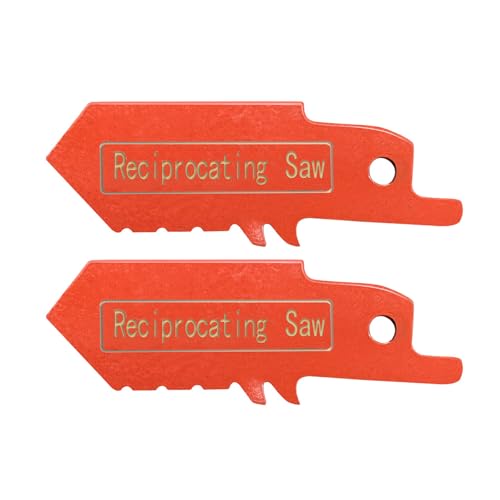
The Verplexter 2-Pack Reciprocating Saw Blades are specialized cutting accessories designed specifically for slicing through drywall, plaster, and related interior wallboards. Tailored for remodelers, electricians, plumbers, and DIY homeowners, these blades offer a targeted cutting solution when opening up walls for pipe repairs, running electrical conduit, or removing damaged wall sections. Rather than dulling an all-purpose wood or pruning blade on abrasive gypsum, having a dedicated wallboard accessory helps keep your tool kit organized and efficient.
In real-world remodeling, cutting into existing drywall and plaster demands control to avoid tearing the paper backing or crumbling delicate lath. These Verplexter blades feature an engineered tooth profile suitable for wallboard materials, allowing users to make plunge cuts and outline access openings smoothly. The universal shank interface is designed to lock securely into standard reciprocating saw chucks, including widely used cordless and corded models from DeWalt, Milwaukee, Makita, and Ridgid.
Durability is an essential factor when cutting abrasive materials like plaster, which can rapidly wear down standard high-carbon steel blades. Verplexter constructs these blades from high-quality steel and adds a protective orange exterior coating intended to resist friction, surface abrasion, and premature wear. This coating supports consistent cutting action as you work around wall studs and track along cut lines in dusty jobsite conditions.
Installing and handling these blades is straightforward thanks to standard reciprocating saw mounting geometry. As with any saw accessory change, users should always ensure the power tool is disconnected from its power source or that the battery pack is removed prior to inserting the blade into the clamp. The high-visibility orange finish makes the blades easy to spot inside a crowded tool bag or toolbox drawer, helping you quickly grab the right blade for interior wall tasks.
There are some realistic limitations to consider before purchasing. This set includes only two blades, which may not be enough for extensive, whole-house demolition projects where multiple replacements are needed. Additionally, these blades are specialized for drywall and plaster; they are not intended for cutting framing studs, nail-embedded timber, structural metal, or masonry. The product data also omits explicit length and tooth-per-inch (TPI) specifications, so buyers requiring exact blade depths will need to confirm dimensions for their specific project needs.
Overall, the Verplexter 2-Pack Drywall and Plaster Reciprocating Saw Blades offer solid practical value for budget-conscious homeowners and trade professionals tackling targeted drywall repairs, fixture rough-ins, or light remodeling work. Their broad tool compatibility and material-specific design make them a handy addition to any reciprocating saw setup.
The Verplexter reciprocating saw blades are engineered with universal tang compatibility, allowing them to mount into standard tool-free and keyed blade clamps across major power tool manufacturers. The product data lists compatibility with major commercial reciprocating saw platforms, including Milwaukee, DeWalt, Makita, and Ridgid.
Before installing, always verify that your reciprocating saw utilizes a standard reciprocating saw shank rather than a proprietary interface. Following standard safety guidelines, disconnect the power cord or remove the battery before inserting, locking, or removing blades from your reciprocating saw.
These blades are specifically engineered for cutting through drywall, plaster, and similar interior wall materials. They are particularly suitable for cutting out electrical gang boxes, creating plumbing access hatches, trimming damaged drywall sheets, and performing controlled demolition around interior wall cavities.
Because they are optimized for gypsum and plaster compounds, they should not be used as replacements for heavy-duty metal-cutting, demolition, or pruning blades. Avoid using them on structural steel, thick hardwoods, or masonry block, as doing so outside their intended application can cause rapid wear or blade damage.

Pros
- Food-grade stainless steel is safe for contact with meat and fish
- Rust-resistant design extends blade life in wet or cold environments
- Fits all popular reciprocating saws without adapter
- 5-pack offers good value for hunters and butchers
- 9-inch length handles large cuts efficiently
Cons
- Designed specifically for frozen meat and bone, not suited for general construction or demolition work
- Thin blade may flex under heavy side loads in non-food applications
- Lack of a storage case may require separate organization in a toolbox
These Caliastro 9-inch reciprocating saw blades are a specialized tool for anyone who regularly processes frozen meat, poultry, or fish. Unlike standard demolition or wood-cutting blades, these are made from food-grade stainless steel with no paint or coatings, so they won't contaminate your food during use. They are designed as butcher saw blades for cutting through bone and frozen meat quickly.
The best fit for these blades is hunters, butchers, and DIY homeowners who process their own game or bulk meat purchases. If you frequently break down whole deer, beef, pork, or lamb quarters, these blades will save you time and effort compared to sawing by hand. They also work well for fish and poultry, making them versatile for any meat processing task.
Performance-wise, the proprietary stainless steel design is engineered for faster cutting and added durability. Users report clean cuts through frozen bone without excessive heat buildup or blade wear. The rust-resistant material is a big plus, as these blades will be exposed to moisture and blood during use. They won't corrode or require special cleaning beyond a simple rinse.
Build quality is solid for the price point. The blades are made of high-quality stainless steel, and the teeth are sharp out of the pack. They fit all major reciprocating saw brands, including DeWalt, Makita, Milwaukee, Ridgid, and Ryobi, so you don't need a special saw. The 9-inch length is ideal for large pieces, but might be too long for tight spaces. Storage is basic since there's no included case. You may want to use a blade holder or roll to keep them organized in a toolbox.
One realistic limitation is that these blades are not intended for general construction, metal cutting, or wood demolition. Using them on nails, concrete, or drywall would quickly dull the teeth. They are a niche tool. Also, the blades are thin, so they may wobble if you apply heavy side pressure. They work best with a straight, back-and-forth motion.
Overall, if you process meat at home or in a small butchering operation, this 5-pack is a practical buy. The food-grade stainless steel, rust resistance, and universal fit make them a reliable choice for frozen meat and bone cutting. They are not for every tool user, but for the specific task they serve well.
The Caliastro blades are made from food-grade stainless steel, which is a significant advantage for meat cutting. Food-grade stainless is non-toxic, non-reactive, and resists rust even with repeated exposure to moisture and animal fats. The blades have no paint or coatings that could chip off into your food. The steel is heat-treated for hardness, providing good edge retention on frozen bone. Each blade is 9 inches long, 1 inch wide, and about 0.04 inches thick. The thickness is typical for reciprocating saw blades, offering a balance between flexibility and rigidity. The shank is universal and fits all standard reciprocating saws. Overall, the construction is appropriate for the intended use, focusing on safety and durability in a food processing environment.
One of the strong points of this product is universal compatibility. These blades work with any reciprocating saw that accepts a standard 1/2-inch universal shank. That includes major brands like DeWalt, Makita, Milwaukee, Ridgid, Porter & Cable, Skil, Ryobi, Black & Decker, Bosch, Hitachi, and many more. There is no need to buy a special saw or adapter. Simply insert the blade into the blade clamp of your saw, and you're ready to cut. This makes them a convenient option for anyone who already owns a reciprocating saw. If you have a Sawzall or a traditional reciprocating saw, these blades will work without issue.
Frequently Asked Questions
Which tooth count works best when cutting through lath and plaster walls?
A 6 TPI (teeth per inch) blade configuration offers the ideal balance of material clearing and vibration control for old plaster and wooden lath. Coarser teeth tend to catch on the thin wood strips, pulling them loose from studs and cracking surrounding plaster keys. Very fine teeth clog quickly with powdery gypsum or lime dust. Reinforced 6 TPI profiles cut cleanly through wood backing without shattering the brittle surface.
Can standard wood reciprocating saw blades handle plaster and lath demolition?
No, standard wood reciprocating saw blades will dull within seconds against abrasive plaster and lime mortar. Old plaster contains sand, aggregate, and binders that act like grinding stones against standard high-carbon steel. Specialty plaster-cutting blades use bi-metal alloys with cobalt or carbide coatings that withstand high friction and extreme heat.
How do you prevent plaster from cracking and crumbling while cutting?
Scoring the cut line with a utility knife and keeping the saw shoe pressed firmly against the wall minimizes plaster vibration and surface flaking. Plaster cracks when the reciprocating motion shakes the unsupported wood lath against the wall framing. Operating your saw at a moderate stroke speed gives the blade teeth time to slice cleanly instead of hammering against the wall.
How often should you replace saw blades during plaster renovations?
Blades should be replaced as soon as cutting speed drops noticeably or vibration increases against the lath. A dull blade hammers against the wall structure rather than cutting, which knocks loose plaster keys on the back side of the wall. Similar to precision tasks like removing blades from Dewalt saws, maintaining sharp cutting edges is essential for clean results and tool safety.
Is a carbide grit rod blade effective for curved plaster cuts?
Yes, a carbide grit rod blade cuts curves and tight outlines smoothly because it lacks directional teeth that snag on wood lath. Rod blades utilize abrasive carbide particles bonded to an alloy steel core. This design slices cleanly through hard plaster, wire mesh, and wood backing without tearing delicate historic plaster.





Write Your Review
No reviews yet. Be the first to share your experience!