


Mismatched corner joints and uneven bevels quickly ruin custom woodworking, framing, and baseboard installations. Selecting the best saw for angled cuts down on trial-and-error trimming by pairing solid blade alignment with dependable miter scales. Whether you are cutting wide baseboards, setting compound rafters, or piecing together delicate picture frames, reliable angle stops and rigid fence support keep workpieces stable under motor load. Many trim carpenters and DIYers look for balanced weight and clear markings so they can transport tools between workshops and jobsites without losing cut accuracy. Exploring versatile options like compound miter saws for precision cuts gives you the mechanical leverage needed to tackle compound angles smoothly.
Accurate angled cutting depends just as much on proper layout measurement as it does on saw power. A dedicated motorized miter saw handles rapid repetitive crosscuts, but pairing your cutting tool with a precision protractor or digital gauge ensures your blade matches actual wall corners rather than theoretical 90-degree framing. Investing in a specialized setup or a miter saw for crown molding lets you dial in spring angles and miter detents with minimal material waste. Based on manufacturer specifications and builder feedback, having the right combination of rigid clamping, fine-tooth blades, and angle-measuring accessories transforms difficult trim joinery into clean, repeatable results.

Pros
- High power-to-weight ratio - strong 15-amp motor in a portable 24-lb saw
- Shadow line guide is intuitive and helps achieve accurate cuts without adjusting lasers
- Easy miter and bevel adjustments with clear scales and positive stops
- Large table provides good material support for longer workpieces
- Includes a quality 40T TCT blade, ready to use out of the box
Cons
- Single bevel (left only) limits compound cutting versatility for some users
- No built-in laser guide, though the shadow line serves a similar purpose
- Some users may prefer a sliding miter saw for wider crosscuts
The Metabo HPT C10FCG2 is a 10-inch single bevel compound miter saw designed for a wide range of users from DIY homeowners to professional contractors. This saw combines a powerful 15-amp motor with a lightweight 24-pound frame, making it an excellent choice for anyone who needs a reliable miter saw for trim work, baseboards, crown molding, framing, and general woodworking projects. Its compact size and portability are especially appealing for electricians, plumbers, and carpenters who frequently move between job sites.
Performance-wise, the 15-amp motor delivers up to 5,000 RPM, providing enough power to cut through hardwoods, pressure-treated lumber, and composite materials with ease. The Xact Cut Shadow Line is a standout feature - it projects a precise shadow onto the workpiece, allowing you to see exactly where the blade will cut without the guesswork of laser guides. This is especially helpful in bright job site conditions where lasers can be hard to see. The improved miter scale and controls make adjustments accurate and repeatable, while the vice clamping system holds the workpiece securely for safer, cleaner cuts.
Build quality is typical of Metabo HPT's Japanese engineering - durable components and a solid feel despite the light weight. The saw's base and fence are sturdy, and the bevel and miter locks engage positively. The included 40-tooth TCT blade is a nice bonus, ready for most general cutting tasks. For storage and transport, the saw's 24-pound weight and compact footprint make it easy to carry in one hand or store on a shelf. It also fits well on a portable miter saw stand or workbench.
In terms of versatility, the saw offers a miter range of 0 to 52 degrees left and right, and a bevel range of 0 to 45 degrees left. This is sufficient for most common angle cuts, but the single bevel design means you can only tilt the blade to the left. For compound cuts requiring bevel in the opposite direction, you'll need to flip the workpiece. The 10-inch blade limits the maximum crosscut capacity to around 6 inches at 90 degrees and less at bevels, so it's not ideal for cutting wide boards or large dimensional lumber.
For maintenance, keeping the blade clean and checking the bevel and miter calibration periodically will ensure long-term accuracy. The saw's warranty (5 years) provides peace of mind for heavy use. While it doesn't have a built-in laser, many users may prefer the shadow line for its visibility and simplicity. Overall, this saw is a practical investment for DIY woodworkers, garage workshop users, and tradespeople who need a dependable, portable miter saw for everyday cutting tasks.

Pros
- Tungsten carbide teeth maintain sharp edges and resist heavy cutting wear
- Fine 40-tooth count creates clean edges with minimal tear-out on finished wood
- Built-in expansion slots reduce vibration and manage blade heat during extended cuts
- Compact size offers enhanced maneuverability for detailed carpentry and remodeling tasks
Cons
- Strictly limited to non-metallic materials and cannot cut steel or masonry
- High tooth count is optimized for clean finish cuts rather than fast, rough lumber ripping
The GRAFF 4-1/2 Inch 40-Tooth Circular Saw Blade is a specialized cutting accessory designed for compact circular saws and compatible cutting tools. Tailored for woodworking, remodeling, and light construction, this compact blade fills the gap between large, bulky framing blades and delicate specialty tools. It serves as an accessible option for DIY homeowners finishing basement drywall, woodworkers trimming custom cabinetry parts, and contractors making quick adjustments on remodeling sites.
In terms of cutting performance, the blade features a 40-tooth layout that focuses on clean, precise results rather than rapid material clearing. This tooth density is particularly helpful when working with materials prone to splintering, such as veneered plywood, melamine, and laminate flooring. The tungsten carbide teeth maintain their edge against abrasive binders found in MDF and particle board, helping to keep each pass consistent without scorching the material or putting excessive drag on the power tool motor.
Build quality centers on durability and operational stability. The body of the disc is stamped from solid steel and fitted with heat expansion slots. These slots serve a dual purpose by allowing the metal to expand under friction without warping out of true, while simultaneously breaking up harmonic resonance to quiet blade vibration. The thin kerf design reduces the volume of material removed, which not only yields faster cut completion but also conserves battery life when running on cordless handheld saws.
Using and maintaining this blade is straightforward for any workshop or garage setting. Its standard compact profile fits neatly into standard toolboxes or accessory cases without requiring extra protective bulk. Keeping the carbide tips clean from pitch and adhesive residue with a quick spray of citrus cleaner ensures optimal performance across its lifespan. When paired with proper personal protective equipment and a matching tool guard, it handles light rip cuts, crosscuts, and plunge cuts with minimal deflection.
As with any specialty blade, there are practical boundaries to observe. This disc is strictly designed for non-metallic items like softwoods, hardwoods, drywall, and plastics; attempting to cut sheet metal or nails will quickly compromise the carbide tips. However, for DIY builders and craftspeople looking for a dedicated finish blade that handles trim, paneling, and plastic components cleanly, this GRAFF cutting disc delivers dependable utility and great overall value.
This 4-1/2-inch blade is engineered to fit compact circular saws, mini plunge saws, and compatible cutting equipment that support a 4.5-inch outer diameter. It provides an efficient cutting option for portable jobsite saws, giving tradespeople a maneuverable blade for tight ceiling work, under-cabinet adjustments, and awkward framing corners.
Users should always verify their specific tool arbor size and ensure all safety guards, flanges, and proper RPM ratings are observed before operation. The blade is suitable for cutting softwood, hardwood, plywood, OSB, laminate, PVC piping, and gypsum board, making it an adaptable fixture in mobile tool kits.

Pros
- Accurate laser-engraved scales ensure reliable angle measurements.
- Lightweight and compact for easy portability and storage.
- Versatile across multiple trades including carpentry, plumbing, and metalworking.
- Durable aluminum build resists corrosion and wear.
Cons
- No locking mechanism; may require careful handling to keep reading steady.
- 7-inch size might be too small for larger workpieces or wide crown molding.
- Scale markings could be hard to read in low light without additional illumination.
The Saker Miter Saw Protractor is a practical 7-inch aluminum angle finder designed for precise measurement of inside and outside corners. It features laser-engraved scales that allow direct reading to your miter saw, making it a handy tool for crown molding, trim work, and general carpentry.
This protractor is best suited for DIY homeowners, carpenters, plumbers, woodworkers, and construction professionals who need quick and accurate angle measurements. Its lightweight aluminum body with an O-shaped design ensures smooth operation when measuring both interior and exterior corners, reducing guesswork and wasted material.
In terms of performance, the laser-engraved markings are easy to read and help improve cutting accuracy. The CNC-machined aluminum construction offers good durability and resistance to corrosion, so it can handle typical workshop or jobsite conditions. The tool's compact size makes it easy to carry in a pocket or pouch, adding convenience for tradespeople on the move.
Build quality is solid for the price point. The aluminum alloy feels sturdy, and the laser engraving should hold up well over time with normal use. There is no locking mechanism, so you need to hold the arms steady while reading, which may take a little practice. The protractor comes without a storage case, but its small footprint means it can be tossed in a toolbox without taking up much space.
One limitation to consider is the 7-inch capacity. While it works well for smaller projects like baseboards or picture frames, it may not be ideal for large crown molding or wide casings. Additionally, the markings might be tough to read in dimly lit areas without a headlamp or flashlight.
Overall, the Saker Miter Saw Protractor is a budget-friendly option that delivers reliable performance for a variety of miter angle tasks. It's a useful addition for any workshop, garage, or jobsite where precise angles are needed, and it offers good value for both occasional DIYers and regular tradespeople.
Pros
- Rugged all-metal build stands up to frequent jobsite use without bending or breaking.
- Laser-engraved scales stay readable even after years of handling and exposure.
- Smooth rotating motion helps lock in precise angles quickly.
Cons
- May require a learning curve for users unfamiliar with protractor-to-miter-saw transfer.
- 7-inch length may be less convenient for very large workpieces or wide angles.
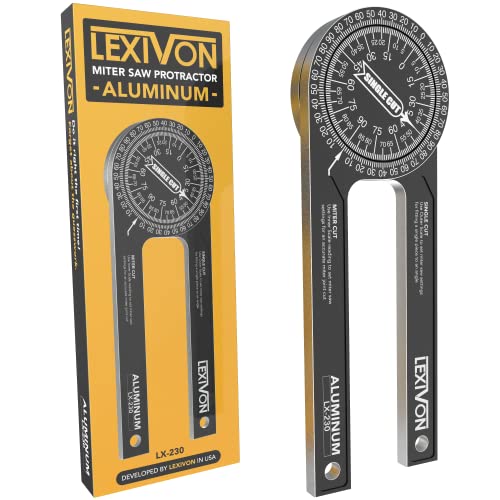
The LEXIVON LX-230 is a dedicated miter saw protractor designed to take the guesswork out of angle measurement for crown molding, trim work, baseboards, and general carpentry. It's a precision angle finder built from CNC-machined anodized aluminum, making it a solid upgrade over plastic versions common in many workshops or garage toolkits.
This tool is a natural fit for DIY homeowners tackling weekend projects like installing crown molding or trimming window casings, as well as for professional woodworkers, carpenters, and contractors who need reliable angle transfer on the jobsite. Plumbers and electricians may also find it useful for cutting raceways or pipe supports where precise miter cuts are required.
When it comes to performance, the laser-engraved scales provide clear, legible markings that won't fade or wear off with regular use. This is a big plus over printed scales that can become unreadable over time. The internal Teflon O-ring mechanism allows the tool to swivel smoothly and lock onto inside and outside corners without binding, helping you transfer the angle directly to your miter saw for an accurate cut. According to product specifications, the 1/4-inch thick aluminum construction resists bending, which means you can count on consistent repeatability when setting up compound cuts.
Build quality is a strong point here. The rust-proof anodized finish protects the tool from moisture and corrosion common in basement workshops or damp garage environments. The compact 7-inch size stores easily in a toolbox drawer or can be hung on a pegboard without taking up much space. Maintenance is minimal - just wipe it clean after use. No special care is needed beyond keeping the pivot point free of sawdust or debris to maintain smooth operation.
One realistic limitation is that, like any angle finder, it requires a bit of practice to master transferring the reading to your saw's miter gauge. Beginners may need to run a few test cuts on scrap material before committing to final pieces. Also, the 7-inch length, while convenient for storage, might require multiple measurements on very wide moldings or long workpieces, which could slow down production in high-volume trim work.
Overall, if you're a DIYer, woodworker, or contractor who regularly cuts crown molding or trim, the LEXIVON LX-230 offers a durable, precise, and easy-to-read solution for under $30. Its aluminum build and laser-engraved scales make it a practical addition to any workshop or garage tool collection, providing reliable angle measurements for years to come.
Pros
- Laser-etched markings remain crisp and easy to read in various shop lighting conditions
- Internal O-ring tension holds angles reliably while positioning against workpiece corners
- Sturdy aluminum construction resists bending better than cheap plastic alternatives
- Direct angle conversion scales save significant layout time on miter saw cuts
Cons
- Does not include a digital readout for micro-fractional angle adjustments
- Compact 7.3-inch arm length may feel small when referencing wide trim profiles or long stock
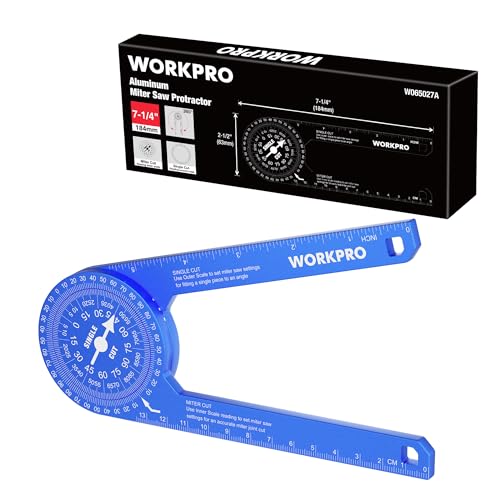
The WORKPRO 7.3-Inch Aluminum Miter Saw Protractor is a dedicated angle-measuring and layout tool engineered to streamline trim carpentry, framing, and general fabrication. Aimed directly at finish carpenters, woodworkers, general contractors, and active DIY homeowners, this compact tool simplifies the process of finding corner angles and transferring them accurately to a miter saw. Instead of wrestling with complex math charts or trial-and-error scrap cuts, users can directly read both single-cut and miter-cut settings straight off the tool face.
Measurement accuracy is the defining factor for any angle finder, particularly when installing crown molding, chair rails, or baseboards in rooms where corners are rarely a perfect ninety degrees. This protractor features laser-etched dual scales that translate interior and exterior wall angles into exact saw bevel and miter adjustments. Smooth operation is driven by an internal rubber O-ring mechanism that provides full 360-degree rotation without catching, sticking, or slipping out of position while you transfer measurements from drywall corners to your cutting station.
In terms of construction, WORKPRO utilizes CNC-machined aluminum alloy rather than fragile plastic. The solid metal build ensures rigidity along the measuring arms, preventing deflection when pressed firmly into tight wall corners or against out-of-square studs. An anodized blue finish adds a strong layer of defense against corrosion, surface scratches, and jobsite grime, while the laser markings are etched directly into the metal surface so they will not rub off after months in a crowded tool apron or job box.
Measuring just 7.3 inches in length, this tool fits effortlessly into standard carpenter pouches, tool totes, or pocket organizers. Its low profile makes it easy to maneuver inside cramped cabinetry, tight soffits, and awkward closet corners where larger measuring guides cannot reach. For workshop organization, the built-in hanging hole lets you slip it directly onto a garage pegboard or workbench hook, keeping it secure and ready for the next trim project.
While the tool performs reliably for standard carpentry, users should keep in mind that its mechanical dial lacks a digital display, meaning ultra-fine fractional degrees require careful visual alignment. Additionally, very wide or uneven architectural moldings might benefit from an even longer straightedge reference. Even so, for trim installers, DIY renovators, and woodworkers seeking an affordable, durable, and math-free solution for crisp miter cuts, this aluminum protractor stands out as a dependable workshop companion.
CNC machining ensures that both arms of this protractor lie flat and maintain true edges along work surfaces. The aluminum alloy core prevents the flexing commonly seen in molded plastic angle finders, helping you maintain consistent contact against framing or trim boards.
The anodized finish provides dependable surface hardness against abrasion, preventing the tool from degrading when tossed into buckets or toolboxes. Additionally, laser etching keeps numerals sharp and readable without relying on printed paint that can quickly wear away in dusty workshop environments.
Dual-scale indexing provides specific arrows for both miter cut and single cut setups, removing human calculation error during complex trim installations. The inner scale assists with single-piece framing cuts, while the outer scale directly indicates the required miter saw angle for two joining pieces.
The internal rubber O-ring introduces subtle friction, allowing the arms to swivel smoothly yet hold their position firmly during transport from the wall corner to your miter saw table. This mechanical tension prevents accidental shifts that could ruin an expensive piece of molding.

Pros
- Sturdy 1/4-inch aluminum construction resists bending and jobsite drops
- Clear laser-engraved markings will not rub off like printed graphics
- Provides direct readings for both miter cuts and single cuts
- Lightweight and compact footprint fits easily in a tool apron or belt
Cons
- Lacks an integrated digital readout for users who prefer backlit screens
- Friction hinge may require occasional re-tightening to maintain tight angles
- Slightly smaller profile might require an extension rule for out-of-square wall studs
The WYTUDTE 7-Inch Aluminum Miter Saw Protractor is a dedicated layout and angle-measuring instrument designed to streamline trim work, molding installation, and framing projects. By capturing corner angles directly and indicating the precise miter saw setting needed, it eliminates the trial-and-error math that often leads to ruined stock. Woodworkers, finish carpenters, remodeling contractors, and weekend DIY homeowners will appreciate the simplicity this analog angle finder brings to common carpentry tasks.
Crafted from CNC-machined aluminum alloy with a thickness of roughly 1/4 inch, the tool delivers a rigid, dependable feel without adding unnecessary weight to your pouch. The rust-proof matte surface resists workshop scratches, moisture exposure, and harsh jobsite elements. Unlike plastic alternatives that flex against irregular drywall, this rigid frame holds its form against baseboards, crown molding corners, and door casing trim for consistent results.
A standout feature is the laser-engraved dual scale system, which clearly differentiates between single-cut and miter-cut angles. The smooth O-ring internal pivot glides easily around inside and outside drywall corners, letting you capture non-standard 88-degree or 92-degree angles effortlessly. Once the measurement is taken, the scale provides the direct setting for your miter saw turntable, significantly reducing scrap material and wasted time.
For daily jobsite practicality, the protractor features a compact 7-inch size that slips into a nail pouch, tool chest drawer, or back pocket. It requires no batteries or delicate sensors, making it instantly ready to work in cold garages or humid workshops. Maintenance is as simple as wiping down the matte surface with a dry cloth and occasionally checking the pivot screw to ensure the desired resistance.
While this tool excels at trim and standard carpentry, it lacks backlighting or digital decimal displays that some finish carpenters prefer for fractional degrees. However, for users tackling baseboard installations, deck railings, ceiling coving, or custom cabinetry, the WYTUDTE Aluminum Protractor offers reliable accuracy, dependable metal construction, and excellent value for everyday workshop and jobsite use.
Direct reading scales eliminate manual calculation errors when transferring corner angles directly to your miter saw table. The tool includes designated markings for miter cuts and single cuts, making it simple to line up trim joints tightly on the first try.
Laser-etched graduations provide crisp contrast against the matte aluminum body, ensuring measurements remain clearly readable even in low-light renovation settings. The stable pivot tension keeps your captured angle secure while walking from the wall to the saw station.
Constructed from lightweight CNC-machined aluminum alloy, this protractor provides rigid strength without excessive bulk. The 1/4-inch thick frame prevents flexing against uneven drywall texture or wooden framing.
The corrosion-resistant matte coating protects against moisture, sweat, and shop debris, ensuring long service life in demanding garage or construction environments without peeling or fading.

Pros
- Affordable and reliable for basic miter cuts around the home or job site
- Lightweight and portable for easy transport between projects
- Simple setup and operation with no power source needed
Cons
- Limited to hand saw use, not compatible with power saws
- Small work area may not suit larger trim pieces
- Plastic construction may not withstand heavy daily use on professional sites
The CRAFTSMAN 12-Inch Hand Miter Saw & Clamping Box (model CMHT20600) is a manual cutting tool designed for precise miter cuts in wood, plastic, and other soft materials. It combines a miter box with a hand saw, allowing users to make accurate 45-degree and 90-degree cuts for trim, molding, and picture frames. This tool is best suited for DIY homeowners, woodworkers, hobbyists, and contractors who need a portable, no-power solution for occasional cutting tasks around the garage, workshop, or job site.
In real-world use, the cam-shaped locking pins secure workpieces firmly against the honeycomb base, reducing movement and improving cut accuracy. The built-in saw stop prevents the saw blade from cutting into the miter box, extending the tool's lifespan and ensuring consistent results. For users tackling baseboards, crown molding, or octagonal shapes, the 22.5-degree face angle setting offers added versatility. The extended lip on the base helps stabilize the box during cutting, which is a thoughtful safety feature.
Build quality is typical for a budget-friendly hand tool. The miter box is made of durable plastic with a honeycomb base that reduces weight while maintaining rigidity. The included hand saw features a comfortable grip and a sharp blade suitable for softwoods and plastics. While not as robust as metal miter boxes, this design keeps the tool lightweight and easy to carry. The molded-in storage bins for cam pins and a pencil are a convenient touch, helping users keep small accessories organized and reducing setup time.
Storage and maintenance are straightforward. The compact size fits easily into a toolbox or can be hung on a pegboard. No special care is needed beyond wiping down the box and blade after use to prevent rust. The saw blade can be replaced if it dulls over time, though replacements may not be widely available. For most DIY projects and light contractor work, the tool offers good value without the need for electricity or batteries.
A realistic limitation is that this is a manual hand saw setup, not a power miter saw. It requires physical effort and is slower than electric alternatives. The 12-inch capacity may not be enough for larger trim pieces or wide boards. Additionally, the plastic construction may not hold up to heavy daily use on professional construction sites. Users who need high-volume, repetitive cutting should consider a power miter saw instead.
Overall, the CRAFTSMAN 12-Inch Hand Miter Saw & Clamping Box is a practical choice for DIYers, woodworkers, and contractors who need a portable, affordable tool for precise miter cuts. It works well for small projects, repairs, and trim work around the home or workshop. If you value simplicity, portability, and basic accuracy without the cost and noise of a power saw, this setup is worth considering.

Pros
- Strong magnets hold the tool securely on metal surfaces, freeing both hands for work.
- Auto-rotating display is convenient when working in tight spaces or overhead.
- V-groove design improves accuracy on round stock like pipes and conduit.
- IP42 rating adds protection against debris and splashes on rough jobsites.
- Lightweight and compact with a protective case, easy to carry and store.
Cons
- IP42 rating is splash-resistant but not fully waterproof; avoid submerging.
- Battery life could be a concern if used continuously for long projects; keep spares handy.
- Some users may prefer a longer or wider level for traditional leveling tasks; this is primarily an angle gauge.
The Klein Tools 935DAG Digital Electronic Level and Angle Gauge is a compact yet highly capable tool that brings digital precision to angle measurement and leveling tasks. Designed for professionals and serious DIYers, it combines an intuitive display with practical features like a magnetic base and V-groove edges, making it well-suited for electricians, plumbers, woodworkers, and general construction work.
One of the standout features is the magnetic base, which lets you attach the gauge to ferromagnetic surfaces such as steel conduit, ductwork, miter saw blades, and metal studs. This hands-free ability is a real time-saver when bending conduit or setting saw angles, as you don't need to hold the tool while adjusting the workpiece. The V-groove edges further enhance this by ensuring a snug fit on pipes and tubing, reducing the risk of slippage and improving accuracy during alignment or bending.
The auto-rotating, reverse contrast display is another practical touch. It automatically flips when the tool is inverted, so readings remain right-side up whether you're working on a horizontal surface or overhead. The high-contrast screen is also easier to read in dimly lit areas, such as inside electrical panels or under sinks. With a measurement range of 0-90 and 0-180 degrees, you can handle everything from setting a miter saw to checking conduit bend angles, and the zero-calibration feature lets you establish a reference point for repeated tasks.
Build quality is typical of Klein Tools: the housing feels solid, and the IP42 rating offers some protection against dust and water splashes, which is useful on typical job sites. However, it's not designed for immersion, so keep it dry when not in use. The included soft carrying case and two AAA batteries mean it's ready to go out of the box, and the compact size (about 2.4 x 2.2 x 1.2 inches) makes it easy to store in a tool pouch or drawer.
Realistically, this is not a traditional bubble level; it's best thought of as a digital angle gauge that also functions as a level. For users who need a long level for checking flatness over large spans, a conventional 2-foot or 4-foot level would be more appropriate. Battery life is not specified, but if you use it heavily, you may want to keep extra AAA batteries on hand. Also, while the magnetic hold is strong, it might not be sufficient on very dirty or painted surfaces.
Overall, the Klein Tools 935DAG is a practical buying choice for anyone who frequently measures or sets angles, especially when working with metal. Electricians bending conduit, plumbers aligning pipes, woodworkers dialing in table saw miter gauges, and HVAC technicians checking duct angles will find it a reliable helper. It's also a nice addition for workshop users and garage DIYers who want improved accuracy without breaking the bank. Given its features and Klein's reputation, it offers solid value for the price.
Frequently Asked Questions
What makes a miter saw the best saw for angled cuts?
A compound miter saw provides rotating tables and tilting bevel heads engineered specifically for precise angular crosscuts. These saws lock securely into preset detents such as 22.5, 31.6, and 45 degrees, which keeps the blade from drifting off your cut line. While circular saws can cut bevels, a stationary miter saw provides superior fence support and clamping stability for finished carpentry.
How do you measure out-of-square corners before making an angled cut?
Aluminum miter saw protractors and digital angle gauges measure out-of-square drywall corners directly so you avoid manual division errors. Standard drywall corners rarely form a perfect 90-degree angle due to mud buildup and framing shifts. Tool-guided protractors read the inside or outside corner angle directly and indicate the exact miter setting needed on your saw table.
Can you use a manual miter box instead of a power saw for angles?
Yes, manual miter clamping boxes work well for small trim profiles, hobby projects, and soft moulding materials. Hand-powered clamping boxes offer dedicated guide slots for 45-degree and 90-degree cuts without producing airborne sawdust or requiring electrical outlets. Power miter saws remain faster for dimensional lumber, but hand boxes offer safe control for delicate trim.
How does blade tooth count affect angled cut quality in wood?
Higher tooth counts between 40 and 80 carbide teeth deliver cleaner angled cuts with significantly less tearout along crosscut wood grain. When cutting across wood grain at sharp angles, fewer teeth can grab and splinter the back edge of delicate molding. Learning how to remove a blade from a miter saw helps you swap in a fine-finish blade suited for clean trim joints.
Why should you calibrate your miter saw bevel with a digital level?
A digital electronic angle gauge verifies true blade-to-table alignment beyond standard factory bevel stop indicators. Jobsite bumps and heavy motor vibration can knock preset bevel pointers slightly off calibration over time. Zeroing a magnetic digital gauge against your saw bed and attaching it directly to the steel blade body guarantees exact tilt angles before you make critical compound cuts.





Write Your Review
No reviews yet. Be the first to share your experience!