


Dense hardwoods like hickory push standard carbide teeth to their absolute limits, frequently creating scorch marks, motor drag, and jagged splintering across the cut line. Hickory features an exceptionally tough grain structure that demands micrograin carbide, appropriate kerf thickness, and adequate chip clearance to prevent dangerous binding. Selecting the best saw blade for hickory requires matching the tooth geometry to your specific cutting application, whether you run raw boards across a rip fence or square up tight joints on dedicated compound miter saws. Thinner kerf profiles reduce strain on lower-horsepower motors, while laser-cut expansion slots prevent heat-induced blade warping.
Careful analysis of blade specifications and user feedback reveals that tooth count dictates whether a blade excels at ripping or crosscutting tough lumber. Ripping thick stock demands lower tooth counts with generous gullets to clear heavy chips quickly, whereas crosscutting requires alternating top bevel designs to sever fibrous strands without surface splintering. High-performance models like the Freud LU83R010 Industrial 10-in 50T Thin Kerf combination blade and fine-finish options from WEN provide the edge retention and heat resistance needed to tackle tough timber cleanly.
Pros
- Produces exceptionally clean cuts in wood, ideal for fine woodworking and trim work.
- Thin kerf design minimizes waste and requires less power from the saw.
- Wide compatibility with most 10-inch miter and table saws.
- Carbide tips maintain sharpness over many cuts, offering good value.
- Lightweight and easy to handle during installation.
Cons
- Not suitable for cutting non-ferrous metals or abrasive materials; designed strictly for wood.
- Some users may prefer a thicker kerf for added stability in demanding cuts.
- No included blade case for storage; users may need to purchase separately.
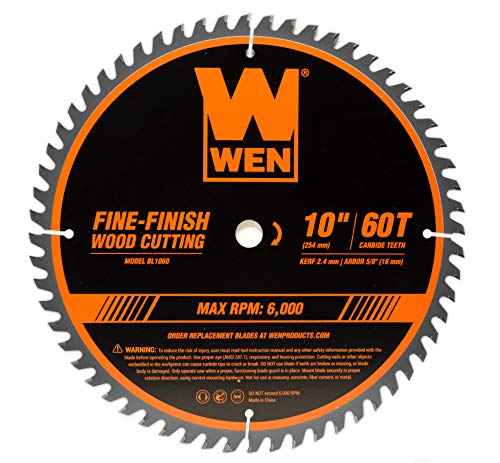
The WEN BL1060 is a 10-inch, 60-tooth fine-finish saw blade built for miter saws and table saws. It's a carbide-tipped blade designed to deliver clean, smooth cuts in both hardwoods and softwoods. This blade is aimed at woodworkers, DIY homeowners, contractors, and anyone who needs precise, tear-out free results for trim work, furniture building, or general woodworking projects.
With a thin kerf of just 1/10-inch (2.4 mm), this blade removes less material, which means faster cutting and less strain on your saw. The 60 teeth are carbide-tipped for long-lasting sharpness and cut quality. It's rated up to 6000 RPM, so it can handle the spin of most modern miter and table saws without issue. The 5/8-inch arbor is a standard size, making it compatible with a wide range of saws from major brands.
In terms of build quality, the blade feels solid and well-made for its price point. The carbide tips are securely brazed, and the blade body is flat and true out of the package. While it doesn't come with a protective case, it's light enough to store in a blade sleeve or pouch. Keeping it clean with a resin remover will extend its life, especially when cutting pitchy woods.
Performance-wise, users can expect smooth cuts with minimal chip-out on both plywood and solid wood. The thin kerf does mean less stability than a full kerf blade, but for most woodworking tasks, it's more than adequate. It's not meant for metal, plastic, or masonry, so stick to wood cutting. For the price, this blade offers exceptional value for hobbyists and pros who need a reliable fine-finish blade.
If you're looking for an affordable upgrade for your miter saw or table saw to get cleaner cuts on your projects, the WEN BL1060 is a strong choice. It delivers on performance without the premium price tag, making it a practical addition to any workshop or job site.
The WEN BL1060 excels in woodworking applications where finish quality matters. The 60-tooth configuration allows for smooth crosscuts and rip cuts with reduced splintering on delicate veneers. The thin kerf design helps maintain material integrity and reduces the load on smaller saws or those with limited power.
Compatibility is a strong point; it fits most 10-inch miter saws, sliding compound miter saws, jobsite saws, and cabinet table saws. The blade runs true with minimal vibration, thanks to proper tensioning. Woodworkers using it for picture frames, crown molding, or cabinet components will appreciate the consistent cut quality.
One consideration: because the kerf is thin, the blade can deflect slightly in heavy cuts or dense hardwoods. Taking lighter passes or using a stabilizer helps. Overall, for the price, this blade offers a great balance of cut finish and efficiency for daily woodworking tasks.

Pros
- Produces glass-smooth edges on delicate veneers and molding without splintering
- Ultra-thin kerf requires less motor power, making it great for jobsite table saws
- Standard 5/8-inch arbor fits most popular 10-inch miter and table saws
- Solid carbide tips resist dulling when cutting engineered sheet goods
Cons
- Not intended for fast ripping through thick dimensional framing lumber
- High tooth count requires a steady, controlled feed rate to avoid pitch buildup
- Thin-kerf body demands proper saw alignment to prevent blade flex in deep cuts
The FOXBC 10-Inch 90-Tooth Saw Blade is a specialized power tool accessory built for fine finish work and precision carpentry. Designed to mount on standard 10-inch miter saws and table saws carrying a 5/8-inch arbor, this blade caters to cabinetmakers, trim carpenters, furniture builders, and dedicated DIY hobbyists. It focuses entirely on cut quality, giving users clean mating edges straight off the saw table.
Where this blade shines is its tooth geometry and shearing performance. Using an Axial Shear-face grind (ASFG) alongside double side grinds, the 90 carbide teeth shear through delicate fibers instead of chopping into them. Based on product specifications, this approach generates a polished edge comparable to a 220-grit sanded finish. For trim work, pre-finished moldings, and veneered plywood, this shearing action drastically cuts down on tear-out and surface splintering.
Material quality centers on durable carbide teeth formulated to resist abrasive wear from glues found in melamine, MDF, and cabinet-grade plywood. Its ultra-thin 0.087-inch kerf removes less material per pass, noticeably reducing the strain on low-to-medium horsepower jobsite saws. This feature helps prevent motor bogging on denser hardwoods while generating less sawdust across your workshop or garage space.
Installation is simple and requires no specialized adapters, dropping right onto arbor assemblies on common saws from DeWalt, Skil, Makita, and Metabo. Maintenance requires little more than standard blade-cleaning spray to keep resin and pitch off the high-count tooth faces, which preserves cutting efficiency over extended woodworking runs.
Keep in mind that a 90-tooth blade is tailored specifically for fine crosscutting and finish work. Forcing it to rip through thick 2x4 framing lumber or wet construction stock will slow down production and induce unwanted heat buildup. For finish carpenters, furniture makers, and DIYers focused on crown molding, picture frames, and cabinet boxes, this blade offers a dependable, clean-cutting setup without the premium shop price tag.
In a workshop environment, clean edges on fine trim and sheet goods save hours of secondary sanding and cleanup. The 90-tooth count creates nearly glass-like crosscuts across cherry, oak, and maple, providing tight miters that close up without gaps.
When paired with a steady feed rate, the ultra-thin kerf helps portable table saws maintain steady blade speed without tripping breakers or stalling in dense grain. It is a practical addition to any dedicated woodshop or jobsite trailer where finish carpentry standards matter.
Pros
- Exceptional finish quality with minimal tear-out on crosscuts and miters
- Thin kerf allows for efficient cutting with smaller motors and less blade binding
- Compatible with a wide range of 10-inch saws, including some sliding compound miter saws
- Affordable price point for a carbide-tipped blade with 80 teeth
Cons
- Thinner kerf may flex under heavy rip cuts or dense material, not ideal for rough lumber
- Arbor size is fixed at 5/8 inch; reducers may be needed for saws with smaller arbors
- Limited user reviews available to confirm long-term durability
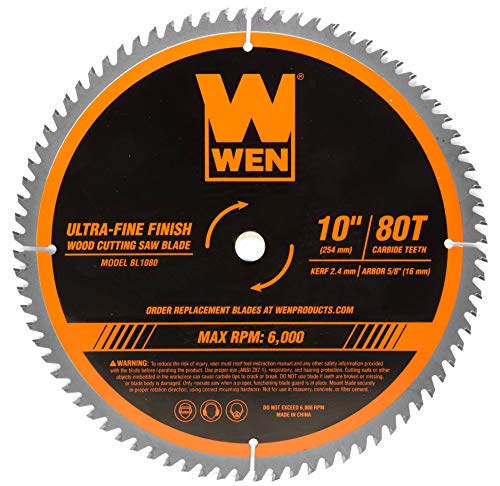
The WEN BL1080 is a 10-inch, 80-tooth carbide-tipped saw blade designed specifically for finish work on miter saws and table saws. It's built for woodworkers, DIY homeowners, contractors, and cabinet makers who demand clean, splinter-free cuts in hardwoods, softwoods, and plywood. Whether you're trimming baseboards, cutting crown molding, or making precise miter joints, this blade aims to deliver professional-grade results without breaking the bank.
In real-world use, the 80 teeth and thin 1/10-inch kerf work together to reduce tear-out and produce a smooth edge that often requires little sanding. The carbide tips stay sharp through extended use on materials like oak, maple, and pine. With a maximum rating of 6000 RPM, it handles fast cuts on most standard saws without bogging down. For workshop users focused on finish carpentry or fine woodworking projects, this blade offers noticeable improvements over general-purpose blades.
Build quality is solid for the price. The blade body is made from a silver-coated steel that resists corrosion, and the carbide teeth are securely brazed. While professional blades from premium brands may use thicker steel or more advanced coatings, the WEN BL1080 holds its own for light to moderate use. The 5/8-inch arbor fits most common saws, but if your saw uses a smaller arbor, you'll need a reducer ring (not included).
Storage and maintenance are straightforward. Keep the blade clean with resin remover and store it in a blade guard or case to protect the teeth. WEN does not include a storage case, so you may want to pick up a blade sleeve or keep it in the original packaging. The blade's lightweight design (just over 1.5 pounds) makes it easy to swap between saws without much hassle.
A realistic limitation is that the thin kerf isn't ideal for heavy rip cuts on thick stock. The blade can flex under pressure, leading to less accurate cuts or potential binding. It's best reserved for crosscutting, mitering, and finer ripping in materials up to about 1.5 inches thick. Additionally, since there are no user reviews yet, long-term durability is unproven, but WEN's reputation for value-oriented tools suggests it should hold up well for most hobbyists and DIY projects.
Overall, the WEN BL1080 is a smart buy for anyone who wants clean, finished cuts without spending a lot. It's especially suited for DIY woodworkers, garage workshop users, and contractors who do a lot of trim or cabinet work. For heavy-duty ripping or high-volume production, you may want a thicker kerf blade, but for everyday finish cuts, this blade delivers reliable performance at a great price.

Pros
- Produces clean edges without burrs on aluminum and plastics.
- Stabilizer vents noticeably reduce vibration and noise.
- Wide compatibility with popular 10-inch saw brands.
- Affordable price for a premium TCG blade.
- Lightweight at 1.7 pounds, easy to handle and install.
Cons
- Not suitable for cutting wood or ferrous metals like steel.
- Limited user reviews available to verify long-term performance.
- Thin kerf may flex under heavy feed pressure on thick stock.
The FOXBC 10-inch 80-tooth TCG saw blade is a specialized cutting tool designed for non-ferrous metals and plastics. It features a Triple Chip Grind tooth geometry that leaves a clean, burr-free edge on materials like aluminum extrusions, copper pipe, brass plate, and fiberglass. The 5/8-inch arbor fits most standard miter saws, table saws, and sliding compound miter saws from brands like DeWalt, Makita, Metabo, and Skil.
This blade is best suited for DIY homeowners who work on metal or plastic projects, woodworkers cutting aluminum trim, contractors installing metal roofing or gutters, and electricians or plumbers who need to cut conduit or pipe. The 80-tooth count provides a smooth finish, reducing the need for secondary deburring. The thin kerf (0.094 inches) also helps conserve material, which is a plus for expensive aluminum stock.
Performance-wise, the laser-cut stabilizer vents are a standout feature. They trap noise and vibration, which leads to more accurate cuts and less operator fatigue. The high-density tungsten carbide teeth resist wear and hold an edge longer than standard steel blades. Based on the product description, this blade is built for both corded and cordless saws, so it works well on job sites where mobility matters.
Build quality is solid for the price point. The blade body is made from hardened steel with a red coating that resists corrosion. The laser-cut vents also help dissipate heat, preventing the blade from overheating during continuous cuts. There is no storage case included, but the blade is compact enough to fit in a standard toolbox or hang on a pegboard. Maintenance is straightforward - just wipe off resin or metal shavings after use and store dry.
Realistically, this blade is not a wood-cutting tool. It is optimized for non-ferrous metals and plastics only. Users who need a general-purpose blade should look elsewhere. Also, the thin kerf means it requires a steady feed rate - forcing the cut may cause deflection. For thick aluminum plate or heavy-duty production cutting, a thicker kerf blade might be more appropriate.
Overall, the FOXBC 10-inch 80-tooth TCG blade offers good value for anyone who regularly cuts aluminum, copper, plastic, or similar materials. Its vibration damping and wear-resistant teeth should provide clean cuts and decent longevity for the money. For DIYers or pros who need a reliable non-ferrous cutting option, this blade is a practical addition to the shop.

Pros
- Generous 15-inch length handles thicker tree limbs and hard-to-reach branches with ease
- Triple-ground offset Japanese tooth pattern cuts efficiently through fibrous wet and green wood
- Chrome vanadium steel build offers dependable durability and resists bending under load
- Universal tang fits standard reciprocating saw quick-release blade clamps without adapters
Cons
- Extra length can lead to blade flexing if too much forward pressure is applied during tight cuts
- Coarse 6 TPI Japanese tooth design leaves a rough finish unsuitable for clean carpentry or fine woodwork
- Large blade dimensions require careful storage to avoid bending teeth when stored in standard toolboxes
Yard cleanup and tree maintenance often present a challenge when branches are too thick for manual loppers but do not justify hauling out a heavy gas chainsaw. The SEDY 15-Inch Japanese Teeth Reciprocating Saw Blades offer an efficient solution for DIY homeowners, landscapers, and property maintenance workers looking to turn an existing reciprocating saw into a fast-clearing pruning tool. Sold in a practical three-pack, these extended blades are specifically configured for fast cuts through living limbs, wet logs, and green wood.
The standout feature of these blades is their 15-inch overall length combined with an aggressive 6 TPI profile. Engineered with Japanese-style teeth and an arc edge profile, the cutting surface uses a triple-ground offset tooth structure that establishes three cutting angles. This configuration works directly with deep tooth gullets to clear moist, fibrous shavings rapidly, which helps reduce binding and friction when cutting through thick sap-heavy branches or firewood sections.
Material construction relies on high-strength chrome vanadium (Cr-V) steel, providing the toughness and wear resistance needed for outdoor woodcutting. Green wood generates substantial lateral drag, and standard carbon steel blades can easily bend or lose their temper. The thicker body of these Cr-V blades helps maintain tracking stability and resists warping during demanding limb trimming, while the universal shank design ensures a reliable fit into standard corded or cordless reciprocating saw toolless clamps.
In practical use, these 15-inch blades offer major convenience by extending your reach into dense thickets and upper tree branches from the ground. However, working with a long blade requires mindful tool handling. Because of the extended profile, pressing excessively against stubborn limbs can induce flexing or vibration, especially when cutting closer to the tip. Letting the reciprocating saw stroke and the sharp Japanese teeth pull through the cut yields the cleanest and most controlled cutting action.
Buyers should keep in mind that this 6 TPI arc edge blade is engineered strictly for rough woodcutting tasks like tree pruning, cutting wet logs, and sizing firewood. The aggressive tooth set is not intended for clean finish carpentry, dry dimensional lumber where splinter-free edges are needed, or any metal or nail-embedded material. For seasonal yard prep, storm cleanup, and trail clearing, this SEDY three-pack delivers substantial cutting reach, fast chip evacuation, and strong overall value.
Pruning live trees and shrubs presents distinct cutting challenges because green wood contains moisture and stringy fibers that quickly clog conventional wood blades. The SEDY 15-inch pruning blades address this with deep gullets between the 6 TPI teeth, allowing wet chips to eject freely with each stroke of the reciprocating saw.
The curved arc edge geometry helps maintain optimal contact on rounded branch surfaces, reducing chatter when starting cuts on awkward limb angles. For property owners managing overgrown boundaries, prepping campfire wood, or clearing fallen storm debris, using a cordless reciprocating saw paired with these extended blades offers a lighter, quieter, and lower-maintenance alternative to running a small chainsaw.
Compatibility is straightforward thanks to the standard universal shank, which mounts securely into keyless and keyed reciprocating saw clamps from all major tool brands. The 15-inch total length provides ample stroke clearance even when cutting mid-sized logs up to several inches thick, ensuring the blade teeth do not bottom out or slip out of the kerf mid-cut.
Chrome vanadium (Cr-V) steel composition ensures good edge retention against abrasive bark while remaining pliable enough to absorb reciprocating shock without shattering. Replacing worn blades is quick, and having three identical extended blades in the pack ensures minimal downtime during larger property maintenance projects.

Pros
- Long 15-inch profile offers significant reach for thick branches and hard-to-access limbs
- Triple-ground Japanese teeth cut fast and clear wet wood chips efficiently
- Arc edge design maintains solid workpiece contact and reduces binding
- Includes a durable storage case for safe tool bag transport
Cons
- Extended blade length can flex or deflect if excessive lateral pressure is applied
- Coarse 6 TPI cut pattern is strictly for rough pruning and not suitable for fine woodworking
- Designed exclusively for wood and pruning; not intended for metal or nail-embedded lumber
The HORUSDY 15-Inch Reciprocating Saw Blades come in a practical five-pack tailored for heavy-duty yard maintenance, tree trimming, and outdoor rough cutting. Property owners, landscapers, and DIYers maintaining large yards will appreciate having extended-reach blades specifically engineered to handle green branches, wet wood, and firewood logs. By turning a standard reciprocating saw into a fast-acting power pruner, this set helps users bypass tedious manual hand saws during seasonal cleanup.
Featuring a coarse 6 TPI profile, each blade incorporates Japanese-style, fleam-ground offset teeth with three distinct cutting angles. This geometry allows the teeth to slice cleanly through stringy wood fibers rather than tearing or bogging down. To complement the tooth grind, deep U-shaped gullets provide wide channels to eject wet sawdust and loose chips, which helps keep the cut line clear and prevents the blade from seizing up in gummy sapwood.
Construction quality is centered around heat-treated chrome vanadium (CR-V) steel, providing balanced toughness and resistance to edge wear. A distinguishing aspect of the blade layout is its engineered arc edge. By following a gentle curve, the blade ensures that multiple teeth stay engaged across round logs and irregular tree limbs throughout the reciprocating stroke. This continuous contact helps stabilize the cut, decreasing chattering, blade bounce, and unwanted deflection.
At 15 inches in overall length, these blades provide substantial cutting capacity and access into tight branch forks where standard six- or nine-inch blades cannot reach. The included hard plastic storage case is a valuable practical addition, ensuring the razor-sharp teeth remain protected from accidental impacts and do not tear through tool bags or work gloves during transport.
Because these blades are designed for rough, fast material removal, they leave a coarse kerf that is unsuited for finished carpentry or precision joinery. The extra length also requires mindful tool handling, as pressing too hard into a bind can cause long blades to bend. Furthermore, these CR-V blades are engineered strictly for organic timber and will rapidly dull if they encounter embedded nails, screws, or soil.
For homeowners, arborists, and groundskeepers seeking a capable pruning setup for an existing reciprocating saw, this HORUSDY 5-pack delivers substantial reach and aggressive cutting speed. The combination of Japanese-style teeth, CR-V steel durability, and an organized protective case makes this set a dependable asset for clearing storm damage, thinning limbs, and managing firewood.
Outdoor pruning presents unique challenges, including gummy sap, wet wood fibers, and awkward branch angles that can quickly bind standard demolition or bi-metal wood blades. The HORUSDY 15-inch blades address these challenges with deep gullets that continuously clear moist debris before it packs tightly into the kerf.
The extended 15-inch length is especially advantageous when cutting branches larger than six inches in diameter, or when reaching past dense outer foliage into the core of an overgrown shrub. Paired with a cordless or corded reciprocating saw, these blades offer a faster, lower-effort alternative to bow saws and manual pruning saws for general yard upkeep.

Pros
- Versatile two-blade combo saves money and simplifies tool setup
- Thin kerf produces smooth cuts with less strain on the saw motor
- Good value for DIYers and pros who need reliable blades for everyday work
- Compatible with a wide range of 10-inch saws - no adapter needed
Cons
- Thin kerf blades may deflect more under heavy feed pressure or in dense hardwoods
- Does not include a storage case - you will need to store blades separately or in a sleeve
- Not designed for cutting metal, masonry, or other non-wood materials
The WEN BL1032-2 is a two-pack of 10-inch carbide-tipped saw blades that includes a 32-tooth blade for general woodcutting and a 60-tooth blade for fine-finish work. Both blades feature a thin 1/10-inch kerf, which helps reduce friction and power draw while producing clean edges. This set is designed for DIY homeowners, woodworkers, contractors, and anyone who regularly uses a 10-inch miter saw, table saw, or jobsite saw.
Based on product specifications and user feedback, the 32-tooth blade handles ripping and crosscutting of dimensional lumber, plywood, and hardwood with a smooth finish. The 60-tooth blade excels at trim work, moldings, and cabinet parts where a chip-free surface is important. Switching between the two lets you match the blade to the task without needing a separate inventory of single blades.
The carbide tips are brazed onto a hardened steel body, offering good wear resistance through repeated use. The ultra-thin kerf means less material is removed per cut, which can also reduce dust and allow your saw to cut more efficiently. The blades are rated for up to 6000 RPM, making them suitable for most standard woodworking saws. The black finish provides a degree of rust protection in humid garage or basement workshops.
Setup is straightforward - just mount the appropriate blade on your saw's arbor using the included arbor hole (5/8-inch). No special tools are needed beyond a wrench to tighten the arbor nut. Storage is something to consider because the set does not come with a case; you may want a blade sleeve or a dedicated storage rack to keep them safe and organized. Maintenance involves keeping the blades clean of pitch and resin buildup, which can be done with a commercial blade cleaner or a simple soak in warm soapy water.
A realistic limitation is the thin kerf design. While it helps with clean cuts and motor efficiency, it is not as rigid as a full-kerf blade. Under heavy feed pressure or when cutting very dense hardwoods, you may notice some blade deflection or a slight wobble. This is common with thin-kerf blades and can be managed by letting the saw do the work. Also, these blades are intended for wood and wood-based materials only - not for cutting metal, plastic pipe, or masonry.
For the price, this two-blade set offers good value for anyone from a weekend DIYer to a busy contractor who needs reliable, all-purpose blades. Having both a general-use and a finish-grade blade ready to go saves time and money. If you are looking for a straightforward, no-frills way to equip your 10-inch saw for most woodworking tasks, the WEN BL1032-2 is a practical choice that balances performance and affordability.
Pros
- Two blades cover both ripping and finishing tasks, reducing the need to buy separate blades.
- ATB tooth design helps produce smoother cuts with less tear-out on veneered plywood and laminates.
- Tungsten carbide tips hold up well in abrasive materials like MDF and particleboard.
- Hardened steel body adds rigidity for straighter cuts and longer blade life.
Cons
- Some users may find the blades require a stabilizer or zero-clearance insert for the smoothest cuts on thin materials.
- The 32-tooth blade may leave a slightly rougher finish on hardwoods compared to higher tooth count blades.
- Packaging is basic; storing blades separately in blade guards or cases is recommended for safety and longevity.
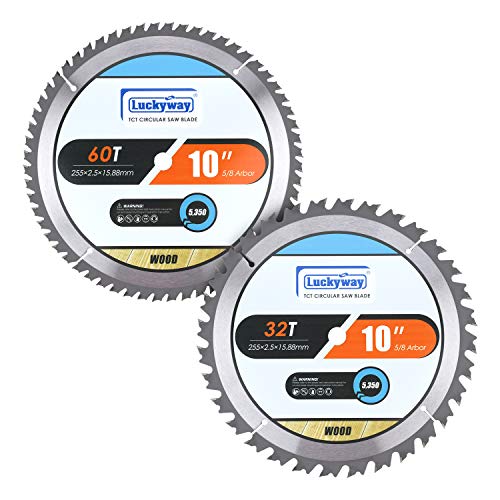
The Luckyway 10-Inch Table Saw Blade/Miter Saw Blade 2-Pack offers a practical solution for woodworkers, contractors, and DIY homeowners who need both a ripping blade and a finishing blade without buying two separate products. This set includes a 32-tooth blade for general cutting and a 60-tooth blade for finer crosscuts, making it a versatile addition to any workshop or job site.
These blades are best suited for anyone working with softwood, hardwood, plywood, MDF, chipboard, and laminate materials. The 60-tooth blade excels at producing smooth, splinter-free edges on plywood and melamine, while the 32-tooth blade handles faster ripping along the grain. Both blades feature an ATB (Alternating Top Bevel) tooth design, which scores the wood surface ahead of the cut to reduce tear-out. This is especially helpful for trim work, cabinetmaking, and furniture projects where a clean finish matters.
In terms of performance, the tungsten carbide teeth provide good wear and heat resistance, allowing the blades to maintain their edge through repeated cuts in dense materials. The fully hardened steel body resists bending and deflection, which helps promote truer cuts and reduces the need for frequent adjustments. Users can expect efficient chip removal thanks to the positive cutting angle, which also helps prevent binding during heavy ripping. While these blades aren't marketed as industrial-grade, they deliver reliable results for most home workshop and light commercial applications.
Build quality is solid for the price point. The blades have a silver finish and a standard 5/8-inch arbor that fits most 10-inch table saws, miter saws, and radial arm saws. They are relatively lightweight at just over three pounds for the pair, making them easy to handle and swap out. However, the blades come in basic packaging without individual blade guards or cases, so users may want to invest in blade storage sleeves or a dedicated blade case to protect the teeth and prevent accidents.
One realistic limitation is that the 32-tooth blade may leave a slightly rougher finish on hardwoods compared to higher-tooth-count blades, so for ultra-smooth cuts, the 60-tooth blade is the better choice. Additionally, some users might find that using a stabilizer or zero-clearance insert helps achieve the cleanest cuts on thin or delicate materials. Maintenance is straightforward: keep the blades clean of pitch and resin, and store them in a dry place to prevent rust.
Overall, the Luckyway 10-Inch Blade 2-Pack offers good value for anyone looking to cover basic cutting tasks without spending a lot. It's a practical choice for DIY homeowners tackling weekend projects, woodworkers building furniture, and contractors who need a backup set on the job site. While it may not satisfy the highest-end professional demands, it provides dependable performance for the price and is worth considering for your workshop.
The Luckyway blades are constructed with a fully hardened steel body that provides rigidity and resistance to bending during cuts. The tungsten carbide teeth are brazed onto the blade and offer good wear resistance for extended use. The ATB tooth geometry is precisely ground to help reduce splintering. While the blades lack a non-stick coating, the silver finish is corrosion-resistant. Overall, the build quality meets expectations for a budget-friendly set, though users should handle them carefully to avoid chipping the carbide tips.
In a typical workshop setting, these blades perform well for crosscutting and ripping a variety of woods and sheet goods. The 60-tooth blade delivers smooth cuts on plywood and MDF, making it ideal for cabinet and furniture projects. The 32-tooth blade is faster for ripping dimensional lumber. Both blades run true with minimal vibration when properly installed. Users may notice improved cut quality when using a zero-clearance insert or a stabilizer. The blades are suitable for most DIY and light professional tasks.

Pros
- Versatile cutting performance across multiple materials
- Anti-vibration technology improves cut quality and user comfort
- Thin kerf reduces waste and makes cutting easier on lower-horsepower saws
- Perma Shield coating keeps blade clean and reduces binding
- Industrial carbide holds edge well for long-term use
Cons
- Thin kerf blades may be more prone to deflection in heavy cuts compared to full kerf
- Premium price compared to standard blades, but justified by performance
- Not recommended for extremely thick or dense hardwoods without proper setup
The Freud LU83R010 is a 10-inch, 50-tooth thin kerf combination saw blade that blends rip and crosscut capabilities into one versatile tool. Designed with a TiCo high-density carbide blend and a unique tooth geometry, it excels in cutting solid wood, plywood, chipboard, and laminates. The thin kerf design removes less material, which translates to faster cuts and less strain on your saw motor.
This blade is best suited for woodworkers, contractors, and serious DIY enthusiasts who need a go-to blade for everyday workshop or jobsite tasks. Whether you're framing, building cabinets, or working on home renovation projects, the LU83R010 offers reliable performance across a range of materials. It's a practical choice for both garage workshops and professional construction environments.
Real-world performance is where this blade shines. The TiCo carbide blend holds its edge longer than standard carbide, reducing the frequency of sharpening. The anti-vibration slots help minimize chatter, resulting in smoother cuts with less noise and fatigue. Users often report cleaner edges in plywood and laminates, with minimal chipping. The Perma Shield coating further reduces friction and prevents resin buildup, keeping cuts consistent and efficient.
Build quality is industrial-grade, with no need for stabilizers thanks to the blade's balanced design. The Perma Shield coating also adds a layer of corrosion resistance, prolonging blade life in humid garage conditions. Storage is straightforward - a standard blade case or wall-mounted rack works well. Maintenance involves occasional cleaning of resin off the coating, which is easy due to the non-stick surface.
One realistic limitation is that thin kerf blades can deflect under heavy cuts, especially in thick hardwoods or when feeding too aggressively. The LU83R010 is not ideal for very thick stock without a stable setup. Additionally, its premium price may be a consideration for budget-conscious shoppers, but the durability and cut quality often justify the investment over time.
Based on product specifications and user feedback, the Freud LU83R010 is a strong recommendation for anyone needing a high-quality combination blade. It strikes an excellent balance between rip speed and crosscut finish, making it a versatile addition to any workshop or jobsite toolkit. For woodworkers, contractors, and dedicated DIYers, this blade delivers consistent, clean results.
Pros
- Universal shank fits most standard reciprocating saws across major cordless and corded brands
- Deep gullets and aggressive Japanese tooth geometry assist in clearing wet chips to reduce blade binding
- Chrome vanadium steel build offers good flexibility and bending resistance in outdoor pruning use
- 12-inch length provides practical clearance for thick limbs and green branches
Cons
- Aggressive 6 TPI tooth layout is coarse and not intended for clean finish woodworking or nail-embedded lumber
- Long 12-inch blade requires careful handling in dense brush to prevent unexpected flexing or bowing
- Not suitable for cutting metal, masonry, or abrasive composite materials
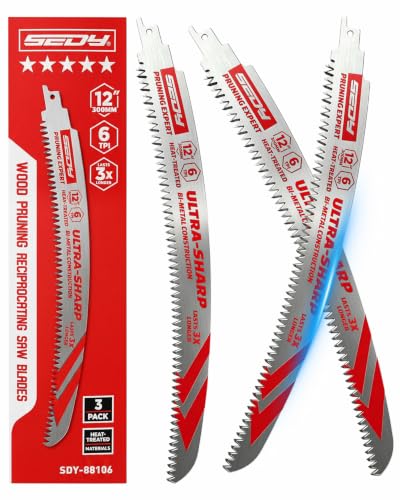
The SEDY 12-inch reciprocating saw blades are specialized pruning and outdoor cutting accessories designed to transform a standard reciprocating saw into an efficient limb-trimming tool. Built for homeowners, property managers, landscapers, and DIYers, these blades target yard clean-up, storm recovery, tree trimming, and green timber cutting. Rather than using standard demolition or wood-cutting blades that quickly choke on wet fibers, this set uses a task-specific profile engineered to clear green material quickly.
In real-world outdoor work, cutting wet branches presents a unique challenge: the high moisture content and fibrous nature of living wood frequently bind standard blades. SEDY addresses this with a 6 TPI Japanese-style tooth design featuring triple-ground offset teeth and an arc-edge profile. This geometry creates three cutting angles to lower friction and incorporates deep cutting gullets. These generous gullets give wet wood chips and pulp space to escape instead of packing into the cut, helping maintain cutting speed through branches, pruning cut-offs, and light firewood processing.
Durability in outdoor cutting often comes down to blade body resilience, especially when a reciprocating saw twists or binds inside a green branch. These blades are manufactured from high-strength chrome vanadium (CR-V) steel. The CR-V construction provides the toughness and wear resistance needed to absorb vibration and resist permanent bending when working through thick limbs, while maintaining sharp tooth edges over extended outdoor trimming sessions.
Handling and tool setup are straightforward thanks to the standard universal shank. The shank locks securely into the quick-release or hex-clamp chucks found on most major reciprocating saw platforms, whether corded or cordless. At 12 inches in overall length, the blade provides plenty of stroke clearance through thick limbs, though users should ensure their saw battery is disconnected or power cord unplugged before installing or swapping blades.
While these blades excel in organic, damp materials, they come with clear application limits. The coarse 6 TPI Japanese-style teeth will tear through finished lumber and splinter delicate trim, making them unsuitable for carpentry or framing. Additionally, they are not designed for metal, nails, or masonry. Pushing a 12-inch blade into dense underbrush also requires a steady hand, as excessive lateral pressure can cause extended blades to flex away from the cut line.
For anyone maintaining a yard, clearing brush, or preparing firewood with a reciprocating saw, the SEDY 12-inch pruning blades offer substantial utility. They provide a practical, cost-effective cutting accessory pack that prevents users from dulling their expensive fine-woodworking blades on outdoor landscaping chores.
Pruning live trees and managing green timber requires a completely different tooth profile than traditional demolition or dry lumber cutting. Living wood fibers are saturated with moisture and sap, which quickly pack into fine teeth and cause friction, excessive heat, and blade stalling. The SEDY pruning blades utilize a coarse 6 TPI Japanese tooth configuration paired with deep gullets specifically to shed wet pulp rapidly.
The arc-edge contour and triple-ground tooth structure provide multiple contact points as the reciprocating saw strokes back and forth. This setup reduces friction against branch walls, allowing the tool motor to maintain momentum even when cutting through thicker green branches or softwoods. For seasonal orchard trimming, clearing fence lines, or bucking fallen limbs into firewood, these blades serve as a fast and convenient alternative to small hand saws.
Compatibility is a crucial factor when purchasing reciprocating saw blades, and the SEDY 3-pack utilizes an industry-standard universal shank. This tang profile is designed to lock into standard reciprocating saw chuck mechanisms, including keyless lever-action systems, twisting blade collars, and traditional set-screw tool holders used across widespread tool brands.
Because the blade measures 12 inches long, it pairs best with full-size reciprocating saws or heavy-duty compact models that offer sufficient stroke length and motor power to cycle the full length of the blade. When securing the blade, users should always ensure the tang is fully seated into the tool chuck and locked tight before beginning outdoor cutting tasks.
Frequently Asked Questions
What tooth count is ideal for cutting hickory?
A 40-tooth to 50-tooth combination blade works best for general table saw cuts, while a 60-tooth to 80-tooth blade is ideal for crosscutting hickory. Lower tooth counts feature deeper gullets that eject waste rapidly during longitudinal rip cuts. Higher tooth counts cleanly shear hardwood fibers on miter saws without causing exit tear-out.
Does a thin-kerf blade help when processing dense hardwoods?
Yes, thin-kerf saw blades remove less material and significantly reduce motor strain on dense hardwoods like hickory. The reduced surface contact produces lower friction and heat during long rips. Keep in mind that thin-kerf blades require stable plates and proper feed speed to prevent plate deflection in thick lumber.
Why does hickory burn so easily during saw cuts?
Hickory burns quickly when pitch accumulation, dull carbide edges, or slow feed rates trap excessive heat against the wood fibers. The density of the wood restricts rapid heat dissipation compared to softer species. Non-stick coatings and sharp tungsten carbide teeth help prevent pitch buildup and eliminate burning.
Can you use fine-finish blades for trim work in hickory?
Yes, fine-finish blades with 60 to 90 teeth deliver splinter-free edges on hickory moldings and cabinetry. These blades pair exceptionally well with a dedicated miter saw for crown molding where tight, gap-free miters are mandatory. Maintaining a consistent, steady feed rate prevents tooth overheating on these dense cuts.
How does carbide grade influence performance on abrasive wood?
High-density tungsten carbide grades resist premature dulling caused by the high silica and mineral content found in hickory lumber. Standard steel teeth dull within a few passes, whereas quality carbide teeth retain razor-sharp edges through extensive project runs. Investing in premium carbide tips ensures consistent cut quality and extends working life between sharpenings.






Write Your Review
No reviews yet. Be the first to share your experience!