


Edge jointing lumber by hand or running every ripped board across a dedicated jointer eats up valuable shop time, especially when slight blade wobble leaves noticeable saw marks along the seam. A true glue-ready cut requires minimal lateral runout and a specialized tooth profile that planes the wood fibers instead of tearing them. Equipping your table saw with the best saw blade for glue joint work solves this headache by providing glass-smooth rip cuts ready for immediate clamping and adhesive application. Whether you are prepping hardwood panels for a tabletop or building fine cabinetry, matching the blade kerf and tooth geometry to your motor horsepower prevents binding and heat buildup.
Evaluating options like a heavy full-kerf blade versus a thin-kerf model depends largely on machine capabilities and project demands. Rigid, thick-kerf plates deliver exceptional stability that resists deflection during long rips, while thin-kerf options allow lower-powered contractor saws to feed stock without bogging down. Just as selecting dedicated tooling makes a difference when using compound miter saws for precision cuts, picking the right ripping blade eliminates tedious sanding steps. Based on manufacturer specifications and common workshop setups, investing in durable carbide tooling with vibration-dampening slots ensures long-lasting edge retention and clean joints across domestic and exotic hardwoods.
Pros
- Produces glue-ready edges, eliminating the need for jointing or sanding.
- Thick kerf and reinforced plate provide excellent stability and flatness.
- Anti-vibration slots extend blade life and improve cut quality.
- Perma-Shield coating reduces maintenance and protects against corrosion.
- Premium carbide blend offers long edge retention and consistent cutting.
Cons
- Premium pricing may not suit budget-conscious DIYers.
- 30-tooth design is specialized for ripping; not ideal for crosscuts or fine joinery.
- Heavier than standard blades due to thick kerf and plate.
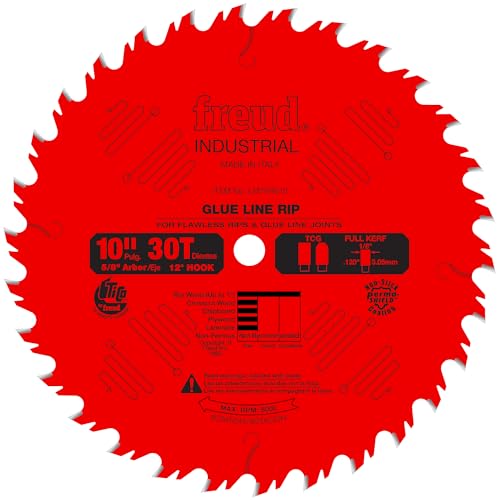
The Freud Industrial Glue Line Ripping Saw Blade (model LM74R010) is a specialized 10-inch, 30-tooth blade designed for woodworkers, contractors, and serious DIY homeowners who demand exceptionally smooth, true-cut surfaces from their ripping operations. This blade features a triple chip tooth (TCG) grind combined with a premium TiCo (Titanium-Cobalt) high-density carbide blend, allowing it to power through hardwoods and softwoods alike while leaving a finish that is often glue-ready straight from the saw.
Who is this blade best suited for? It is an excellent choice for cabinet makers, furniture builders, and finish carpenters who need clean, splinter-free edges without the extra step of jointing or sanding. It also works well for contractors and workshop users who regularly rip large panels or dimensional lumber and want to minimize post-cut finishing work. The blade's heavy-duty construction, with a thick kerf and reinforced plate, provides the stability needed for consistent, accurate cuts in demanding applications.
In terms of real-world performance, the combination of the TiCo carbide blend and anti-vibration laser-cut slots results in reduced vibration and sideways movement during the cut. This translates to a smoother operation, longer blade life, and a cleaner cut edge. The Perma-Shield non-stick coating further enhances performance by reducing friction and heat buildup, as well as preventing pitch and resin from accumulating on the blade teeth. This means less downtime for cleaning and more consistent cutting over time.
Build quality is a standout feature. The blade uses a thick carbide formulation that holds its edge well, even when cutting dense or abrasive materials. The reinforced plate resists warping and maintains flatness, which is critical for achieving straight cuts. The anti-vibration slots are laser-cut for precision, and the Perma-Shield coating adds corrosion resistance, making this blade suitable for both workshop and job site environments where moisture and dust are present.
Storage and maintenance are straightforward. The blade can be stored in a standard blade case or hung on a wall peg. The Perma-Shield coating makes cleaning easy; a simple wipe with a solvent or blade cleaner removes most pitch buildup. However, users should note that this blade is specifically designed for ripping operations. Its 30-tooth configuration and TCG grind are optimized for cutting with the grain, not for crosscutting or delicate joinery. If you need a blade for multiple tasks, you may want to pair this with a combination or crosscut blade.
Overall, the Freud LM74R010 is a practical investment for woodworkers and contractors who prioritize cut quality and productivity in ripping applications. While its premium price may be a consideration for casual DIYers, the time saved on finishing and the consistent results make it a worthwhile addition to any serious workshop or job site tool collection.
The Freud Industrial Glue Line Ripping Saw Blade is built with a thick kerf and a reinforced plate to ensure maximum stability and flatness during heavy use. The plate is laser-cut from high-quality steel, and the anti-vibration slots are precisely engineered to minimize noise and wobble. The TiCo carbide tips are brazed onto the blade with a high-temperature process that ensures they stay firmly attached even under stress. The Perma-Shield coating is applied evenly and provides a durable non-stick surface that resists corrosion and resin buildup. Overall, this blade feels substantial and well-engineered, suitable for daily professional use.
In a workshop setting, this blade excels at ripping hardwood boards, plywood, and MDF with minimal tear-out. The triple chip tooth design produces a flat, smooth edge that is often ready for gluing without additional planing or sanding. The anti-vibration slots keep the blade running true, even when feeding stock quickly. The thick kerf does remove more material than a thin-kerf blade, but the trade-off is increased stability and longer blade life. For woodworkers who do a lot of ripping, this blade can significantly reduce finishing time and improve overall workflow.

Pros
- Outstanding cut quality for ripping applications, producing ready-to-glue edges
- Long-lasting carbide tips that hold up well in dense and abrasive materials
- Reduced vibration contributes to both better cuts and less user fatigue
- Non-stick coating makes cleanup easier and extends blade life between sharpenings
- Thin kerf saves material and reduces strain on the saw motor
Cons
- Designed specifically for ripping, not suitable for crosscutting or miter cuts
- Premium pricing compared to standard contractor-grade blades
- Thin kerf may deflect slightly under extreme feed pressure or with very thick stock
The Freud LM75R010 is a 10-inch industrial thin kerf glue line ripping blade, purpose-built for making long, straight cuts along the grain in solid wood. It’s part of Freud’s high-end lineup, featuring 30 teeth with a Triple-Chip Grind (TCG) and a 12-degree hook angle that’s optimized specifically for ripping on table saws, radial arm saws, and some circular saws. This blade is designed for users who demand furniture-grade results directly from the saw, without needing extra jointing or planing steps.
This blade is best suited for serious woodworkers, cabinet makers, finish carpenters, and contractors who work with hardwoods, softwoods, plywood, and engineered panels. DIY homeowners tackling big projects like building a deck, workbench, or bookshelves will also appreciate the smooth finish and time savings. It’s not intended for crosscutting, but for ripping it excels, making it a specialized tool for those who do a lot of that type of cutting.
In terms of real-world performance, the LM75R010 delivers exceptionally clean cuts with minimal tear-out, even on challenging grain patterns. The thin kerf (0.091") removes less material than a standard full-kerf blade, which means less waste and easier feeding, especially on underpowered saws. The Perma-Shield coating reduces friction and helps prevent pitch from sticking, so the blade stays sharper longer and produces more consistent results. Users report that it leaves a surface that often requires no sanding before gluing.
Build quality is a strong suit. The blade uses Freud’s TiCo HI-Density carbide, which is a premium blend that resists chipping and holds an edge well. The plate is laser-cut from high-grade steel and includes anti-vibration slots that noticeably dampen noise and wobble. The Perma-Shield coating also protects against rust and corrosion, making the blade suitable for workshop environments with varying humidity. The arbor is 5/8", which is standard for most table saws and many circular saws.
Storage and maintenance are straightforward. The blade comes in a reusable plastic sleeve that protects the teeth during storage. Regular cleaning with a resin remover and occasional sharpening by a professional will keep it performing at its best. There’s no specialized storage case included, so you may want to add a blade case or store it carefully in your shop drawer.
One realistic limitation is that this is a ripping-only blade. If you need to do crosscuts or miters, you’ll need a separate combination or crosscut blade. Also, the thin kerf can be more prone to deflection if you push the stock too hard or try to cut very thick material in one pass. Take light to moderate passes for best results. Overall, for woodworkers who prioritize ripping quality and blade longevity, the Freud LM75R010 is a worthwhile investment that performs well above its price point.
Pros
- Selection of three blade contours helps match specific craft and trimming needs
- Dedicated plastic storage case keeps sharp blades organized and safely contained
- Versatile material support covering light wood, model plastics, leather, and paper
- Budget-friendly 6-piece pack provides practical value for detail hobbyists
Cons
- Handle is not included, requiring compatible craft knife or mini hand saw hardware
- Not intended for dimensional lumber, metal cutting, or motorized power tool use
- Fine, pointed design requires careful handling and dedicated eye protection during use
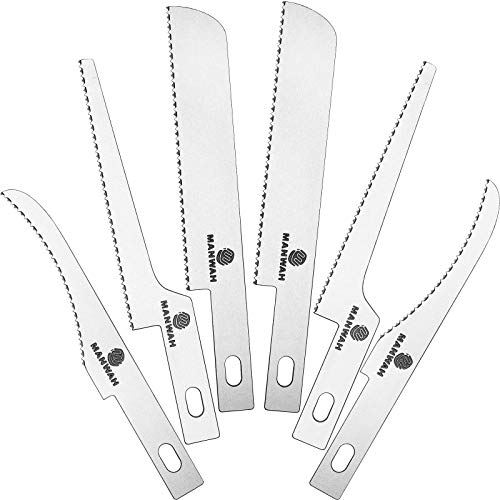
The Honoson 6-Piece Hobby Saw Blade set is a specialized replacement pack created for mini hand saws and precision craft tools. Tailored for scale model makers, wood carvers, miniaturists, and paper crafters, this assortment provides the delicate cutting geometry needed for intricate craftwork. Instead of tackling heavy-duty construction lumber, these narrow blades focus on controlled trimming, fine kerfs, and detailed shaping where larger saws would easily overpower or ruin fragile workpieces.
In practical bench use, these blades handle a variety of craft-grade materials. The manufacturer lists compatibility with light wood, plastic, paper, and leather, making them suitable for trimming excess sprue plastic on scale kits, cutting thin basswood or balsa strips, shaping leather accents, or carving fine details into wooden blanks. The set provides three different blade profiles with two blades per style, giving users flexibility when transitioning between straight cuts, contoured trimming, or delicate carving strokes.
The build quality centers on functional utility for fine manual detailing. Measuring around 4.72 inches in package length with a total package weight of just 0.03 pounds, these slender silver blades are thin and narrow to minimize material waste and cut resistance. The package includes a clear plastic case, which serves both as safe workshop storage between projects and as a practical container to prevent loose edges from damaging other tools or causing accidental bench injuries.
Setup and daily handling depend on your existing tool handle, as this package contains only the replacement blades. Installing a blade into a compatible mini craft knife or hobby saw collet is straightforward, allowing quick swaps as work demands change. Because the blades feature sharp tips and fine teeth, keeping safety glasses on during trimming helps protect against tiny wood shavings or plastic debris that can snap off during precision cuts.
Realistic limitations are straightforward but essential to consider. These are manual hobby blades meant exclusively for delicate crafts; they are not intended for motorized reciprocating saws, structural framing, or thick hardwoods. Furthermore, buyers must have an appropriate mini hand saw handle or hobby knife collet that accepts this style of flat replacement shank, as no handle is supplied in the package.
For modelers, graphic designers, carvers, and DIY crafters seeking a budget-friendly way to restock worn craft saw blades, the Honoson 6-piece assortment is a sensible purchase. Having three distinct shapes in a protective case offers good everyday versatility for detailed cutting benches without requiring a major tool investment.
These replacement blades are engineered for mini craft hand saws and compatible hobby tool holders. They feature narrow flat shanks intended for manual craft knife collets rather than motorized reciprocating saws or jigsaws.
Before buying, verify that your craft knife or hobby saw clamping mechanism accepts standard fine hobby saw shanks. Having a matching handle ensures a secure clamp and steady blade tracking across delicate wood, plastic, or leather projects.
The package contains six silver replacement saw blades split evenly across three distinct cutting styles, providing two blades of each profile.
A dedicated plastic storage box is also supplied. This compact case keeps sharp spare blades organized, protects blade edges from premature dulling in a toolbox, and offers a safe way to collect worn blades for disposal.
Frequently Asked Questions
What tooth geometry makes the Best Saw Blade For Glue Joint effective for edge gluing?
Triple Chip Grind (TCG) teeth alternate with flat rakers to plane the wood surface smooth while clearing chips efficiently. This specialized configuration prevents the scoring ridges typically left by standard Alternate Top Bevel (ATB) blades. The flat-bottomed cut creates square, parallel board edges that mate flush without requiring jointer cleanup or excessive clamping pressure.
Should you choose a full kerf or thin kerf saw blade for glue joint cuts?
A full-kerf blade offers superior plate rigidity on table saws rated at 2 horsepower or higher, whereas a thin-kerf blade works best on lower-powered jobsite or contractor saws. Full-kerf plates resist sideways deflection during heavy rips in dense hardwoods, maintaining a dead-flat face across the entire length of the board. Thin-kerf designs remove less material, putting less drag on portable motors while still producing joint-ready edges when fed smoothly.
Can you make glue joint rip cuts using a miter saw or hobby blade?
No, dedicated glue joint rip cuts require a stationary table saw with a rigid rip fence rather than a crosscut tool or small hobby blade. Standard crosscut blades leave micro-ridges along the edge grain, and tools like miniature craft blades lack the plate thickness and tooth geometry for straight board rips. When working with complex trim angles, maintaining sharp blades as detailed in our guide on miter saw for crown molding ensures tight joints, but ripping wide boards requires a true table saw ripping setup.
How does blade vibration affect the strength of a glue joint?
Blade vibration creates micro-ripples and uneven contact points along the wood edge that weaken adhesive bonding. High-performance ripping blades feature laser-cut anti-vibration slots and thermal expansion channels to suppress harmonic chatter during continuous feeds. Eliminating blade flutter guarantees that opposing wood faces make seamless 100 percent wood-to-wood contact under clamp pressure.
Why is non-stick coating important on a ripping saw blade?
Non-stick coatings reduce surface friction and prevent pitch or resin from adhering to the blade body during deep ripping. Sticky resin buildup traps intense heat around the carbide teeth, causing thermal expansion, premature dulling, and blade warping that ruins cut squareness. Coatings like Perma-Shield keep the blade running cooler, which preserves tooth sharpness and stops unsightly burn marks on delicate hardwood edges.





Write Your Review
No reviews yet. Be the first to share your experience!