


Standard woodworking miter saws are built primarily to slice through softwoods and hardwoods at high rotational speeds, but home workshops frequently present mixed-material tasks. When metal framing studs, electrical conduit, or structural square tubing land on your workbench, the natural impulse is to ask: can i use a miter saw to cut metal without damaging the machine or creating an unsafe workspace? The direct answer is yes, but only under very specific conditions that depend heavily on the type of metal, the rotational speed of the saw, and the blade technology you mount to the arbor. Learning how tool physics changes between wood and metal helps prevent costly equipment damage and personal injury, especially when comparing standard woodworking setups to cutting aluminum on a miter saw with dedicated nonferrous tooling.
Attempting to cut steel with a conventional wood blade will dull carbide teeth almost instantly and create severe kickback risks. However, dedicated multi-material miter saws engineered by manufacturers like EVOLUTION or heavy-duty dry-cut machines from brands such as DEWALT and VEVOR are designed specifically to tackle tough ferrous and nonferrous profiles. Understanding the mechanical differences between high-speed wood saws, dedicated abrasive chop saws, and specialized cold-cut metal saws allows DIYers and fabricators to choose the correct approach. Taking the time to evaluate proper blade selection, workpiece clamping, and debris control ensures that every cut remains accurate, predictable, and safe.

Pros
- Powerful motor for a budget-friendly miter saw
- Lightweight and easy to carry to job sites or store in a garage
- Versatile cutting angles for various projects including wood, metal, and plastics
- Includes extension tables for better support of longer workpieces
- Good safety features with blade guard and vise clamp
Cons
- Single bevel design limits compound cutting versatility compared to dual bevel saws
- No built-in laser guide for quick alignment
- Dust collection bag may not capture all fine particles
The Marvtool 10-inch compound miter saw is a versatile power tool designed for cutting wood, metal, plastic, and laminates with precision. With its 15-amp motor spinning at 5000 RPM, this saw is well-suited for DIY homeowners tackling home repairs, woodworkers crafting projects, contractors working on job sites, and garage users handling various materials. Its lightweight build and compact footprint make it a practical addition to any workshop or tool collection.
In practical use, the Marvtool miter saw delivers consistent cutting power across soft metals, hardwoods, and plastics. The 36-tooth TCT blade provides clean crosscuts and miters, though users may want to upgrade the blade for finer finish work. The saw's single bevel from 0 to 45 degrees allows for angled cuts in one direction, which is adequate for most framing and trim work. The vise clamp secures workpieces firmly, reducing vibration and improving accuracy.
The saw features a transparent blade guard for safe operation, and the dust collection bag helps keep the workspace tidy. The extension tables provide additional support for longer boards, enhancing stability during cuts. At just 20.5 pounds, this miter saw is easy to carry between job sites or store in a garage. The head locks securely into the base for safe storage, saving valuable bench or shelf space.
Setting up the Marvtool miter saw is straightforward out of the box. The included Allen key allows for quick blade changes, and the extension tables attach easily. No complex assembly is required. Routine maintenance involves keeping the blade clean and checking the dust bag. The compact design means it can be stored on a shelf or in a cabinet when not in use.
The main limitation is the single bevel design, which requires flipping the material for compound cuts in the opposite direction. This can slow down workflows on complex trim work. Also, the saw lacks a laser guide, so users must rely on manual alignment or mark cuts. The dust collection bag is decent but may not capture all fine particles, especially during heavy use.
For DIYers and tradespeople seeking a budget-friendly miter saw for general cutting tasks, the Marvtool is a solid choice. It's particularly well-suited for light to moderate use in home workshops, garage projects, and construction sites where portability matters. While professionals may prefer a dual bevel saw for advanced trim work, this saw offers great value for its price point. The 2-year warranty adds confidence in the purchase.

Pros
- Space-saving 2-in-1 design replaces two tools in one compact footprint
- Multi-material cutting capability with included TCT blade saves time and money on blade changes
- Accurate bevel and miter adjustments with positive stops for repeatable cuts
- Safety features like retracting blade guard and riving knife offer peace of mind
- Lightweight and portable for easy transport and storage
Cons
- Rip capacity in table saw mode is limited to 1-1/2 inches, restricting wider rip cuts
- Miter crosscut capacity of 4-3/4 x 2-3/16 inches may not handle larger stock
- Some users may prefer a dedicated saw for heavy-duty professional use rather than a convertible model
The Evolution R8MTS 8-1/4" Convertible Miter/Table Saw is a clever 2-in-1 solution designed for DIY homeowners, woodworkers, contractors, and anyone working in tight spaces like garages, workshops, or job sites. This multi-function saw combines a compound miter saw and a table saw into one compact, portable unit, allowing you to switch between modes quickly using simple locking pins. It's a practical choice for those who need versatility without sacrificing valuable bench or floor space.
Performance-wise, the R8MTS really shines with its ability to cut wood, plastic, mild steel, aluminum, and composites using a single TCT (Tungsten Carbide Tipped) blade. This multi-material capability means you can move from cutting hardwood trim to slicing through metal conduit without changing blades, which is a huge productivity boost for contractors and tradespeople. The 12A high-torque motor delivers enough power for clean, burr-free cuts in steel and smooth finishes in hardwood, while the thin-kerf blade helps reduce waste and improve accuracy.
Build quality is solid for a compact saw. The cast aluminum table top provides a flat, stable cutting surface, and the dual-locking rip fence ensures secure workpiece positioning. The miter range goes from 45 degrees left to 45 degrees right with preset stops for common angles, and the bevel adjusts from 0 to 45 degrees, making it easy to tackle crown molding, baseboards, and angled cuts. Safety features are well thought out, including a blade guard that stays covered until contact, a riving knife to reduce kickback, and dust extraction ports to keep your workspace cleaner.
In terms of storage and portability, the R8MTS is a winner. Weighing just 28.6 pounds with a compact footprint of 15.7 x 16.5 x 12.8 inches, it's easy to carry from the truck to the job site or store on a shelf or in a cabinet. The convertible design also means you don't need a separate miter saw stand and table saw cart, which simplifies setup and breakdown. For DIYers with limited garage space, this is a major advantage.
That said, there are realistic limitations to consider. The rip capacity in table saw mode is only 1-1/2 inches, so you won't be resawing wide boards or cutting large sheets of plywood. The miter crosscut capacity is 4-3/4 inches high by 2-3/16 inches wide, which handles most trim and small stock but may not accommodate larger dimensional lumber. Also, because it's a convertible design, some heavy-duty professionals might prefer dedicated saws for demanding daily use. However, for the vast majority of DIY projects, home repairs, and light to medium contractor work, these limits are rarely a problem.
Overall, the Evolution R8MTS is a smart investment for anyone who needs a versatile, space-saving cutting solution. It's particularly well-suited for woodworkers tackling small to medium projects, contractors working on trim and metal fabrication, and DIY homeowners who want one tool that can handle multiple materials. Based on product specifications and user feedback, this saw delivers reliable performance, solid build quality, and genuine versatility at a reasonable price point. If you're looking to maximize your workshop's capabilities without expanding its footprint, the R8MTS is definitely worth a look.
The Evolution R8MTS is designed to perform well in small workshops and garages where space is at a premium. Its 2-in-1 design means you can keep both miter and table saw capabilities in a single footprint, which is a huge advantage for DIYers and hobbyists. The 12A motor provides enough torque for cutting through hardwood, plastic, and mild steel, and the included TCT blade delivers clean cuts without frequent blade changes. For woodworking projects like building shelves, cutting trim, or crafting furniture, this saw offers good accuracy thanks to the preset miter stops and smooth bevel adjustment. The dust extraction ports help keep sawdust under control, which is always appreciated in a home workshop. While it may not replace a full-size cabinet saw for heavy production work, it's more than capable for most weekend projects and light professional use.
For garage users, the Evolution R8MTS is a practical choice because it combines two essential saws into one compact unit. If you have a typical two-car garage with limited bench space, this saw can sit on a workbench or be stored on a shelf when not in use. The lightweight design (28.6 pounds) makes it easy to move around, and the convertibility means you can switch from cutting angle iron for a custom rack to trimming baseboards for a home renovation without changing tools. The ability to cut metal without swapping blades is especially handy for garage projects like building workbenches, storage racks, or repairing equipment. Just be mindful of the rip capacity if you plan to cut wide stock; for most garage tasks like cutting lumber, metal tubing, or plastic sheets, it works great.
The Evolution R8MTS is built with a focus on durability and precision. The cast aluminum table top provides a flat, warp-resistant surface that holds up well over time. The dual-locking rip fence and adjustable miter gauge give you secure workpiece control, and the blade guard mechanism is designed to retract only when the blade contacts the material, keeping the blade covered for safety. The motor housing and base are made from robust materials that can handle job site bumps and daily use. While the saw is compact, the components feel solid, and the locking pins for mode conversion are sturdy and reliable. Overall, the build quality is appropriate for a tool in this price range, offering good value for DIYers and light professionals who need a dependable multi-functional saw.

Pros
- Keyless blade change mechanism eliminates downtime searching for misplaced arbor tools
- Sturdy solid steel base delivers high stability and features pre-drilled bench mounting holes
- Reliable 15-amp motor powers through dense metal profiles with minimal bogging
- Tool-free fence and quick-clamping vise simplify setup for miter and bevel cuts
Cons
- At 39 pounds, it requires noticeable physical effort when moving frequently between job sites
- Abrasive wheel cutting produces substantial sparks and dust, requiring thorough workspace protection
- Abrasive disc diameter decreases with use, which gradually reduces maximum cutting depth
The DEWALT D28715 14-inch chop saw is an abrasive metal-cutting benchtop tool built for heavy-duty fabrication, repair work, and structural metal preparation. It fits naturally into the workflow of metal fabricators, general contractors, mechanics, pipefitters, and serious home garage hobbyists who routinely cut through angle iron, solid bar stock, heavy conduit, and steel box tubing.
Driving the saw is a high-torque 15-amp motor with plenty of power reserves, giving it dependable cutting efficiency when slicing through dense metal cross-sections. A major productivity advantage is the Quick-Change keyless arbor mechanism, which lets operators swap abrasive discs quickly without fumbling for specialized wrenches. Paired with the tool-free Quick-Fence that adjusts up to 45 degrees, the unit helps keep multi-angle fabrication moving smoothly.
DEWALT built this machine on an extra-wide solid steel base that anchors the tool against vibration and supports long workpieces with confidence. The base includes pre-drilled holes for permanent bench mounting, and fabricators can even tack-weld custom stops or alignment jigs directly onto the steel surface. Smooth head travel is handled by a heavy-duty compression spring rather than standard torsion springs, providing predictable downward feed resistance and extended component durability through the comfortable D-handle.
Weighing around 39 pounds, the saw provides adequate portability for truck bed transit using the built-in head lock-down pin, though it performs best when bolted down to a dedicated cutting bench or stand. As with any abrasive saw, users should anticipate hot sparks and metal particulate, making a clean workspace and appropriate eye and ear protection essential. The natural wear of abrasive cutting wheels also means cut depth slightly decreases over the life of each disc.
For tradespeople, agricultural mechanics, and DIY fabricators seeking reliable cutting capacity without the high initial cost of dry-cut cold saws, the DEWALT D28715 offers a rugged, straightforward solution. Its tool-free adjustments, resilient steel base, and generous capacity make it a practical asset for demanding workshop metal prep.
In a busy shop environment, workflow speed depends on fast stock repositioning. The quick-lock vise on the DEWALT D28715 allows operators to clamp down round pipe, square tubing, and flat stock in seconds without spinning a threaded rod end-to-end.
The cutting envelope easily accommodates up to 5-inch round stock and 4-1/2 by 6-1/2-inch rectangular material. This wide throat allows users to process common structural sizes without flipping the workpiece repeatedly, making it well-suited for fence building, trailer repairs, and mechanical frame construction.
Pros
- Powerful 1200W motor handles most common metal cutting tasks with ease
- Cold cut blade produces smooth, burr-free edges requiring less finishing work
- Adjustable cutting angle up to 45 degrees adds versatility for angled cuts
- Safety features like auto-return guard and quick-lock provide peace of mind
- Quick setup and clamping system saves time on repetitive cuts
Cons
- Cutting capacity limited to 2.76 inch width and 2.56 inch thickness may not suit large beams or thick plate
- Cord length not specified; users may need an extension cord for convenient placement
- Some users may find the lack of a laser guide reduces precision for very fine adjustments
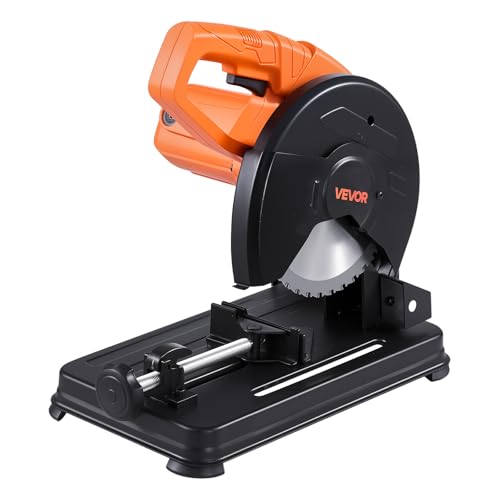
The VEVOR 7-1/4 inch chop saw is a dedicated metal cutting tool built around a 1200W motor and a stainless steel cold cut blade. It is designed to handle a variety of metal stock including square tubes, flat steel, and I-shaped beams. This saw is best suited for DIY homeowners tackling garage projects, mechanics working on vehicle frames, and contractors who need a portable saw for light to medium metal fabrication on the jobsite.
In terms of performance, the motor spins the blade at 4000 RPM, which provides enough speed and torque to cut through common metals cleanly. The cold cut blade technology helps produce burr-free edges, reducing the need for additional grinding or deburring. Based on product specifications, the saw can deliver over 3500 cuts per blade, which suggests good longevity for moderate use. The adjustable cutting angle from 0 to 45 degrees allows for miter cuts, making it useful for framing, brackets, or angled supports.
Build quality appears solid with a compact frame and safety-oriented features. The auto-return blade guard automatically covers the blade after each cut, and the quick-lock mechanism prevents accidental startup. The quick-adjustment wrench clamps materials securely, and the single-hand operation reduces fatigue during repetitive cuts. At 14.44 pounds, the saw is light enough to carry to different work areas without strain.
Setup and storage are straightforward. The saw measures about 14.5 by 9 by 15 inches, fitting well on a workbench or in a tool cabinet. Maintenance mainly involves keeping the blade clean and checking the clamps for debris. No complicated assembly is required out of the box. Many users may prefer a dedicated metal cutting saw like this to avoid contaminating a wood-cutting blade.
Realistically, the cutting capacity is limited to a maximum width of 2.76 inches and thickness of 2.56 inches. That covers most square tubes and flat bars but not large structural beams or thick plates. The cord length is not specified, so an extension cord will likely be needed for mobility. Additionally, the included blade, while durable, may eventually require replacement, and aftermarket options are widely available.
Overall, the VEVOR chop saw is a practical choice for anyone needing an affordable, portable metal cutting solution for home workshops, garages, or light commercial use. It balances power, precision, and safety in a compact package. For users who cut metal regularly but don't need a heavy-duty industrial machine, this saw offers solid value.
The 1200W motor delivers consistent cutting power across a range of metals. The 4000 RPM speed, combined with the cold cut blade, produces clean cuts with minimal burrs. This efficiency reduces time spent on secondary finishing. The adjustable angle feature allows for accurate miter cuts, which is particularly useful when fitting metal pieces together in construction or automotive work.
Safety is prioritized with an auto-return blade guard that covers the blade immediately after the cut, and a quick-lock mechanism that prevents the saw from starting unintentionally. The stainless steel blade is designed for longevity and resists corrosion. The clamping system holds workpieces firmly, reducing the risk of kickback or movement during cutting. The saw's compact build and lightweight design make it safer to handle and position compared to larger stationary units.

Pros
- Lightweight aluminum construction makes it easy to move between the garage and jobsite
- LED cut indicator provides consistent visual accuracy across various lighting conditions
- Reliable 15-amp motor provides ample torque for dimensional lumber and trim boards
- Straightforward angle locking mechanism ensures solid miter positions during cuts
Cons
- Single bevel design requires flipping stock for opposing bevel cuts
- Stock dust collection bag captures only a portion of fine sawdust during heavy use
- Fine furniture makers may want to upgrade to a higher-tooth finish blade for ultra-fine veneers
The VEVOR 10-Inch Compound Miter Saw is a benchtop cutting tool designed for handling angled, cross, and bevel cuts on lumber, molding, and composite materials. Powered by a heavy-duty 15-amp motor that spins the blade up to 5000 RPM, this tool provides the necessary muscle for typical home improvement chores, framing tasks, and interior remodeling. It is particularly well suited for DIY homeowners, hobbyist woodworkers, punch-list contractors, and garage workshop enthusiasts who need dependable cutting performance without committing to the bulk or expense of an industrial sliding unit.
In terms of operational accuracy, the saw features an integrated LED alignment system that casts a distinct line across the cut line. Unlike traditional lasers that can lose calibration after transport or hard knocks, LED shadow guides utilize the blade's actual position, keeping alignment consistent. The left-tilting bevel mechanism adjusts smoothly from 0 to 45 degrees, allowing users to cut baseboards, door casing, and craft frames with tight, clean seams. The miter table locks firmly into common preset detents, reducing guesswork during repetitive angle work.
Build quality centers on a cast aluminum base that balances rigidity with portability. Weighing roughly 24 pounds, the machine is easy to pick up, stow on a shelf, or carry out to the driveway for outdoor cutting tasks. The aluminum deck provides a flat, stable surface for supporting dimensional lumber, while the included hold-down clamp keeps boards secured against the fence during active cuts, minimizing workpiece drift and tear-out.
Safety is addressed through a dual-action trigger design that requires intentional activation, reducing the risk of accidental startup in busy work environments. The transparent lower blade guard retracts smoothly as the saw head lowers, maintaining line-of-sight while shielding against flying debris. Setup out of the box is relatively quick, requiring minimal assembly before mounting the blade and verifying fence squareness with a standard combination square.
There are practical limitations to keep in mind based on design specifications. As a non-sliding single-bevel saw, crosscut width is limited to standard 10-inch capacities, meaning wider boards require a multi-step flip or a different cutting approach. Flipping material is also necessary for matching opposite bevel angles. Furthermore, like many miter saws in this category, connected shop vacuums capture dust more effectively than the included fabric collection bag.
For homeowners taking on deck repairs, shelf building, baseboard installation, or general garage projects, the VEVOR 10-Inch Compound Miter Saw presents a practical, cost-effective cutting solution. Its combination of low transport weight, reliable power, and clear alignment guidance makes it a smart addition to any expanding home tool collection.
When set up on a standard workbench or portable miter saw stand, this tool delivers steady cutting performance through standard 2x4 framing studs, softwood trim, and PVC decking. The 15-amp motor maintains consistent speed under load, preventing binding when tackling denser hardwoods like oak or maple when paired with a steady feed rate.
The compact footprint takes up minimal bench space, making it an excellent match for modest one-car garage shops where tool storage is always at a premium. Quick-turn locking knobs allow smooth transitions between miter cuts and bevel cuts, letting you move through repetitive trim jobs efficiently.

Pros
- Cuts metal, wood, and plastic cleanly without requiring blade changes
- Ultra-portable frame makes it simple to move around jobsites or stow on garage shelving
- High-torque motor prevents motor strain when slicing through tough materials
- Clear miter and bevel markings allow straightforward angle alignment
Cons
- Non-sliding mechanism restricts maximum cutting capacity on wider dimensional lumber
- Multi-material blade leaves a coarser finish on fine finish carpentry compared to dedicated high-tooth wood blades
The Evolution R210CMS is a dedicated 8-1/4-inch compound miter saw built around multipurpose cutting technology. Designed specifically to handle multiple materials without the tedious need for frequent blade changes, this compact saw fills a unique space in home workshops and mobile trade rigs. It serves DIY homeowners tackling backyard builds, electricians trimming conduit, plumbers sizing PVC pipe, and metal fabricators cutting angle iron or thin tubing.
Performance centers on the 1200W high-torque motor and a matched gearbox system designed to run at the precise RPM needed for multi-material efficiency. Based on manufacturer specifications and trade feedback, the saw cuts cleanly through mild steel plate without extreme heat or hazardous sparks, leaving a cool-to-the-touch, virtually burr-free edge ready for immediate welding or fastening. It also powers effortlessly through framing lumber with embedded nails, making it a reliable workhorse for renovation projects where hidden fasteners might ruin standard wood blades.
Build quality focuses on functional portability and shop practicality. Weighing under 13 pounds, the chassis is remarkably easy to carry with one hand, making it ideal for jobsite work or tradespeople working out of service vans. The tool features clear angle scales for both 45-degree left and right miter cuts, as well as a 0 to 45-degree bevel tilt mechanism. The integrated Japanese tungsten-carbide-tipped blade provides substantial wear resistance against abrasive materials, ensuring prolonged sharpness across varied cutting tasks.
Setting up and maintaining the saw requires minimal fuss. Its compact dimensions make benchtop mounting quick, while its modest footprint fits easily into tight garages and small utility rooms. Storage requires little shelf space, which benefits users with limited shop square footage. Standard maintenance primarily involves blowing out metal shavings and sawdust from the lower guard assembly and periodically checking bevel stops for squareness.
Prospective buyers should consider a few design limitations. Because this is a fixed compound saw without sliding rails, cut capacity is limited to smaller dimensional lumber and light profiles. Woodworkers seeking to square wide boards or finish fine furniture grade trim will likely require dedicated high-tooth fine finish blades or larger sliding saws. The included multi-material blade prioritizes versatility over furniture-ready edge smoothness.
For homeowners, general handymen, garage tinkerers, and remodelers who frequently cut diverse materials like conduit, trim, copper pipe, and plastic, the Evolution R210CMS represents an exceptionally versatile and cost-effective cutting solution. Its combination of lightweight handling, capable motor power, and all-in-one blade technology makes it a practical addition to any active workspace.
Unlike traditional abrasive chop saws that produce smoke, intense heat, and excessive sparks when cutting steel, the Evolution system relies on a slow-speed, high-torque approach. This setup keeps cuts cool and workable directly off the table, reducing surface cleanup before welding or assembling.
The multipurpose blade simplifies everyday garage projects by eliminating the downtime of swapping out blades when moving from lumber framing to aluminum extrusions or steel brackets. This versatility increases productivity during mixed-material builds, outdoor repair projects, and general structural fabrication.

Pros
- Compact and easy to store, perfect for small workshops or garage toolboxes
- Japanese pull saw provides two TPI options for different wood types without changing blades
- Replaceable blades extend the set's versatility to include soft metals and thick materials
- Affordable price point makes it accessible for hobbyists and home renovators
- Miter box delivers accurate 45- and 90-degree cuts for trim work and crafts
Cons
- Narrow miter box (2.68-inch width) limits use to light-duty materials; not suitable for thick lumber or heavy construction
- Included saw blades may require frequent replacement under regular use on hardwoods
- Lacks a built-in clamp or vise, so users may need to secure the miter box separately for stable cuts
The ZHYFC 4-Piece Miter Box and Saw Set is a compact cutting system designed for light-duty projects around the home or workshop. It combines a Japanese pull saw with two interchangeable blades and a small miter box, giving DIY enthusiasts and woodworkers a convenient way to make precise miter and bevel cuts without investing in a power saw.
This set is best suited for homeowners tackling small trim repairs, hobbyists crafting furniture details, or anyone needing a portable solution for baseboards, chair legs, wainscoting, or picture frames. While it's not built for thick lumber or heavy construction, it handles thin wood strips, plastic, and soft trim pieces with ease. The included Japanese pull saw features a dual-edge blade - 10 TPI on one side for quick cuts through softwoods like pine, and 17 TPI on the other for smoother cuts in hardwoods such as oak or maple. The triple-ground teeth maintain sharpness and clear sawdust efficiently, which speeds up cutting and reduces effort.
Performance-wise, the replaceable blades add versatility. The 25 TPI fine-toothed blade is ideal for cutting soft metals like aluminum or copper pipes, while the 9 TPI coarse blade tackles harder wood, MDF, and PVC. The miter box itself is 2.68 inches wide, which is plenty for typical trim work but not for wide boards. It offers preset miter angles for common cuts, and the anti-slip handle and fixing screw help keep the setup stable during use. Build quality is adequate for the price - the plastic miter box feels lightweight but sturdy enough for light use, and the saw handles are comfortable for short sessions.
Storage and maintenance are straightforward. The set comes with all pieces that can be packed together, though there's no dedicated case. You'll want to keep the blades dry and oiled to prevent rust, and replace them when they dull. A limitation to note is the miter box's width - it won't accommodate boards over about 2.5 inches thick, so it's not suitable for large framing or construction projects. Also, the saw is a pull saw (cuts on the pull stroke), which may take a bit of getting used to if you're accustomed to Western push saws.
Overall, the ZHYFC 4-Piece Miter Box and Saw Set offers good value for light-duty DIY work. It's a practical addition to a home workshop or garage for quick trim adjustments, model making, or small woodworking tasks. For heavy-duty cutting, you'd want a power miter saw, but for portability and precision on small projects, this kit gets the job done reliably.
The miter box in this set is designed with preset slots for common angles (likely 45 and 90 degrees) to guide the saw blade for consistent, repeatable cuts. Users report that the narrow channel (2.68 inches) holds the saw steady, reducing blade drift during cuts. The Japanese pull saw's thin kerf also contributes to clean, accurate cuts with minimal tear-out on softwoods. For light-duty trim work and crafts, this setup provides respectable precision for the price point. However, because the miter box is plastic, it may not hold up to heavy use or repeated cuts on very hard materials without wear. For occasional hobby use, though, it delivers reliable accuracy.
Understanding Metal Cutting Capabilities on a Miter Saw
Using a miter saw for metal depends entirely on distinguishing between standard high-speed woodworking miter saws and purpose-built metal-cutting machines. A typical 10-inch or 12-inch woodworking saw spins its arbor at roughly 4,000 to 5,000 RPM, which creates optimal chip clearance in timber but generates excessive friction against dense metals. Purpose-built multi-material miter saws or dedicated cold-cut metal saws operate with specialized high-torque gearboxes that reduce rotational speed down to around 1,500 to 2,500 RPM. This substantial speed reduction prevents excessive heat buildup, extends carbide tip life, and reduces hot spark showers.
If you choose to use a standard high-speed wood saw for light metal cutting, your workpiece materials must generally remain limited to thin-gauge, nonferrous metals like brass, copper, and architectural aluminum. Ferrous metals such as mild carbon steel, rebar, angle iron, and stainless steel require specialized engineering that manages dense material resistance. Putting mild steel under a high-speed wood saw can overwhelm the motor, melt plastic guards, and shatter standard carbide teeth. Making the right decision starts with identifying the properties of your workpiece, checking your saw speed ratings, and mounting a blade engineered specifically for that metallurgy.
Ferrous Versus Nonferrous Metals: Core Material Distinctions
Metal classification represents the most important factor when planning any cut on a pivoting saw. Nonferrous metals do not contain significant amounts of iron, meaning they are non-magnetic, considerably softer, and far less prone to violent work-hardening under friction. Materials such as aluminum extrusions, copper pipe, brass threshold plates, and thin aluminum trim can be cut on many standard miter saws when paired with an appropriate negative-rake carbide blade. Because nonferrous metals generate soft chips rather than hot incendiary sparks, they present lower thermal risks to the tool housing.
Ferrous metals contain iron, providing immense tensile strength and hardness that demand completely different cutting dynamics. Common workshop ferrous stock includes structural tubing, black iron pipe, cold-rolled rod, unistrut, and sheet metal studs. Cutting these dense alloys with an ordinary saw blade creates extreme friction, generating molten metal fragments and sparks that reach temperatures capable of igniting wood dust inside collection chutes. Ferrous metals also grab blade teeth aggressively if the workpiece flexes during a cut, dramatically increasing the likelihood of sudden motor stalls and dangerous kickback events.
Whenever you need to crosscut steel profiles, you must rely either on an abrasive chop saw or a dedicated dry-cut saw fitted with tungsten carbide-tipped ferrous blades. Tools such as the EVOLUTION R210CMS or the convertible EVOLUTION R8MTS feature specialized gearboxes and Japanese TCT multi-material blades designed specifically to shear through mild steel cleanly. Without a low-speed, high-torque motor and steel-rated tooth geometry, attempting to push through ferrous stock will ruin standard woodworking equipment. Always verify whether a magnet sticks to your workpiece before bringing the saw blade down.
The Critical Role of Motor Speed and Gearbox Torque
Rotational speed and torque govern how a cutting edge engages with the grain or molecular lattice of a material. A wood-cutting compound miter saw, such as the VEVOR 10-inch miter saw running at 5,000 RPM, uses high speed to slice cleanly through wood fibers without tear-out. However, pushing a blade at 5,000 RPM through a wall of solid mild steel causes tooth tips to skate across the metal rather than take uniform chips. This rapid friction generates extreme surface heat, softens the tool steel backing of the blade, and causes carbide tips to fracture or release from their braze pockets.
Dedicated cold-cut chop saws and multi-material miter saws feature specially optimized gear reduction sets that sacrifice no-load RPM in favor of immense mechanical torque. The lower rotational velocity allows each tungsten carbide tooth to scoop out clean, curled metal shavings while remaining below the thermal threshold where steel softens. Because the cut generates minimal heat, the workpiece remains cool enough to handle almost immediately, eliminating the heat-affected zone and burrs common to high-speed cutting. This balance between speed and torque explains why multi-material saws can cut steel safely while standard wood saws struggle.
If you only own a high-speed miter saw, you must understand that the tool cannot be converted into a true cold-cut steel saw simply by swapping the blade. Running a steel-cutting TCT blade on a 5,000 RPM arbor violates the maximum safe operating speed stamped on the blade plate. Doing so exposes the operator to severe blade failure risks and quickly destroys expensive specialty blades. Respecting the RPM rating of both the power tool and the cutting accessory is essential for smooth workshop operation.
Evaluating Blade Types: TCT Cold-Cut Blades Versus Abrasive Wheels
Selecting the right blade style dictates cut quality, operator comfort, and operating costs across any fabrication project. The two dominant consumable types for cutting metals on stationary chop and miter tools are bonded abrasive cutting wheels and tungsten carbide-tipped (TCT) tooth blades. Traditional chop saws, such as the DEWALT 14-inch D28715, frequently utilize reinforced abrasive wheels composed of aluminum oxide or silicon carbide grains held together by resin matrices. These abrasive wheels grind through heavy angle iron and solid bars by wearing away both the workpiece and the wheel itself.
Abrasive cutting offers substantial power for thick stock, but it introduces distinct drawbacks that fabricators must manage. Abrasive discs generate vast clouds of foul-smelling dust, hot sparks, and heavy perimeter burrs that require secondary grinding before parts can be welded or assembled. Furthermore, as the abrasive disc wears down during heavy cuts, its usable cutting diameter decreases continuously, which reduces the maximum depth of cut over time. In contrast, modern TCT cold-cut blades, such as the stainless steel cold-cut blade on the VEVOR 7-1/4 inch chop saw, maintain a constant outer diameter throughout their lifespan.
TCT blades slice metal via shearing action rather than friction grinding, which yields virtually burr-free edges and square joints ready for immediate fabrication. While TCT blades carry a higher upfront cost than fiber discs, their durability and speed often yield lower per-cut operating expenses in production environments. However, TCT blades are far less forgiving of loose workpieces or sudden lateral twisting during a cut. If a piece of metal shifts while in contact with a spinning toothed blade, the carbide teeth can shear off instantly, requiring total blade replacement.
Workpiece Clamping and Mechanical Stability
Clamping a metal workpiece firmly against the table and fence is completely non-negotiable when operating any motorized saw. Woodworkers frequently hold lumber against a miter saw fence by hand, relying on high downward friction and broad surface area to stabilize the board. Metal possesses a slick, non-porous exterior that easily slips under rotational torque, creating an immediate danger if attempted freehand. If a spinning blade catches an unconstrained metal tube, the blade can throw the workpiece violently or pull the operator toward the cutting zone.
Dedicated metal cutting saws integrate heavy-duty mechanical vises directly into their heavy stamped steel or cast bases. Saws like the DEWALT 14-inch chop saw feature a quick-lock vise assembly and heavy-duty compression mechanisms designed to pin structural shapes immovably against an adjustable steel fence. Multi-material compound miter saws also include vertical screw clamps that apply downward pressure right beside the blade kerf. Ensuring that round pipe or asymmetrical conduit cannot roll or lift during the downstroke prevents blade binding and keeps cut angles strictly true.
When cutting thin-walled metal tubing or delicate aluminum profiles, standard clamping pressure can sometimes crush or deform the hollow shape. Fabricators often insert scrap wooden dowels or custom hardwood backing blocks inside the hollow profile to support the metal walls during clamping. Solid support along both horizontal and vertical axes guarantees that the blade exits cleanly through the bottom wall without snagging the unsupported edge. Taking two minutes to secure proper mechanical clamping will always save parts and prevent tool damage.
Managing Workshop Fire Hazards and Airborne Particulates
Introducing metal cutting into an environment primarily arranged for woodworking creates serious fire and respiratory hazards that require active mitigation. Wood dust that settles inside miter saw lower blade guards, plastic motor housings, and fabric collection bags is extremely combustible. When cutting ferrous metals, the resulting shower of glowing friction sparks can easily ignite fine sawdust hidden inside the vacuum shroud or dust chute. Before making any metal cuts on a saw that previously processed wood, you must thoroughly blow out the motor vents, clean the base, and remove the cloth collection bag.
Never connect a standard woodworking shop vacuum or central dust collection system to a miter saw while cutting metal. Flying sparks sucked into a plastic hose lined with dry wood shavings will ignite a smoldering fire inside the vacuum canister within minutes. Purpose-built metal saws utilize deflected metal shields, heavy cast-aluminum chip deflectors, or dedicated magnetic chip collectors to contain dense swarf safely. If your saw has a plastic blade guard, inspect it frequently to ensure hot chips are not eroding or melting the polymer structure during extended cuts.
Personal protective equipment must also adapt when transitioning from timber to metal tasks. While standard safety glasses and hearing protection are common in all shops, metal cutting demands impact-rated face shields to protect against high-velocity metal chips. Long-sleeved natural fiber clothing, such as heavy cotton or leather, prevents hot swarf from burning your skin. Avoid synthetic fleece or polyester garments that melt rapidly when contacted by stray sparks, and always keep a fully charged Class ABC fire extinguisher within immediate arm reach of the workstation.
Alternative Cutting Solutions for Light Fabrication and Small Shops
When powered miter saws cannot safely match the metal workpiece at hand, alternative cutting methods provide excellent precision without thermal hazards. For delicate hobby tasks, architectural modeling, or narrow trim, manual miter boxes offer total control and zero spark generation. Sets like the 4-Piece Miter Box and Saw Set include dedicated fine-toothed 25 TPI blades engineered specifically for cutting soft copper, thin brass, and aluminum extrusions cleanly. Manual cutting eliminates high-speed kickback risks entirely, making it well-suited for fine craft environments where power tools prove unwieldy.
For high-volume structural metal cutting in professional fabrication shops, portable metal-cutting band saws and dedicated cold saws remain the gold standard. Horizontal band saws produce zero sparks, generate very little noise, and yield square, cool-to-the-touch edges across thick solid stock that would stall standard circular saws. Reciprocating saws and compact metal shears can also handle rough jobsite demolition and rough sizing without requiring dedicated stationary table setups. Matching the correct cutting tool to the specific scale of your project prevents unnecessary wear on woodworking machinery.
DIY remodelers working across diverse flooring, trim, and transition profiles often need flexibility across mixed installations. If your current renovation project includes synthetic planks rather than metal transitions, reading about cutting vinyl flooring with a miter saw illustrates how blade tooth count and feed speed impact finish quality on delicate non-wood materials. Evaluating the exact requirements of your project prevents costly mistakes and preserves your equipment across every cut.
Step-by-Step Checklist for Safe Metal Cutting on Compatible Saws
Executing clean, safe cuts on metal stock requires a disciplined sequence of checks before you ever pull the trigger. First, disconnect the saw from its power outlet or remove the battery pack to verify that the arbor nut is torqued securely to the manufacturer specification. Ensure the blade installed matches both the outer diameter and arbor size of your tool, and confirm that its maximum RPM rating exceeds your saw motor output. Clear the entire cutting table of stray wood shavings, rags, and solvents before repositioning the saw in a well-ventilated workspace away from open containers.
Next, position your metal workpiece firmly against the back fence and secure it with a mechanical clamp rather than hand pressure. Support any overhang on long pipes or angle iron using adjustable roller stands so the stock cannot tilt and bind the blade mid-cut. Set your bevel and miter angles precisely, double-checking that the blade path clears all metal vise jaws and fence extensions throughout its complete range of motion. Put on your safety glasses, full-face impact shield, and hearing protection before reconnecting the power supply.
Finally, pull the trigger and allow the motor to reach its full operating speed before lowering the cutting head toward the material. Lower the blade smoothly with steady, moderate downward pressure, letting the blade teeth or abrasive grains shear the metal at their natural pace. Forcing the blade too quickly down into the stock overloads the motor, dulls the cutting edge, and creates excessive burring. Once the cut finishes, hold the saw head fully down, release the trigger, and wait for the blade to come to a complete stop before lifting the head and loosening the clamp.
Successfully cutting metal on a miter saw relies on respecting the mechanical limitations of your tool and matching the blade technology to the exact alloy on your bench. While multi-material miter saws and cold-cut chop saws excel across structural steel, conduit, and heavy tube, standard high-speed wood saws must remain restricted to thin nonferrous profiles fitted with proper negative-rake blades. Prioritizing rigid clamping, proactive fire safety, and controlled feed rates guarantees clean, accurate cuts while maintaining a reliable, hazard-free workshop environment.




Write Your Review
No reviews yet. Be the first to share your experience!