


Dull cutters turn standard firewood processing and tree trimming into slow, exhausting work that strains your powerhead and ruins your guide bar. When cutters lose their keen edge, chainsaws produce fine sawdust instead of coarse chips, requiring excessive physical downforce that can lead to accelerated bar wear and severe kickback risks. Learning how to sharpen stihl chain saw teeth with correct round file sizes, proper filing angles, and adjusted depth gauges restores fast, predictable cutting action without trip-to-the-shop delays.
Maintaining a sharp chain requires balancing cutting-tooth geometry with the clearance provided by each depth gauge, also known as the raker. While dedicated shop grinders provide rapid stock removal, field-ready hand files and integrated guide holders allow you to renew cutters directly on the bar between fuel fills. Whether you maintain specialized wood-cutting saws or review general workshop techniques like a miter saw cutting guide for fine trim work, keeping your cutting edges razor-sharp ensures safe operation, reduced engine strain, and prolonged tool longevity.

Pros
- Complete set with multiple file sizes for various chain pitches.
- Includes depth gauge and flat file for comprehensive chain maintenance.
- Compact and portable pouch with high visibility.
- Ergonomic wooden handle improves comfort.
- Quick gauge tool adds extra functionality.
Cons
- Files may wear out faster than premium brands like Stihl or Oregon.
- Wooden handle may not fit all users' preferences for grip.
- No file guides included, which some beginners might expect.
The Hipa 12-Pack Chainsaw Sharpening File Kit is a complete maintenance set designed for anyone who owns a chainsaw, from weekend DIYers to professional tree service crews. It includes six round files in the most common sizes (1/8", 5/32", 11/64", 3/16", 13/64", and 7/32"), a 6-inch flat file, a combination depth gauge tool (.025" and .030"), and a multi-function quick check gauge. All of these fit neatly into a bright orange zippered pouch for easy transport and storage.
This kit is best suited for homeowners, woodworkers, landscapers, farmers, and contractors who need to keep their chainsaws, pole saws, and other cutting equipment sharp. With the variety of file sizes, you can match nearly any standard chain pitch. The depth gauge ensures you maintain proper raker clearance, which directly affects cutting efficiency and safety. The flat file is handy for dressing off burrs or leveling depth gauges.
In terms of performance, the files are made from hardened steel and are designed to handle the tough task of reshaping chain cutters. While they may not last as long as some premium brands, they provide reliable sharpening for routine maintenance. The ergonomic wooden handle can be swapped between files, offering a comfortable grip and good control. Users appreciate the quick check gauge, which helps verify pitch size, filing angle, and cutter length at a glance.
Build quality is adequate for the price point. The files feature laser-etched size markings that remain legible, and the depth gauge is a simple but effective stamped metal tool. The flat file is standard size and fits the handle securely. The pouch is a basic nylon fabric with a zipper, but it does the job of keeping everything together. For workshop storage, you may prefer to keep the pouch in a drawer or hang it on a pegboard.
One realistic limitation is that the files themselves are individual items without their own handles, so you need to use the supplied wooden handle each time. Some users might prefer dedicated handles for faster changes. Also, the kit does not include file guides, which some beginners find helpful. However, the quick check gauge compensates partially by giving you the correct angles.
Overall, the Hipa chainsaw sharpening kit is a solid value for the money. It offers everything you need to maintain your chainsaw's cutting edge without buying individual tools. Whether you're touching up a chain after a day of cutting firewood or sharpening between jobs, this kit is a practical addition to any workshop or truck box. For the price, it's hard to beat the convenience and completeness.

Pros
- Cuts sharpening time in half by dressing teeth and rakers at the same time
- Clear visual angle guides assist both beginners and seasoned saw operators
- Durable, rigid frame ensures consistent contact across the cutting edge
- No electricity required, making it ideal for on-site woods and yard touch-ups
Cons
- Dedicated strictly to standard 3/8-inch pitch chains and will not fit .325 or 3/8 Picco profiles
- Files eventually wear out under heavy use and require replacement inserts
- Requires proper user technique and hand pressure to avoid uneven cutter wear
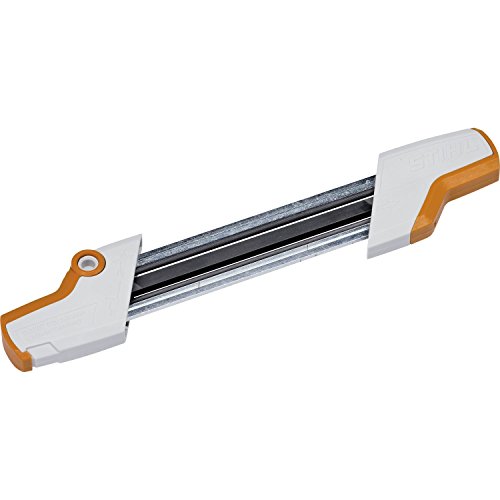
The Stihl 2-in-1 Easy File is a dedicated manual chainsaw chain sharpening guide engineered to maintain cutting efficiency for DIY homeowners, firewood processors, tree service workers, and garage mechanics. Keeping saw chains sharp is essential not only for clean cuts but also for extending powerhead engine life and reducing user fatigue. This tool streamlines the traditional two-step filing process into a single, unified action.
Instead of filing cutting teeth with a standard round file and then switching to a flat file with a separate depth gauge tool, this dual-action jig holds both round and flat files simultaneously. On every forward stroke across a cutter link, the round file sharpens the cutting edge while the flat file automatically trims the depth gauge, or raker, to the factory-specified height. This design significantly improves workflow speed and ensures consistent cutting depth across the entire chain loop.
Build quality centers on a rigid metal guide assembly that firmly holds the files in proper alignment, preventing wobble or uneven pressure during the stroke. Clear stamped angle markings on the top guide plate make it simple to track the standard 30-degree filing direction. Because the round and flat files are held securely by friction collars, they can be rotated to access fresh cutting surfaces or replaced entirely when they eventually dull, giving the tool long-term service value.
In terms of practical operation, users simply roll the tool over when switching from left-hand to right-hand cutting teeth. One key operational boundary is pitch matching: this specific model is calibrated strictly for standard 3/8-inch pitch chains. It will not work properly on .325-inch pitch loops or low-profile 3/8 Picco setups, so matching the tool to your exact chain pitch before use is mandatory.
For anyone who cuts firewood, maintains rural acreage, or handles outdoor cleanup, the Stihl 2-in-1 Easy File delivers reliable, shop-quality chain dressing right at the tailgate. It offers an efficient, dependable way to keep saw chains operating at their sharpest without relying on bulky bench grinders or inconsistent freehand filing.
This sharpener is sized specifically for standard 3/8-inch pitch saw chains commonly used on mid-to-large displacement farm and professional chainsaws. Before using this guide, verify that your drive links are stamped for standard 3/8-inch pitch rather than 3/8-inch extended or low-profile Picco chains, as file diameters and raker clearances differ substantially.
For best results during field maintenance, secure the chainsaw bar in a stump vise or tailgate clamp to eliminate bar movement. Apply even forward strokes with light downward pressure, making sure to avoid drawing the files backward against the metal teeth. Keeping the files clean with a wire brush and storing the assembly in a dry tool roll prevents tooth loading and rust buildup.
Pros
- Simultaneous tooth and raker filing saves considerable time in the shop or field
- Built-in guide lines help maintain precise cutting angles without guessing
- Durable steel construction withstands rugged jobsite and woodshed conditions
- Files are replaceable so the main guide body lasts for years
Cons
- Strictly limited to .325 pitch saw chains and cannot be used on 3/8 or 1/4 inch chains
- Directional layout requires a brief learning curve for first-time users
The Stihl 2-in-1 Easy File Chainsaw Chain Sharpener is a dedicated manual maintenance tool engineered to restore cutting teeth and lower depth gauges at the exact same time. Traditional saw chain maintenance usually requires two separate operations: running a round file across the cutter face and following up with a flat file against a depth gauge plate. This dual-action accessory integrates two round files and a central flat file into a single rigid frame, cutting service time roughly in half while maintaining consistent tooth geometry.
This tool is ideal for DIY homeowners cutting seasonal firewood, rural property managers, tree service crews, landscapers, and workshop woodcutters who rely on .325 pitch chains. Keeping a chainsaw sharp is not just about cutting speed; it is also a fundamental safety concern, as dull chains require excessive push pressure and increase kickback risks. For trade workers and groundskeepers who do not want to carry electric bench grinders to the field, this manual system delivers fast touch-ups right on the saw bar.
In terms of performance, the tool tracks cleanly over the chain link while resting on the top plate. As you push forward, the round file shapes the cutting corner and side plate while the center flat file shaves the raker to the exact manufacturer-specified clearance relative to the tooth height. This balanced removal prevents the chain from grabbing too aggressively or producing fine sawdust instead of crisp wood chips. The rigidity of the steel frame minimizes flex, providing uniform filing pressure and predictable material removal on every stroke.
The build quality is tailored for tough jobsite conditions. Featuring a sturdy guide frame with embossed alignment marks, the tool gives clear visual reference lines to help maintain standard 30-degree sharpening angles. The handles offer comfortable control and protect fingers from accidental contact with neighboring cutters. Because standard round and flat files wear out over continuous use, the housing easily opens to allow quick file replacement without needing to discard the main assembly.
A clear limitation to keep in mind is chain compatibility. This specific model is strictly engineered for .325 pitch chains and will not properly engage 3/8-inch low profile, standard 3/8-inch, or .404-inch chains. First-time users will also need to pay attention to the directional arrows stamped into the frame, as the tool must be flipped horizontally when transitioning from right-side cutters to left-side cutters.
Overall, the Stihl 2-in-1 Easy File represents one of the most practical and efficient chain care investments available for chainsaws running .325 pitch loops. For anyone looking to eliminate tedious two-step file work and achieve clean, professional cuts in the field or workshop, this manual sharpener is an exceptional addition to any saw kit.
In garage and workshop environments, this filing system removes the guesswork usually associated with depth gauge maintenance. By keeping the rakers proportionally matched to the tooth height automatically, it ensures the chain feeds into hardwoods and softwoods smoothly without bogging down the powerhead.
The compact dimensions allow it to slip into a saw carry case, jobsite toolbox drawer, or mobile service truck without occupying valuable room. It requires zero electrical power, making it just as capable during backcountry trail clearing as it is on the home workbench.
Essential Steps and Techniques for Sharpening Stihl Chainsaws
Restoring a factory-sharp edge on a chainsaw requires understanding the relationship between the cutter tooth top plate, side plate, and depth gauge. When a saw cuts wood, each curved cutter operates much like a miniature wood chisel, scooping out chips while the depth gauge just ahead of it regulates how deep the tooth bites into the timber. If you sharpen only the tooth without lowering the depth gauge, the saw will eventually fail to bite, sliding harmlessly over log surfaces while generating friction and smoke.
Consistent manual sharpening relies on applying consistent stroke counts, maintaining an identical horizontal angle, and keeping the file at the correct depth across every left-hand and right-hand tooth. By establishing a systematic workflow and inspecting the chain before touching steel to tooth, you can extend the service life of your saw chain significantly while preserving the balance of your bar.
Identifying Chain Pitch, Gauge, and Matching File Diameters
Before selecting a file, you must match the exact diameter of the round file to the pitch of your saw chain. Stihl manufactures several distinct chain types, including common low-profile 3/8-inch Picco chains, standard .325-inch pitch chains, and full-size 3/8-inch chains found on larger farm and professional saws. Using the wrong file diameter alters the cutter hook profile, either creating an aggressive undercut that dulls rapidly or a shallow blunt bevel that cannot bite.
For small homeowner saws running Stihl Picco Micro or Mini 3/8-inch low-profile chains, a 5/32-inch (4.0 mm) round file is standard. Medium-displacement saws frequently run .325-inch pitch chains, which normally require a 3/16-inch (4.8 mm) round file. Heavy-duty saws equipped with full 3/8-inch pitch chains rely on a 13/64-inch (5.2 mm) round file, though a 7/32-inch file is frequently used across generic non-Stihl 3/8-inch chains. You can verify your chain pitch by checking the numbers stamped on the side plate of the drive link or the information stamped directly into the tail of your guide bar.
Comprehensive kits like the Hipa 12 Pack Chainsaw File provide multiple round file diameters, including 5/32-inch, 3/16-inch, 7/32-inch, 1/8-inch, 11/64-inch, and 13/64-inch options. Having these varying sizes on hand ensures you have the exact file diameter required whether you are maintaining a compact pole pruner or a mid-sized ground saw. Matching the proper file diameter guarantees that roughly one-tenth to one-fifth of the file diameter stands slightly proud above the cutter top plate during filing strokes.
Preparing the Chainsaw and Securing the Workpiece
Preparation begins with complete tool safety and proper mechanical stabilization. Turn off the engine, switch the ignition switch to the stop position, and disconnect the spark plug boot to eliminate any possibility of accidental starts. For battery-powered models, remove the battery pack entirely before cleaning or touching the chain assembly. Wear heavy leather work gloves to protect your hands from razor-sharp edges and metal burrs throughout the maintenance procedure.
Clean the chain thoroughly using a wire brush, solvent, or dedicated resin remover to clear accumulated sawdust, bar oil sludge, and tree pitch from the cutters and depth gauges. Heavy dirt buildup obscures tooth damage, clogs file teeth, and prevents accurate angle alignment. Once cleaned, clamp the guide bar securely in a bench vise padded with soft aluminum jaws or wood blocks, positioning the clamp near the center of the bar without pinching the chain drive links in the bar rail.
Check and adjust chain tension prior to filing. A loose, sloppy chain rocks sideways in the bar groove when you press a file against it, ruining your filing angles and producing inconsistent cutting edges. Tighten the tensioning screw until the bottom of the lowest drive links snug firmly against the underside of the guide bar, yet the chain can still be pulled smoothly along the rails by hand. Engaging the chain brake periodically while filing holds the individual cutter firmly in position during each stroke.
Locating the Master Tooth and Setting Filing Angles
Inspect the entire chain to locate the shortest, most heavily worn, or damaged cutter tooth. Striking hidden stones, embedded fencing wire, or sandy soil often chips the chrome plating off one or two cutters. This shortest cutter serves as your master tooth, and all other cutters must eventually be filed down to match its overall length so the saw cuts straight without pulling to one side.
Mark the top plate of this master tooth with a bright grease pencil, permanent marker, or chalk mark so you have a recognizable starting point as you advance the chain around the bar. Most standard Stihl chains feature a top-plate sharpening angle of 30 degrees relative to the guide bar rail. Some specialized ripping chains require 10-degree angles, while semi-chisel chains may occasionally specify 30 to 35 degrees, but 30 degrees remains the standard benchmark for general crosscutting wood.
Hold the round file horizontally, level with the top edge of the guide bar rail. Unless your specific chain manufacturer manual instructs a 10-degree down-tilt angle, keep the file perpendicular to the vertical plane of the bar. Position the file inside the gullet so that the file contact points bear simultaneously against the top plate cutting edge and the vertical side plate edge.
Executing Proper Stroke Mechanics on Cutting Teeth
Chainsaw files are designed to cut only on the forward push stroke. Place the round file into the gullet of the tooth, rotate your body so your push path aligns exactly with the 30-degree guide line stamped on the tooth back, and push forward smoothly using balanced two-handed control. Apply firm pressure directed outward toward the cutting edge and slightly upward into the top plate roof.
Lift the file completely off the steel on the return stroke. Dragging the hardened teeth of the file backward across the cutter dulls your file rapidly, leaves rough microscopic burrs along the cutting edge, and ruins the smooth mirror finish needed for razor-sharp performance. Execute three to five smooth, controlled forward strokes per tooth, counting your strokes so each tooth receives equal stock removal.
Work on all cutters facing one direction first, such as all right-hand cutters, before rotating the saw or repositioning yourself to file the opposite left-hand cutters. This unidirectional approach builds muscle memory, helping you replicate the exact horizontal angle, file height, and stroke pressure consistently across the entire loop. Advance the chain along the guide bar as you complete each tooth, setting the chain brake each time to lock the tooth solidly while filing.
Regulating Depth Gauges and Using Progressive Guides
Filing the cutters back lowers their overall height, reducing the vertical clearance between the top plate cutting edge and the depth gauge standing in front of it. On standard chains, this depth gauge clearance should measure between .025 inches and .030 inches. If the depth gauge is too high, the cutters cannot contact the wood grain with sufficient bite; if filed down too far, the cutters take excessive bites, causing severe grabbing, chain chatter, stalling, and violent kickback.
The 2-in-1 combo tool included with the Hipa 12 Pack Chainsaw File kit includes slotted depth gauge guides marked for .025-inch and .030-inch clearances alongside a 6-inch flat file. Place the slotted depth gauge tool over the cutters so the raker protrudes through the slot. Any metal extending above the flat surface of the gauge must be filed down flush using forward strokes with the flat file.
After filing the raker flat to height, lightly round off the leading front corner of the depth gauge with your flat file to restore its original contoured shape. A rounded leading edge helps the raker glide smoothly over wood fibers without snagging, reducing operational vibration. Just as precise blade setup matters when exploring cutting plastic and composite materials on benchtop saws, balancing depth gauges on your chainsaw ensures consistent chip formation across hardwoods and softwoods alike.
Comparing 2-in-1 Sharpeners with Traditional File Kits
Traditional multi-piece file kits provide broad versatility at a modest cost, making them attractive for users maintaining several different power tools. A comprehensive pack containing multiple round file diameters, a flat file, interchangeable wooden handles, and a universal depth gauge allows you to service pole saws, mini trim chains, and heavy ground saws from a single pouch. However, manual kits demand careful visual alignment, steady hands, and independent depth gauge measuring sessions.
Integrated sharpening devices like the Stihl 2 in 1 Easy File Chainsaw Chain Sharpener for 3/8-inch chains streamline the entire process by combining tooth sharpening and raker lowering into a single stroke. This dedicated tool houses two round files positioned alongside a central flat file within a rigid guide frame. As you push the frame along the cutter, the round file sharpens the cutting edge while the flat file automatically trims the depth gauge to its exact relative height.
Similarly, the dedicated Stihl 2 IN 1 EASY FILE CHAINSAW CHAIN SHARPENER for .325-inch pitch chains offers the same single-operation convenience tailored to mid-sized bars. While 2-in-1 sharpeners are pitch-specific and represent a higher initial expense per tool size, they eliminate guesswork, enforce proper filing angles with built-in frame markings, and substantially cut down field maintenance time. Homeowners and property managers prioritizing speed and angle accuracy often find 2-in-1 sharpeners well worth the investment.
Diagnosing Uneven Cuts, Curved Kerfs, and Premature Dulling
When a chainsaw pulls to the left or right during a straight bucking cut, uneven cutter lengths or mismatched depth gauge heights are almost always the cause. If the cutters on the right side of the loop are sharper or longer than those on the left, the chain pulls toward the sharper side, binding the bar inside the cut kerf. Correct this by measuring cutter lengths with a dial caliper or check gauge, filing the longer teeth down to match the shortest master tooth.
Curved cutting paths can also stem from an asymmetric guide bar rail. When one rail wears down lower than the other due to lack of periodic bar rotation, the chain tilts slightly sideways under load. Check your guide bar rails with a small steel square; if the rails are uneven or display rolled burrs along the outer edges, dress the bar flat with your flat file and rotate the bar 180 degrees before reinstalling the chain.
Premature dulling often occurs when the file creates an excessively sharp, fragile hook along the top edge. If you press too hard upward or use an undersized round file, the thin chrome edge will fold over quickly after cutting just a few branches. Conversely, if your saw generates powdery dust despite multiple file passes, you may have failed to lower the depth gauges, leaving the cutters unable to penetrate the wood.
Safe Inspection and Post-Sharpening Bar Reassembly
Once all cutters and depth gauges have been filed, inspect the entire chain loop for structural damage before returning the chainsaw to service. Examine the drive links for burrs or peening that could damage the sprocket and rail grooves. Discard any chain displaying cracked tie straps, missing rivet heads, or teeth worn past the stamped rear wear limit line.
Blow away all metallic filing dust and shavings from the chain and bar guide rails using a shop brush or compressed air. Metal filings left inside the bar rail mix with tacky bar lubricant, forming an abrasive paste that wears out the nose sprocket bearings and bar groove prematurely. Verify that the oil inlet hole on the guide bar is completely free of compacted wood shavings and sludge so bar oil flows freely during operation.
Reassemble the sprocket cover, readjust chain tension so the loop snaps snugly against the rails, and verify that the chain brake engages and disengages crisply. Start the saw safely on clear ground and confirm that a faint spray of bar oil appears against a clean log or surface when running at medium throttle. Regular touch-ups with the correct file kit keep your Stihl chainsaw cutting cleanly, efficiently, and safely through every project.




Write Your Review
No reviews yet. Be the first to share your experience!