


Straight, repeatable rip cuts form the foundation of dependable woodworking, yet factory fences on portable and jobsite saws often struggle with deflection and limited length. Learning how to build table saw fence solutions allows woodworkers to eliminate binding, correct drifting alignment, and secure wider workpieces with confidence. Whether building a custom wooden rip guide from scratch or assembling an extruded track system, achieving parallel alignment to the blade remains the essential benchmark for workshop safety and precision.
Auxiliary extensions and commercial upgrades often provide the necessary rigidity when a factory fence lacks clamping power or accessory mounting options. Woodworkers accustomed to general tool operations, such as handling a portable setup following a circular saw guide, will appreciate how a rigid rip fence stabilizes material throughout the entire cut. Exploring practical fabrication techniques alongside dedicated aftermarket rail systems helps clarify which approach best supports your workshop projects.

Pros
- Versatile add-on works with many saw types and fence brands, from portable to full cabinet saws.
- Multiple T-slots and clamp slots give you flexible positioning for better control on long cuts.
- Sturdy anodized aluminum construction feels solid and resists wear over time.
- Quick attachment and removal with clamps make it convenient to use only when needed.
- Integrates seamlessly with BOW Feed Supports and other accessories for a complete extension system.
Cons
- Requires separate purchase of XT T-Track Clamps (part #XT2) for most saws, adding to initial cost.
- 46-inch length may be overkill for very small benchtop saws, potentially causing overhang issues.
- Learning curve to position and clamp correctly for balanced infeed and outfeed support.
The BOW Products XT XTENDER Fence is an add-on fence system designed to increase the capacity and versatility of your table saw. Made from robust aluminum extrusion with a black anodized finish, this 46-inch fence attaches to your existing saw fence using T-track clamps. It features three T-slots along the top for mounting accessories like featherboards and stops, plus milled slots on the back for multiple positioning options. This accessory is all about giving you more control over longer workpieces without upgrading your entire saw.
This fence is best suited for woodworkers, DIY homeowners, and contractors who use portable, benchtop, or smaller cabinet saws. If you often cut plywood or long boards on a saw with a small table, the XTENDER can make a big difference. It also works well with bandsaws, helping to keep material square during resawing. The design focuses on improving feed control and safety by extending the fence surface and providing a stable platform for push sticks or featherboards.
In real-world use, the performance boost comes from the added reach and stability. With the T-slots, you can easily attach featherboards to prevent kickback or hold material against the fence. The optional XT Feed Supports act as a shelf to extend the table surface, giving you better infeed and outfeed support. This reduces the chance of boards tipping or binding, making cuts smoother and safer. The fence's ability to position forward, backward, or centered means you can tailor the support to your specific cut, whether you need more room on the infeed or outfeed side.
Build quality is solid. The aluminum extrusion is thick enough to resist flexing under pressure, and the anodized surface resists rust and corrosion in a humid workshop. The T-slots are precision-milled and run the full length, so accessories slide easily. The fence itself weighs about 8.8 pounds, which feels substantial but not unmanageable. Setup requires the XT T-Track Clamps (sold separately), which attach to your saw's existing fence. Once clamped, the XTENDER stays put during cuts, though you may need to adjust clamp tightness for a slip-free hold. Storage is simple: unclamp and hang it on a wall hook or lay it flat in a toolbox.
There are a few realistic limitations. The most obvious is the need to buy the clamps separately unless you have a Delta UniFence or Harvey fence that uses the included slot. That adds about $30-40 to the total cost. Also, the 46-inch length may be too long for very compact benchtop saws, potentially causing the fence to extend past the saw's base and creating an imbalance. You'll want to measure your saw's fence depth before ordering. Some users might find the initial positioning a bit fiddly, especially when trying to align it for both infeed and outfeed support.
Overall, this is a practical upgrade for anyone with a smaller table saw who wants to handle longer boards more safely and accurately. It's not a necessity for every shop, but if you regularly work with sheet goods or long lumber, the XT XTENDER Fence can improve your productivity and cut quality. For the price, it offers good value compared to buying a larger saw or a dedicated outfeed table. Just factor in the cost of the clamps and be prepared to spend a few minutes dialing in the setup. For woodworkers and DIYers looking to get more from their existing saw, this fence is worth serious consideration.

Pros
- Substantially increases infeed and outfeed material support on compact shop and contractor saws
- Low fence mode provides safe clearance for push sticks when ripping narrow strips
- Drop-in hardware system speeds up jig changes and featherboard positioning
- Clamps securely to existing fences without drilling permanent mounting holes
Cons
- Requires adjusting your rip fence scale or adding 1-1/4 inches to rip measurements
- Overall 47-1/4-inch length requires sufficient front and rear clearance in compact garages
The O'SKOOL Table Saw Rip Fence System is an auxiliary extruded aluminum fence extension designed to expand workpiece control and cut precision on standard table saws. By clamping directly over an existing rip fence, it extends the effective reference surface to 46 inches, with an overall length of 47-1/4 inches. This setup is tailored for woodworkers, cabinetmakers, DIY furniture builders, and dedicated home shop owners who need the stability of an extended reference guide when handling long boards or large sheet materials.
In practical workshop applications, cut quality depends heavily on keeping the workpiece flush against the fence throughout the entire stroke. The extended profile acts as both an infeed guide and an outfeed support, helping prevent stock from drifting away from the blade as it exits the cut. The 3-in-1 design adapts smoothly to different cutting operations. Standard high fence mode supports tall panels and vertical box cuts, while the 3/4-inch low fence position allows push sticks to clear the blade guard during narrow rips. For flush trimming or template operations, the L-fence layout provides solid guidance without binding.
Build quality centers on heavy-duty extruded aluminum that provides structural rigidity without excessive weight. The straight, machined profile resists lateral deflection under hand pressure, which helps produce square, repeatable cuts on hardwoods and composite panels alike. Along the body, eight built-in T-slots accept standard hardware. The included drop-in T-bolts are particularly convenient, as they drop straight into the track slots from above rather than needing to slide in from either end, saving time when repositioning featherboards or shop-made stop blocks.
Mounting this system is straightforward and reversible. It clamps firmly over standard rip fences, requiring no drilling or mechanical modifications to your saw. Maintenance is minimal, requiring only an occasional wipe down to clear sawdust and a periodic check of the clamping knobs. Because the aluminum track adds exactly 1-1/4 inches of thickness to your saw fence, users will need to reset their saw's measurement cursor or manually account for the offset when setting cut widths.
For woodworkers working in compact workshops where a dedicated outfeed table would consume valuable floor space, this extension provides dependable support and versatile jig mounting. While taking the 1-1/4-inch offset into account requires a minor adjustment to your measuring habits, the gains in feed control, thin rip safety, and overall cut accuracy make this accessory a practical addition to any table saw setup.
The multi-profile architecture of this fence extension addresses several common table saw challenges. When processing sheet goods or ripping wide panels, the upright configuration provides broad lateral support to stop tall pieces from tipping. Transitioning to thin rips is simple, providing a low reference edge that leaves ample room for hands and push blocks to pass safely between the fence and blade guard.
Woodworkers who frequently build specialized jigs will appreciate the eight integrated T-slots. Whether mounting auxiliary wooden faces, vertical featherboards to eliminate board chatter, or micro-adjustable stop blocks for repetitive crosscuts on a sled, the open slot pattern provides ample mounting locations across the entire 46-inch span.
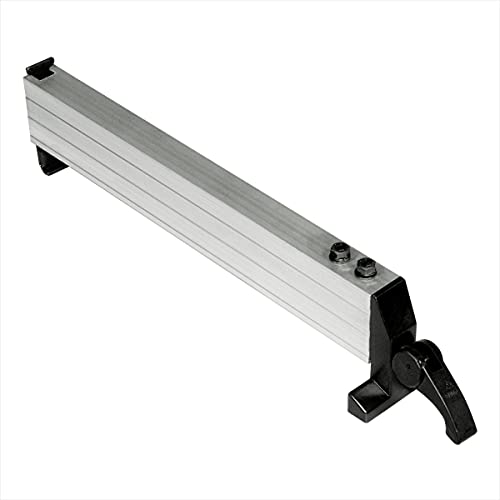
Pros
- Quick rail-free clamp design installs directly onto standard 9-inch saw tables
- Cam-action locking lever provides dependable clamping pressure during stock feed
- Broad compatibility across multiple benchtop band saw brands
- Helps improve ripping accuracy on small hobbyist woodworking setups
Cons
- Strictly limited to small tables between 11-1/8 inches and 11-13/16 inches deep
- Requires manual alignment verification against the miter slot to ensure absolute parallelism
- Designed for light-to-medium DIY stock rather than heavy commercial resawing
The POWERTEC BS900RF Rip Fence is a dedicated band saw guide accessory designed to bring straight, repeatable cutting capability to benchtop wood band saws. Many compact 9-inch band saws come from the factory without a fence, leaving users to rely on makeshift clamped boards or freehand lines. This specialized guide clamps directly across the cast iron or stamped steel work table, giving woodworkers a solid edge reference for ripping, resawing thin stock, and truing board edges.
This accessory is best suited for DIY homeowners, hobbyist woodworkers, and small garage workshop users who own entry-level 9-inch band saws. Brands like POWERTEC, WEN, Ryobi, Delta, Craftsman, and Central Machinery frequently feature table depths that match this fence. Woodworkers shaping small craft projects, model builders sizing thin strips, and home repair hobbyists cutting trim will find this tool far more convenient than setting up temporary clamp boards.
In terms of practical workshop performance, the guide functions around an intuitive cam-lever locking system. Users slide the fence into position along the table, square it up, and press down the lever to lock both ends securely against the table edges. The clamping mechanism holds firm under standard board feed pressure, preventing deflection during moderate ripping tasks. By providing a steady guide face, it improves cutting efficiency and helps eliminate blade wander caused by uneven hand feeding.
Build quality focuses on lightweight practicality. Measuring just over a foot in length and weighing under a pound, it adds minimal bulk to a small saw table while keeping operation simple. The clamp range adjusts by turning the lock lever clockwise or counterclockwise, allowing fine-tuning to match table depth variations between 11-1/8 inches and 11-13/16 inches. The low profile also makes storage easy, as it slides into a drawer or hangs from a pegboard hook when performing curved scroll cuts.
As with any universal accessory, there are practical limitations to keep in mind. The clamping range is specifically tailored to compact band saws, meaning it will not fit 10-inch, 12-inch, or full-sized 14-inch workshop band saws. Additionally, because it lacks a geared rack system, users should routinely measure the front and rear distance to the miter slot before clamping to ensure the fence sits perfectly parallel with the blade track.
Based on product specifications and user feedback, the POWERTEC BS900RF is a practical, budget-friendly addition to any small woodshop. It turns an entry-level benchtop saw into a much more versatile machine for ripping small stock, making it a sound purchase for hobbyists seeking cleaner cuts and quicker setups.
The POWERTEC BS900RF is engineered to fit band saw work tables with front-to-back depths ranging from 11-1/8 inches to 11-13/16 inches. Rotating the locking lever adjusts the clamping reach smoothly to accommodate minor manufacturing variations across brands.
Compatible machines include the POWERTEC BS900 9-inch wood band saw along with similarly sized models from WEN, Ryobi, Delta, Craftsman, Harbor Freight, Central Machinery, and Black & Decker. Buyers should verify table depth with a tape measure before ordering to ensure proper clamping contact.

Pros
- Significantly increases infeed and outfeed workpiece stability on portable jobsite saws
- Integrated T-tracks accommodate standard woodworking jigs and featherboards cleanly
- Mounts quickly using standard track clamps without modifying your existing fence
- High-precision American manufacturing delivers straight, reliable rip registration
Cons
- Standard track clamps required for mounting are not included in the package
- The 36-inch length is tailored for compact machines and may be short for large cabinet saws
The Woodpeckers ARF-BSCS Auxiliary Rip Fence is a dedicated precision guide attachment designed to expand workpiece support on compact machinery. Tailored for woodworkers, finish carpenters, cabinetmakers, and serious DIY remodelers, this 36-inch extruded fence brings stationary-tool stability to jobsite table saws, vintage contractor saws, bandsaws, and router tables. Portable saws frequently struggle with narrow factory fence faces, making this accessory a practical upgrade for handling long or wide sheet goods with confidence.
On compact saws, short fence surfaces can lead to binding or drift during long rips. Based on product specifications, this auxiliary fence provides a rigid 3-1/2-inch vertical face and includes two 7-inch material supports that extend reach on both the infeed and outfeed sides. This extra surface area helps maintain firm workpiece registration against the fence throughout the cut. Furthermore, the built-in T-track slots simplify the addition of featherboards and stops, which directly enhances cut accuracy and workshop safety.
Manufactured at Woodpeckers' facility in Strongsville, Ohio, the unit emphasizes rugged construction and reliable tolerance control. The fence extrusion and its sliding clamping blocks are machined to an exact 2-inch thickness, allowing users to make quick, predictable mental calculations when setting rip widths. Built with durable aluminum and clean finishes, it resists corrosion and jobsite wear while staying lightweight enough for routine transport between shop and field.
Setting up the auxiliary fence takes minimal effort because it locks onto standard fences using standard track clamps. Woodworkers do not need to drill mounting holes or make irreversible modifications to their existing equipment. When the job is done, loosening the sliding clamping blocks lets you pull the fence off quickly, slipping it easily onto a workshop wall rack or inside a mobile trailer without taking up valuable floor space.
While this accessory solves the issue of short fence support on jobsite saws, buyers should note that standard track clamps are not supplied and must be purchased separately. In addition, woodworkers running full-sized 50-inch cabinet saws may find the 36-inch length too short for oversized panel processing. For contractors and hobbyists working with portable or benchtop equipment, this Woodpeckers fence represents a well-engineered upgrade that delivers clean rip cuts, repeatable setups, and dependable workshop longevity.
The Woodpeckers ARF-BSCS fence extension is engineered to fit a broad range of compact workshop machinery. Its universal clamping arrangement attaches to virtually any factory rip fence that accommodates standard track clamps, making it suitable for compact jobsite table saws, portable benchtop models, and classic contractor saws.
Beyond table saws, the 36-inch profile works seamlessly on router tables and bandsaws where auxiliary fence height and T-track flexibility are beneficial. The design requires no permanent drilling or fence alterations, allowing users to move the auxiliary fence between different shop tools in just a couple of minutes.

Pros
- Exceptional accuracy with digital feedback for consistent, repeatable cuts
- Robust steel and aluminum construction built for daily workshop use
- Smooth micro-adjustment system allows fine-tuning without backlash
- Easy-to-read backlit display with multiple unit options and memory retention
- Comprehensive kit includes rail, fence, display, drilling jig, and hardware for most saws
Cons
- Premium price point may be a barrier for casual DIYers on a budget
- Rail ships in two sections, requiring careful alignment during assembly
- Batteries for the digital display are not included, an extra expense
The Wixey Professional Table Saw Fence System (WR750) is a precision rip fence upgrade designed to bring professional-grade accuracy to your table saw. It replaces factory fences on many contractor and cabinet saws, offering a 36-inch rip capacity and a heavy-duty steel fence riding on an aluminum rail. The standout feature is the digital readout, which provides real-time measurements in inches, fractions, or millimeters with an accuracy of +/-0.002 inches per foot. This system targets woodworkers, contractors, and serious DIY enthusiasts who need repeatable, reliable cuts for furniture making, cabinetry, and other detailed projects.
In real-world use, the Wixey fence system shines in productivity and precision. The micro-adjust wheels and roller glide allow smooth, fine-tuned fence movement, so you can dial in exact rip widths without overshooting. The digital display is backlit and easy to read, even in dim workshop lighting, and it remembers your calibration even when powered off or removed from the rail. This means less time measuring and re-measuring, and more time making accurate cuts. For contractors on job sites or woodworkers in a busy shop, this efficiency can significantly speed up workflow.
Build quality is a strong point. The fence is made from heavy-duty steel with a durable black finish, and the rail is extruded aluminum, providing a rigid, stable platform. The included drilling jig and mounting hardware make installation straightforward for most saws, though you will need to carefully align the two-piece rail during setup. The system feels solid and should hold up well under regular use in a professional environment or a demanding home workshop.
Storage and maintenance are minimal. The fence glides along the rail without needing lubrication, and the digital readout operates on two AAA batteries (not included). The constant memory feature means you won't have to recalibrate after each use, which is a practical time-saver. However, the system does not come with a storage case, so you will need to keep it mounted on your saw or store the rail sections safely if removed.
A realistic limitation is the price. At nearly $500, this is a significant investment for a hobbyist woodworker, but for professionals or serious DIYers who demand accuracy and repeatability, the cost can be justified by the time saved and improved cut quality. Additionally, while the rail ships in two parts for easier packaging, some users may find the alignment process a bit fiddly. Overall, this is a premium upgrade that can transform a standard table saw into a precision cutting tool.
Based on product specifications and user feedback, the Wixey Professional Table Saw Fence System is a strong recommendation for woodworkers, contractors, and advanced DIYers who need consistent, accurate rip cuts. It is less suited for casual users with basic sawing needs, but for those who prioritize precision and productivity, this fence system delivers excellent performance and durability.
The Wixey WR750 fence system is built with a heavy-duty steel fence and an extruded aluminum rail, providing a rigid, stable platform for accurate cuts. The steel fence has a durable black finish that resists rust and wear in a workshop environment. The rail is designed to withstand the demands of daily use, and the included mounting hardware is robust, ensuring a secure fit to your saw table. The digital readout housing feels solid, and the micro-adjust mechanism operates smoothly without play. Overall, the build quality is professional-grade, suitable for both contractor job sites and home workshops.
The standout feature of this fence system is its digital readout, which offers accuracy of +/-0.002 inches per foot. Users can choose between inches, fractions, or millimeters, and the backlit display ensures visibility in various lighting conditions. The micro-adjust wheels allow for fine-tuning fence position without backlash, enabling repeatable cuts down to 1/32 of an inch. The constant memory feature means the system retains calibration even when the display is removed or powered off, so you can trust your settings from one session to the next. This level of precision is ideal for tasks like cutting joinery, panels, and repetitive parts in woodworking projects.
Installing the Wixey fence system requires some basic tools and mechanical aptitude. The kit includes a drilling jig and a bit to help you align and drill mounting holes for the rail on your saw table. The rail ships in two sections, which need to be joined carefully to ensure a straight, level surface. The fence then slides onto the rail, and the digital readout attaches to the fence with included brackets. Most users report a straightforward installation process that takes about an hour. The system is designed to fit many popular contractor and cabinet saws, but it is always wise to check compatibility with your specific model before purchasing.

Pros
- Telescoping 18 to 32 inch fence provides excellent support on wide panels and long stock
- Four expansion discs dial out all play in standard 3/8 x 3/4 inch miter tracks
- Positive detents make switching between common miter angles quick and repeatable
- Clear magnifier on the flip stop simplifies reading fine fence markings
Cons
- Extending the fence fully requires proper bench clearance on smaller compact jobsite saws
- Requires initial zero-calibration and fence alignment out of the box for peak precision
- Only compatible with standard 3/8 x 3/4 inch tracks, not undersized or proprietary slots
The GOINGMAKE Table Saw Miter Gauge is an aftermarket upgrade engineered to replace the sloppy, imprecise miter gauges typically bundled with entry-level and mid-tier table saws. Aimed directly at woodworkers, cabinetmakers, DIY furniture builders, and garage workshop enthusiasts, this accessory focuses on eliminating track play and delivering dependable, repeatable cuts. By pairing a rigid extruded guide bar with an adjustable protractor head, it helps woodworkers achieve clean joinery without guessing or fighting blade deflection.
Real-world workshop performance hinges on its zero-play bar fitment and detent system. Designed for standard 3/8-inch by 3/4-inch T-slots and U-slots, the guide bar utilizes four expansion rings that adjust to take up loose tolerances. This rigid tracking keeps cuts moving straight without binding. The indexing head features 13 positive angle stops spanning from negative 67.5 degrees to positive 67.5 degrees. A spring-loaded push button locks into precision-drilled positioning holes, making common 90-degree crosscuts, 45-degree picture frames, and compound angles fast to set up and securely lock down.
Material build quality stands out through heavy-gauge anodized aluminum alloy construction. The extruded fence telescopes smoothly from 18 inches out to 32 inches, offering substantial support for wider panels and long boards. On top of the fence, the micro-adjustable flip stop provides fine adjustments with accuracy rated down to 0.001 inches. A built-in magnifying lens over the dual metric and inch scale ensures quick, fatigue-free readouts, while a low-friction sliding pad on the base prevents scoring on precision-ground cast iron saw tables.
Setup and maintenance are straightforward, though getting the most out of the unit requires careful initial squareness checks against your saw blade. Adjusting the expansion rings takes only a hex key, and zeroing out the flip stop eliminates the need to measure cuts with a standard tape. Keeping the track and scale free from fine sawdust with an occasional blast of compressed air keeps the sliding mechanism gliding freely.
While it works seamlessly with standard miter slots found on most cabinet, contractor, and hybrid saws, owners of compact jobsite saws should verify their slot dimensions and check that the 32-inch fence extension does not interfere with narrow outfeed setups. For woodworkers struggling with inaccurate factory gauges, this miter gauge offers a practical blend of rigidity, fine measurement control, and solid detent locking to boost workshop productivity.
Repeatable accuracy is critical when cutting picture frames, face frames, and fine cabinetry joinery. The micro-adjustable flip stop on this miter gauge features fluid adjustment threads with minimal mechanical backlash, allowing woodworkers to creep up on final dimensions with fine control down to 0.001 inches.
The fence features clear dual-scale markings in inches and millimeters, paired with an optical magnifier that eliminates parallax error during setup. Once locked, the positive detent stops at common angles such as 15, 22.5, 30, 45, 60, and 90 degrees keep the protractor head rigid against sideways cutting forces.
This miter gauge is built to fit table saws equipped with industry-standard 3/8-inch deep by 3/4-inch wide miter slots, including both straight U-slots and standard T-slot profiles. The four adjustable expansion rings along the bar allow users to compensate for manufacturing variations across different saw brands.
Woodworkers using full-size cabinet saws, cast iron contractor saws, and hybrid table saws will find standard compatibility. However, portable benchtop saws that use non-standard, shallow, or keyed tab slots may not accommodate this miter bar without track modifications.
Engineering an Accurate Table Saw Fence System
A table saw fence serves as the primary reference guide for longitudinal rip cuts, requiring absolute parallelism to the saw blade to operate safely. When a fence pinches material against the back of the spinning blade, intense friction creates burning and can trigger violent kickback toward the operator. Understanding how to build table saw fence assemblies begins with choosing stable materials, establishing square clamping geometry, and integrating reliable adjustment points. A properly constructed fence must lock securely at both ends or utilize a rigid T-style head that prevents angular movement under lateral feed pressure.
Selecting Core Materials for Dimensional Stability
Building a shop-made fence body demands materials that resist warping, twisting, and atmospheric humidity changes across seasons. Baltic birch plywood and medium-density fiberboard (MDF) represent standard choices for wood-based builds due to their uniform density and flat surfaces. Solid hardwoods such as quartersawn white oak or hard maple also provide excellent durability, provided they are thoroughly acclimated to shop conditions before milling. Laminating multiple plywood layers creates a rigid torsion box structure that resists bowing over extended lengths.
For fences requiring extreme rigidity and low friction, high-pressure laminate or melamine faces glued to the substrate ensure workpieces glide smoothly. An alternative modern approach incorporates heavy structural aluminum extrusions, which eliminate seasonal movement entirely and provide integrated mounting channels. Woodworkers seeking long-term dimensional stability often prefer aluminum profiles because they maintain straightness across wider temperature fluctuations. Whichever material core you select, verifying flat surfaces with a precision straightedge before final assembly remains essential.
Designing the T-Square Guide and Clamping Mechanism
The classic Biesemeyer-style T-square mechanism remains the industry standard for single-point locking rip fences. This design features a structural crossbar perpendicular to the main fence body, riding along a front guide tube bolted to the saw table. When the cam-action lever is engaged, a clamping pad presses firmly against the tubular rail, pulling the fence face square to the front edge. Designing a DIY version requires careful attention to the contact pads and pivot geometry to ensure clamping force does not distort fence alignment.
Secondary designs utilize dual-lock systems that hook onto the rear rail of the table saw for additional holding strength. While dual-locking mechanisms can reduce deflection on lightweight jobsite saws, they demand precise alignment to avoid racking during repositioning. Low-friction plastic pads or UHMW tape placed along the glide points allow the fence to slide effortlessly across cast-iron tables. Ensuring smooth tracking prevents sudden jerks that might misalign visual reference cursors or measurement indicators.
Integrating Aluminum Extrusions and Accessory T-Tracks
Modern fence systems gain tremendous versatility from integrated T-track channels along their top, front, and rear faces. Adding standard track hardware allows quick attachment of featherboards, sacrificial sub-fences for rabbeting, and micro-adjustable stop blocks. Commercial add-on extrusions, such as the BOW Products 46-inch XT XTENDER Fence, incorporate multiple dedicated slots to accept workholding clamps and auxiliary support brackets. These channels let operators reposition feed accessories without drilling holes into the primary fence body.
Multi-slot extrusions also simplify the addition of specialized outfeed shelves and infeed guides for wide sheet goods. For instance, the O’SKOOL Table Saw Rip Fence System features eight integrated T-slots, allowing woodworkers to switch between tall panel support and low-profile ripping modes. Drop-in hardware fittings eliminate the need to slide bolts from the ends of the rail, speeding up workflow adjustments. Constructing your fence with modular track integration transforms a simple straightedge into an adaptable workpiece management station.
Step-by-Step Construction of a Shop-Made Auxiliary Fence
Constructing a rigid auxiliary slip-on fence provides an immediate upgrade to an existing factory table saw fence without permanent modifications. Begin by cutting three strips of stable three-quarter-inch Baltic birch plywood: a vertical face, a top cap, and a back clamping strip. Rip the vertical face to match the height of your existing fence or extend it taller if tall panel work is planned. Use a jointer or hand plane to confirm that the bottom reference edge is dead flat before gluing the components together.
Join the vertical face and top cap at a strict ninety-degree angle using wood glue and countersunk screws, checking the inside corner with an engineer square. Attach the back clamping strip to form an inverted U-channel that fits snugly over your saw’s metal fence body. Threaded inserts or through-bolts with star knobs can be installed along the rear strip to exert gentle clamping pressure against the factory fence. Apply several coats of paste wax or shellac to the face to reduce friction and protect the wood against shop humidity changes.
Inspect the completed auxiliary assembly on the saw table to verify there is zero twist or vertical gap along the tabletop surface. Dedicated commercial variants like the Woodpeckers Auxiliary Rip Fence demonstrate how sliding clamping blocks and material supports stabilize workpieces on compact jobsite saws. Similar precision principles apply when aligning workpieces on secondary cutting tools, such as cutting trim with a miter saw to achieve clean joints. A flat, square auxiliary face prevents workpieces from lifting or wedging during delicate feed operations.
Calibrating Fence Parallelism and Micro-Adjustments
Achieving dead-parallel alignment between the rip fence and the table saw blade requires methodical measurement using dependable reference tools. Disconnect the saw from electrical power, raise the blade fully, and select a single carbide tooth marked with a reference dot. Measure the distance from that reference tooth to the fence face at the front of the blade using a dial indicator or brass feeler gauge. Rotate the blade backward so the marked tooth sits at the rear of the throat plate, and repeat the measurement to the fence.
A properly calibrated fence should either be perfectly parallel or set with a minute run-out of roughly two to three thousandths of an inch away from the blade at the rear. This slight toe-out prevents the rising back teeth from grazing the freshly cut wood edge, reducing burning and chatter. Adjust the mounting set screws located on the T-head guide bracket in small increments until the dial indicator reads consistently. Lock all adjustment set screws securely before running test cuts in scrap stock to confirm clean edge quality.
Digital Readout Upgrades and Precision Measuring Systems
Visual cursors riding over adhesive measurement tapes can introduce parallax errors and reading inaccuracies during critical joinery cuts. Upgrading your custom or commercial fence rail with an electronic digital readout eliminates visual guesswork by displaying exact fractions or decimals. Systems such as the Wixey Professional Table Saw Fence System provide back-lit digital displays reading to thousandths of an inch with constant calibration memory. These assemblies utilize magnetic or capacitive sensing strips mounted along the guide rail to track position accurately.
Integrating a micro-adjust thumbwheel alongside digital hardware allows fine movements that are impossible to execute with manual hand tapping alone. When building a custom fence carriage, a threaded rod mechanism paired with a locking knob provides reliable micro-positioning capability. Establishing repeatable fence positioning saves substantial material when producing duplicate cabinet components or matched rail-and-stile frames. Digital measurement tools also speed up setup when switching between standard full-kerf blades and thin-kerf ripping blades.
Miter Gauge Fence Synergy and Crosscut Support
While rip fences control longitudinal cuts along the grain, crosscutting requires dedicated miter gauge guidance to move stock past the blade safely. Attempting to use a standard rip fence as a stop block during crosscutting traps the cut piece between the blade and fence, causing dangerous kickback. Instead, an extended miter gauge fence equipped with a flip stop provides accurate, repeatable length cutting without binding risks. Heavy extruded miter guides maintain squareness against standard tabletop slots while supporting broad boards.
Advanced miter accessories, like the GOINGMAKE Table Saw Miter Gauge for Table Saw, offer extendable fences from eighteen to thirty-two inches with integrated flip stops. These systems incorporate micro-adjustable stops and positive angle detents to ensure clean miter joints and precise right-angle crosscuts. Expandable guide bars with adjustable nylon or brass rings take up lateral play inside the table’s miter slot. Coordinating your rip fence setup with an accurate miter gauge establishes a versatile cutting station capable of handling both dimensional lumber and wide panels.
Band Saw Rip Fence Adaptations for Small Workshops
Woodworkers operating in compact shops frequently adapt table saw fence designs to fit smaller cutting machines such as band saws. Band saw tables present unique challenges because flexible blades often wander or track at slight angles, requiring fence drift adjustment. Compact clamping guides, such as the POWERTEC BS900RF Rip Fence for POWERTEC BS900 Wood band saws, clamp directly to the table edge without external rails. This direct-clamping design suits smaller table castings measuring roughly eleven to twelve inches square.
When building an auxiliary fence for resawing on a band saw, the vertical face should be taller to support standing boards securely. Including a single pivot point or curved reference face allows the operator to steer stock slightly to compensate for blade drift during resawing. Quick cam-action levers enable rapid repositioning without requiring hex wrenches or specialized shop tools. Adapting proven clamping geometry across multiple workshop saws ensures consistent ripping accuracy regardless of machine size.
Safety Protocols and Kickback Prevention Practices
Operating a table saw with an auxiliary or shop-built fence requires strict adherence to foundational woodworking safety measures. Never perform freehand cuts on a table saw; every cut must utilize either the rip fence or a miter guide for positive workpiece control. Ensure the saw’s riving knife or splitter remains properly aligned directly behind the blade to prevent cut kerfs from closing around the teeth. Inspect the fence face before each cut to confirm it sits flush against the table without small wood chips trapped underneath.
Use suitable push sticks or push blocks whenever ripping stock narrower than six inches to keep hands safely clear of the rotating blade. Auxiliary featherboards mounted into T-slots keep workpieces tight against the fence and down on the table, preventing upward lift during the feed. Disconnect power supplies before making alignment adjustments, checking squareness, or mounting accessory rails. Equipping your workshop with personal protective equipment, including impact-resistant safety glasses and hearing protection, ensures a safe and productive environment.
Evaluating DIY Custom Builds Against Commercial Upgrade Kits
Deciding between constructing a custom wooden fence and purchasing a commercial aluminum rail system depends on your budget, tools, and project demands. Building a custom plywood or hardwood fence allows complete customization to fit vintage saw castings or unconventional table extensions. However, wooden fences require periodic checks for squareness and may expand slightly during humid summer months. Fabricating precise locking cam hardware also requires careful metalworking or access to specialized donor parts.
Commercial replacement systems offer factory-machined straightness, anodized wear resistance, and integrated digital or cursor scales straight out of the package. Extruded aluminum rails provide modular T-slots that accommodate aftermarket accessories without custom routing. While commercial assemblies involve higher initial expense, they save considerable fabrication time and provide rigid steel or aluminum locking carriages. Evaluating whether you need a quick auxiliary slip-on cover or a complete rail replacement clarifies the best investment for your cutting workflow.
Mastering table saw fence design ultimately hinges on uncompromising alignment, rigid clamping, and smooth workpiece support across every cut. Whether you fabricate a stable plywood auxiliary guide or install an extruded aluminum system with micro-adjustments, verifying parallelism protects your fingers and produces pristine joinery. Take the time to dial in your fence settings carefully, inspect reference edges periodically, and enjoy cleaner, safer rips on every shop build.




Write Your Review
No reviews yet. Be the first to share your experience!